

Klein Tools
Klein Tools ET920 USB Digital Meter (USB-A and USB-C)
An inline USB meter with USB-A and USB-C pass-through that shows voltage, current, charge, energy and calculated resistance, powered by the port it measures.
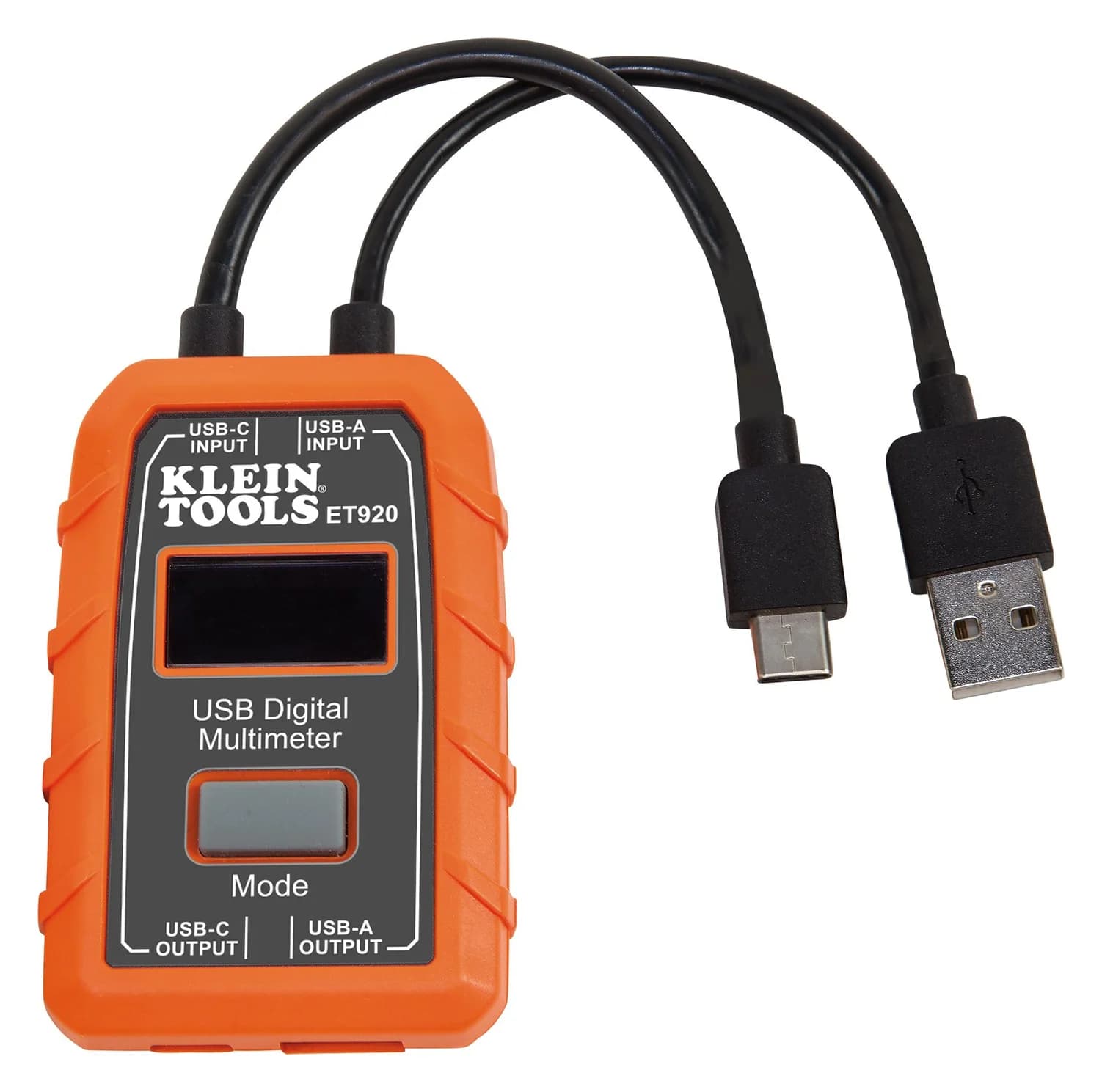
1 / 5 · hero · hover to zoom
Photo: Klein Tools
Key facts
- Connectors
- USB-A input and output; USB-C input and output (the inputs are on short attached cables, about 4 in / 100 mm)
- Voltage
- 3 to 20 V DC; accuracy ±1% (the manual adds '±2 Bytes')
- Current
- USB-A 0.05 to 3 A; USB-C 0.05 to 5 A; accuracy ±1% (the manual adds '±2 Bytes')
- Lowest displayed current
- 50 mA (below that the display shows zero)
- Charge delivered
- Up to 99,999 mAh
- Energy delivered
- Up to 999 Wh
- Resistance (calculated)
- Up to 400 Ω
Which version should you buy?
This page covers: ET920 USB-A and USB-C meter only.
ET920 USB-A and USB-C meter
This pageModel: ET920
- What differs
- Measures USB-A or USB-C power, using one connector side at a time.
- Best for
- Checking both USB-A and USB-C chargers and devices.
ET900 USB-A-only meter
Model: ET900
- What differs
- USB-A only, with no USB-C connections. Klein has discontinued this model.
- Best for
- USB-A checks when specifically seeking the older model.
Watch out
- ET900 is USB-A only; choose ET920 for USB-C as well.
- ET920 uses matching input and output types; it is not a USB-C-to-USB-A adapter.
- A listing with an ET310, RT310 or outlet tester is a bundle, not the meter alone.
Why people pick it
- Reads both USB-A and USB-C ports, up to 5 A on USB-C, per Klein's spec
- Counts charge (mAh) and energy (Wh) for up to 999 hours, enough to log a full power-bank discharge
- Rated for a 2 m drop and powered by the port, so there's no battery to replace
- Klein publishes its accuracy: ±1% for voltage and current
Know before you buy
- Tops out at 20 V: no USB PD EPR (28 V and up), and Klein warns that more than 24 V DC damages it
- Doesn't show currents below 50 mA, so standby and trickle draw read as zero
- Klein's specs list no USB PD profile, PPS or e-marker readout
- Only one side (USB-A or USB-C) works at a time
Full specifications
| Connectors | USB-A input and output; USB-C input and output (the inputs are on short attached cables, about 4 in / 100 mm) |
|---|---|
| Voltage | 3 to 20 V DC; accuracy ±1% (the manual adds '±2 Bytes') |
| Current | USB-A 0.05 to 3 A; USB-C 0.05 to 5 A; accuracy ±1% (the manual adds '±2 Bytes') |
| Lowest displayed current | 50 mA (below that the display shows zero) |
| Charge delivered | Up to 99,999 mAh |
| Energy delivered | Up to 999 Wh |
| Resistance (calculated) | Up to 400 Ω |
| Elapsed time | Up to 999 h 59 min 59 s |
| Memory | 10 stored readings |
| Overload | Klein warns that more than 24 V DC damages the meter |
| How it connects | USB-A in to USB-A out, or USB-C in to USB-C out; the two sides can't be used at the same time, and it isn't a USB-C to USB-A adapter |
| Quick Charge | Works with Qualcomm Quick Charge ports (Klein) |
| Power | Draws power from the port under test; no batteries |
| Drop protection | 2 m (6.6 ft) |
| Ingress protection | IP20 |
| Safety standards | Conforms to UL 61010-1 and 61010-2-030; certified to CSA C22.2 No. 61010-1 and 61010-2-030 |
| Size | 75 × 50 × 15 mm (2.95 × 1.96 × 0.6 in) |
| Weight | 1.7 oz |
From manufacturer documentation, checked November 2, 2026. Spotted an error? Tell us.