Skip to content

Fluke

Fluke 1AC II VoltAlert Non-Contact Voltage Tester

A pen-style non-contact AC voltage detector that senses 90 to 1000 V AC, glows red and beeps near live conductors, runs a continuous self-test and is rated CAT IV 1000V.

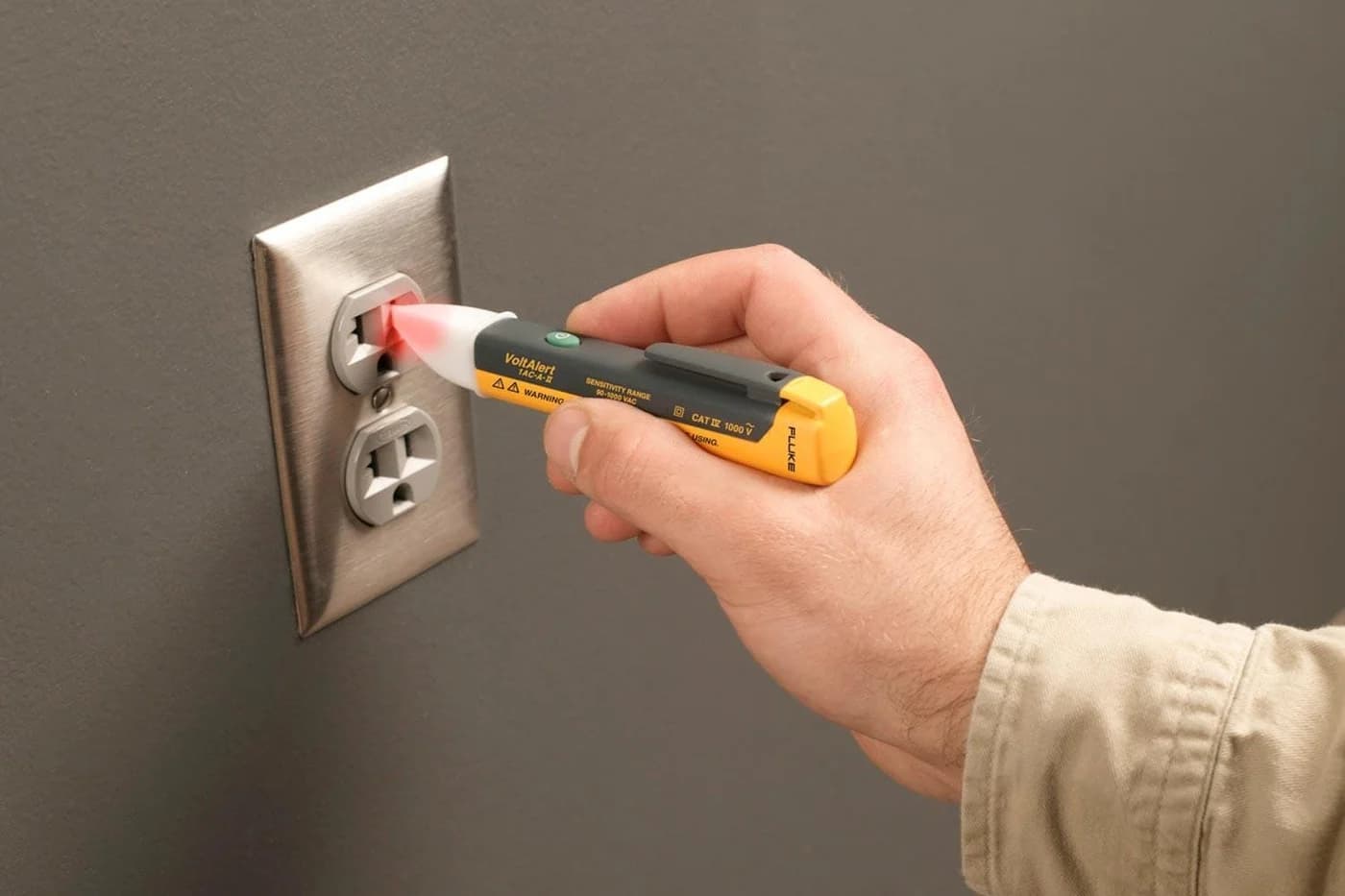
Fluke 1AC II VoltAlert non-contact voltage tester glowing red at a wall receptacle
1 / 1 · lifestyle · hover to zoom

Photo: Fluke

Key facts

Detection range
Nominally 90 to 1000 V AC
How it senses
The steady electrostatic field of AC voltage, through insulation, without touching the conductor
Indication
Red glow at the tip and a beeper that can be switched off
Self-test
Continuous self-test: the VoltBeat indicator flashes while the tester is working
Known-live check (instruction sheet)
Test on a known live source within its range before and after use
Fluke's limit (instruction sheet)
A single-pole non-contact detector can't confirm a circuit is safe; Fluke says to use a voltmeter or two-pole detector to confirm there's no hazardous voltage
Safety rating
CAT IV 1000V (IEC 61010-1, pollution degree 2; IEC 61010-2-030)

Which version should you buy?

This page covers: Single Fluke 1AC-A1-II, nominal 90–1000 V AC range.

  • 1AC II single tester, 90–1000 V AC

    This page

    Model: 1AC-A1-II (part 2432932)

    What differs
    Single flat-tip tester with the A1/A2 nominal 90–1000 V AC detection range.
    Best for
    Mains-voltage presence checks needing the lower detection threshold.
  • 1AC II five-pack

    Model: FLK-1AC-A1-II-5PK (part 2433042)

    What differs
    Five of the A1-II testers instead of a single unit.
    Best for
    Teams needing several testers.
  • 1AC II European range, 200–1000 V AC

    Model: 1AC II E1/E2

    What differs
    Regional version with a higher 200 V AC detection threshold.
    Best for
    Buyers specifically needing the European E1/E2 detection range.
  • 1LAC II low-voltage tester

    Model: 1LAC-A-II (part 2433021)

    What differs
    Separate low-voltage model detecting 20 V to 90 V AC.
    Best for
    Low-voltage AC control-circuit checks.

Watch out

  • The five-pack contains five testers; check for 5PK in the model number.
  • A1/A2 and E1/E2 have different starting thresholds; a 200 V version is unsuitable for detecting lower-voltage mains.
  • 1LAC II is for 20–90 V AC controls; it is not the regular 1AC II.
  • A shared 1AC II title does not establish the range or pack size.

Why people pick it

  • Continuous self-test shows the tester is working before you rely on it
  • CAT IV 1000V rating
  • Glows and beeps, with a silent mode
  • Battery life of more than a year, per Fluke

Know before you buy

  • Its 90 V AC threshold won't flag low-voltage wiring
  • Fluke itself says a single-pole non-contact detector can't confirm a circuit is dead
  • AC only, and shielding, insulation, distance, an isolated user or a recessed socket can stop it detecting (Fluke)
  • Detects voltage only; it can't measure it

Full specifications

Detection rangeNominally 90 to 1000 V AC
How it sensesThe steady electrostatic field of AC voltage, through insulation, without touching the conductor
IndicationRed glow at the tip and a beeper that can be switched off
Self-testContinuous self-test: the VoltBeat indicator flashes while the tester is working
Known-live check (instruction sheet)Test on a known live source within its range before and after use
Fluke's limit (instruction sheet)A single-pole non-contact detector can't confirm a circuit is safe; Fluke says to use a voltmeter or two-pole detector to confirm there's no hazardous voltage
Safety ratingCAT IV 1000V (IEC 61010-1, pollution degree 2; IEC 61010-2-030)
Ingress protectionIP40
Operating temperature-10 to 50°C
Operating altitude3000 m
Battery2 × AAA (included); typical battery life of more than a year
WarrantyTwo years

From manufacturer documentation, checked November 2, 2026. Spotted an error? Tell us.

Featured in

Alternatives to consider