Best picks
Best Non-Contact Voltage Testers (and Why Silence Doesn't Prove a Wire Is Dead)
Non-contact voltage testers picked by job: Klein's dual-range NCVT3P, the one-button NCVT1P and the self-testing Fluke 1AC II, plus what no pen can detect.
By thisMETER EditorialUpdated November 2, 202611 min read3 picks
Our picks at a glance
- See on Amazon1
Best for most homes
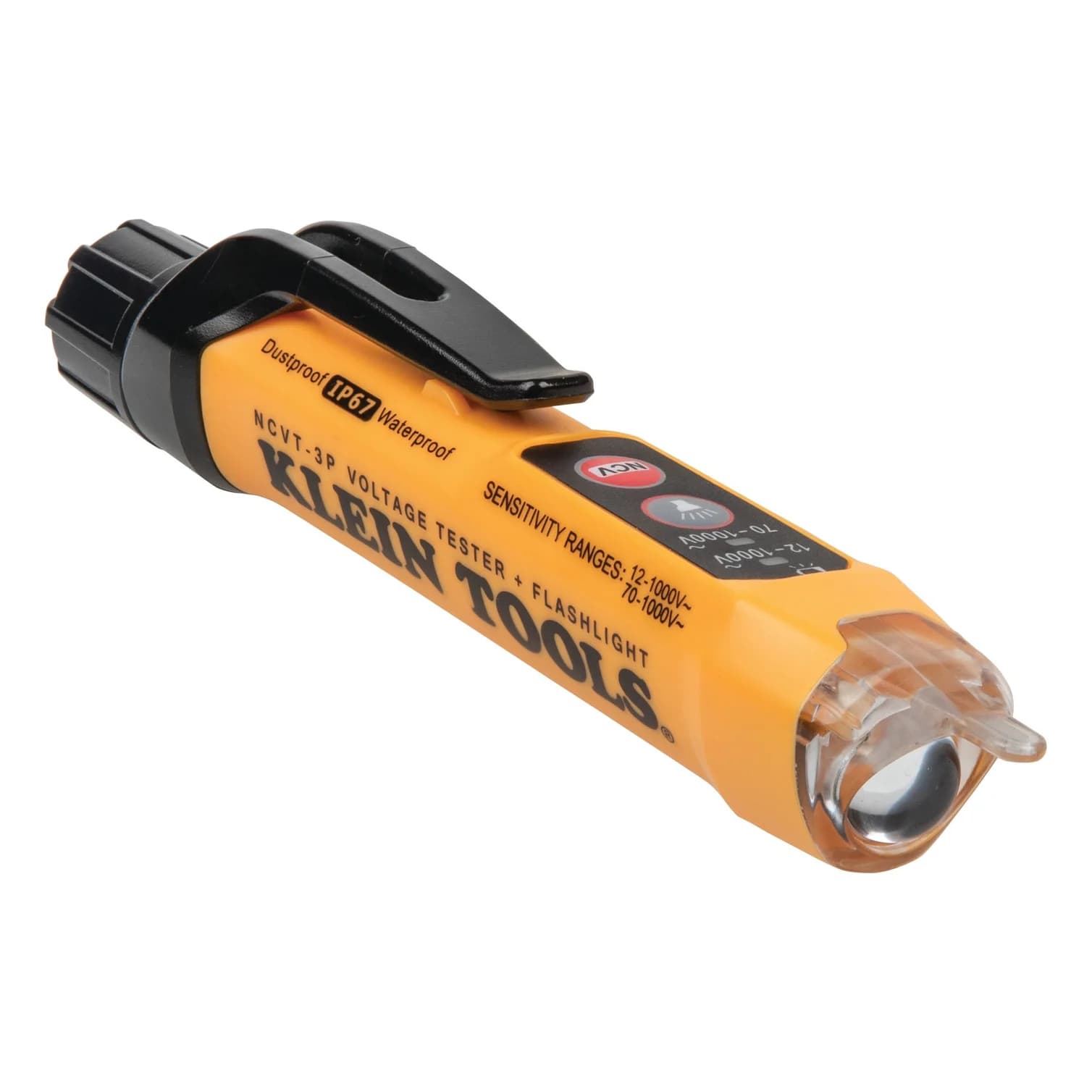
Klein Tools NCVT3P Dual-Range Non-Contact Voltage Tester with Flashlight (12-1000V AC)1000V max · CAT IV 1000V
- See on Amazon2
The simplest pen
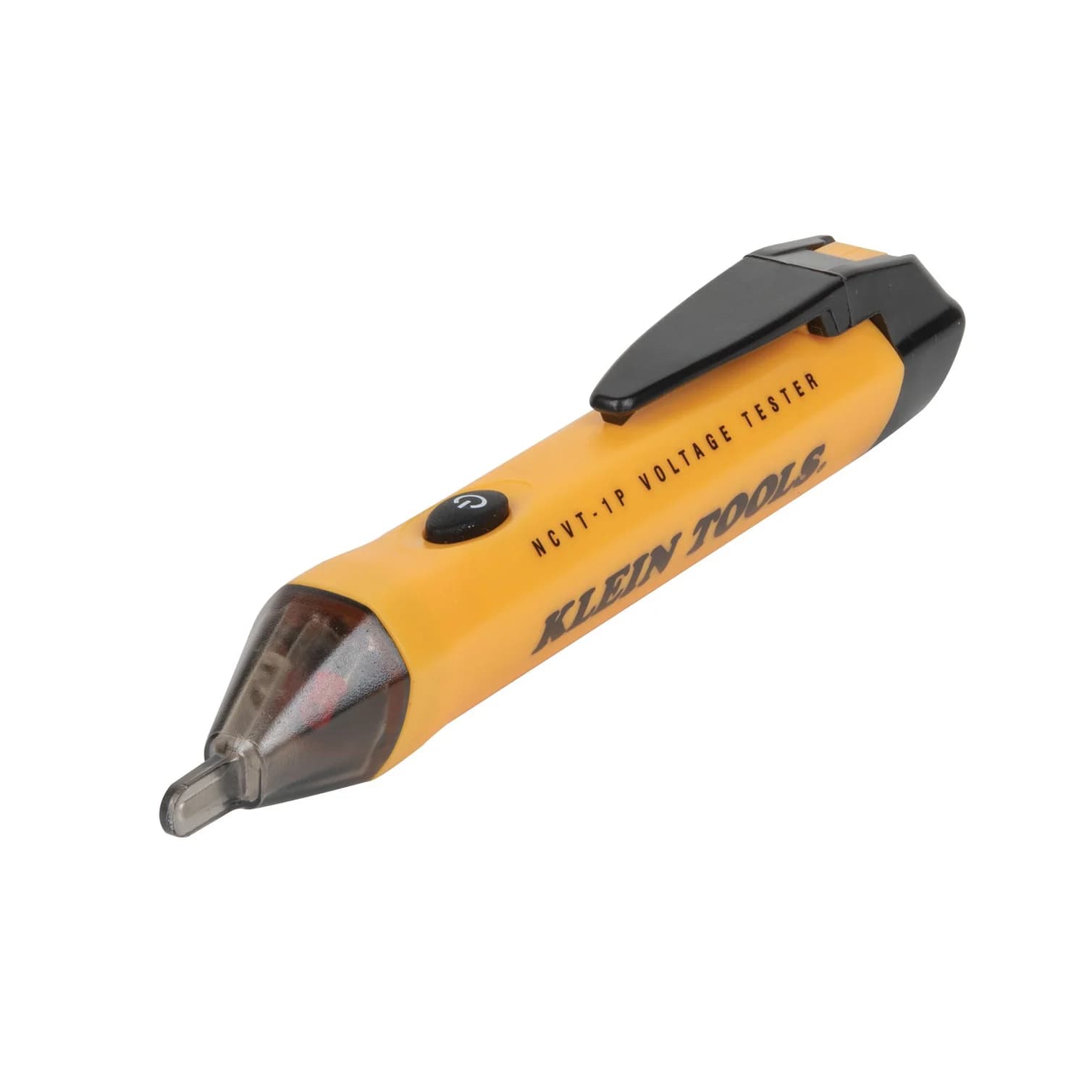
Klein Tools NCVT1P Non-Contact Voltage Tester Pen (50-1000V AC)1000V max · CAT IV 1000V
- See on Amazon3
For most homes, the Klein Tools NCVT3P is the non-contact voltage tester to buy: it has two sensitivity modes (a low-voltage mode for doorbells and thermostats, and a standard mode for line voltage), a built-in flashlight and a CAT IV 1000V rating. For the simplest one-button pen, get Klein's NCVT1P; if you want a pen that shows it's still working between checks, the Fluke 1AC II runs a continuous self-test. Specs and instructions checked on each maker's site, November 1, 2026.
All three detect AC only, and the makers agree on the part that matters most: silence doesn't prove a wire is dead. Klein's instructions say "If no indication, voltage could still be present." Fluke's say a single-pole non-contact detector "is NOT suitable to determine if a circuit is hazardous." Read what they can't detect before you rely on one.
Quick picks
| Pick | Best for | Detects (AC) | Shows it's on | Rating |
|---|---|---|---|---|
| Klein NCVT3P | Most homes, including low-voltage wiring | 12 to 1000 V (low-voltage mode), 70 to 1000 V (standard mode) | Green light when no voltage is sensed | CAT IV 1000V, IP67 |
| Klein NCVT1P | The simplest one-button pen | 50 to 1000 V | Green LED while powered on | CAT IV 1000V |
| Fluke 1AC II | A self-test you can see | 90 to 1000 V (nominal) | Tip blinks red while working | CAT IV 1000V, IP40 |
Source: Klein's NCVT3P and NCVT1P pages; Fluke's 1AC II specifications
What a non-contact tester can and can't tell you
A non-contact pen senses the field around an AC conductor through its insulation, so the tip never touches metal. That's what makes it quick to wave at a cord or a switch. It's also why it misses things: Klein lists a field that is "blocked, dampened, or otherwise interfered with" among the reasons a pen may not detect. Fluke's instruction sheet puts it plainly: "If the field strength is low, the Tester may not provide indication of live voltages."
- Yes: AC voltage in cords, outlets, switches, breakers, light fixtures and wires, through the insulation
- Yes: With the NCVT3P's low-voltage mode, AC in doorbells, thermostats, low-voltage lighting and irrigation systems
- No: DC voltage, such as car batteries, solar panels and battery banks
- No: Voltage inside shielded wire or cable
- No: Any voltage, if the user is isolated from an effective earth ground (Klein lists this as a "will not detect" case)
- Partly: Wire in grounded metal conduit, partly buried wire, a tip held too far away, or a gloved hand: it may not detect
- Partly: Recessed sockets and some standard or tamper-resistant outlets: it may not detect
Two more warnings come straight from Klein's instructions. First, "Never assume neutral or ground wires are de-energized. Neutrals in multi-wire branch circuits may be energized when disconnected." Second, the LEDs are harder to see in bright light, so listen for the beep outdoors.
The makers' rule: check it on a live circuit, before and after
Klein says to verify operation "before and after each use" on a known working circuit within the tester's rating. Fluke says the same: test "on a known live source within the rated ac voltage range of the product, both before and after use." The second check is the one people skip, and it's the one that tells you a "no voltage" result wasn't a dead battery.
Tap a label to explore. You can also hover or use your keyboard.
Check known live sourceBefore use: within specified AC range
Test on a known live source within the pen's specified AC range. The Fluke instructions describe a steady tip glow and a continual beep if the beeper is enabled.
Sources: 1: Fluke instructs users to test on a known live source within the specified AC voltage range both before and after use., 2: The Fluke pen indicates AC voltage with a steady tip glow and, if enabled, a continual beep.Check the targetAn AC-field indication check
The pen responds to AC electric fields of sufficient strength. A weak field may produce no live-voltage indication.
Sources: 3: Fluke says the tester responds to AC electric fields of sufficient strength; weak fields may produce no live-voltage indication.Voltage may remainNo indication does not prove power is off
If the tip does not glow, voltage could still be present. Continue with the known-live check after use.
Sources: 1: Fluke instructs users to test on a known live source within the specified AC voltage range both before and after use., 4: Fluke warns that voltage can still be present when its pen tip does not glow.Check known live sourceAfter use: verify the response again
Return to the known live source within the specified AC range after use. Verify that the pen still gives its live-voltage indication.
Sources: 1: Fluke instructs users to test on a known live source within the specified AC voltage range both before and after use., 2: The Fluke pen indicates AC voltage with a steady tip glow and, if enabled, a continual beep.Stop using faulty penA failed live check means stop
Do not use the pen if it appears damaged or is not operating properly.
Outcome
Sources: 5: Fluke says not to use a tester that appears damaged or is not operating properly.Confirm absence before workUse a voltmeter or two-pole detector
A single-pole non-contact pen cannot determine whether a circuit is hazardous. A voltmeter or two-pole voltage detector is necessary to confirm the absence of hazardous voltage before work.
Outcome
Sources: 6: Fluke says a single-pole non-contact tester cannot determine whether a circuit is hazardous; a voltmeter or two-pole detector is necessary to confirm absence of hazardous voltage before work.The before-and-after pen checks verify the pen. They do not confirm the absence of hazardous voltage.
Source notes6 references
Fluke instructs users to test on a known live source within the specified AC voltage range both before and after use.
media.fluke.com — source for Fluke instructs users to test on a known live source within the specified AC voltage range both before and after use.Test on a known live source within the rated ac voltage range of the product, both before and after use to ensure unit is in good working condition.
The Fluke pen indicates AC voltage with a steady tip glow and, if enabled, a continual beep.
media.fluke.com — source for The Fluke pen indicates AC voltage with a steady tip glow and, if enabled, a continual beep.Placing the tip of the unit near an ac voltage produces a steady glow at the tip and, if enabled, a continual beep.
Fluke says the tester responds to AC electric fields of sufficient strength; weak fields may produce no live-voltage indication.
media.fluke.com — source for Fluke says the tester responds to AC electric fields of sufficient strength; weak fields may produce no live-voltage indication.The Tester indicates active voltage in the presence of AC electric fields of sufficient strength emanating from the conductor. If the field strength is low, the Tester may not provide indication of live voltages.
Fluke warns that voltage can still be present when its pen tip does not glow.
media.fluke.com — source for Fluke warns that voltage can still be present when its pen tip does not glow.When using the Tester, if tip does not glow, voltage could still be present.
Fluke says not to use a tester that appears damaged or is not operating properly.
media.fluke.com — source for Fluke says not to use a tester that appears damaged or is not operating properly.Do not use if the Tester appears damaged or if the Tester is not operating properly.
Fluke says a single-pole non-contact tester cannot determine whether a circuit is hazardous; a voltmeter or two-pole detector is necessary to confirm absence of hazardous voltage before work.
media.fluke.com — source for Fluke says a single-pole non-contact tester cannot determine whether a circuit is hazardous; a voltmeter or two-pole detector is necessary to confirm absence of hazardous voltage before work.A single pole non-contact voltage detector such as this Tester is NOT suitable to determine if a circuit is hazardous. A volt meter or 2-pole voltage detector is necessary to confirm the absence of hazardous voltage prior to commencing work
Confirm the pen is on
Klein says not to use its pens unless a power-on light is lit. On the Fluke 1AC II, the tip blinks while the self-test runs.
Test a known live source
Use a circuit you know is energized and within the pen's range. It should light and beep.
Test the conductor you care about
Hold the tip close: Klein specifies its detection thresholds with the tip within 0.25 in (6 mm) of the source.
Test the known live source again
If the pen doesn't respond now, the earlier "nothing" result tells you nothing.
Confirm before anyone touches the wire
Fluke says a voltmeter or two-pole voltage detector is necessary to confirm the absence of hazardous voltage. If that isn't your trade, call a licensed electrician.
Best for most homes: Klein Tools NCVT3P
The NCVT3P covers more jobs than any other pen here because it has two modes: the low-voltage mode detects from 12 V AC and the standard mode from 70 V AC, both up to 1000 V AC. Klein's NCVT3P page pitches the low mode at the 12 to 70 V AC band and lists doorbells, thermostats, low-voltage lighting and irrigation systems alongside cords, breakers, switches and outlets. A pen with a single 50 V or 90 V threshold won't flag that low-voltage wiring.
Klein Tools
Klein Tools NCVT3P Dual-Range Non-Contact Voltage Tester with Flashlight (12-1000V AC)
A pen-style non-contact AC voltage detector with two sensitivity modes (12 to 1000 V AC and 70 to 1000 V AC), a built-in flashlight and a CAT IV 1000V rating.
Comes in 4 versions: see which to buy
- 1000V max
- CAT IV 1000V
- Detection: Mode 1 above 70 V AC, Mode 2 above 12 V AC, under the "normal" conditions Klein's instruction sheet defines
- Flashlight that works without the voltage function
- CAT IV 1000V, IP67 dustproof and waterproof, 2 m (6.6 ft) drop protection
- Two AAA batteries and auto power-off
The trade-off is a wording trap. Klein's product page says the green light "indicates no voltage," while its instruction sheet says voltage could still be present with no indication and warns the pen may not be compatible with some standard or tamper-resistant outlets. Read the green light as "on, nothing detected," never as "safe to touch." Klein also sells kits that pair a dual-range pen with a receptacle tester, which is worth it if you also check outlets (see our outlet and GFCI tester guide).
The simplest pen: Klein Tools NCVT1P
The NCVT1P does one thing: a green LED shows it's powered on, and a red LED and a tone come on when it senses voltage, across a single 50 to 1000 V AC range, per Klein's NCVT1P page. There are no modes to forget, which suits occasional use.
Klein Tools
Klein Tools NCVT1P Non-Contact Voltage Tester Pen (50-1000V AC)
A basic pen-style non-contact AC voltage detector with a 50 to 1000 V AC range, a red LED and tone alert, and a CAT IV 1000V rating.
Comes in 4 versions: see which to buy
- 1000V max
- CAT IV 1000V
- CAT IV 1000V, 2 m (6.6 ft) drop protection
- Two AAA batteries included, auto power-off
The trade-offs: Klein doesn't recommend it for tamper-resistant outlets and points you to the NCVT-2P or NCVT-3P in low-voltage mode instead. There's no flashlight. And check the model number when you buy: the 2021 CPSC recall covers Klein's NCVT1 (no "P") and kits containing it, with date codes ending H7; the NCVT1P isn't on the recall list.
Best self-checking pen: Fluke 1AC II VoltAlert
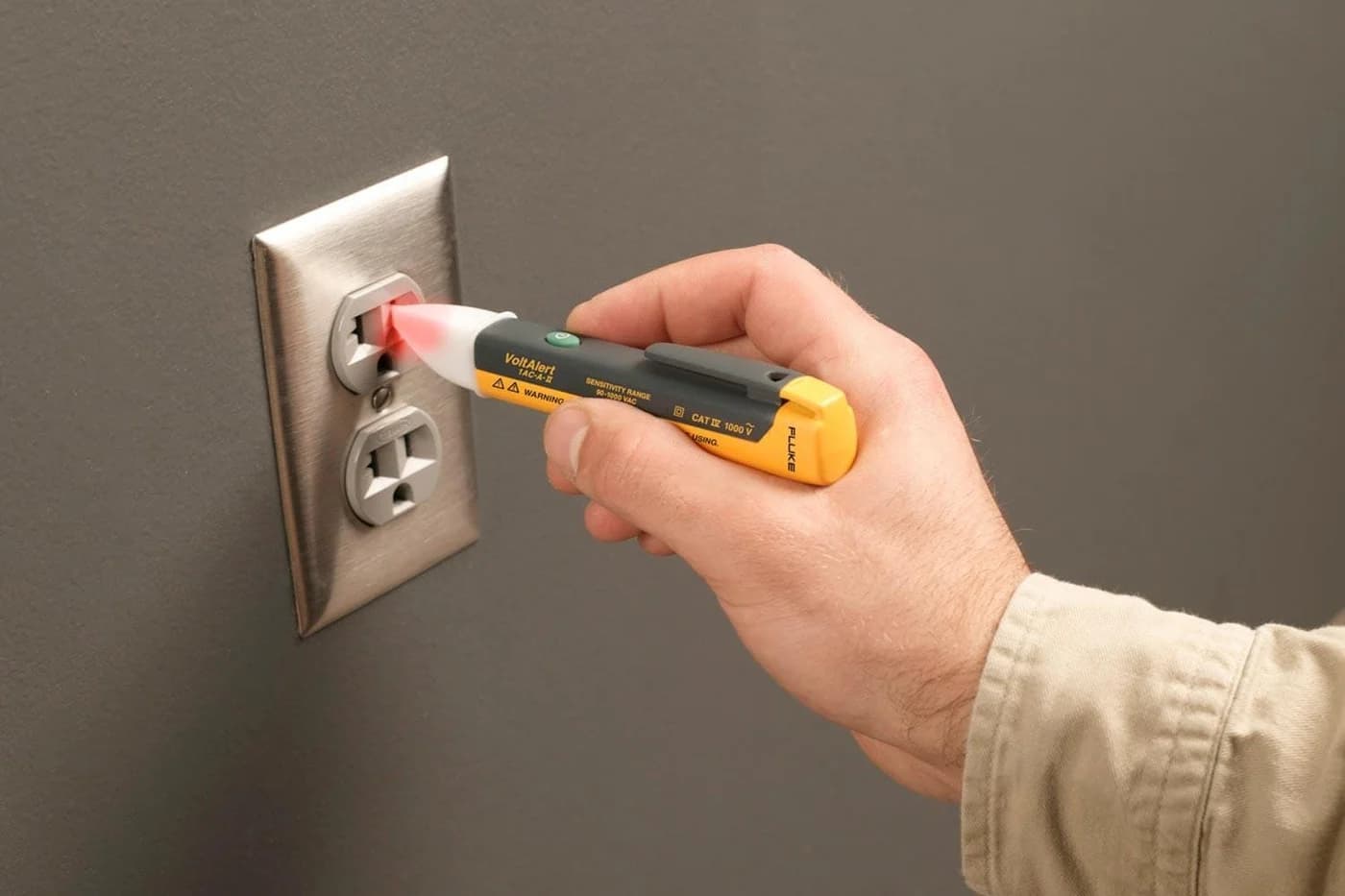
The 1AC II answers the question every quiet pen raises: is it actually on? Fluke's 1AC II page describes a continuous self-test ("When the tip blinks red you know it's working properly"), and its instruction sheet calls it VoltBeat, a check of battery and system integrity.
Fluke
Fluke 1AC II VoltAlert Non-Contact Voltage Tester
A pen-style non-contact AC voltage detector that senses 90 to 1000 V AC, glows red and beeps near live conductors, runs a continuous self-test and is rated CAT IV 1000V.
Comes in 4 versions: see which to buy
- 1000V max
- CAT IV 1000V
- Detects nominally 90 to 1000 V AC; the tip glows red and a beeper sounds, and the beeper can be switched off for quiet rooms
- CAT IV 1000V and IP40
- Typical battery life of more than a year on two AAA batteries; two-year warranty
The trade-offs: its 90 V threshold sits above the 12 to 70 V band the NCVT3P's low-voltage mode covers, so it won't flag doorbell or thermostat wiring. Fluke is also the bluntest maker about the limits of its own product: the instruction sheet says a single-pole non-contact detector "is NOT suitable to determine if a circuit is hazardous" and that "a volt meter or 2-pole voltage detector is necessary to confirm the absence of hazardous voltage prior to commencing work." Check the model too: Fluke lists the 1LAC II, a low-voltage detector for 20 to 90 V, and a 5-pack of the 1AC II as separate products. The single pen is model Fluke-1AC-A1-II.
Already own a multimeter or clamp meter?
You may already carry a non-contact detector. The Fluke 117 multimeter has VoltAlert built in, and the Klein CL390 and CL710 clamp meters have one in the jaw. The same rules apply: the 117's manual says not to rely on VoltAlert with shielded wire, and Klein's clamp manuals repeat "If no indication, voltage could still be present." The advantage of a meter is the next step: once the pen says "maybe," a meter can measure. See our multimeter picks and clamp meter picks.
How we choose
We haven't lab-tested these pens. Every pick comes from research:
- Maker documents. Detection ranges, ratings, battery and warranty figures come from Klein's and Fluke's product pages and instruction sheets, read November 1, 2026.
- Standards. CAT ratings exactly as the makers mark them (IEC 61010), read with Fluke's measurement-category definitions.
- Limits. Each pick's "won't detect" list, quoted from its instructions, carries as much weight as its features.
- Safety record. The CPSC recall database, checked for every model.
Our full method is on How we choose, and what CAT ratings mean is on How we measure.
Buying guide
Low-voltage mode or not? If you work on doorbells, thermostats, landscape lighting or irrigation controls, you want a pen that reaches down to 12 V AC, which here means the NCVT3P. For line-voltage checks only, the NCVT1P's 50 V threshold or the 1AC II's 90 V threshold is enough.
CAT IV 1000V on all three. Measurement categories describe where on an electrical system a tool is built to cope with voltage spikes. Fluke's definitions put CAT II at receptacle-connected loads and CAT IV at the utility connection, electricity meters and service entrance. All three pens are rated CAT IV 1000V, the highest combination here, so the rating won't separate them.
Kit or pen? A pen tells you whether AC is present. It can't tell you whether an outlet is wired correctly or whether a GFCI trips. If you need both answers, look at Klein's kits that pair a dual-range pen with a receptacle tester, or buy a tester separately from our outlet tester guide.
Shopping for someone who does this for a living? Our gifts for electricians guide covers what to add to a kit that already has a pen.
Verdict
Get the Klein Tools NCVT3P: its two modes cover low-voltage and line-voltage wiring, and the flashlight, IP67 body and CAT IV 1000V rating suit real jobs. The Klein NCVT1P is the one-button alternative for occasional checks, and the Fluke 1AC II is the pen to pick if you want visible proof it's working. Whichever you buy, test it on a known live circuit before and after every use, and treat silence as "not detected," never as "dead."
Frequently asked questions
Can a non-contact voltage tester detect DC voltage?
No. Klein's instructions for the NCVT3P and NCVT1P say the tester will not detect voltage if the voltage is DC, and Fluke rates the 1AC II for AC voltage only (90 to 1000 V AC). Car batteries, solar panels and battery banks are DC, so check them with a multimeter's DC volts setting, or with an AC/DC clamp meter if you need the current.
How do I know my non-contact voltage tester is working?
Test it on a known live circuit within its range before and after each use: Klein and Fluke both say so in their instructions. Check that it is on, too. Klein says not to use its pens unless a power-on light is lit, and Fluke's 1AC II blinks its tip while its self-test runs. A switched-off pen or a flat battery stays silent, just like a dead wire.
Why didn't my voltage tester beep on a live wire?
Both makers list the usual causes: shielded cable, wire inside grounded metal conduit, the tip too far from the conductor, gloves, a user who is insulated from ground, and recessed or tamper-resistant outlets. That is why Klein warns that voltage could still be present with no indication, and why Fluke says a single-pole non-contact detector can't determine whether a circuit is hazardous.
Best for most homes
Klein Tools NCVT3P Dual-Range Non-Contact Voltage Tester with Flashlight (12-1000V AC)