

Best picks
Best Clamp Meters: AC-Only vs AC/DC, and When You Need True RMS
Clamp meters picked by job: Klein's AC/DC CL710 and CL390 and Fluke's AC-only 323. Why DC current needs an AC/DC clamp, and why you clamp one wire, not a cord.
By thisMETER EditorialUpdated November 2, 202610 min read3 picks
Our picks at a glance
- See on Amazon1
Best overall
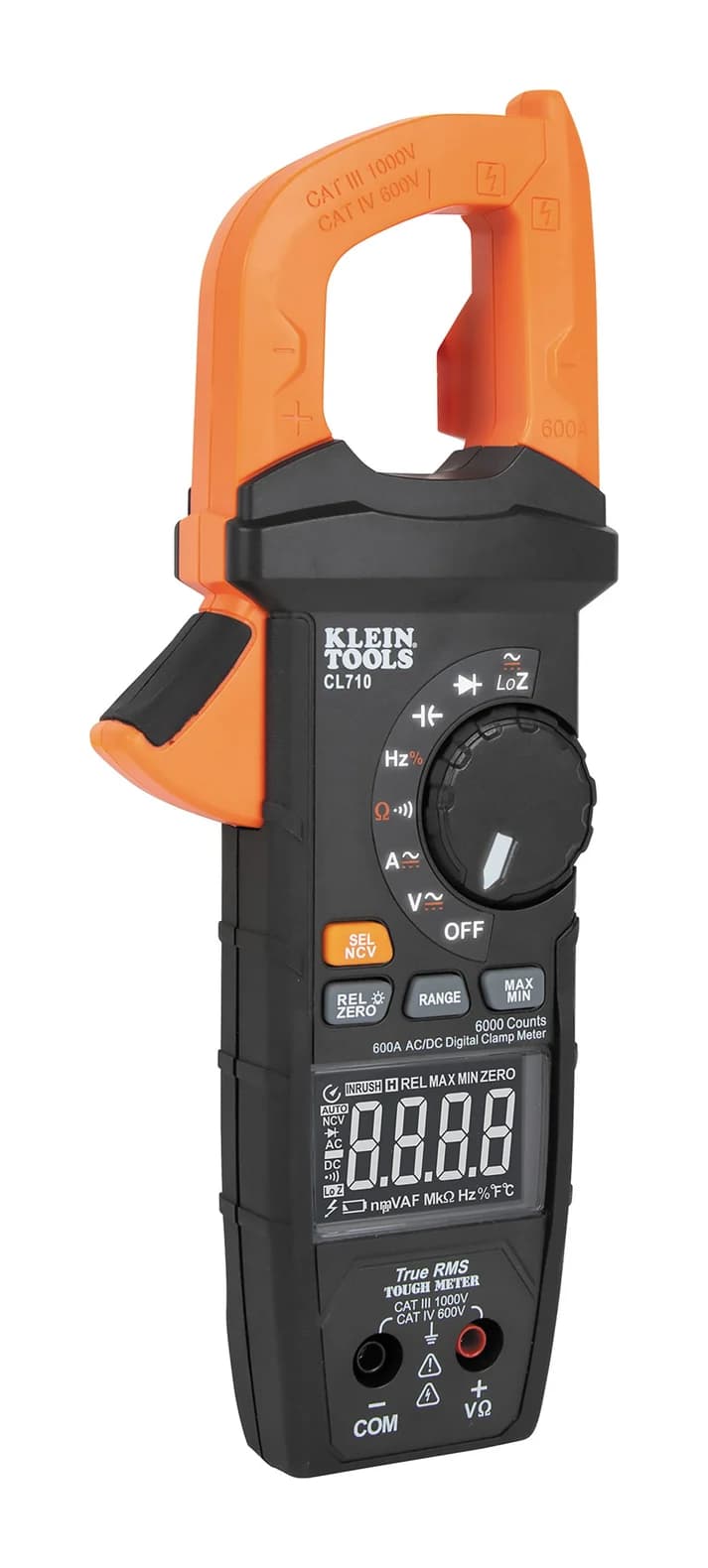
Klein Tools CL710 600A AC/DC Auto-Ranging True RMS Clamp Meter1000V max · 600A max · 6000 counts · CAT IV 600V, CAT III 1000V
- See on Amazon2
Best for HVAC
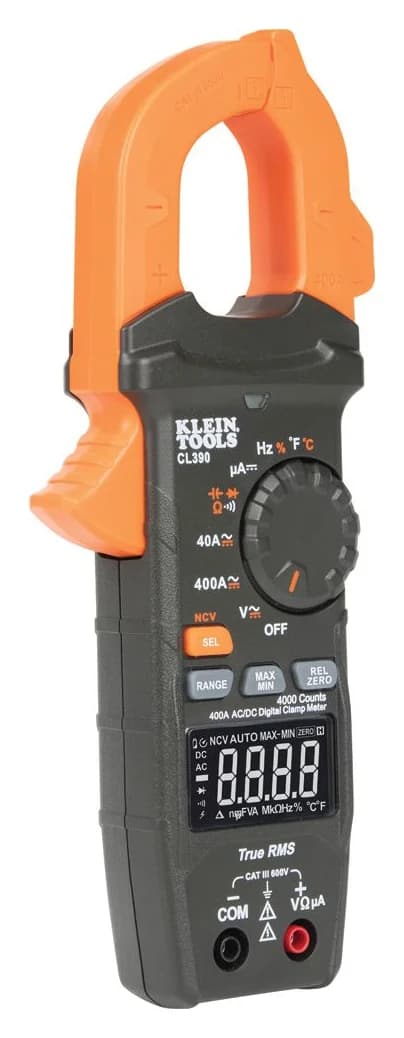
Klein Tools CL390 400A AC/DC Auto-Ranging True RMS Clamp Meter600V max · 400A max · 4000 counts · CAT III 600V
- See on Amazon3
For most people who need a clamp meter, the Klein Tools CL710 is the one to get: it reads AC and DC current to 600 A, adds a low-impedance mode for ghost voltages and non-contact detection in the jaw, and is rated CAT IV 600V / CAT III 1000V. For HVAC work, Klein's CL390 adds a DC microamp range and a thermocouple, and if you only ever measure AC, the Fluke 323 is the simple True RMS choice. Specs, accuracy tables and ratings checked on Klein's and Fluke's sites, November 1, 2026.
The first decision is AC-only or AC/DC. Get it wrong and the meter can't read a car, a solar array or a battery bank at all.
Quick picks
| Pick | Best for | Current (jaw) | Extras | Safety rating (as marked) |
|---|---|---|---|---|
| Klein CL710 | Most people; cars, solar, panels | AC and DC to 600 A | LoZ mode, non-contact voltage, IP40 | CAT IV 600V, CAT III 1000V |
| Klein CL390 | HVAC, small DC currents | AC and DC to 400 A | DC microamps, temperature, non-contact voltage | CAT III 600V |
| Fluke 323 | AC-only jobs | AC to 400 A | Slim body for tight panels | CAT III 600V, CAT IV 300V |
- Yes: Klein CL710: AC and DC current to 600 A
- Yes: Klein CL390: AC and DC current to 400 A (smallest measurable: 0.3 A), plus DC microamps through the test leads
- Partly: Fluke 323: AC current to 400 A only
- No: Fluke 323: no DC current, so no car, solar or battery current
AC-only or AC/DC: why it matters
A clamp meter measures the magnetic field around a conductor, so it can read current without disconnecting or de-energizing the circuit. How it senses that field decides what it can read. Fluke's clamp meter explainer puts it simply: current-transformer clamp meters "Measure only alternating current (AC)," and Hall-effect clamp meters "Measure both alternating current and direct current (AC and DC)."
DC current is everywhere outside the house wiring: car batteries and starters, solar panels and charge controllers, battery banks and inverters. For any of those, you need an AC/DC clamp like the CL710 or CL390. The Fluke 323 is AC-only; Fluke's own manual notes that the 325 in the same family adds DC current.
Zero it first. An AC/DC clamp needs zeroing before a DC reading. Fluke's instructions say zeroing "removes dc offset from the reading," and to do it with the jaws closed and no conductor inside. Klein's CL390 and CL710 have a REL/ZERO button for the same job.
Tap a label to explore. You can also hover or use your keyboard.
Scroll across to see every column
| Option | Connection | Meaning |
|---|---|---|
Current-transformer jawAC current onlyThis jaw technology measures AC current without cutting the circuit. For load current, clamp around one conductor. Sources: 1: A clamp meter can measure current without cutting the circuit., 2: Current-transformer clamp meters measure AC current only., 4: For load current, the clamp belongs around one conductor; enclosing line and neutral together cancels the reading. | Jaw around one conductor | AC current only |
Hall-effect jawAC and DC currentThis jaw technology measures AC and DC current without cutting the circuit. For load current, clamp around one conductor. Sources: 1: A clamp meter can measure current without cutting the circuit., 3: Hall-effect clamp meters measure AC and DC current., 4: For load current, the clamp belongs around one conductor; enclosing line and neutral together cancels the reading. | Jaw around one conductor | AC and DC current |
Entire line cordCancelled load-current readingClamping line and neutral together cancels the load-current reading. A cancelled reading does not mean that no current is flowing. Sources: 4: For load current, the clamp belongs around one conductor; enclosing line and neutral together cancels the reading. | Line and neutral together | Load-current reading cancels |
Current through test leadsPower off before connectingTurn circuit power off before inserting the meter in series. Current passes through the meter when power is restored. Sources: 5: When measuring current directly through a multimeter's test leads, the instrument goes in series with the circuit., 6: HIOKI advises turning circuit power off before connecting a multimeter for current measurement in series. | Meter in series with the circuit | Current through test leads |
Bars start at zero and share a scale within each column.
Conceptual current connections. The jaw types shown describe current sensing.
Source notes6 references
A clamp meter can measure current without cutting the circuit.
www.hioki.com — source for A clamp meter can measure current without cutting the circuit.Since clamp meters can measure current simply by being clamped around a cable, they can also be used to check current values without cutting circuits.
Current-transformer clamp meters measure AC current only.
www.fluke.com — source for Current-transformer clamp meters measure AC current only.Current transformer clamp meters: Measure only alternating current (AC).
Hall-effect clamp meters measure AC and DC current.
www.fluke.com — source for Hall-effect clamp meters measure AC and DC current.Hall Effect clamp meters: Measure both alternating current and direct current (AC and DC).
For load current, the clamp belongs around one conductor; enclosing line and neutral together cancels the reading.
www.fluke.com — source for For load current, the clamp belongs around one conductor; enclosing line and neutral together cancels the reading.Place the clamp jaws around only one conductor of the circuit to be tested. Clamping around both the line and neutral conductors (like a line cord) at the same time will cancel the current flow reading.
When measuring current directly through a multimeter's test leads, the instrument goes in series with the circuit.
www.hioki.com — source for When measuring current directly through a multimeter's test leads, the instrument goes in series with the circuit.When connecting the test leads to the circuit, connect the black lead to the power supply’s negative side and the red lead to the load side so that the instrument is in series with the circuit.
HIOKI advises turning circuit power off before connecting a multimeter for current measurement in series.
www.hioki.com — source for HIOKI advises turning circuit power off before connecting a multimeter for current measurement in series.Consequently, it’s good practice to turn off power to the circuit under measurement so that a voltage is not applied inadvertently. Then connect the current in series with the measurement terminals and turn the power back on.
How to clamp correctly
Clamp one conductor
Fluke: clamping around both the line and neutral conductors (like a line cord) at the same time will cancel the current flow reading.
Close the jaw fully
Klein says the clamp must be completely closed with the trigger fully released.
Center the wire
Klein says the wire should pass perpendicularly through the center of the clamp, in line with the arrow markings. Fluke adds 2% to the 323's accuracy for position sensitivity.
Read, then remove
Fluke's 323 manual adds a safety rule worth remembering: "Do not use a current measurement as an indication that a circuit is safe to touch."
Best overall: Klein Tools CL710
The CL710 is the clamp that covers the most jobs. Klein's CL710 manual lists AC and DC current to 600 A through the jaw, and AC/DC voltage to 1000 V, resistance, capacitance, frequency, continuity and diode test through the leads, with True RMS on AC voltage and current.
Klein Tools
Klein Tools CL710 600A AC/DC Auto-Ranging True RMS Clamp Meter
A 6,000-count True RMS clamp meter that measures AC and DC current to 600 A and voltage to 1000 V, with a low-impedance mode and non-contact voltage detection in the jaw.
Comes in 2 versions: see which to buy
- 1000V max
- 600A max
- 6000 counts
- CAT IV 600V, CAT III 1000V
- Low-impedance (LoZ) mode, which Klein describes as "for identifying and eliminating ghost or stray voltages"
- Non-contact voltage detection in the jaw, with alerts that intensify closer to the source
- 6,000-count transflective reverse-contrast display and an illuminated dial
- Current accuracy ±(2.0% + 8) on the 60 A range and ±(2.0% + 5) on 600 A
- CAT IV 600V, CAT III 1000V; IP40; 2 m (6.6 ft) drop protection; three AAA batteries
The trade-offs: its lowest current range is 60 A with 10 mA steps, so very small loads read coarsely, and there's no DC microamp range. Its jaw opens to 1.4 in, smaller than the CL390's. One feature bullet on Klein's CL710 page mentions a thermocouple, but the box list and the manual have no temperature function, so don't buy it for temperature.
Best for HVAC: Klein Tools CL390
The CL390 trades top-end current for the small measurements HVAC work needs. Klein's CL390 page lists AC and DC current to 400 A through the jaw, plus DC microamps, voltage, resistance, capacitance, frequency, duty cycle and temperature through the leads and thermocouple. DC microamps are how flame sensors are checked: Fluke, for example, describes its 116 HVAC meter as having "microamps to test flame sensors."
Klein Tools
Klein Tools CL390 400A AC/DC Auto-Ranging True RMS Clamp Meter
A 4,000-count True RMS clamp meter that measures AC and DC current to 400 A, voltage to 600 V and DC microamps, with non-contact voltage detection in the jaw and a thermocouple for temperature.
Comes in 2 versions: see which to buy
- 600V max
- 400A max
- 4000 counts
- CAT III 600V
- DC microamps on a 200 µA range (0.1 µA resolution, ±(1.0% + 5)), through the test leads
- K-type thermocouple included; the manual limits that probe to below 230 °C (446 °F)
- Non-contact voltage detection in the jaw; 1.6 in (4.1 cm) jaw opening
- Clamp current accuracy ±(2.0% + 9) on its 40 A and 400 A ranges; smallest measurable current 0.3 A
- CAT III 600V; 2 m (6.6 ft) drop protection; carrying case and leads with CAT III/CAT IV caps included
The trade-offs: CAT III 600V means it isn't rated for service-entrance work, the display is 4,000 counts, and Klein lists no low-impedance mode.
Best AC-only clamp: Fluke 323
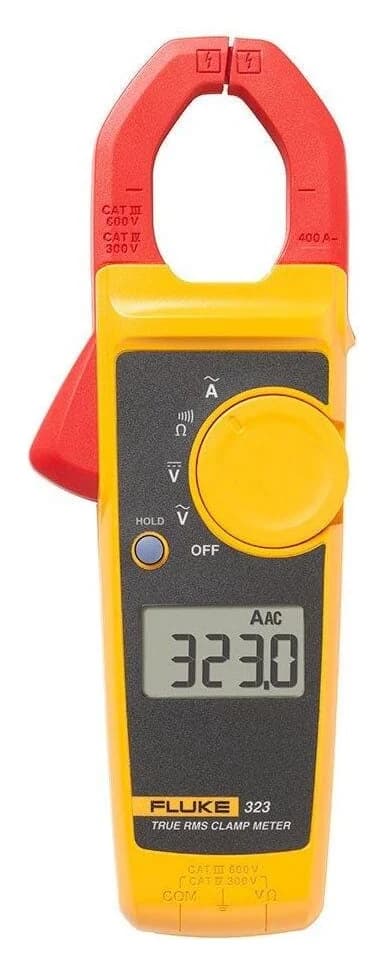
If every job is AC, the 323 keeps it simple. Fluke's 323 page lists True RMS AC current to 400 A, AC and DC voltage to 600 V, resistance and continuity, in a slim body Fluke designed for tight cable compartments.
Fluke
Fluke 323 True RMS Clamp Meter
A basic True RMS clamp meter rated CAT III 600V and CAT IV 300V that measures AC current to 400 A, AC and DC voltage to 600 V, resistance and continuity; it doesn't measure DC current.
Comes in 6 versions: see which to buy
- 600V max
- 400A max
- CAT III 600V, CAT IV 300V
- AC current accuracy 2% ± 5 digits (45 to 65 Hz) and 2.5% ± 5 digits (65 to 400 Hz), plus 2% for position sensitivity
- Takes conductors up to 30 mm (600 MCM)
- CAT III 600V, CAT IV 300V; 265 g; two-year warranty; soft case and test leads included
The trade-offs: no DC current at all, no backlight, and resistance only to 4,000 Ω, with no capacitance, frequency or temperature.
Clamp meter vs multimeter
| Clamp meter (picks here) | Multimeter (our multimeter picks) | |
|---|---|---|
| How it reads current | Through the jaw, without breaking the circuit | In series: the circuit has to be opened |
| Current range | 400 A (CL390, 323) to 600 A (CL710) | 10 A on the meters we cover, with short-term allowances above that |
| Small currents | 0.3 A minimum on the CL390; DC microamps through its leads | Microamps on the Klein MM420 and Fluke 87V MAX |
| Voltage, resistance, continuity | Through test leads | Through test leads, usually with more ranges |
Fluke's clamp explainer sums up the advantage: the hinged jaw lets you measure current "without the need for disconnection or de-energization." For a single appliance on a plug, a plug-in watt meter is easier still, because a cord carries current out and back and can't be clamped whole: see our Kill A Watt and plug-in watt meter guide.
How we choose
We haven't lab-tested these clamps. Every pick comes from research:
- Maker documents. Current ranges, per-range accuracy, jaw size and ratings come from Klein's and Fluke's product pages and manuals, read November 1, 2026.
- Standards. CAT ratings exactly as marked; how AC-only and AC/DC clamps differ, as Fluke explains it.
- Fit to the job. DC current, microamps, low-impedance mode and the smallest readable current count as much as the top range.
- Safety record. The CPSC recall database, checked for every model.
Our full method is on How we choose.
Buying guide
DC first. If you work on cars, solar or batteries, buy AC/DC. That rules out the Fluke 323.
True RMS on all three. Every pick here measures True RMS. Fluke explains that an averaging meter can read up to 40% low or 10% high on distorted waveforms from loads like variable-speed drives and computers, and those are common now.
CAT rating for where you'll clamp. The CL710's CAT IV 600V covers the service entrance; the CL390's CAT III 600V and the 323's CAT III 600V suit panels and branch circuits. The test leads have to match: Fluke's 323 manual says not to exceed the rating of the lowest-rated component of the meter, probes and accessories. Our multimeter guide explains the categories.
Inrush and motors. None of these three lists an inrush-current function. If you diagnose motors and compressors, look for one on the spec sheet.
Non-contact detection is a bonus, not a test. The CL710 and CL390 have it in the jaw, and Klein's manuals carry the same warning as a pen: "If no indication, voltage could still be present." See our non-contact voltage tester guide.
Shopping for a tradesperson? All three appear in our gifts for electricians guide.
Verdict
The Klein Tools CL710 is the best clamp meter for most people: AC and DC current to 600 A, a low-impedance mode, non-contact detection and CAT IV 600V. HVAC technicians should get the Klein CL390 for its DC microamp range and thermocouple. If you only ever measure AC, the Fluke 323 is the simple, slim True RMS option, as long as you never need DC current.
Frequently asked questions
Can a clamp meter measure DC current?
Only if it's an AC/DC model. Fluke explains that current-transformer clamp meters measure only AC, while Hall-effect clamp meters measure both AC and DC. Klein's CL710 and CL390 read DC current through the jaw, which is what car, solar and battery work needs; Fluke's 323 doesn't measure DC current at all (Fluke says the 325 in the same family does).
Why does my clamp meter read zero on an extension cord?
Because the cord carries the current out and back. Fluke's instructions are to place the jaws around only one conductor; clamping around both the line and neutral conductors of a line cord at the same time cancels the reading. For an appliance on a plug, a plug-in watt meter is the easier tool.
Clamp meter or multimeter: which do I need?
For current, a clamp meter: it measures through the jaw without disconnecting or de-energizing the circuit, and the picks here read 400 to 600 A. A multimeter must be connected in line, in series; the multimeters we cover are rated for 10 A (with short-term allowances: 20 A for 30 seconds on the Fluke 117 and 87V MAX, 15 A in 15-second tests on the Innova 3340) but resolve much smaller currents. For voltage, resistance and continuity, both work: the clamps here measure those through test leads.