

Best picks
Best Multimeters in 2026: for Home, Electricians, Electronics and Cars
Multimeters picked by job, from the Klein MM420 to the Fluke 117 and 87V MAX, plus how to read CAT ratings and per-range accuracy, and when True RMS matters.
By thisMETER EditorialUpdated November 2, 202610 min read5 picks
Our picks at a glance
- See on Amazon1
Best for most homes
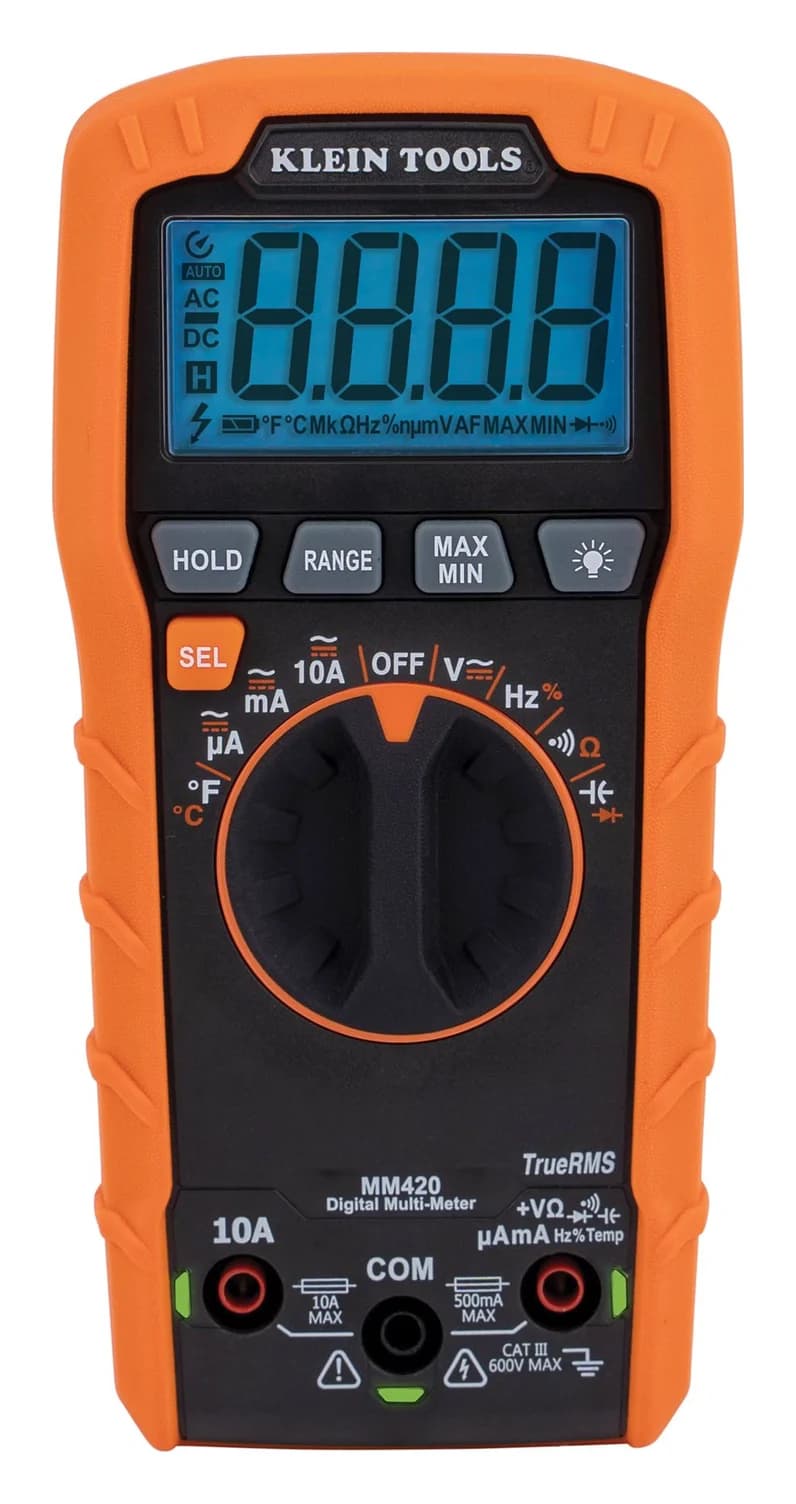
Klein Tools MM420 Auto-Ranging True RMS Digital Multimeter (600V)600V max · 10A max · 4000 counts · CAT III 600V
- See on Amazon2
Best for electricians
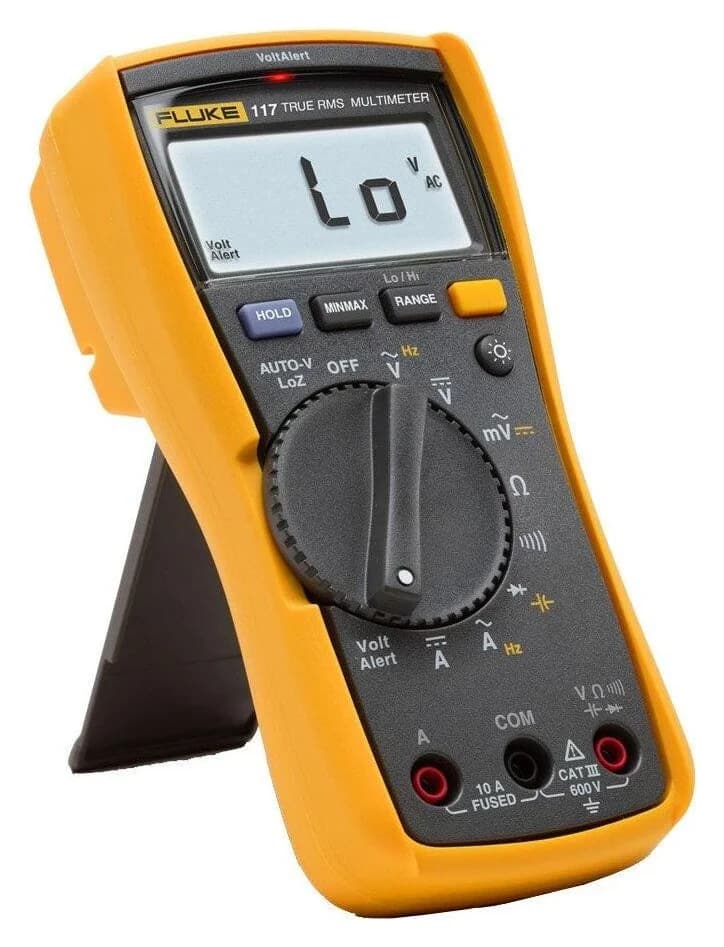
Fluke 117 Electrician's True RMS Multimeter with Non-Contact Voltage600V max · 10A max · 6000 counts · CAT III 600V
- See on Amazon3
Best rugged meter
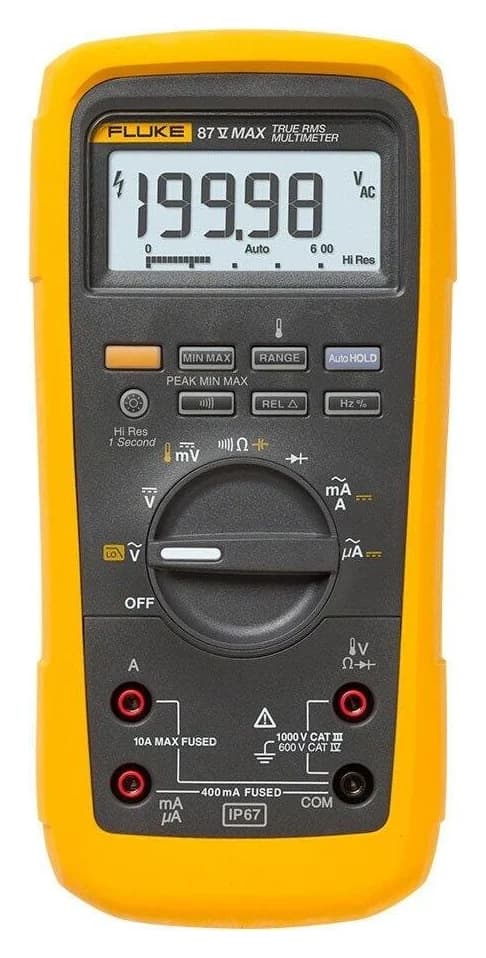
Fluke 87V MAX True RMS Digital Multimeter1000V max · 10A max · 6000 counts · CAT IV 600V, CAT III 1000V
- See on Amazon4
- See on Amazon
For most homes, the Klein Tools MM420 is the multimeter to get: it's True RMS and auto-ranging, rated CAT III 600V, and adds temperature, capacitance and a microamp range to the basics, with LEDs that show which jacks to use. Electricians should get the Fluke 117, which adds built-in non-contact voltage detection and a low-impedance mode for ghost voltages, and anyone who needs CAT IV, a waterproof case or the finest resolution here should get the Fluke 87V MAX. Specs, accuracy tables and ratings checked on Klein's, Fluke's and Innova's sites, November 1, 2026.
Three things on the spec sheet decide which meter fits a job: the CAT rating, per-range accuracy and True RMS. Here's how to read them.
- ±0.08 VHow far a Fluke 117 reading of 12.00 V can be off, per its spec
- 40% lowHow far an average-responding meter can misread distorted AC, per Fluke
- CAT IV 600VThe 87V MAX's rating, the only CAT IV rating stated among these picks
Quick picks
| Pick | Best for | True RMS | Display | Safety rating (as marked) |
|---|---|---|---|---|
| Klein MM420 | Most homes, DIY, hobby electronics | Yes | 4,000 counts | CAT III 600V |
| Fluke 117 | Electricians | Yes | 6,000 counts | CAT III 600V |
| Fluke 87V MAX | Industrial work, CAT IV, the bench | Yes | 6,000 counts, or 19,999 in high-resolution mode | CAT IV 600V, CAT III 1000V |
| Fluke 107 | A pocket meter | No | 6,000 counts | CAT III 600V |
| Innova 3340 | Cars | Not stated | Not stated | Not stated on Innova's page |
How to read a multimeter spec sheet
1. The CAT rating, and where it applies
Measurement categories describe how big a voltage spike a meter is built to survive, which depends on where you are in the building. Fluke's multimeter safety guide gives the categories with examples:
| Category | Where (Fluke's examples) |
|---|---|
| CAT II | Appliances, portable tools; outlets more than 10 m (30 ft) from a CAT III source |
| CAT III | Feeders, short branch circuits, devices fed directly from distribution panels |
| CAT IV | The service entrance, the run between meter and panel, electricity meters |
Fluke's advice is to "choose a tool rated for the highest category you could potentially use it in and select a voltage rating to match, or exceed" it. Two traps follow. First, the category comes before the voltage: Fluke's ABCs of multimeter safety calls it "the real misunderstanding" to pick a CAT II 1000 V meter thinking it's superior to a CAT III 600 V one. Second, the leads count. Fluke's 323 manual says not to exceed the rating "of the lowest rated individual component" of the meter, probes and accessories. Klein ships the MM420's leads with CAT III/CAT IV shields and says that leaving them off in CAT III or CAT IV locations "increases arc-flash risk"; Fluke says the same of the 107's protective caps.
2. Accuracy, range by range
Accuracy is written as ±(% of reading + digits), and it changes from range to range. Take a 12 V reading:
- The Fluke 117 shows 12.00 V on its 60 V range, where it's specified to ±(0.5% + 2). That's 0.06 V from the percentage plus 2 digits of 0.01 V: ±0.08 V.
- The Klein MM420 shows 12.00 V on its 40 V range, specified to ±(0.5% + 5): 0.06 V plus 5 digits of 0.01 V, or ±0.11 V.
Same percentage, different result: the digits term matters most on small readings. The makers also attach conditions: Fluke specifies the 117's accuracy for one year after calibration at 18 to 28 °C, and Klein the MM420's at 18 to 28 °C, accurate for one year. Our How we measure page has the full method.
3. True RMS
An average-responding meter is accurate on a clean sine wave and can be badly off on anything else. Fluke's True RMS explainer says an averaging meter measuring distorted waves "can be up to 40% low or 10% high," and names variable-speed drives and computers as the loads that distort them. Three of the five picks are True RMS; the Fluke 107 isn't, and Innova makes no True RMS claim for the 3340.
Best for most homes: Klein Tools MM420
The MM420 covers the most everyday jobs with the least to learn. Klein's MM420 page lists 600 V AC/DC, 10 A AC/DC, 50 MΩ resistance, temperature, capacitance, frequency, duty cycle, diode test and continuity, all auto-ranging and True RMS.
Klein Tools
Klein Tools MM420 Auto-Ranging True RMS Digital Multimeter (600V)
A 4,000-count auto-ranging True RMS multimeter rated CAT III 600V that measures up to 600 V and 10 A, plus temperature, capacitance, frequency and duty cycle.
Comes in 4 versions: see which to buy
- 600V max
- 10A max
- 4000 counts
- CAT III 600V
- Lead-Alert: LEDs light the input jacks the selected function needs
- Small currents: a 400 µA range alongside mA and 10 A, useful for electronics, and its manual recommends 30-second measurements with 10-minute rests above 6 A
- Safety: CAT III 600V; conforms to UL 61010-1 and is certified to CSA C22.2 No. 61010-1, per the manual; 2 m (6.6 ft) drop protection
- In the box: test leads with CAT III/CAT IV caps, a thermocouple (the manual rates it below 180 °C / 356 °F only), two AAA batteries
The trade-offs: a 4,000-count display, against 6,000 on the Fluke picks, and no low-impedance mode or built-in non-contact detection. Searching for the Klein MM400? Klein's MM400 page says "This product is no longer in production" and points to the MM420 as its newer model.
Best for electricians: Fluke 117
The 117 is built around the way electricians work. Fluke's 117 page lists VoltAlert non-contact detection, AutoVolt (it picks AC or DC on its own) and "a selectable low-impedance mode to prevent false readings from ghost voltage." Fluke's application note on stray voltage explains that ghost voltages "occur from capacitive coupling between energized circuits and non energized, non connected adjacent wiring," which a normal high-impedance meter can display as if it were real. A low-impedance input loads that coupling down.
Fluke
Fluke 117 Electrician's True RMS Multimeter with Non-Contact Voltage
A compact 6,000-count True RMS multimeter for electricians, rated CAT III 600V, with built-in VoltAlert non-contact voltage detection, automatic AC/DC selection and a low-impedance mode.
Comes in 5 versions: see which to buy
- 600V max
- 10A max
- 6000 counts
- CAT III 600V
- True RMS, 6,000 counts; DC volts ±(0.5% + 2), AC volts ±(1.0% + 3) from 45 to 500 Hz
- 600 V AC/DC and 10 A AC/DC; rated CAT III 600V
- 9 V battery, about 400 hours typical without the backlight; 3-year warranty
The trade-offs: no milliamp or microamp ranges (its smallest current step is 1 mA on the 6 A range), so it's the wrong meter for electronics. Nor does it measure temperature: a range on Fluke's 117 page comes from a comparison chart and footnotes, while the 117's own spec table and manual list none. And CAT III 600V means it isn't rated for service-entrance work. The VoltAlert sensor has the same limits as any non-contact pen: Fluke's manual says not to rely on it with shielded wire (more in our non-contact voltage tester guide).
Best rugged meter: Fluke 87V MAX
The 87V MAX is the pick when the meter has to survive the job. Fluke's 87V MAX page lists an IP67 case, a 4 m (13 ft) drop rating with the holster, and CAT IV 600V / CAT III 1000V, with CE and CSA among its agency approvals.
Fluke
Fluke 87V MAX True RMS Digital Multimeter
A rugged industrial True RMS multimeter rated CAT IV 600V and CAT III 1000V, with an IP67 case, a 4 m drop rating, a low-pass filter for motor-drive readings and temperature measurement.
Comes in 4 versions: see which to buy
- 1000V max
- 10A max
- 6000 counts
- CAT IV 600V, CAT III 1000V
- DC volts ±(0.05% + 1) on the 6 V to 1000 V ranges (±(0.1% + 1) on 600 mV), plus a 19,999-count high-resolution mode
- A low-pass filter for readings on variable-frequency motor drives, and True RMS AC
- Current from microamps to 10 A; temperature with the included 80BK-A probe (-40 to 260 °C)
- Three AA batteries, about 800 hours typical without the backlight; limited lifetime warranty
The trade-offs: at 698.5 g with the holster it's a heavy handheld, Fluke lists no built-in non-contact detection, and its ratings exceed household needs.
Best pocket meter: Fluke 107
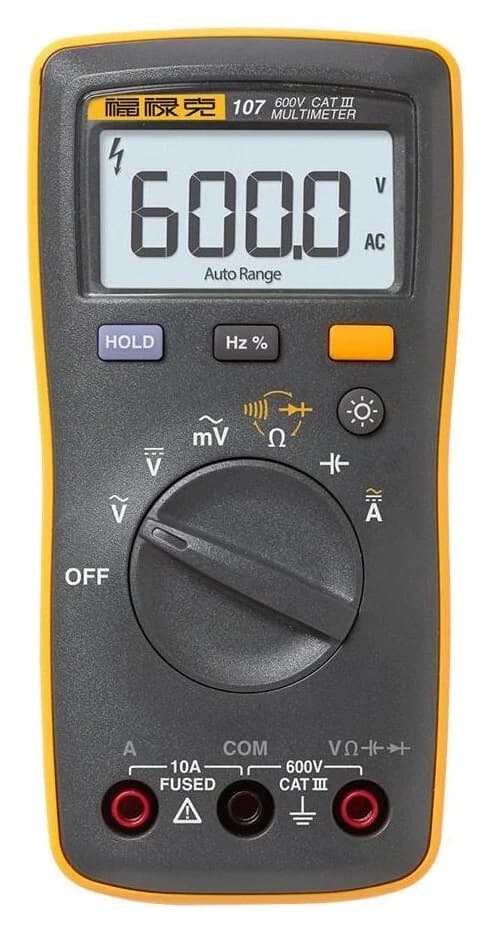
The 107 is the answer if you came looking for the Fluke 101: Fluke's US multimeter listing doesn't include the 101, while it does list the 106 and 107. Fluke's 107 page calls it small enough for a shirt pocket and rates it CAT III 600V.
Fluke
Fluke 107 Pocket Digital Multimeter
A palm-size 6,000-count multimeter rated CAT III 600V that measures AC and DC voltage and current to 600 V and 10 A, plus resistance, capacitance, frequency and duty cycle; it is not True RMS.
Comes in 3 versions: see which to buy
- 600V max
- 10A max
- 6000 counts
- CAT III 600V
- 6,000 counts, backlight and data hold; DC volts ±(0.5% + 3), AC volts ±(1.0% + 3) from 40 to 500 Hz
- AC and DC current on 4 A and 10 A ranges; capacitance, frequency and duty cycle
- IP40, a 1 m drop test, 200 g, two AAA batteries (at least 200 hours); 2-year warranty
- TL75 test leads and a magnetic SmartStrap lanyard in the box
The trade-offs: it isn't True RMS. Fluke positions it "for everyday applications where true-rms accuracy isn't needed," and its own Q&A answer says it is not a True RMS meter.
Best for cars: Innova 3340
The 3340 adds what engine work needs. Innova's 3340 page lists RPM from 0 to 10,000 with an inductive pickup, on conventional and distributorless ignitions including coil-on-plug, plus dwell, pulse width, duty cycle, frequency and temperature.
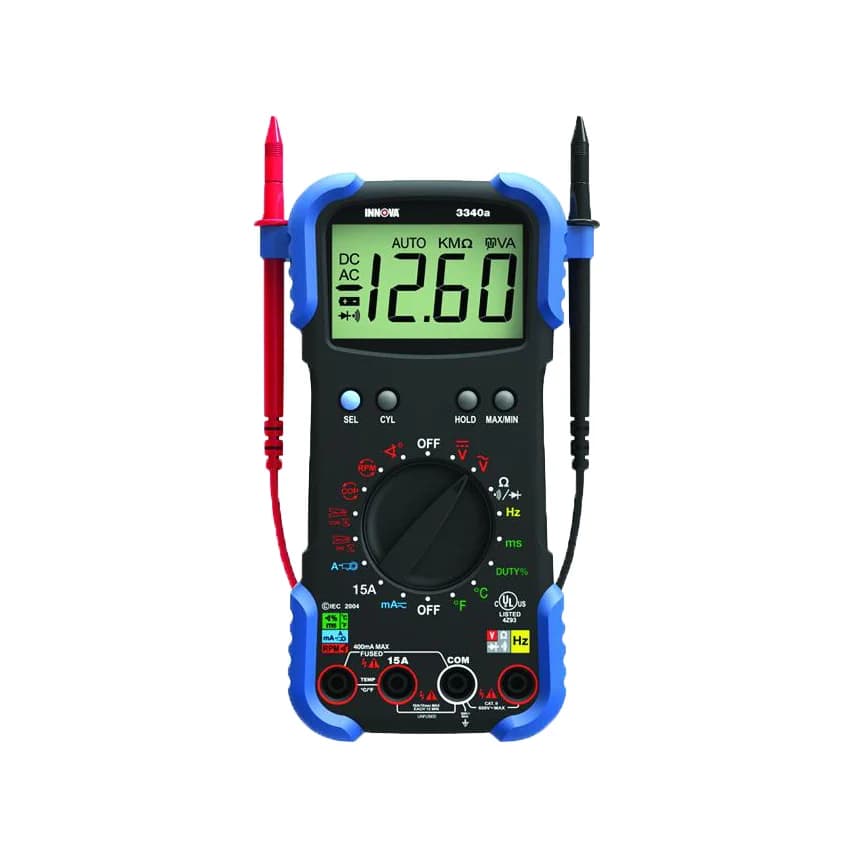
Innova
Innova 3340 Automotive Digital Multimeter
An auto-ranging automotive multimeter that adds RPM (with an inductive pickup), dwell, pulse width, duty cycle, frequency and temperature to the usual electrical tests, with a 15 A unfused current input.
- 15A max
- Auto-ranging, with a 10 MΩ input impedance that Innova says "prevents damage to the vehicle's ECU"
- 40 mA and 400 mA fused DC current ranges, and a 15 A unfused DC input for 15-second tests with at least 15 minutes between them
- A temperature probe, an inductive RPM clamp and a case in the box; two AA batteries; 1-year warranty
The trade-offs: Innova's page states no voltage range, display count, accuracy or CAT rating. Treat it as a car meter: for household wiring, use one of the CAT-rated picks above.
Fluke vs Klein, spec by spec
| Klein MM420 | Fluke 107 | Fluke 117 | Fluke 87V MAX | |
|---|---|---|---|---|
| Best DC volts accuracy | ±(0.5% + 5) | ±(0.5% + 3) | ±(0.5% + 2) | ±(0.05% + 1) |
| Smallest current range | 400 µA | 4 A | 6 A (1 mA steps) | Microamps (0.1 µA steps) |
| Non-contact voltage | Not listed | Not listed | Yes (VoltAlert) | Not listed |
| Low-impedance mode | Not listed | Not listed | Yes | Not listed |
| Temperature | Yes | Not in its specs | Not in its specs | Yes |
| Drop rating | 2 m | 1 m | Not stated | 4 m with holster |
What about budget meters?
Budget meters often list big ratings, so read the page closely. KAIWEETS's HT118A page, for example, says the meter "measures up to 600V AC/DC voltage" while its own table lists a 1000 V DC range, and it names "IEC Rated CAT III 1000V, CAT IV 600V, CE, RoHS" without naming a UL, ETL or CSA listing.
- Yes: The same voltage range everywhere on the page
- Yes: The symbol and listing number of an independent testing lab, such as UL, CSA or TÜV, as Fluke advises
- No: A CE mark on its own: Fluke notes makers may self-certify it, so it "is not, therefore, a guarantee of independent testing"
Until a maker's documents agree with themselves and name an independent listing, we don't pick its meter for mains work.
How we choose
We haven't lab-tested these meters. Every pick comes from research:
- Maker documents. Ranges, per-range accuracy, counts, ratings and warranty come from Klein's, Fluke's and Innova's product pages and manuals, read November 1, 2026.
- Standards. CAT ratings exactly as marked, read with Fluke's category table; True RMS as Fluke defines it.
- Certification and safety record. Independent listings where the maker states them, and the CPSC recall database for every model.
- Fit to the job. A meter's limits count as much as its features.
Our full method is on How we choose.
Buying guide
Check the fuse rating. The current jacks are protected by fuses, and the right replacement matters. Fluke's 117 manual specifies an 11 A, 1000 V fast fuse with a 17,000 A minimum interrupt rating, and Fluke warns that an inadequate replacement fuse increases the risk of arc explosion if voltage is applied to the current jacks by mistake.
Learn the basics first. If you're new to meters, our how to use a multimeter guide walks through continuity, DC voltage and current on low-voltage circuits. For current on household wiring, a clamp meter measures without breaking the circuit: see our clamp meter picks.
Buying one as a present? Our gifts for electricians guide covers what to check on the box: the model generation, what's in the kit and the rating on the leads.
Verdict
The Klein Tools MM420 is the best multimeter for most homes: True RMS, auto-ranging, CAT III 600V, with temperature and a microamp range. Electricians should get the Fluke 117 for its non-contact detection and low-impedance mode, and the Fluke 87V MAX is the one for CAT IV work, harsh sites and the finest resolution. The Fluke 107 is the pocket choice (and the US answer to the Fluke 101), and the Innova 3340 is a car meter first.
Frequently asked questions
Do I need a True RMS multimeter?
If you measure AC from anything electronic, yes. Fluke explains that an average-responding meter is accurate on a pure sine wave, but on the distorted waveforms that variable-speed drives and computers create it can read up to 40% low or 10% high. For basic checks on clean AC, a meter like the Fluke 107 is fine: Fluke itself positions it for jobs where True RMS accuracy isn't needed.
What happened to the Fluke 101?
Fluke's US multimeter listing doesn't include the 101, and its old US product address now opens that listing. The pocket-size models Fluke lists in the US are the 106 and 107. We cover the 107: 6,000 counts, CAT III 600V, AC and DC volts and amps, capacitance and frequency, but not True RMS.
Is a CAT III 600V multimeter enough for home use?
For outlets, branch circuits and appliances, yes. Fluke's category table puts outlets more than 10 m (30 ft) from a CAT III source in CAT II, and feeders, short branch circuits and devices fed directly from panels in CAT III. CAT IV covers the service entrance and electricity meter; leave that work to a licensed electrician. The test leads need at least the same rating as the meter.