Best picks
Best Outlet and GFCI Testers (and What They Can't Tell You)
Outlet and GFCI testers compared: Klein's RT250 shows voltage and GFCI trip time, the RT210 shows lights. What each can and can't find, and how to test a GFCI.
By thisMETER EditorialUpdated November 2, 20269 min read1 picks
Our picks at a glance
For most homes, the Klein Tools RT250 is the outlet tester to get: its backlit screen shows the line voltage, names the wiring fault and times how long a GFCI takes to trip, where most testers only light up a pattern. If you just want to know whether an outlet is wired right and a GFCI trips, Klein's three-light RT210 does that. Specs and instructions checked on Klein's site, November 1, 2026.
Both are for North American 120 V, three-wire outlets, and both have the same blind spots. Klein's own list of what they don't indicate starts with "quality of ground," so a "correct" result means the common faults are absent, not that the outlet is safe. When a tester flags a problem, Klein's instruction is the right one: consult a qualified electrician.
Quick picks
| Pick | Best for | Shows | GFCI test | Rating |
|---|---|---|---|---|
| Klein RT250 | Most homes; anyone who wants numbers | Voltage, wiring fault and GFCI trip time on a backlit LCD | Creates a 6 to 9 mA ground fault and times the trip | CAT II 135V; conforms to UL 1436 |
| Klein RT210 | A quick yes/no check | Three lights, read against the chart printed on the tester | Hold its test button for 7 seconds | CAT II 300V |
- 6-9 mAThe ground fault the RT250 creates to trip a GFCI
- 7 sHow long Klein says to hold the RT210's GFCI test button
- 120 VNorth American three-wire outlets only, for both testers
What a plug-in tester shows, and what it can't
A plug-in tester lights a pattern that you match against the chart printed on it (the RT250 names the fault on its screen instead). Klein lists the conditions each tester indicates and, just as usefully, the ones it doesn't.
- Yes: Correct wiring, open ground, open neutral, open hot, hot and neutral reversed, hot and ground reversed
- Yes: RT250 only: a dual open neutral and ground, the actual line voltage, and a low (30 to 85 V) or high (135 to 150 V) voltage warning
- Yes: Whether a GFCI trips when the tester creates a ground fault (and, on the RT250, how long it took)
- No: The quality of the ground, or a neutral and ground reversal
- No: Multiple hot wires, or combinations of faults (the RT250 catches one combination: dual open neutral and ground)
- No: Whether an AFCI works: Klein lists "AFCI: No" for the RT250
The false-ground trap. IDEAL, which makes circuit analyzers that test for it, describes a false ground as "a bootleg (ground jumper wire at the outlet device) or inadvertent contact of the ground wire to the neutral connection." Neither Klein tester lists that among the faults it finds, which fits Klein's warning that the tester "only detects common wiring problems." A three-prong outlet that reads "correct" on a plug-in tester has passed a basic check, nothing more. If an older home has three-prong outlets you're unsure about, that's an electrician's job.
Clear the circuit first. Klein says everything plugged into the circuit should be unplugged "to help reduce the possibility of erroneous readings," because other equipment on the circuit can interfere with the tester.
Tap a label to explore. You can also hover or use your keyboard.
Klein RT250North American three-wire 120V outlets only
The RT250 is for North American three-wire 120V outlets only.
Sources: 1: The RT250 is for North American three-wire 120 V outlets only., 2: The RT250 screen displays voltage, wiring faults and GFCI trip time.Screen readingsVoltage, wiring fault, GFCI trip time
The LCD shows voltage, identifies the wiring fault and reports the time needed to trip a GFCI device.
Sources: 2: The RT250 screen displays voltage, wiring faults and GFCI trip time.Outside this checkGround quality; neutral-ground reversal; AFCI
The RT250 does not indicate ground quality or a neutral-ground reversal. It does not test AFCI operation.
Sources: 3: The RT250 does not indicate the quality of the ground., 4: The RT250 also does not indicate a reversal of neutral and ground conductors., 5: The RT250 does not test AFCI operation.Check wiring before GFCIWiring fault: stop; consult qualified electrician
Do not attempt GFCI ground fault testing on an incorrectly wired circuit. Consult a qualified electrician for wiring problems.
Sources: 6: Do not attempt a GFCI ground fault test on an incorrectly wired circuit., 7: The RT250 only detects common wiring problems, and Klein directs users to a qualified electrician for wiring problems.Common wiring checkA correct result has limited scope
This tester detects common wiring problems only. A correct result cannot clear the blind spots listed here.
Sources: 3: The RT250 does not indicate the quality of the ground., 4: The RT250 also does not indicate a reversal of neutral and ground conductors., 5: The RT250 does not test AFCI operation., 7: The RT250 only detects common wiring problems, and Klein directs users to a qualified electrician for wiring problems.Klein RT250 example. A correct wiring result is limited to the checks this tester performs.
Source notes7 references
The RT250 is for North American three-wire 120 V outlets only.
www.kleintools.com — source for The RT250 is for North American three-wire 120 V outlets only.For use on 3-wire, North American 120V electrical outlets only
The RT250 screen displays voltage, wiring faults and GFCI trip time.
www.kleintools.com — source for The RT250 screen displays voltage, wiring faults and GFCI trip time.The RT250 is an electrical receptacle tester that tests the wiring conditions at an electrical outlet and inspects GFCI devices. The LCD displays the voltage, identifies the wiring fault, and the time required to trip a GFCI device.
The RT250 does not indicate the quality of the ground.
data.kleintools.com — source for The RT250 does not indicate the quality of the ground.NOTE: Conditions NOT indicated include, but are not limited to, quality of ground, multiple
The RT250 also does not indicate a reversal of neutral and ground conductors.
data.kleintools.com — source for The RT250 also does not indicate a reversal of neutral and ground conductors.hot wires, reversal of neutral and ground conductors, and combinations of defects other
The RT250 does not test AFCI operation.
www.kleintools.com — source for The RT250 does not test AFCI operation.AFCI: No GFCI: Yes
Do not attempt a GFCI ground fault test on an incorrectly wired circuit.
data.kleintools.com — source for Do not attempt a GFCI ground fault test on an incorrectly wired circuit.DO NOT attempt GFCI ground fault testing on an incorrectly wired circuit.
The RT250 only detects common wiring problems, and Klein directs users to a qualified electrician for wiring problems.
data.kleintools.com — source for The RT250 only detects common wiring problems, and Klein directs users to a qualified electrician for wiring problems.• This tester only detects common wiring problems. Always consult a qualified electrician
How to test a GFCI with a plug-in tester
The GFCI's own button comes first. Leviton's instructions say to "Press the TEST button (then RESET button) every month to assure proper operation," and Klein's RT210 sheet starts with that same button before using the tester's.
Read the GFCI's manual
Klein says to check how the specific GFCI operates before using a tester on it.
Unplug everything on the circuit
Other devices on the circuit can cause erroneous readings.
Check the wiring first
Plug in the tester. If it shows a wiring fault, stop: Klein says not to attempt a GFCI test on an incorrectly wired circuit.
Press the GFCI's TEST button
The GFCI should trip and the tester's lights go dark. Press RESET.
Use the tester's GFCI button
On the RT210, hold it for 7 seconds; the GFCI should trip. The RT250 creates a 6 to 9 mA fault and shows the trip time.
Reset, and call for help if it fails
If the GFCI doesn't trip or won't reset, consult a qualified electrician.
Best overall: Klein Tools RT250
The RT250 turns lights into numbers. Klein's RT250 page describes a backlit LCD that shows the voltage, identifies the wiring fault and shows "the time required to trip a GFCI device." Its instruction sheet adds the details:
- Creates a 6 to 9 mA ground fault to trip the GFCI, then shows the pre-test voltage and the time to trip
- Flags a dual open neutral and ground, which Klein says is a patent-pending detection
- Warns of low (30 to 85 V AC) or high (135 to 150 V AC) voltage
- Auto-Hold keeps the reading on screen after you unplug it from a hard-to-reach outlet
- Conforms to UL 1436 and is certified to CSA C22.2 No. 160; rated CAT II 135V; 2 m (6.6 ft) drop protection; two AAA batteries, with auto power-off after 3 minutes
The trade-offs: it's for "3-wire, North American 120V electrical outlets only," and it doesn't test AFCIs. If the circuit stays live during the GFCI test, or the screen shows "> sec," Klein says the GFCI may be miswired, installed incorrectly or not working. The tester tells you there's a problem; it doesn't find where. Klein also lists an RT250KIT that pairs it with a dual-range non-contact pen (our non-contact voltage tester guide explains why both are useful).
Simplest tester: Klein Tools RT210
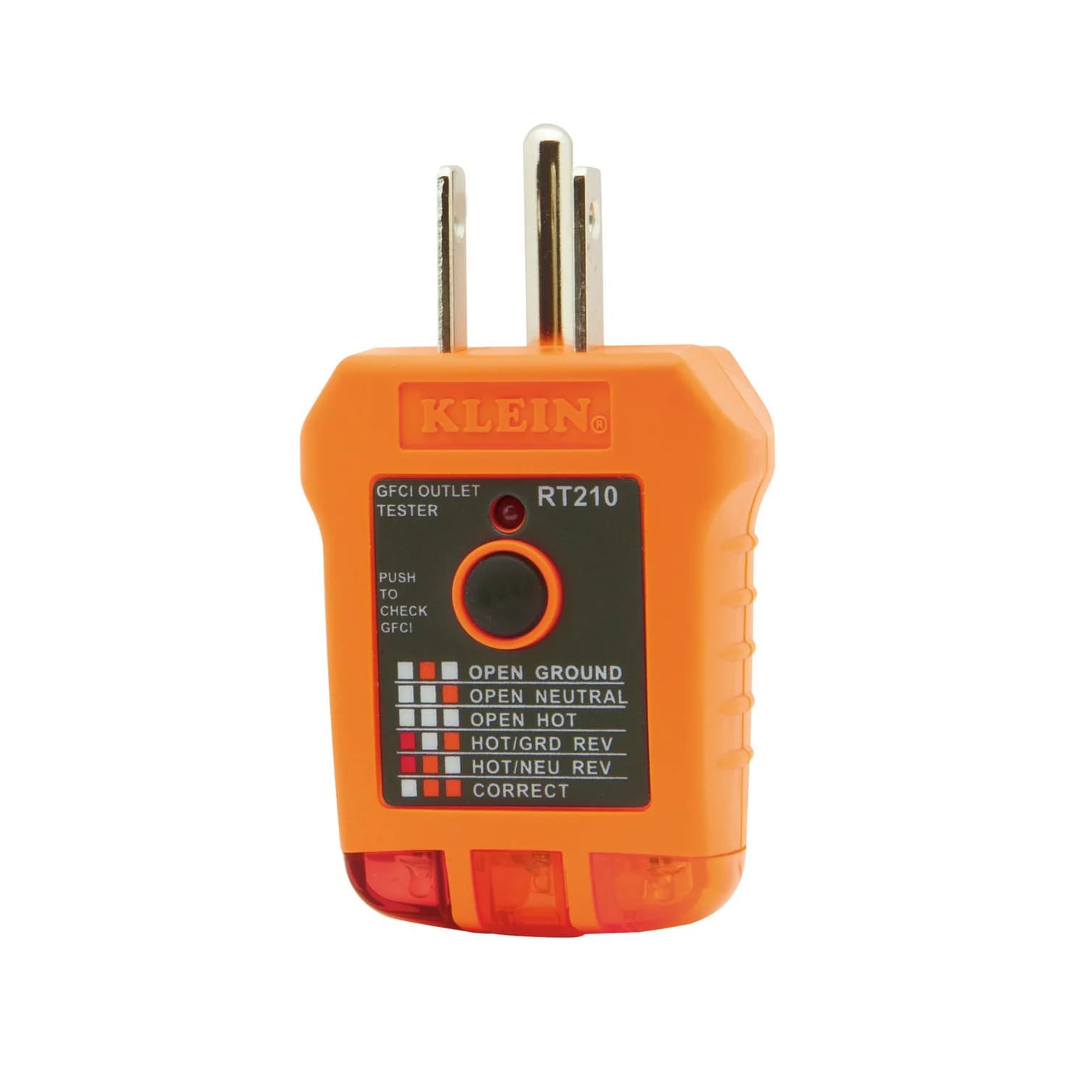
The RT210 is the classic three-light tester. Klein's RT210 page says it detects "the most common wiring problems in standard and GFCI receptacles," read against a chart printed on the tester: open ground, reverse polarity, open hot, open neutral and hot/ground reversed.
Klein Tools
Klein Tools RT210 GFCI Outlet Tester
A three-light plug-in tester for standard and GFCI receptacles that shows common wiring faults and has a button to trip a GFCI.
Comes in 4 versions: see which to buy
- CAT II 300V
- GFCI test: hold the tester's test button for 7 seconds, and check that the GFCI trips and the lights go dark
- Rated for 110/125 V AC at 50/60 Hz in three-wire outlets; CAT II 300V
- 2 m (6.6 ft) drop protection
The trade-offs: no voltage reading and no trip time, just lights. Klein's instructions list the conditions it doesn't indicate: the quality of the ground, multiple hot wires, combinations of defects and a reversal of the neutral and ground.
If you searched for a "circuit tester"
"Circuit tester" covers several tools. A plug-in receptacle tester like the two above checks an outlet. A non-contact pen tells you whether AC is present in a cord or switch: our non-contact voltage tester picks cover those. A breaker finder traces an outlet back to its breaker; Klein sells one combined with a GFCI outlet tester, which we haven't covered yet.
What about a multimeter? A multimeter can read the voltage at an outlet, but that's a live mains measurement: do it only as your meter's manual describes, with a meter and leads rated for it. For checking how an outlet is wired, a plug-in tester is the simpler and safer tool. Our multimeter guide covers what CAT ratings mean on a meter.
How we choose
We haven't lab-tested these testers. Every pick comes from research:
- Maker documents. What each tester shows, its test current, ratings and limits come from Klein's product pages and instruction sheets, read November 1, 2026.
- Standards and listings. The RT250's UL 1436 and CSA conformance as Klein states it; CAT ratings exactly as marked.
- What it can't do. Each tester's "not indicated" list counts as much as its features.
- Safety record. The CPSC recall database, checked for both models.
Our full method is on How we choose.
Buying guide
Lights or a screen? The RT210's lights answer "is it wired the common way?" The RT250 adds the actual voltage (a sagging or high reading gets its own warning) and the GFCI trip time, which is the difference between "it tripped" and "it tripped promptly."
CAT II on both. Klein's RT250 sheet defines CAT II as circuits "connected directly to utilization points (socket outlets and similar points)." That's exactly where a plug-in tester works, so the rating isn't a weakness. It's also why these testers belong in an outlet, not in a panel.
120 V, three-wire only. Klein specifies the RT250 for three-wire North American 120 V outlets only, and the RT210 for 110/125 V AC three-wire outlets. Neither is for two-wire (ungrounded) or 240 V outlets.
Buying for a tradesperson? Both testers appear in our gifts for electricians guide, next to the tools that pair with them.
Verdict
The Klein Tools RT250 is the outlet tester to buy: it shows the voltage, names the wiring fault and times the GFCI trip, and it conforms to UL 1436. The Klein RT210 is the simple three-light alternative when you only need a quick check. Neither can judge the ground's quality or catch a false ground, so treat "correct" as a passed basic check, and leave anything that fails to a licensed electrician.
Frequently asked questions
Can an outlet tester detect a bootleg ground?
Not the two here. Klein lists what its RT210 and RT250 don't indicate, including the quality of the ground and a neutral and ground reversal, and neither tester lists a false ground among its results. IDEAL describes a false or bootleg ground as a ground jumper wire at the outlet, or a ground wire touching the neutral, and sells circuit analyzers built to flag it. If you suspect one, call a licensed electrician.
How often should you test a GFCI outlet?
Leviton's GFCI instructions say to press the TEST button, then the RESET button, every month to make sure the device works. A plug-in tester is a second check, not a replacement: Klein's RT210 instructions start with the GFCI's own TEST button before using the tester's button. If a GFCI won't trip or won't reset, Leviton's instructions say to replace it; have a licensed electrician do that.
What does the GFCI trip time on the Klein RT250 mean?
When you press its GFCI button, the RT250 creates a 6 to 9 mA ground fault and shows how long the GFCI took to cut the power. If the circuit stays live, or the screen shows "> sec", Klein says the GFCI may be miswired, installed incorrectly or not working, and to consult a qualified electrician. Check the GFCI's own manual first, as Klein advises.