

Buying guide
AC Circuit Breaker Finder Buying Guide
Pick by Circuit Type, Voltage and Outlet
Choose an AC circuit breaker finder by circuit type and voltage. Compare Klein, Fluke and IDEAL finder kits, outlet compatibility, GFCI behavior and DC limits.
By thisMETER EditorialUpdated November 5, 202610 min read5 picks
On this page · Our picks at a glance
Our picks at a glance
- 1
Best for most homes
120 V max · CAT II 120V
Choose for: Best for most homes
Limit: Circuit-powered transmitter: no dead circuits, no higher voltage
- 2
The receiver-extras alternative
300 V max · CAT II 150 V
Choose for: The receiver-extras alternative
Limit: 120V AC circuits only; IDEAL lists no higher-voltage or DC capability for this model
- 3
Best AC kit for 240V and dead circuits
480 V max · CAT III 600V
Choose for: Best AC kit for 240V and dead circuits
Limit: A large, 6-plus-pound kit; overkill for someone who only wants to identify outlet breakers
Show all 5 picks
- 4
Best electric circuit tracer kit
600 V max · CAT IV 600 V, CAT III 1000 V
Choose for: Best electric circuit tracer kit
Limit: Requires following the maker safety instructions around energized circuits
- 5
When the circuit is not AC mains
Choose for: When the circuit is not AC mains
Limit: Analog tone tool, not an AC mains instrument
For an AC breaker-finding job on a live 120V outlet, the Klein Tools ET310 is the pick for most homes: a plug-in transmitter with wiring-condition lights and a GFCI test, working on 90–120V AC. If the circuit is 240V, beyond an outlet, or can be traced with a documented direct- or remote-ground connection, move up to the Klein ET450 kit; for a de-energized circuit, follow the manual's neutral/ground or remote-ground method. For professional tracing with a CAT IV 600V rating and a signal clamp choose the Fluke 2062. The IDEAL 61-535 is the alternative simple 120V finder with a mute button, NCV tip and work light; the Fluke Networks Pro3000 is a tone-and-probe set for de-energized low-voltage pairs, not AC mains. Specifications below come from the makers' pages and manuals, checked November 5, 2026.
Confirm one thing before anything else: the finder's voltage and circuit-type specification must match the circuit you intend to identify. AC-only outlet finders are 120V-class tools; a DC, 240V appliance or dead-circuit job needs a different model. This guide buys by that boundary, and our general breaker finder roundup compares the wider field including the ET350.
Quick picks: match the AC circuit first
Compare specifications and all conditions
Live 120V outlet
- Our pick
- Klein ET310
- What the maker documents
- 90–120V AC, three-pin grounded outlet plug, GFCI test
- The limit to respect
- Circuit-powered transmitter: no dead circuits, no higher voltage
Live 120V branch, noisy panel
- Our pick
- IDEAL 61-535
- What the maker documents
- Strongest-signal identification, mute, 80–300V NCV tip, work light
- The limit to respect
- CAT II 150V; energized 120V AC circuits
240V, fuses, or dead AC circuits
- Our pick
- Klein ET450
- What the maker documents
- AC/DC indicators at 12/48/120/240/480V; energized and de-energized tracing
- The limit to respect
- Disconnect above 480V AC/DC; remote ground trips GFCIs
Professional AC tracer kit
- Our pick
- Fluke 2062
- What the maker documents
- CAT IV 600V, Smart Sensor display, i400 clamp, 6/33 kHz auto frequency
- The limit to respect
- Follow the manual's clamp connection conditions
De-energized low-voltage pairs
- Our pick
- Pro3000 tone and probe
- What the maker documents
- Tone up to 10 miles on most cables, SmartTone pair ID
- The limit to respect
- Analog tone tool, not an AC mains instrument
Full comparison table
Swipe to compare. Row labels stay visible.
| Your circuit | Our pick | What the maker documents | The limit to respect |
|---|---|---|---|
| Live 120V outlet | Klein ET310 | 90–120V AC, three-pin grounded outlet plug, GFCI test | Circuit-powered transmitter: no dead circuits, no higher voltage |
| Live 120V branch, noisy panel | IDEAL 61-535 | Strongest-signal identification, mute, 80–300V NCV tip, work light | CAT II 150V; energized 120V AC circuits |
| 240V, fuses, or dead AC circuits | Klein ET450 | AC/DC indicators at 12/48/120/240/480V; energized and de-energized tracing | Disconnect above 480V AC/DC; remote ground trips GFCIs |
| Professional AC tracer kit | Fluke 2062 | CAT IV 600V, Smart Sensor display, i400 clamp, 6/33 kHz auto frequency | Follow the manual's clamp connection conditions |
| De-energized low-voltage pairs | Pro3000 tone and probe | Tone up to 10 miles on most cables, SmartTone pair ID | Analog tone tool, not an AC mains instrument |
Scroll horizontally to see every column
| Your circuit | Our pick | What the maker documents | The limit to respect |
|---|---|---|---|
| Live 120V outlet | Klein ET310 | 90–120V AC, three-pin grounded outlet plug, GFCI test | Circuit-powered transmitter: no dead circuits, no higher voltage |
| Live 120V branch, noisy panel | IDEAL 61-535 | Strongest-signal identification, mute, 80–300V NCV tip, work light | CAT II 150V; energized 120V AC circuits |
| 240V, fuses, or dead AC circuits | Klein ET450 | AC/DC indicators at 12/48/120/240/480V; energized and de-energized tracing | Disconnect above 480V AC/DC; remote ground trips GFCIs |
| Professional AC tracer kit | Fluke 2062 | CAT IV 600V, Smart Sensor display, i400 clamp, 6/33 kHz auto frequency | Follow the manual's clamp connection conditions |
| De-energized low-voltage pairs | Pro3000 tone and probe | Tone up to 10 miles on most cables, SmartTone pair ID | Analog tone tool, not an AC mains instrument |
Best for most homes: Klein Tools ET310
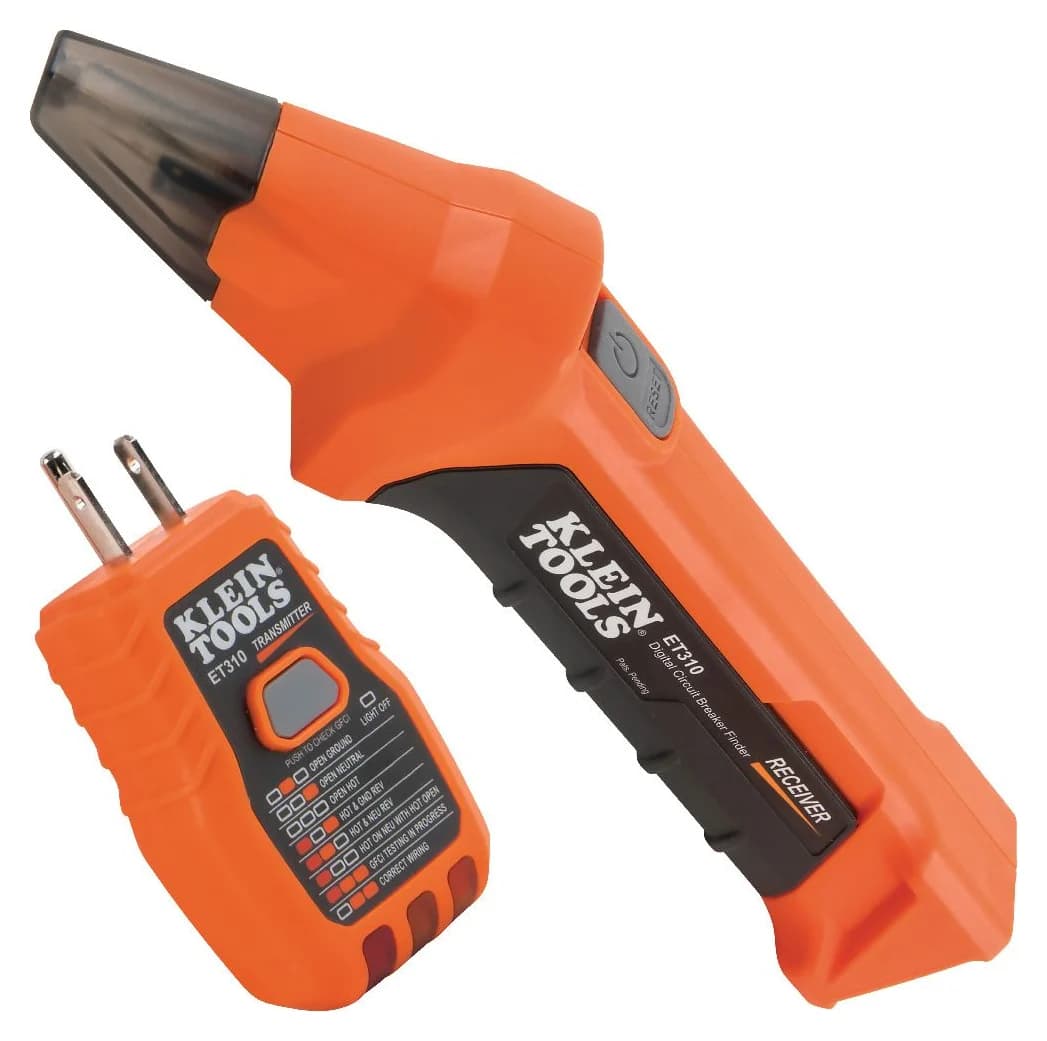
The ET310 is the AC-only answer in its clearest form. Klein's product page specifies 90–120V AC operation, a three-pin plug for North-American-style grounded electrical outlets, and a transmitter that is powered by the circuit — no transmitter battery. The instructions define the workflow: plug the transmitter into a known live, correctly wired outlet, power the receiver, reset it away from the panel, scan all breakers once while the receiver learns the panel (ignoring all indications), then scan again for the identification. The transmitter also carries a GFCI test button and wiring-condition lights; the manual notes conditions not indicated include open ground, multiple hot wires and reversal of ground and neutral.
The trade-offs are the definition of AC-only: the manual states the tester is designed for use with 120V AC electrical systems and DO NOT connect to higher voltage electrical supplies; the transmitter cannot run on a dead circuit; and light fixtures need the separate 69411 accessory kit or the ET310KIT package. For outlet diagnostics beyond identification, the ET350 — covered in our parent roundup — adds GFCI trip-time reporting.
The receiver-extras alternative: IDEAL 61-535
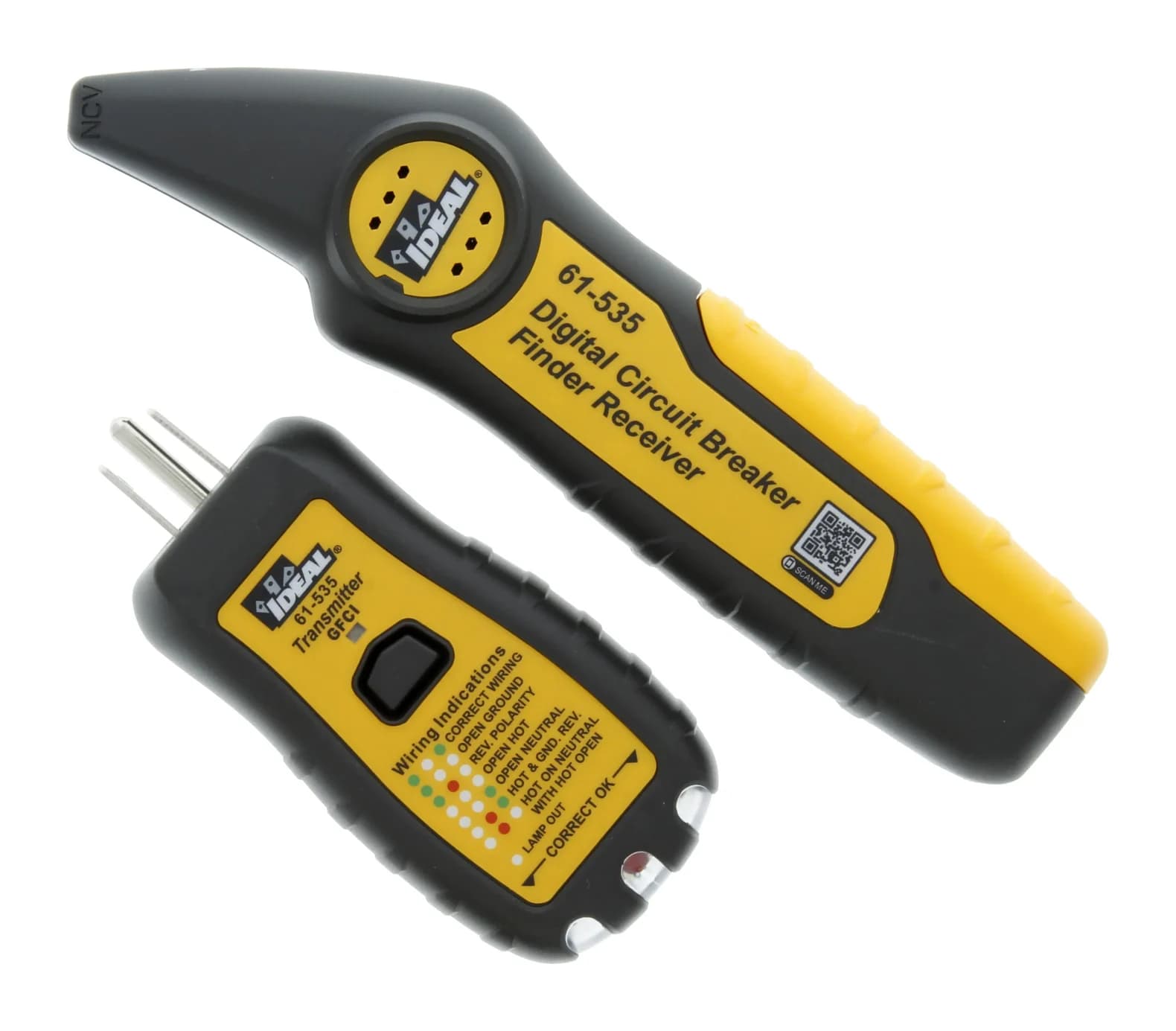
IDEAL's 61-535 page documents the same 120V AC branch-circuit job with a different receiver: it identifies the breaker or fuse with the strongest signal using a flashing green LED and beeps, and the audible tones can be muted for noise-sensitive environments. The receiver adds a non-contact voltage sensor in the tip detecting 80–300V AC with a red flashing LED, plus a built-in work light that runs independently of the tester functions. The page description says the receiver powers off automatically after five minutes of non-use, while the same page's specification table lists Auto Power Off as No. It is cULus certified (UL 1436, CSA C22.2 No. 160) and marked CAT II 150V.
The trade-offs: the product page's Battery Size field says 2 x 9V, while the manual specifies a 9V receiver battery and a transmitter that takes its power from the circuit, so confirm supplied batteries with the seller. The base package has no light-socket or alligator adapter — the instructions treat the TL-532A adapter set as a separate optional purchase — and it has the same live-circuit requirement as any plug-in AC finder.
Best AC kit for 240V and dead circuits: Klein Tools ET450
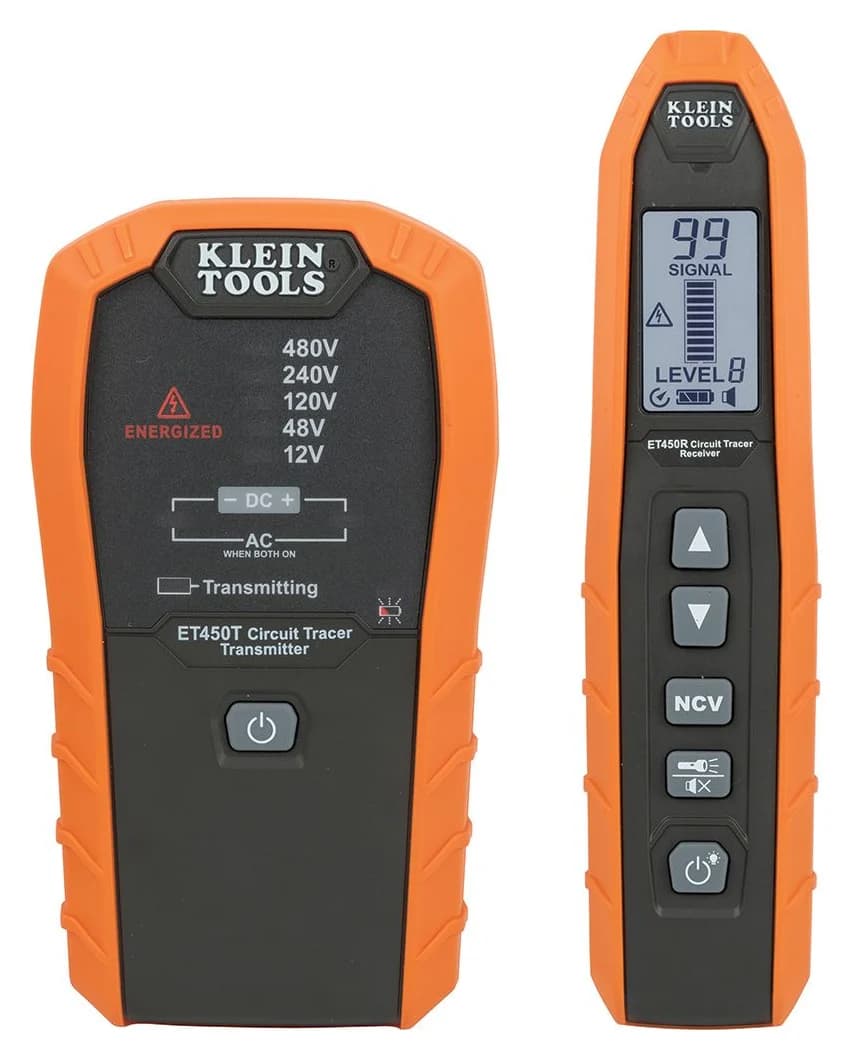
The ET450 is where the AC boundary widens. Klein's kit page calls it a professional tracer for energized and non-energized breakers, fuses, and wires, with the transmitter showing external voltage indicators of 12V, 48V, 120V, 240V, and 480V and detecting the signal through drywall, cement block, and underground. The manual adds 8 sensitivity levels (energized circuits typically levels 1–3, de-energized may need 4–8), a numerical signal strength of 0–99 where 99 means saturation, tracing depth 0–0.5 m depending on medium and application, and an explicit instruction: if the energized indicator blinks, voltage greater than 480V AC/DC is detected — disconnect immediately.
Two AC-specific cautions from the manual: the remote-ground connection method will trip GFCI receptacles (use the direct-ground method on protected circuits), and a wire in grounded metal conduit shields the transmitted signal. The kit includes transmitter, receiver, blade and ground prongs, alligator clips, 3-foot and 20-foot lead adapters, AC plug leads, instructions, batteries and a hard case — so it connects to hardwired and de-energized points using its clips, prongs and lead adapters. Add a separately compatible light-socket adapter if you need to connect at a lamp socket.
Best electric circuit tracer kit: Fluke 2062
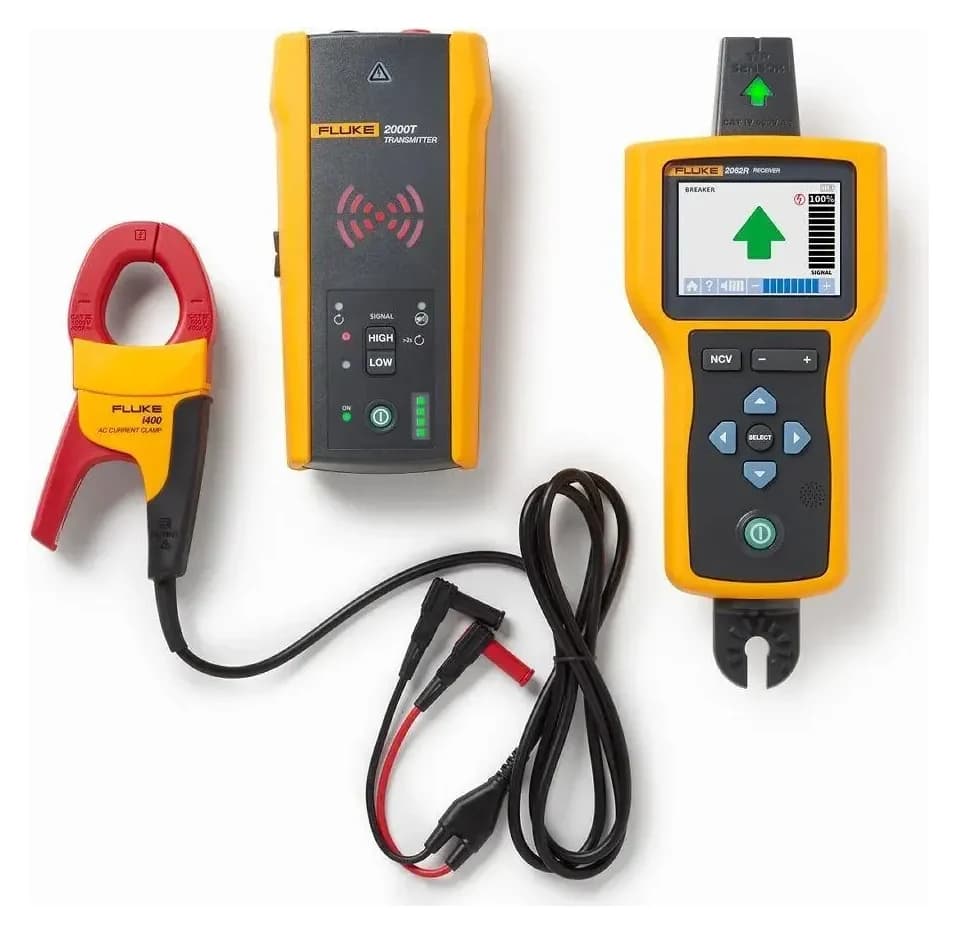
The 2062 is the electric-circuit tracer pick when the whole AC job — energized or de-energized, residential through industrial — has to sit under one rating. Fluke's 2062 page rates both the 2062R receiver and 2000T transmitter CAT IV 600V with 600V AC/DC operation, markets the tool for residential, commercial and industrial environments, and states this CAT rating offers the highest protection available on any wire tracer. It also says the product is designed for transient overvoltage spikes up to 8,000V. The transmitter automatically senses whether the system is energized or de-energized and selects a 6.25 kHz or 32.768 kHz output frequency, and the receiver offers Smart Sensor, tip-sensor and breaker modes — breaker mode identifies breakers and fuses based on the highest recorded signal from the transmitter.
The kit includes the i400 AC current clamp for inducing a tracing signal when there is no access to bare conductors (Fluke notes the Loop-mode boosted 6 kHz signal through insulation), plus the 2000ACC lead set, outlet adapters, magnetic hanger, batteries and a hard case. The trade-offs are the professional ones: the clamp's manual-specified connection conditions (the transmitter cannot determine whether wires it encloses are energized), and a price class beyond household outlet mapping — where the ET310 is already sufficient.
When the circuit is not AC mains: Fluke Networks Pro3000
For de-energized network, telephone and other low-voltage pairs, an analog tone-and-probe set is the correct tool, and Fluke Networks' Pro3000 is the long-standing one. Its datasheet documents SmartTone pair identification — short the far end of a pair and the tone cadence changes, positively verifying the pair — a tone signal sent up to 10 miles (16 km) on most cables, angled bed-of-nails clips, a rugged RJ-11 plug for direct access to phone and data jacks, and the probe's loud speaker for tracing through drywall, wood, or other enclosures. Fluke Networks states it tones and traces wire on non-active networks. The toner also checks continuity and line polarity, and over-voltage protection is specified at 60VDC in toner/polarity mode.
The variants matter here: the 26000900 kit pairs the tone generator with the unfiltered probe; the PRO3000F60-KIT pairs it with the 60 Hz filtered probe for North America (the PRO3000F50 versions are international only); and the datasheet lists a free spare tip and nylon pouch inside the kit. This is not an AC breaker finder — its probes hear tone on pairs, not transmitter signals on breaker panels.
What AC-only actually means in breaker identification
- Yes: Live 120V AC outlets: plug-in transmitters (ET310, 61-535) are built for this job
- Yes: 240V/480V AC circuits: ET450 and Fluke 2062 document the higher voltage ranges
- Yes: De-energized AC wiring: ET450 and Fluke 2062 trace with the circuit off
- No: Dead circuits with a circuit-powered transmitter: the ET310 transmitter cannot power up
- No: DC and automotive circuits: AC outlet finders are outside their design; match a DC tracer
- No: Absence-of-voltage proof: identification is not verification; use a listed voltage tester
An "AC" rating is a boundary in three places: where the transmitter connects (a three-pin grounded outlet plug limits you to live North American 120V-style receptacles), how the transmitter is powered (circuit-powered tools like the ET310 die with the circuit), and the breaker identification principle (the receiver follows the transmitter's injected signal on AC wiring — it is not a DC or ohmmeter function). Klein's ET310 and ET450 pages and Fluke's 2062 page all describe signal-injection tracing; none of them documents DC breaker identification.
Outlet, breaker and panel compatibility
Outlet connection. The ET310's three-pin plug requires a North-American grounded outlet, and ungrounded or two-prong cases need the ET310KIT's 3-to-2 adapter; the ET350/ET310 family and the 61-535 are all 120V-class. Lighting fixtures need a screw-in socket adapter: included with ET310KIT, optional 69411 for the ET310, and the ET450 kit ships prongs, clips and lead adapters for hardwired points.
Breaker and panel type. These finders identify the breaker with the strongest transmitter signal, which works the same on a conventional or AFCI/GFCI breaker — nothing in the makers' pages restricts identification to plain breakers. The practical variables are panel crowding and shielding: grounded metal conduit shields the ET450's signal, and the ET310's learning scan is the tool's answer to adjacent-breaker confusion.
Voltage boundary. 90–120V AC on the ET310; 120V AC live branch circuits on the 61-535; 480V AC/DC disconnect threshold on the ET450; 600V AC/DC on the Fluke 2062. A higher rating is not a licence: each manual restricts connection to its documented methods, and panel work itself belongs to a licensed electrician.
GFCI and AFCI behavior to check before buying
Three documented interactions matter:
- ET310 GFCI test: pressing the transmitter's GFCI button trips a working device; the instructions cover reading the result and resetting. Before testing, consult the GFCI device's own user manual.
- ET450 remote ground trips GFCIs: the manual states this connection method will trip GFCI receptacles; on protected circuits use the direct-ground method and expect a weaker signal.
- Breaker-level tests belong to the breaker. For a GFCI or AFCI breaker, the manufacturer's test button on the breaker itself is the documented test; the finder only tells you which breaker feeds the circuit.
Verification and lockout workflow
Confirm the circuit type
Match voltage and outlet style to the transmitter; do not connect an AC-only finder to a higher-voltage supply.
Let the receiver learn the panel
ET310: reset away from the panel, one full learning scan, then the identification scan. 61-535: sweep for the strongest signal.
Switch off and verify
Throw the identified breaker, then verify absence of voltage with a listed tester — the finder's identification is not that proof.
Lock out and re-check
Apply your lockout/tagout procedure and re-test before touching conductors; leave panel work to a licensed electrician.
Klein's ET310 instructions require verifying the tester on a known live and correctly wired receptacle before each use, and verifying the circuit is de-energized before inspecting, applying or removing anything. Fluke's tracer manual likewise requires a separate tester to verify de-energization. Our non-contact voltage tester guide covers the first check; a plug-in outlet tester gives the second.
Comparison: the four AC picks side by side
Klein ET310
- Circuit scope (maker-documented)
- Live 90–120V AC grounded outlets
- Voltage class
- CAT II 120V
- Power
- Transmitter circuit-powered; receiver 1×9V
All specifications
- Extras that earn the price
- Wiring lights, GFCI test, learning scan
IDEAL 61-535
- Circuit scope (maker-documented)
- Live 120V AC branch circuits
- Voltage class
- CAT II 150V
- Power
- Page says 2×9V; manual says receiver 1×9V, circuit-powered transmitter
All specifications
- Extras that earn the price
- Mute, NCV tip 80–300V, work light
Klein ET450
- Circuit scope (maker-documented)
- Energized and de-energized breakers, fuses, wires
- Voltage class
- Transmitter CAT III 600V; disconnect above 480V
- Power
- Included batteries
All specifications
- Extras that earn the price
- 8 sensitivity levels, 0–99 signal, lead kit, hard case
Fluke 2062
- Circuit scope (maker-documented)
- Energized and de-energized wires to 600V AC/DC
- Voltage class
- CAT IV 600V
- Power
- Receiver 4×AA; transmitter 8×AA
All specifications
- Extras that earn the price
- Smart Sensor display, i400 clamp, auto 6/33 kHz
Full comparison table
Swipe to compare. Row labels stay visible.
| Model | Circuit scope (maker-documented) | Voltage class | Power | Extras that earn the price |
|---|---|---|---|---|
| Klein ET310 | Live 90–120V AC grounded outlets | CAT II 120V | Transmitter circuit-powered; receiver 1×9V | Wiring lights, GFCI test, learning scan |
| IDEAL 61-535 | Live 120V AC branch circuits | CAT II 150V | Page says 2×9V; manual says receiver 1×9V, circuit-powered transmitter | Mute, NCV tip 80–300V, work light |
| Klein ET450 | Energized and de-energized breakers, fuses, wires | Transmitter CAT III 600V; disconnect above 480V | Included batteries | 8 sensitivity levels, 0–99 signal, lead kit, hard case |
| Fluke 2062 | Energized and de-energized wires to 600V AC/DC | CAT IV 600V | Receiver 4×AA; transmitter 8×AA | Smart Sensor display, i400 clamp, auto 6/33 kHz |
Scroll horizontally to see every column
| Model | Circuit scope (maker-documented) | Voltage class | Power | Extras that earn the price |
|---|---|---|---|---|
| Klein ET310 | Live 90–120V AC grounded outlets | CAT II 120V | Transmitter circuit-powered; receiver 1×9V | Wiring lights, GFCI test, learning scan |
| IDEAL 61-535 | Live 120V AC branch circuits | CAT II 150V | Page says 2×9V; manual says receiver 1×9V, circuit-powered transmitter | Mute, NCV tip 80–300V, work light |
| Klein ET450 | Energized and de-energized breakers, fuses, wires | Transmitter CAT III 600V; disconnect above 480V | Included batteries | 8 sensitivity levels, 0–99 signal, lead kit, hard case |
| Fluke 2062 | Energized and de-energized wires to 600V AC/DC | CAT IV 600V | Receiver 4×AA; transmitter 8×AA | Smart Sensor display, i400 clamp, auto 6/33 kHz |
Sources: ET310 page and instructions, 61-535 page, ET450 kit page and manual, Fluke 2062 page.
How we choose
We compared the makers' product pages, manuals and datasheets — operating voltage, circuit state, connection accessories and documented workflow — checked November 5, 2026. These are research-based picks; we have not physically tested the tools. Conflicting or unstated figures are left out. Our selection method explains the process.
Verdict
On a live 120V AC outlet, buy the Klein ET310 (or the IDEAL 61-535 when a mute, an NCV tip and a work light earn their place). Buy the Klein ET450 when 240V circuits, fuses or de-energized wiring are in scope, and the Fluke 2062 for professional tracing under CAT IV 600V with a clamp. For de-energized low-voltage pairs, the Pro3000 tone and probe is the right instrument — and for anything DC, automotive or network-tuning, choose the tool made for that circuit instead. The wider field, including the ET350's outlet diagnostics, is in our best circuit breaker finders roundup.
Frequently asked questions
Will an AC circuit breaker finder work on a 240V circuit?
Only if the transmitter is documented for that voltage. Klein's ET310 is a 90–120V AC outlet tool: its instructions say it is designed for 120V AC systems and to not connect it to higher-voltage supplies. The IDEAL 61-535 is likewise a 120V AC branch-circuit tool. For 240V-class work, Klein lists 12V, 48V, 120V, 240V and 480V external voltage indicators on the ET450; the 240V indicator can also illuminate at 208V or 277V, and the transmitter must be disconnected above 480V AC/DC. Fluke documents the 2062 for 600V AC/DC circuits. Match the connected breaker type in your panel before buying.
Can a circuit breaker finder identify a DC breaker or a 12/24V automotive circuit?
Not an AC-only outlet finder. The ET310 transmitter plugs into North American grounded outlets on AC mains and takes its power from the circuit; DC and automotive work are outside that design. Klein positions the ET450 as a tracer for energized and de-energized breakers, fuses and wires with AC/DC external voltage indicators, and it lists tracing frequencies but does not document a DC breaker-identification mode. For automotive circuits, a dedicated DC circuit tracer is the matching category; our general guide covers the boundary.
Do these finders work on GFCI or AFCI breakers?
Yes for identification, with two cautions. An ET310 can trip a GFCI while testing it, and the manual tells you to reset the device; the ET450's remote-ground connection method will trip GFCI receptacles, so use the direct-ground method on those circuits. None of these GFCI test buttons verify arc-fault (AFCI) protection: use the breaker manufacturer's own test procedure. Our general breaker-finder guide covers the Eaton distinction.
Can I trace wires that are not live, like network or thermostat cable?
Use a tone-and-probe set, not an AC outlet finder. Fluke Networks' Pro3000 is designed to tone and trace wire on non-active networks, with angled bed-of-nails clips, an RJ-11 plug and SmartTone pair identification by shorting the far end. For AC power wiring that is switched off, the ET450 and Fluke 2062 both document de-energized tracing. Mains-voltage tracing still follows the maker's manual.
Does the finder prove the breaker is off before I work on the circuit?
No. Identifying the correct breaker is not an absence-of-voltage test. Klein's ET310 instructions require verifying de-energization before inspecting or removing anything, and Fluke's tracer manual requires an additional tester to verify de-energization. Use a listed voltage tester, apply lockout/tagout discipline, and leave panel work to a licensed electrician.
Why does my breaker finder point at more than one breaker?
The ET310's receiver learns the panel on a first scan — ignoring all indications — and identifies the breaker on the second; its instructions say to always reset the receiver away from the panel, because resetting near a learned panel corrupts the result. On the ET450, a signal-strength reading of 99 means saturation, not extra certainty, and energized circuits typically use sensitivity levels 1–3 while de-energized circuits may need levels 4–8. Have an electrician resolve any ambiguous identification.

Related guides
Buying guide · Voltage & Outlet Testers
Circuit Tracer Tools: How to Choose a Kit That Finds the Right Wire
Choose a circuit tracer kit for breaker ID, dead-wire tracing, live circuits or buried cable. Compare the Klein ET310, ET450, Fluke 2062 and NOYAFA NF-820 kits.
Buying guide · Voltage & Outlet Testers
Breaker Finder Kit Buying Guide: Compare What Is Actually Included
Compare breaker finder kits by included transmitters, receivers, adapters, leads, batteries and cases, so you pay for the package your job needs.
Buying guide · Voltage & Outlet Testers
Circuit Breaker Locator Buying Guide: Find the Right Breaker Safely
Choose a circuit breaker locator for outlet, lighting and panel jobs. Compare the Klein ET310, ET450, Fluke 2062 and IDEAL 61-535 kits before you buy.