

Buying guide
Circuit Tracer Tools
How to Choose a Kit That Finds the Right Wire
Choose a circuit tracer kit for breaker ID, dead-wire tracing, live circuits or buried cable. Compare the Klein ET310, ET450, Fluke 2062 and NOYAFA NF-820 kits.
By thisMETER EditorialUpdated November 5, 202611 min read4 picks
On this page · Our picks at a glance
Our picks at a glance
- 1
Which breaker feeds this outlet
120 V max · CAT II 120V
Choose for: Which breaker feeds this outlet
Limit: It does not follow wire routes; see our breaker-finder guide
- 2
Follow a wire in walls, floors or ceilings
480 V max · CAT III 600V
Choose for: Follow a wire in walls, floors or ceilings
Limit: A large, 6-plus-pound kit; overkill for someone who only wants to identify outlet breakers
- 3
Pro troubleshooting, guidance display
600 V max · CAT IV 600 V, CAT III 1000 V
Choose for: Pro troubleshooting, guidance display
Limit: Clamp needs an eligible closed return path
Show all 4 picks
- 4
Buried or very long low-budget runs
Choose for: Buried or very long low-budget runs
Limit: Depth and distance claims are conditional; no CAT marking stated
If you need to follow a wire — through drywall, along a conduit run, or out into the yard — the Klein Tools ET450 is the kit most buyers should get: it traces energized and de-energized breakers, fuses and wires with direct-connection leads, prongs and clips, and ships with every adapter and battery in a hard case. If the job is only "which breaker runs this outlet," the Klein ET310 breaker finder is the cheaper, simpler answer. Electricians who want directional guidance and clamp coupling through insulation should look at the Fluke 2062, and the NOYAFA NF-820 covers maker-claimed buried-cable work at a DIY price. Recommendations are based on maker specifications and manuals, checked November 5, 2026.
- 480 VKlein's ET450 disconnect-immediately limit, per its manual
- 8Receiver sensitivity levels on both the ET450 and Fluke 2062
- 2 mNOYAFA's stated NF-820 detection depth for underground cable
Quick picks: buy for the tracing job
Compare specifications and all conditions
Which breaker feeds this outlet
- Our pick
- Klein ET310
- What earns its place
- Circuit-powered transmitter, wiring indicators, GFCI test
- What to check before buying
- It does not follow wire routes; see our breaker-finder guide
Follow a wire in walls, floors or ceilings
- Our pick
- Klein ET450
- What earns its place
- Energized and de-energized tracing, prongs, clips and long leads, hard case
- What to check before buying
- Remote-ground method trips GFCI receptacles
Pro troubleshooting, guidance display
- Our pick
- Fluke 2062
- What earns its place
- Smart Sensor display, CAT IV instruments, i400 clamp
- What to check before buying
- Clamp needs an eligible closed return path
Buried or very long low-budget runs
- Our pick
- NOYAFA NF-820
- What earns its place
- Maker-claimed 2 m depth and long tracing distance
- What to check before buying
- Depth and distance claims are conditional; no CAT marking stated
Full comparison table
Swipe to compare. Row labels stay visible.
| Your job | Our pick | What earns its place | What to check before buying |
|---|---|---|---|
| Which breaker feeds this outlet | Klein ET310 | Circuit-powered transmitter, wiring indicators, GFCI test | It does not follow wire routes; see our breaker-finder guide |
| Follow a wire in walls, floors or ceilings | Klein ET450 | Energized and de-energized tracing, prongs, clips and long leads, hard case | Remote-ground method trips GFCI receptacles |
| Pro troubleshooting, guidance display | Fluke 2062 | Smart Sensor display, CAT IV instruments, i400 clamp | Clamp needs an eligible closed return path |
| Buried or very long low-budget runs | NOYAFA NF-820 | Maker-claimed 2 m depth and long tracing distance | Depth and distance claims are conditional; no CAT marking stated |
Scroll horizontally to see every column
| Your job | Our pick | What earns its place | What to check before buying |
|---|---|---|---|
| Which breaker feeds this outlet | Klein ET310 | Circuit-powered transmitter, wiring indicators, GFCI test | It does not follow wire routes; see our breaker-finder guide |
| Follow a wire in walls, floors or ceilings | Klein ET450 | Energized and de-energized tracing, prongs, clips and long leads, hard case | Remote-ground method trips GFCI receptacles |
| Pro troubleshooting, guidance display | Fluke 2062 | Smart Sensor display, CAT IV instruments, i400 clamp | Clamp needs an eligible closed return path |
| Buried or very long low-budget runs | NOYAFA NF-820 | Maker-claimed 2 m depth and long tracing distance | Depth and distance claims are conditional; no CAT marking stated |
What a circuit tracer kit should include
A tracing kit is a transmitter plus a receiver, and the difference between kits is mostly what connects the transmitter to the circuit. Klein's ET450 kit lists the pieces that matter: transmitter, receiver, blade and ground prongs, alligator clips, three-foot and twenty-foot lead adapters, AC plug leads, instructions, all required batteries, and a hard carrying case. Fluke's 2062 kit lists its receiver, transmitter, i400 AC Current Clamp, 2000ACC test lead accessory kit, magnetic hanger, batteries, hard case and a quick reference guide.
- Yes: Outlet plug connection (ET310, ET450, ET310 accessories)
- Yes: Clips or leads for direct conductor connection (ET450, 2062)
- Yes: Long extension leads for remote grounding (ET450)
- Yes: Clamp coupling through insulation (2062, via i400)
- No: Tracing without any return path (no kit)
- No: Reliable depth claims through metal conduit (signal is shielded)
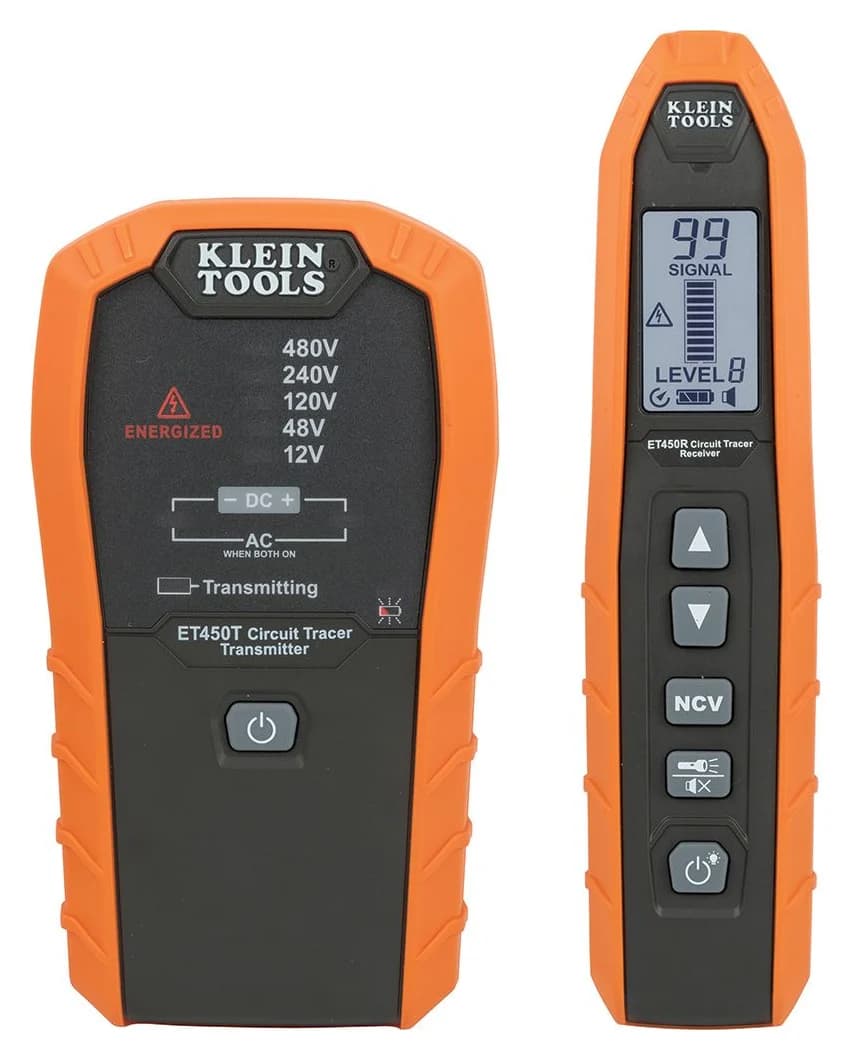
The receiver side matters just as much. Klein's ET450 receiver shows 0–99 signal strength on its LCD with a 0–10 bar graph, tone and eight sensitivity levels; Fluke's 2062R adds the Smart Sensor display that visualizes energized-wire orientation on a color LCD, while in Smart Sensor mode it automatically adjusts sensitivity and prevents manual adjustment. Both are reading the same physics — a transmitted tone on the conductor — with different feedback for the user.
Energized, de-energized, and the limits that come with each
The ET450 and Fluke 2062 are specified for energized and de-energized circuits; that is the capability that separates a tracer from a breaker finder. The ET310's transmitter is powered by the outlet itself and Klein specifies 90 to 120 V AC operation, so the circuit must be live for it to work at all. The ET450 and Fluke 2000T transmitters each inject their own signal, and Fluke's transmitter automatically senses whether the system is energized or de-energized and selects its output frequency accordingly. NOYAFA's page claims the NF-820 supports high- and low-voltage circuits, but its manual warns against detecting a live power cord, so treat the NF-820's energized tracing as unconfirmed.
Two documented limits shape real jobs. First, Klein's manual prefers a remote-ground connection for signal strength — connecting the ground prong via the twenty-foot lead to a different circuit's ground — and warns that this method will trip GFCI receptacles, with direct-ground, clip or de-energized workarounds. Second, metal conduit shields the transmitted signal from the receiver, which is why none of these kits promises dependable tracing through steel. Fluke's manual similarly restricts its clamp to low-impedance closed circuits or conduit grounded at both ends.
Depth, wall material and buried-cable claims
Source: each maker's product page or manual (linked in the sections below)
Treat every depth number as a conditional claim, not a guarantee. Klein gives two conditional ET450 depth statements: 0 to 0.5 m in the receiver specification and approximately 2 ft (0.6 m) in its underground tracing instructions, and the same manual documents detection through drywall, cement block and underground. NOYAFA states the NF-820 detects cable location underground at up to two meters depth; NOYAFA's pages conflict on the NF-826, listing 2.5 m in an NF-820-page comparison while the NF-826's own page lists a 2 m maximum depth range. Fluke does not publish a burial depth for the 2062; its longer tip-sensor distances are open-air specifications. If the job is genuinely underground utility locating, a dedicated buried-utility locator with a stronger transmitter is the professional answer.
Best overall wire tracer kit: Klein Tools ET450
Klein's ET450 page calls it a professional tracer for energized and non-energized breakers, fuses and wires, detectable through drywall, cement block and underground.
- Coverage: energized and de-energized breakers, fuses and wires
- Signal and feedback: 33 kHz transmitter frequency; receiver with LCD backlight, 0–99 signal strength, 0–10 bar graph, tone, plus flashlight and non-contact voltage function specified from 80 to 1000 V AC
- Safety markings: transmitter CAT III 600V, receiver CAT III 600V / CAT II 1000V; the manual's disconnect instruction above 480 V AC/DC controls the operating limit
- In the box: transmitter, receiver, prongs, clips, lead adapters, plug leads, batteries (six AA for the transmitter, four for the receiver) and hard case
- Ruggedness: 6.6 ft. (2 m) drop protection and IP42 ingress rating
The trade-offs: the remote-ground method trips GFCIs, metal conduit blocks the signal, and there is no clamp for insulation-only coupling — you need access to a conductor, an outlet, or clips on bare (verified dead) wire. For the choice between this and the smaller ET310, read our ET310 vs ET450 comparison; for the step up to Fluke, see ET450 vs Fluke 2062.
See the ET450 kit at Klein Tools
Best for breaker identification only: Klein Tools ET310
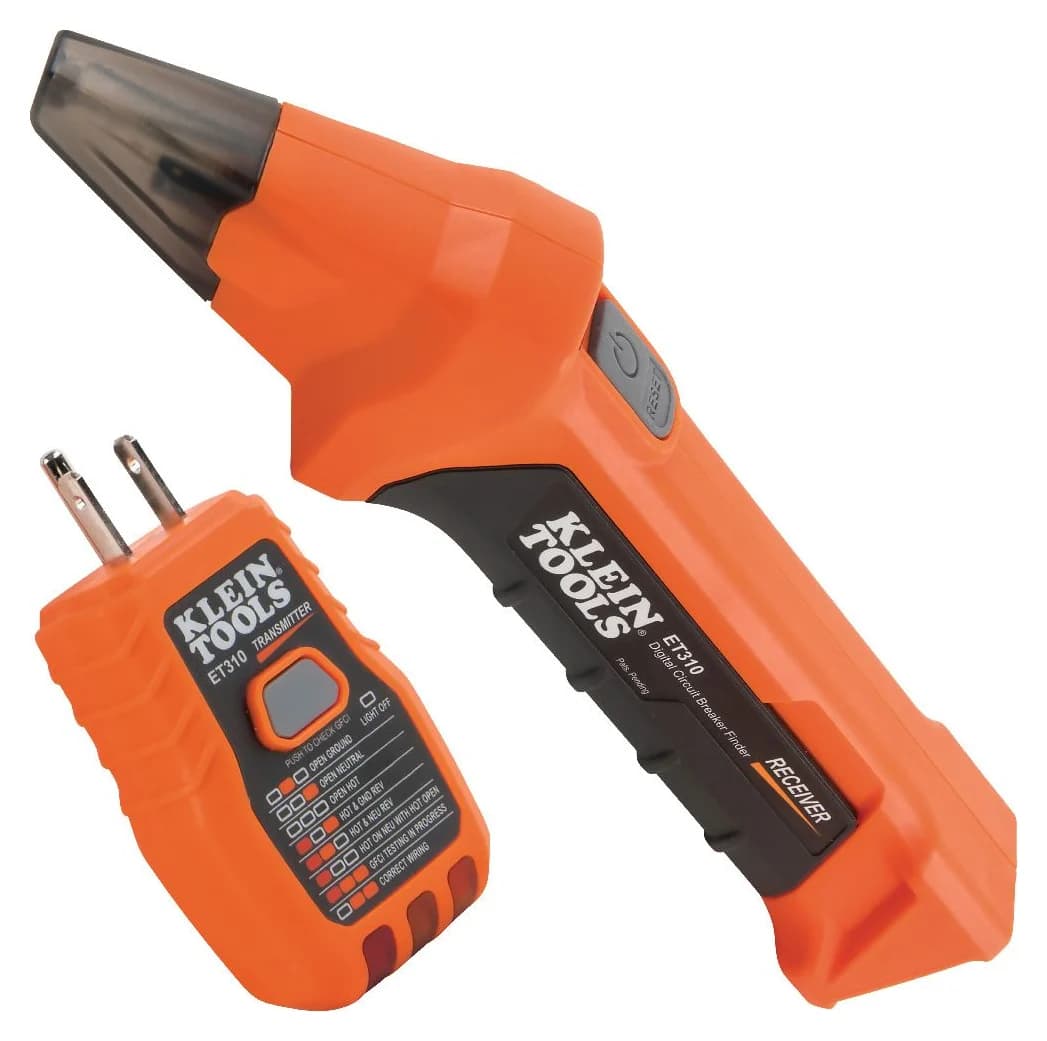
Most "circuit tracer" searches are really breaker searches. The ET310 is a digital circuit breaker finder with an integrated GFCI outlet tester: plug the transmitter into the outlet, scan the receiver down the panel, and the strongest signal identifies the breaker.
- Coverage: locating breakers for outlets and fixtures on 90–120 V AC systems, plus wiring-condition indicators and a GFCI test
- Power: the transmitter is powered by the circuit under test; one 9 V battery runs the receiver
- Safety markings: CAT II 120V, indoor use only, 120 V AC systems only
- Extras: the optional 69411 accessory kit adds adapters for connecting the transmitter to fixtures and bare wires; Klein says to verify bare wires are not energized before applying or removing the transmitter
The trade-offs: it does not trace wire routes, it cannot work on a dead circuit, and Klein's warnings say to de-energize before clipping accessories to bare wires. If that is your whole job, our breaker-finder roundup covers the full field, including the IDEAL 61-535 and the ET310KIT package.
Best for pros and clamp access: Fluke 2062
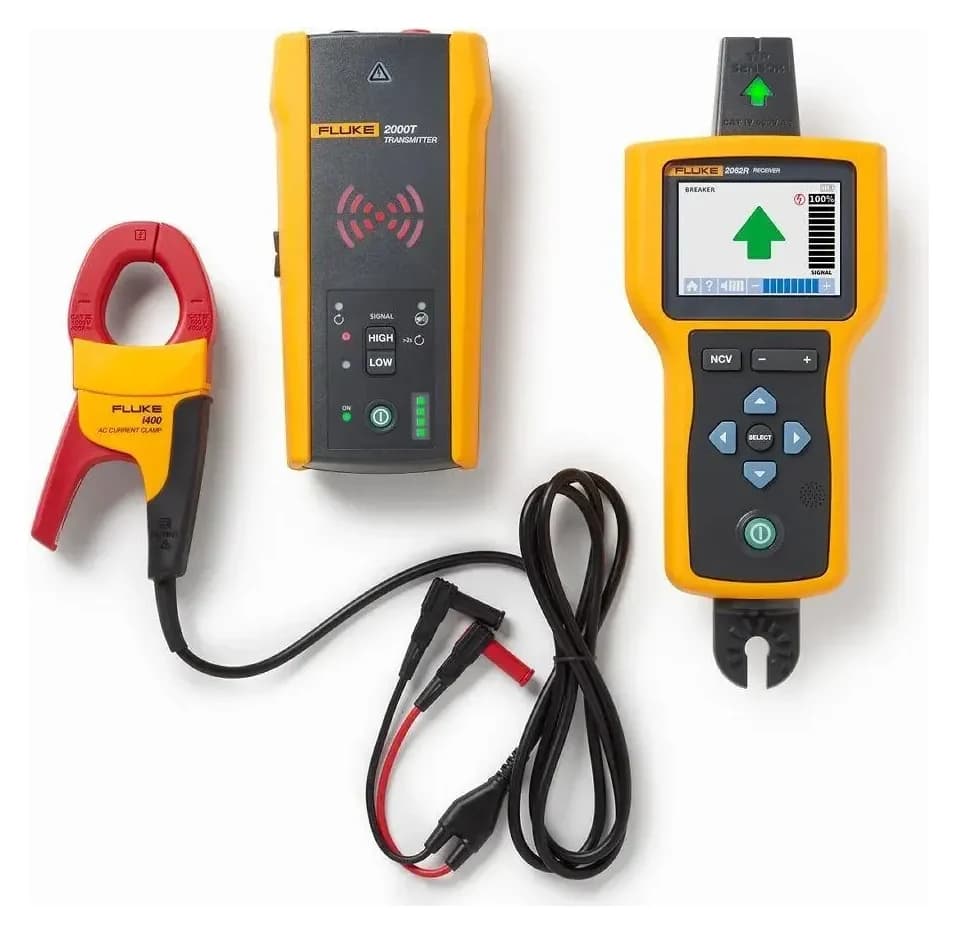
The Fluke 2062 Advanced Pro Wire Tracer Kit is the professional step up. Fluke rates both the 2062R receiver and 2000T transmitter CAT IV 600 V with a 600 V AC/DC operating voltage, and the kit includes the i400 clamp for inducing a tracing signal through cable insulation when there is no access to bare conductors.
- Guidance: the Smart Sensor locates and displays energized wires on a color display; a tip sensor with audible tone handles corners, tight spaces and junction boxes
- Modes: four receiver tracing modes, including passive non-contact voltage tracing without the transmitter; three transmitter power modes (high, low, loop)
- Frequencies: the 2000T automatically selects its output frequency for energized versus de-energized circuits
- In the box: receiver, transmitter, i400 clamp, 2000ACC lead accessory kit, magnetic hanger, batteries, hard case, quick reference guide
The trade-offs: it is a professional-budget instrument, and the clamp is not a universal solution — Fluke's documentation restricts it to low-impedance closed circuits or conduits and shielded wires grounded at both ends, and with the clamp attached the transmitter cannot determine whether the enclosed wires are energized. The Fluke 2052 kit carries the same transmitter, clamp and lead accessories without the 2062R's Smart Sensor or the 2062's Smart strap magnetic hanger; its 2052R receiver still has a color LCD with a Quick Scan mode for energized-wire detection and visualization, which we break down in ET450 vs Fluke 2062.
Budget pick for buried and long runs: NOYAFA NF-820
The NOYAFA NF-820 is a high/low-voltage wire tracker aimed at DIY and low-voltage budgets. NOYAFA states a detection depth up to two meters for underground or otherwise invisible cable, adjustable transmitter and receiver sensitivity, an AC anti-interference mode, and tracing of single, two-core or multi-core cable.
- Coverage: maker-claimed underground detection to 2 m and long tracing distance; open circuits, shorts and breaks
- Connection: alligator clips; NOYAFA states the clips can connect to circuits up to 400 V AC
- Power: conflicting NOYAFA descriptions — the product page says a lithium transmitter and 9 V receiver, while the manual lists 3.7 V lithium batteries for transmitter (1800 mAh) and receiver (1100 mAh); confirm the shipped hardware before buying batteries
- Certifications: RoHS, FCC and CE compliance, per NOYAFA
The trade-offs: no IEC measurement-category (CAT) marking is stated, depth and distance figures are conditional maker claims rather than third-party tests, and NOYAFA's own pages conflict on the NF-826: its comparison table gives it backlit LCDs, a lithium receiver battery and a 2.5 m depth, while the NF-826's own product page lists a 2 m maximum depth range. For the differences, read our NF-820 vs NF-826 comparison. For automotive short-circuit tracing instead, see our Power Probe ECT3000 guide.
How the kits compare
These are manufacturer specifications, not comparative field results. Sources: Klein's ET450 page and manual, Klein's ET310 page, Fluke's 2062 page and NOYAFA's NF-820 page.
Identify the breaker
- Klein ET310
- Yes
- Klein ET450
- Yes
- Fluke 2062
- Yes
All specifications
- NOYAFA NF-820
- Not the design focus
Follow a wire route
- Klein ET310
- No
- Klein ET450
- Yes
- Fluke 2062
- Yes
All specifications
- NOYAFA NF-820
- Yes
Energized and de-energized
- Klein ET310
- Live circuits only
- Klein ET450
- Both
- Fluke 2062
- Both
All specifications
- NOYAFA NF-820
- Maker claims conflict; manual warns against live power-cord detection
Connection to the circuit
- Klein ET310
- Outlet plug
- Klein ET450
- Prongs, clips, leads
- Fluke 2062
- Leads, probes, adapters, i400 clamp
All specifications
- NOYAFA NF-820
- Alligator clips
Safety category stated
- Klein ET310
- CAT II 120V
- Klein ET450
- CAT III 600V
- Fluke 2062
- CAT IV 600 V
All specifications
- NOYAFA NF-820
- None stated
Receiver feedback
- Klein ET310
- LEDs and tone
- Klein ET450
- LCD 0–99, bar graph, tone
- Fluke 2062
- Color display, Smart Sensor, tone
All specifications
- NOYAFA NF-820
- Speaker and indicator light
Stated depth or distance
- Klein ET310
- Not applicable
- Klein ET450
- Up to half a meter, conditional
- Fluke 2062
- Open-air tip-sensor distances
All specifications
- NOYAFA NF-820
- Up to two meters, conditional
Full comparison table
Swipe to compare. Row labels stay visible.
| Capability | Klein ET310 | Klein ET450 | Fluke 2062 | NOYAFA NF-820 |
|---|---|---|---|---|
| Identify the breaker | Yes | Yes | Yes | Not the design focus |
| Follow a wire route | No | Yes | Yes | Yes |
| Energized and de-energized | Live circuits only | Both | Both | Maker claims conflict; manual warns against live power-cord detection |
| Connection to the circuit | Outlet plug | Prongs, clips, leads | Leads, probes, adapters, i400 clamp | Alligator clips |
| Safety category stated | CAT II 120V | CAT III 600V | CAT IV 600 V | None stated |
| Receiver feedback | LEDs and tone | LCD 0–99, bar graph, tone | Color display, Smart Sensor, tone | Speaker and indicator light |
| Stated depth or distance | Not applicable | Up to half a meter, conditional | Open-air tip-sensor distances | Up to two meters, conditional |
Scroll horizontally to see every column
| Capability | Klein ET310 | Klein ET450 | Fluke 2062 | NOYAFA NF-820 |
|---|---|---|---|---|
| Identify the breaker | Yes | Yes | Yes | Not the design focus |
| Follow a wire route | No | Yes | Yes | Yes |
| Energized and de-energized | Live circuits only | Both | Both | Maker claims conflict; manual warns against live power-cord detection |
| Connection to the circuit | Outlet plug | Prongs, clips, leads | Leads, probes, adapters, i400 clamp | Alligator clips |
| Safety category stated | CAT II 120V | CAT III 600V | CAT IV 600 V | None stated |
| Receiver feedback | LEDs and tone | LCD 0–99, bar graph, tone | Color display, Smart Sensor, tone | Speaker and indicator light |
| Stated depth or distance | Not applicable | Up to half a meter, conditional | Open-air tip-sensor distances | Up to two meters, conditional |
How we choose
We compared maker product pages, instruction manuals, marked safety categories and documented kit contents, checked November 5, 2026. These are research-based recommendations; we have not physically tested these tracers. Where the makers disagree — depth figures, voltage limits, what a category marking permits — we state the conflict instead of picking a number. Our selection method explains the process.
Buying guide: match the kit to the job before the brand
Name the job
Breaker identification, dead-wire tracing, live tracing or buried runs need different tools.
Check the connection you can make
Outlet, bare conductor, clip access or insulation-only clamp decides which kit can couple a signal.
Read the limits, not the headline
GFCI trips, metal conduit shielding and return-path requirements are in the manuals.
Verify the safety category
The lowest-rated accessory limits the whole setup; panel work belongs to a licensed electrician.
Breaker identification needs the least. The ET310 and IDEAL 61-535 both do it for live 120 V AC branch circuits; Ideal's page adds a receiver non-contact voltage sensor up to 300 V AC and a mute button. Neither replaces a tracer for route-following.
De-energized tracing needs a signal path. The ET450 and 2000T inject their own tone, but every connection method in the manuals assumes a return path. An isolated open wire with no closed loop is the case no transmitter-and-receiver kit solves by itself.
Buried-cable claims deserve the most skepticism. Depth numbers are conditional, and NOYAFA's are maker self-reports. Before trenching or drilling over a claimed trace, call the national "call before you dig" utility-locating service — that is the free, official answer for underground utilities, and no consumer tracer substitutes for it.
When to stop and call an electrician
Open-panel work, service-entrance equipment, shared neutrals you cannot isolate, and any circuit you cannot positively de-energize and lock out are licensed-electrician territory. A tracer is a locating aid, not a test instrument for energized bare conductors: Klein's ET310 manual tells you to verify the circuit is not energized before applying clip accessories to bare wires. Use the tracer to gather information, then hand the panel work to a pro. For the smaller job of confirming an outlet is wired correctly, our outlet tester guide covers plug-in checkers.
Verdict
Buy the ET450 if following wires is the actual job; buy the ET310 if you only need the breaker; step up to the Fluke 2062 for CAT IV-rated instruments, directional guidance and clamp access; and consider the NOYAFA NF-820 for low-budget buried runs with honestly conditional expectations. Whichever kit you choose, read its manual's connection methods and operating limits before the first job — the differences between these tools live in what they can connect to, not in the headline frequency.
Frequently asked questions
What is the difference between a circuit breaker finder and a circuit tracer?
A breaker finder answers one question: which breaker controls this outlet? Klein's ET310 does that with a plug-in transmitter and a receiver you scan down the panel, plus outlet wiring and GFCI checks. A tracer like the ET450 or Fluke 2062 follows the conductor itself through walls, floors or ground, energized or dead, using direct leads or a clamp. If you only need to shut the right breaker off, a breaker finder is the cheaper, simpler tool; see our circuit-breaker finder guide.
Can a circuit tracer follow a wire with the power off?
Yes. The Klein ET450 and Fluke 2062 are both specified for de-energized breakers, fuses and wires. The ET450's transmitter connects with prongs, clips or leads; the Fluke's loop mode is for closed de-energized circuits, and its transmitter picks a different output frequency for energized versus de-energized work. A dead wire still needs a return path for the signal, so check the manual's connection methods before buying.
How deep can these tools trace a buried cable?
Only the makers' conditional claims exist here. Klein gives two conditional ET450 depth statements: 0 to 0.5 m in the receiver specification and approximately 0.6 m in its underground tracing instructions, both depending on medium and application. NOYAFA states a two-meter depth for the NF-820 on underground runs, while its NF-826 page also says 2 m and a separate NOYAFA comparison says 2.5 m. Fluke's longer tip-sensor distances are open-air specifications, not burial claims. Soil, conduit and nearby conductors all change real performance, so treat depth figures as best-case maker statements.
Is it safe to use a circuit tracer inside a live panel?
Treat the marked category as a limit, not permission. Klein marks the ET450 transmitter CAT III 600V but instructs you to disconnect it immediately above 480 V AC/DC. Fluke rates the 2062 receiver and transmitter CAT IV 600 V with a 600 V AC/DC operating voltage, and its outlet adapters are rated lower than the instruments. Panels and service equipment are work for a licensed electrician; a tracer's indicators do not prove a conductor is safe to touch.

Related guides
Buying guide · Voltage & Outlet Testers
Circuit Breaker Finders for Tool Selection: Which Family Should You Buy?
Decide between a breaker finder, a wire tracer, an outlet tester and a tone-and-probe kit. Compare Klein ET310, ET350, ET450, Fluke 2052 and kit contents.
Buying guide · Voltage & Outlet Testers
Circuit Breaker Locator Buying Guide: Find the Right Breaker Safely
Choose a circuit breaker locator for outlet, lighting and panel jobs. Compare the Klein ET310, ET450, Fluke 2062 and IDEAL 61-535 kits before you buy.
Buying guide · Voltage & Outlet Testers
Breaker Finder Kit Buying Guide: Compare What Is Actually Included
Compare breaker finder kits by included transmitters, receivers, adapters, leads, batteries and cases, so you pay for the package your job needs.