

Buying guide
Circuit Breaker Finders for Tool Selection
Which Family Should You Buy?
Decide between a breaker finder, a wire tracer, an outlet tester and a tone-and-probe kit. Compare Klein ET310, ET350, ET450, Fluke 2052 and kit contents.
By thisMETER EditorialUpdated November 5, 20269 min read5 picks
On this page · Our picks at a glance
Our picks at a glance
- 1
Label the breaker behind a live outlet
120 V max · CAT II 120V
Choose for: Label the breaker behind a live outlet
Limit: 120V AC indoor systems only; do not connect it to higher-voltage supplies
- 2
Same job plus outlet health checks
Choose for: Same job plus outlet health checks
Limit: 69411 fixture accessory kit sold separately
- 3
Follow wire routes, live or dead circuits
480 V max · CAT III 600V
Choose for: Follow wire routes, live or dead circuits
Limit: Not a plug-and-play outlet finder; read the connection methods
Show all 5 picks
- 4
Professional tracing, highest safety rating
Choose for: Professional tracing, highest safety rating
Limit: Included outlet adapters carry a lower category rating than the leads
- 5
Map network, phone or low-voltage wiring
Choose for: Map network, phone or low-voltage wiring
Most people searching for circuit breaker finders need one of four different tools, and buying the wrong one is expensive in both directions. If you want to label the breaker behind a live outlet, the Klein Tools ET310 does exactly that; the ET350 adds outlet diagnostics. If you need to follow wire routes or work on dead circuits, you need a circuit tracer — the Klein ET450 first, or the Fluke 2052 kit for professional CAT IV 600 V tracing with a signal clamp. For network, telephone and other de-energized low-voltage wiring, the right family is a tone-and-probe set like Klein's Tone & Probe PRO (VDV500-820).
For model-by-model rankings and full specification tables, see our best circuit breaker finders roundup; this page settles the family decision first.
- 600 V AC/DCFluke 2052 tracer operating voltage, per Fluke's specifications
- 480 VHighest external voltage indicator on the Klein ET450 transmitter
- 1,000+ feetToner-PRO tone transmit distance, per Klein
Quick picks: match the tool to the job
All figures below are manufacturer specifications from official product pages, not our own measurements.
Compare specifications and all conditions
Label the breaker behind a live outlet
- Tool family
- Plug-in breaker finder
- Our pick
- Klein ET310
- Why it fits
- Simple transmitter-and-receiver pair with wiring lights
All specifications
- Buying trap
- Fixture adapters are a separate kit unless you buy ET310KIT
Same job plus outlet health checks
- Tool family
- Breaker finder with diagnostics
- Our pick
- Klein ET350
- Why it fits
- Voltage, wiring-fault and GFCI trip-time readouts
All specifications
- Buying trap
- 69411 fixture accessory kit sold separately
Follow wire routes, live or dead circuits
- Tool family
- Circuit tracer
- Our pick
- Klein ET450
- Why it fits
- Energized and de-energized tracing, adjustable sensitivity, full kit
All specifications
- Buying trap
- Not a plug-and-play outlet finder; read the connection methods
Professional tracing, highest safety rating
- Tool family
- Circuit tracer kit
- Our pick
- Fluke 2052
- Why it fits
- CAT IV 600 V, breaker mode, i400 signal clamp
All specifications
- Buying trap
- Included outlet adapters carry a lower category rating than the leads
Map network, phone or low-voltage wiring
- Tool family
- Tone and probe set
- Our pick
- Klein Tone & Probe PRO
- Why it fits
- Tone generator plus probe for open-ended, non-energized pairs
All specifications
- Buying trap
- Never on energized circuits, per Klein's warnings
Full comparison table
Swipe to compare. Row labels stay visible.
| Your job | Tool family | Our pick | Why it fits | Buying trap |
|---|---|---|---|---|
| Label the breaker behind a live outlet | Plug-in breaker finder | Klein ET310 | Simple transmitter-and-receiver pair with wiring lights | Fixture adapters are a separate kit unless you buy ET310KIT |
| Same job plus outlet health checks | Breaker finder with diagnostics | Klein ET350 | Voltage, wiring-fault and GFCI trip-time readouts | 69411 fixture accessory kit sold separately |
| Follow wire routes, live or dead circuits | Circuit tracer | Klein ET450 | Energized and de-energized tracing, adjustable sensitivity, full kit | Not a plug-and-play outlet finder; read the connection methods |
| Professional tracing, highest safety rating | Circuit tracer kit | Fluke 2052 | CAT IV 600 V, breaker mode, i400 signal clamp | Included outlet adapters carry a lower category rating than the leads |
| Map network, phone or low-voltage wiring | Tone and probe set | Klein Tone & Probe PRO | Tone generator plus probe for open-ended, non-energized pairs | Never on energized circuits, per Klein's warnings |
Scroll horizontally to see every column
| Your job | Tool family | Our pick | Why it fits | Buying trap |
|---|---|---|---|---|
| Label the breaker behind a live outlet | Plug-in breaker finder | Klein ET310 | Simple transmitter-and-receiver pair with wiring lights | Fixture adapters are a separate kit unless you buy ET310KIT |
| Same job plus outlet health checks | Breaker finder with diagnostics | Klein ET350 | Voltage, wiring-fault and GFCI trip-time readouts | 69411 fixture accessory kit sold separately |
| Follow wire routes, live or dead circuits | Circuit tracer | Klein ET450 | Energized and de-energized tracing, adjustable sensitivity, full kit | Not a plug-and-play outlet finder; read the connection methods |
| Professional tracing, highest safety rating | Circuit tracer kit | Fluke 2052 | CAT IV 600 V, breaker mode, i400 signal clamp | Included outlet adapters carry a lower category rating than the leads |
| Map network, phone or low-voltage wiring | Tone and probe set | Klein Tone & Probe PRO | Tone generator plus probe for open-ended, non-energized pairs | Never on energized circuits, per Klein's warnings |
Start at a live outlet or fixture
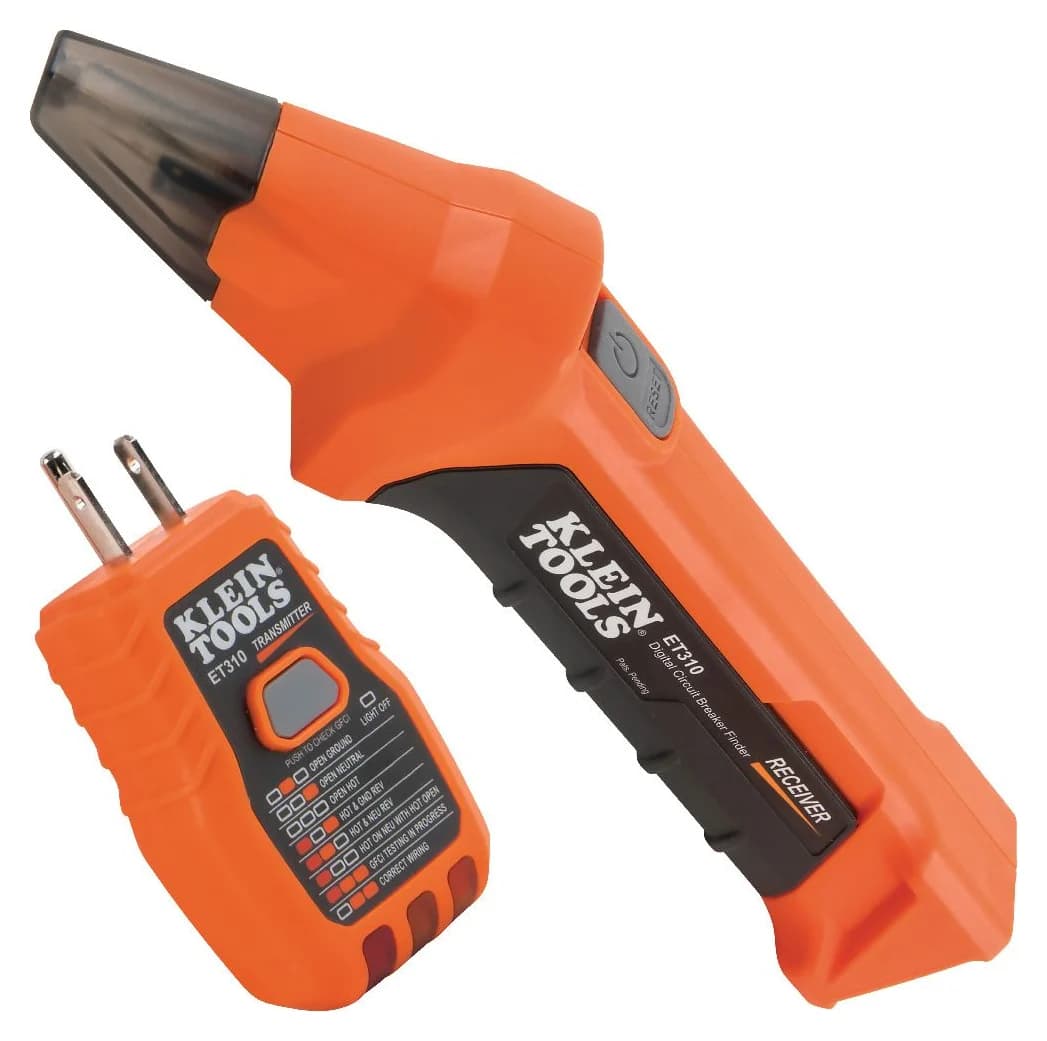
A plug-in breaker finder (ET310, ET350) is the whole tool for labeling that circuit's breaker; ET350 also performs outlet diagnostics, non-contact voltage testing and work-light functions.
Start at a switch, fixture or dead circuit
Step up to a tracer: ET450 or Fluke 2052, which also trace wire routes.
Start at a network or telephone panel
Buy a tone-and-probe set, not an electrical tracer.
Need signal injection without bare-wire access
The Fluke 2052 kit includes the i400 clamp for inducing a signal through insulation in Loop mode.
Breaker identifier for outlets: Klein Tools ET310
The ET310 is the answer when the job is literally "which breaker feeds this outlet." Klein's product page describes a two-part tool: a transmitter plugged into the outlet or fixture and a receiver scanned along the panel, with clear visual and audible indication when the correct breaker is found. It operates on 90-120V AC circuits, the transmitter is powered by the connected circuit (no battery), and the receiver uses one 9V battery.
What makes it a finder rather than a tracer: it identifies the supplying breaker. It does not follow wire routes, and the page specifies it is designed for 120V AC electrical systems with a CAT II 120V safety rating. The transmitter's GFCI outlet tester inspects wiring condition at the outlet and tests GFCI devices, and the receiver shuts off after roughly three minutes of non-use. Adapters for light sockets and bare wires live in the optional 69411 accessory kit.
If all you need is outlet wiring checks without finding breakers, a plain outlet tester is the cheaper, simpler family.
Breaker finding plus outlet diagnostics: Klein Tools ET350
The ET350 is the same outlet-first family with more information per trip. Klein's page lists four functions: locating circuit breakers, diagnosing outlet conditions, non-contact voltage testing and a built-in work light. Its Learn mode reads the panel in a single scan and Locate mode then finds the single breaker, while the transmitter reports voltage, wiring faults and GFCI trip time.
It is still an energized-outlet tool — the breaker-finding workflow starts at a correctly wired, powered outlet — and the fixture adapters are again sold separately as Klein 69411. Choose it over the ET310 when you want numeric outlet diagnostics in the same instrument; choose a tracer when the circuit may be dead.
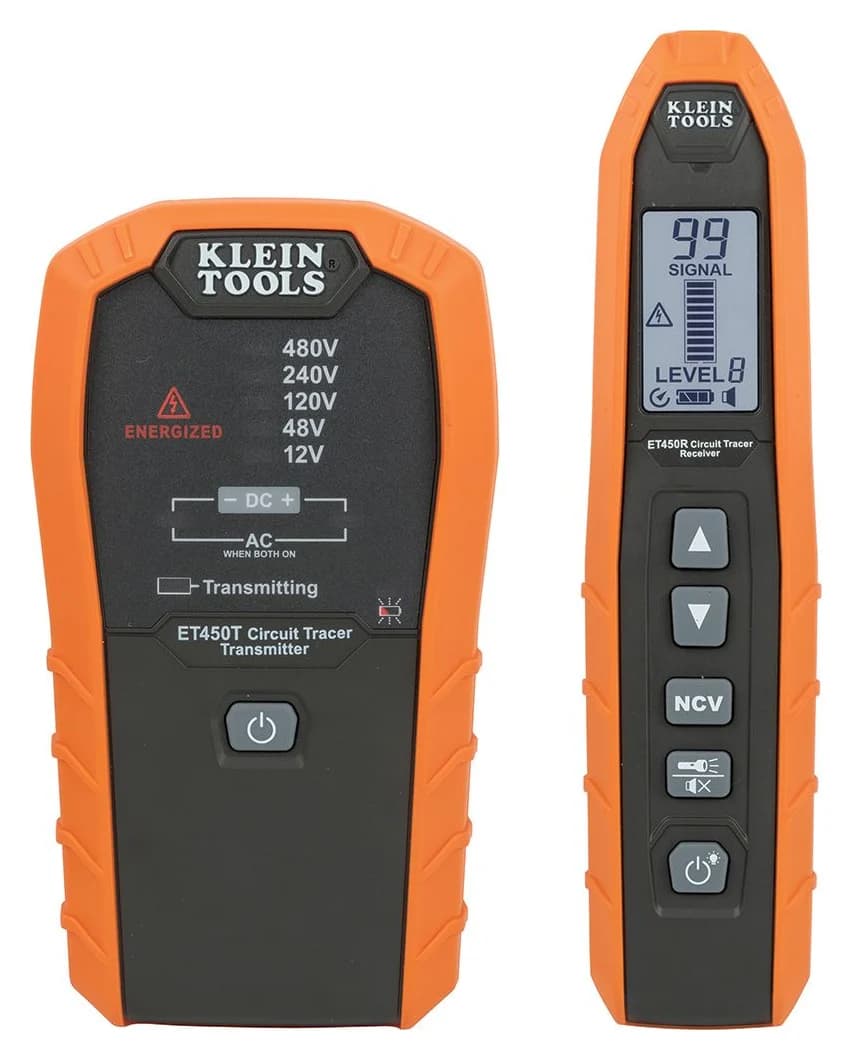
First true circuit tracer: Klein Tools ET450
The ET450 is where the family changes. Klein's kit page, in the maker's own wording, describes reliable tracing of energized or non-energized breakers, fuses and wires, with an adjustable receiver sensitivity that can detect the transmitted signal through drywall, cement block and underground. Applications include tracing wires, conduit or pipes, or a single wire in a bundle.
The transmitter has external voltage indicators for 12V, 48V, 120V, 240V and 480V, helping you confirm what you are connected to, and the receiver adds a non-contact voltage function and flashlight. The complete kit — transmitter, receiver, blade and ground prongs, alligator clips, 3-foot and 20-foot lead adapters, AC plug leads, batteries and a hard case — is the practical reason to pick it over buying a finder and accessories separately.
Receiver sensitivity is the specification that separates a usable tracer from a frustrating one: the ET450's level is adjustable. Klein lists a general tracing depth of 0-0.5 m depending on medium/application; for underground tracing, its manual says approximately 0.6 m and warns that actual detection depth varies, while metal conduit can shield the signal. For higher-voltage supplies, our 240V circuit tracer guide covers the connection decisions in detail.
Professional tracer kit with signal clamp: Fluke 2052
The Fluke 2052 is the buy when tracing is a professional routine rather than an occasional task. Fluke's specifications rate the 2052R receiver and 2000T transmitter CAT IV 600 V; Fluke states that this CAT rating offers the highest protection available on any wire tracer, and the transmitter and receiver operating voltage is 600 V AC/DC. The receiver offers Quick Scan, Precision, Breaker and Non-Contact Voltage Detection modes, with breaker and fuse identification based on the highest recorded signal from the transmitter.
The 2000-T transmitter works on energized and de-energized circuits up to CAT IV 600 V, automatically sensing the system state. Fluke's overview says the transmitter selects a 6 kHz or 33 kHz output frequency; its specification table gives 6.25 kHz energized and 32.768 kHz de-energized, with High, Low and Loop signal modes. Eight receiver sensitivity levels give flexibility when tracing. The kit includes the i400 AC Current Clamp; Fluke says it is used with Loop mode to induce a boosted 6 kHz signal through insulation when a direct bare-conductor connection is unavailable. It also includes the 2000ACC test-lead accessory kit, batteries and a hard case.
Check the accessory ratings before ordering: Fluke lists the supplied test leads at CAT IV 600 V but the outlet adapters at CAT II 300 V, so the lowest-rated included accessory governs how you may connect. The Fluke 2062 sibling adds the 2062R receiver's Smart Sensor feature, which locates and displays energized wires on its color display; our breaker finder roundup compares the two kits directly.
De-energized wire mapping: Klein Tools Tone & Probe PRO Set
None of the electrical tools above is the right buy for data, telephone and other low-voltage wiring. Klein's Tone & Probe PRO set (VDV500-820) pairs the Toner-PRO tone generator with the Probe-PRO tracing probe for open-ended, non-energized wiring. The toner offers five distinct tone cadences, transmits 1,000+ feet, connects with Angled Bed of Nails clips or an RJ11 plug into telephone and RJ45 data jacks, and tests continuity and polarity with labeled LEDs. Klein lists the included items as the Toner-PRO, Probe-PRO, pouch and eight AAA batteries.
The boundary is absolute: Klein's warnings say do not use on energized circuits. This set maps which pair goes where; electrical tracers have different documented uses, including Klein's listed tracing of a single wire in a bundle, so choose the tool whose connection method and circuit-state warnings match the wiring being mapped. Our Ethernet cable tester guide covers the wiremap testing these tools don't do.
- Yes: Plug-in breaker finder (ET310, ET350): identifies the breaker behind one live outlet
- Yes: Circuit tracer (ET450, Fluke 2052): also follows wire routes, live or dead circuits
- Yes: Tone-and-probe set: maps non-energized phone and data pairs
- No: Thermal camera: cannot identify which breaker feeds a circuit
- Partly: Non-contact voltage pen: confirms presence of voltage only, per our NCVT guide
What about a thermal camera or an outlet tester?
Two other families come up in these searches, for different reasons. A non-contact voltage tester is the cheapest useful electrical tool, but it confirms voltage is present — it cannot tell you which breaker controls the circuit; we cover it in our non-contact voltage tester guide. A thermal camera, including the Milwaukee thermal camera models people often compare at this price, shows heat patterns rather than circuit identity: it can help locate an overheating connection once you know the circuit, but it will not label a breaker. If a thermal imager is genuinely in your budget, start with our Milwaukee thermal imager alternatives and thermal camera roundup instead of forcing it to do a tracer's job.
How we choose
We rank these families by the decision they answer, using each manufacturer's product pages, specification sheets and instruction downloads as the only source for capabilities, ratings and kit contents. We never open retailer listings, and we treat a safety category and an operating voltage as separate specifications rather than reading one into the other. Because we have not physically tested these instruments, we do not claim detection accuracy or range beyond what the maker states; where a capability boundary matters — de-energized tracing, energized-circuit bans, accessory ratings — we quote the manufacturer's own wording. Family boundaries follow the makers' own descriptions of what each tool does, not marketing categories.
Buying guide: what to check before any circuit tracer kit
- Circuit state first. Decide whether the job is outlet identification (powered), route tracing (powered or dead) or pair mapping (non-energized). Every pick above is anchored to a documented circuit state.
- Kit contents, not just the model number. Fixture adapters, lead adapters, clamps and cases vary by package: Klein's 69411 accessory kit supplies fixture adapters, while the Fluke 2052 kit includes leads, probes, adapters, clips and the i400 clamp.
- Sensitivity and panel behavior. Adjustable receiver sensitivity (ET450; Fluke's eight levels) is what lets one instrument work across panel types, junction boxes and in-wall tracing.
- GFCI, AFCI and supply checks. A finder's GFCI button tests ground-fault devices at the outlet; it does not verify AFCI protection, and 240V supplies need the tracer families with documented connection methods.
- Safety verification after the identification. OSHA's lockout/tagout standard requires verification that isolation and deenergization have been accomplished before work begins; it does not state that a breaker-finder indication substitutes for that verification.
Verdict
Buy the cheapest family that answers your actual job. Labeling breakers behind live outlets: Klein ET310, or ET350 when you want outlet diagnostics in the same tool. Tracing routes or dead circuits: Klein ET450, stepping up to the Fluke 2052 for CAT IV 600 V ratings, automatic frequency selection and the i400 clamp. Mapping non-energized phone and data pairs: Klein's Tone & Probe PRO set. The full model-by-model comparison, including the Fluke 2062, lives in our circuit breaker finder roundup.
Frequently asked questions
Is a circuit breaker finder the same thing as a circuit tracer?
No, and the difference decides your budget. A plug-in breaker finder such as the Klein ET310 or ET350 only labels the breaker supplying one live outlet or fixture. A circuit tracer such as the Klein ET450 or Fluke 2052 also follows wire routes and works on de-energized circuits, which is why it costs more. If every job starts at a live outlet or fixture, the finder is all you need for that circuit.
Can a breaker finder trace wires with the power off?
Only the tracer families can. Klein's ET450 page, in the maker's own wording, describes reliable tracing of energized or non-energized breakers, fuses and wires, and Fluke lists the 2052's transmitter as working on energized and de-energized circuits up to CAT IV 600 V. The ET310 transmitter is powered by the connected circuit, so it needs the outlet live. None of these readings replace verifying absence of voltage before touching conductors.
Do I need a tone-and-probe kit too?
Only for low-voltage and data wiring. A tone generator and probe pair, like Klein's Tone & Probe PRO set, maps open-ended non-energized telephone and network pairs over long runs. Klein's warnings say not to use it on energized circuits, so it complements rather than replaces an electrical tracer.
Will a breaker finder work on a 240-volt circuit?
Not the plug-in families. Klein specifies the ET310 for 120 V AC systems and warns against connecting it to higher-voltage supplies; it likewise specifies that the ET350 is designed for 120 V AC electrical systems. For higher-voltage work, see our dedicated guide to 240 V circuit tracer kits and their connection rules.
Can I find a breaker with a thermal camera instead?
A thermal camera shows heat, not circuit identity. It cannot tell you which breaker feeds an outlet, and a loaded circuit is often not warm enough to stand out. Thermal imagers are the right tool once you have an electrical problem to locate; see our thermal camera coverage for those models.

Related guides
Buying guide · Voltage & Outlet Testers
Circuit Tracer Tools: How to Choose a Kit That Finds the Right Wire
Choose a circuit tracer kit for breaker ID, dead-wire tracing, live circuits or buried cable. Compare the Klein ET310, ET450, Fluke 2062 and NOYAFA NF-820 kits.
Buying guide · Voltage & Outlet Testers
Circuit Breaker Locator Buying Guide: Find the Right Breaker Safely
Choose a circuit breaker locator for outlet, lighting and panel jobs. Compare the Klein ET310, ET450, Fluke 2062 and IDEAL 61-535 kits before you buy.
Buying guide · Voltage & Outlet Testers
Breaker Finder Kit Buying Guide: Compare What Is Actually Included
Compare breaker finder kits by included transmitters, receivers, adapters, leads, batteries and cases, so you pay for the package your job needs.