

Buying guide
Circuit Breaker Locator Buying Guide
Find the Right Breaker Safely
Choose a circuit breaker locator for outlet, lighting and panel jobs. Compare the Klein ET310, ET450, Fluke 2062 and IDEAL 61-535 kits before you buy.
By thisMETER EditorialUpdated November 5, 202611 min read5 picks
On this page · Our picks at a glance
Our picks at a glance
- 1
Identify the breaker for outlets and fixtures
Choose for: Identify the breaker for outlets and fixtures
Limit: It does not trace wire routes; CAT II 120V rating
- 2
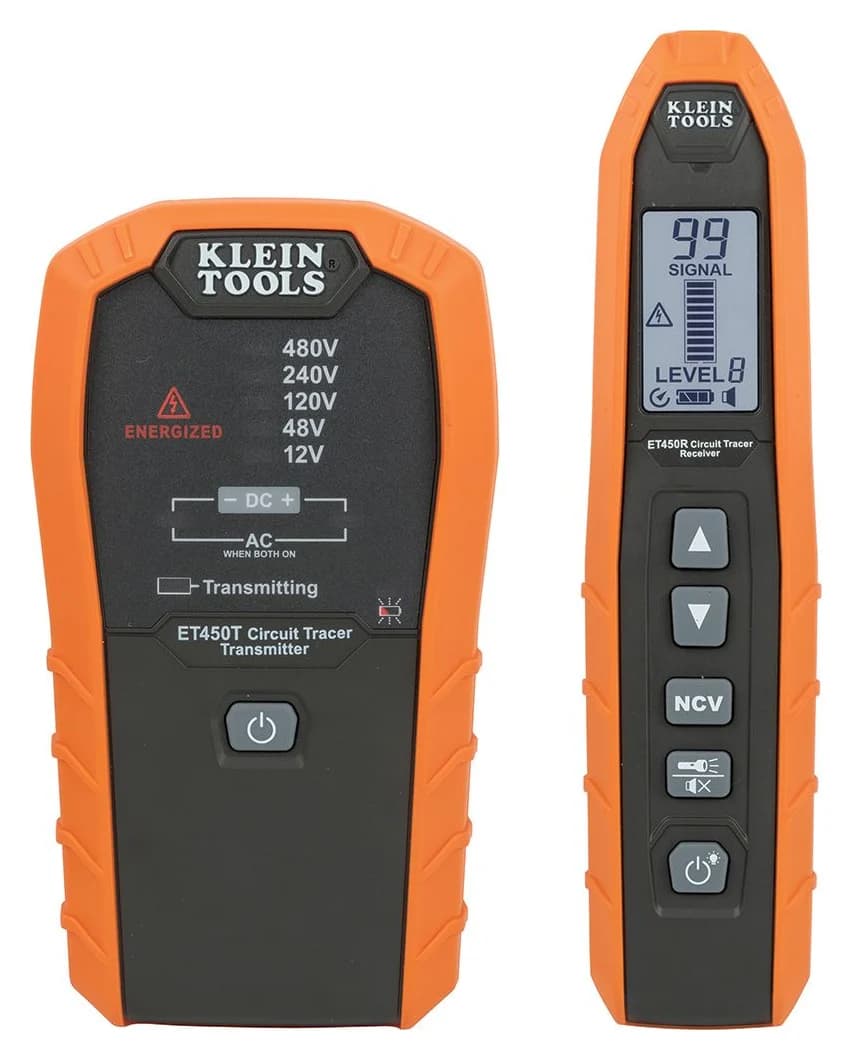
Also follow wires, energized or dead
480 V max · CAT III 600V
Choose for: Also follow wires, energized or dead
Limit: A large, 6-plus-pound kit; overkill for someone who only wants to identify outlet breakers
- 3
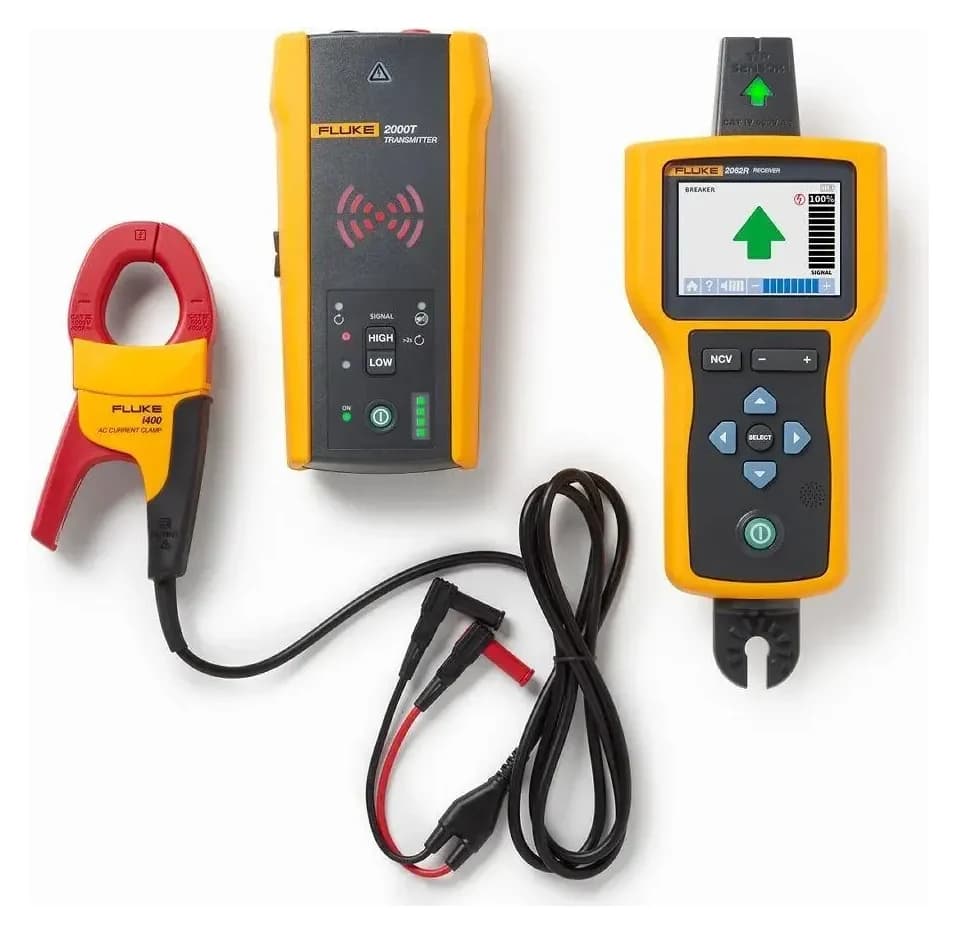
Pro troubleshooting and panel-class safety
600 V max · CAT IV 600 V, CAT III 1000 V
Choose for: Pro troubleshooting and panel-class safety
Limit: The clamp needs an eligible closed return path
Show all 5 picks
- 4
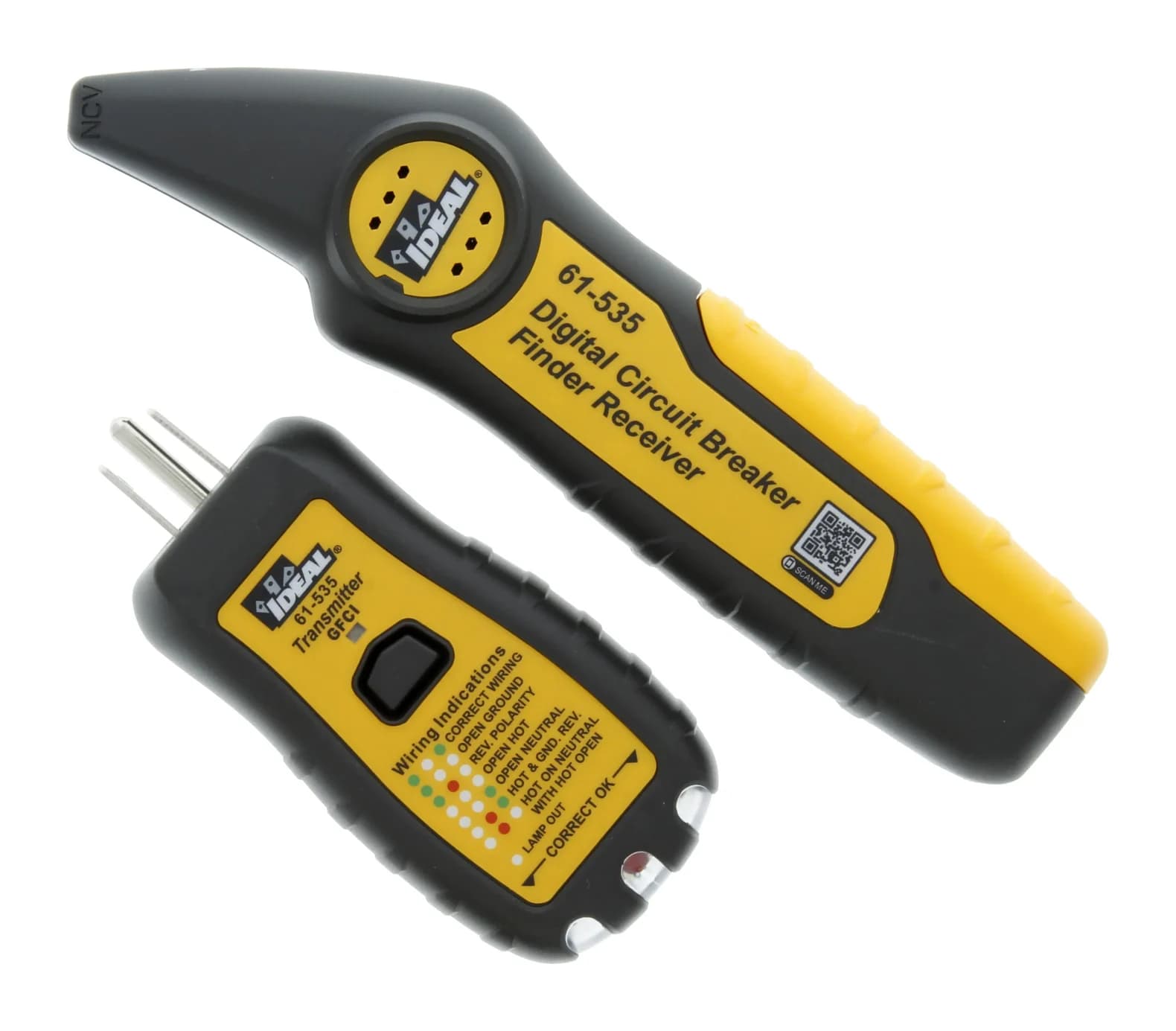
Budget breaker ID on live circuits
300 V max · CAT II 150 V
Choose for: Budget breaker ID on live circuits
Limit: Receiver auto power off after five minutes; CAT II 150V; light-fixture work needs the TL-532A adapter
- 5
Map dead network or low-voltage wires
Choose for: Map dead network or low-voltage wires
Limit: Toner only, not a breaker locator; F50 filter version is not sold in the USA
If you're about to swap an outlet or a light fixture and you don't know which breaker controls it, a circuit breaker locator answers that question in one scan: a transmitter puts a signal on the circuit, and a receiver at the panel tells you which breaker to shut off. For most homes we'd buy the Klein Tools ET310KIT, because it adds the light socket and alligator clip adapters that turn an outlet-only tool into a whole-house one. If you also want to follow wires through walls or trace dead circuits, step up to the Klein ET450 or the Fluke 2062. Recommendations are based on maker specifications and manuals, checked November 5, 2026.
- 90-120 VAC circuits the ET310 handles, per Klein's product page
- 8Receiver sensitivity levels on the Fluke 2062
- 150 VCAT II limit of the IDEAL 61-535, per its spec sheet
Quick picks: buy for the job, not the feature list
Compare specifications and all conditions
Identify the breaker for outlets and fixtures
- Our pick
- Klein ET310KIT
- What earns its place
- Outlet-powered transmitter, GFCI and wiring checks, socket and clip adapters
- What to check before buying
- It does not trace wire routes; CAT II 120V rating
Also follow wires, energized or dead
- Our pick
- Klein ET450
- What earns its place
- Tracing kit with prongs, clips and long leads, hard case
- What to check before buying
- Remote-ground method trips GFCI receptacles
Pro troubleshooting and panel-class safety
- Our pick
- Fluke 2062
- What earns its place
- CAT IV 600 V instruments, Smart Sensor display, i400 clamp
- What to check before buying
- The clamp needs an eligible closed return path
Budget breaker ID on live circuits
- Our pick
- IDEAL 61-535
- What earns its place
- Muteable tones, tip voltage sensor, two-year warranty
- What to check before buying
- Receiver auto power off after five minutes; CAT II 150V; light-fixture work needs the TL-532A adapter
Map dead network or low-voltage wires
- Our pick
- Fluke Networks Pro3000
- What earns its place
- SmartTone pair verification, up to 10 miles of tone
- What to check before buying
- Toner only, not a breaker locator; F50 filter version is not sold in the USA
Full comparison table
Swipe to compare. Row labels stay visible.
| Your job | Our pick | What earns its place | What to check before buying |
|---|---|---|---|
| Identify the breaker for outlets and fixtures | Klein ET310KIT | Outlet-powered transmitter, GFCI and wiring checks, socket and clip adapters | It does not trace wire routes; CAT II 120V rating |
| Also follow wires, energized or dead | Klein ET450 | Tracing kit with prongs, clips and long leads, hard case | Remote-ground method trips GFCI receptacles |
| Pro troubleshooting and panel-class safety | Fluke 2062 | CAT IV 600 V instruments, Smart Sensor display, i400 clamp | The clamp needs an eligible closed return path |
| Budget breaker ID on live circuits | IDEAL 61-535 | Muteable tones, tip voltage sensor, two-year warranty | Receiver auto power off after five minutes; CAT II 150V; light-fixture work needs the TL-532A adapter |
| Map dead network or low-voltage wires | Fluke Networks Pro3000 | SmartTone pair verification, up to 10 miles of tone | Toner only, not a breaker locator; F50 filter version is not sold in the USA |
Scroll horizontally to see every column
| Your job | Our pick | What earns its place | What to check before buying |
|---|---|---|---|
| Identify the breaker for outlets and fixtures | Klein ET310KIT | Outlet-powered transmitter, GFCI and wiring checks, socket and clip adapters | It does not trace wire routes; CAT II 120V rating |
| Also follow wires, energized or dead | Klein ET450 | Tracing kit with prongs, clips and long leads, hard case | Remote-ground method trips GFCI receptacles |
| Pro troubleshooting and panel-class safety | Fluke 2062 | CAT IV 600 V instruments, Smart Sensor display, i400 clamp | The clamp needs an eligible closed return path |
| Budget breaker ID on live circuits | IDEAL 61-535 | Muteable tones, tip voltage sensor, two-year warranty | Receiver auto power off after five minutes; CAT II 150V; light-fixture work needs the TL-532A adapter |
| Map dead network or low-voltage wires | Fluke Networks Pro3000 | SmartTone pair verification, up to 10 miles of tone | Toner only, not a breaker locator; F50 filter version is not sold in the USA |
Our parent page, the circuit breaker finder guide, covers the broader finder field; this page stays on the buying decision for the locator itself.
How a locator tells you it found the right breaker
Every breaker locator is the same two-piece system: a transmitter connected to the circuit and a receiver scanned along the breakers. What separates them is the feedback and the confidence it gives you.
The Klein ET310 receiver "delivers clear visual and audible indications when the correct breaker has been located," and its transmitter doubles as a GFCI outlet tester that reports wiring condition — so one plug-in tells you both which breaker and whether the outlet itself is wired correctly. The IDEAL 61-535 pinpoints the breaker with the strongest signal "using a flashing green LED and a series of beeps," and its transmitter's green and red LEDs show correct or incorrect wiring.
The step-up kits add finer control. The Klein ET450 receiver reports signal strength with an audible beep and visual indicators, and its sensitivity level is adjustable, which is what lets you separate the right breaker from its neighbors in a crowded panel. The Fluke 2062 receiver provides a numeric, bar graph and audible indication, eight sensitivity levels, and a tip sensor with a pinpointing distance of approximately five centimeters in energized and de-energized modes.
Best breaker locator for most homes: Klein ET310KIT
The ET310 itself is a plug-in tool: Klein's ET310 page specifies 90-120V AC operation, a CAT II 120V rating, a 6.6-foot drop rating, and an included 9V battery for the receiver only — the transmitter is powered by the circuit. The kit is why we pick it.
Klein Tools
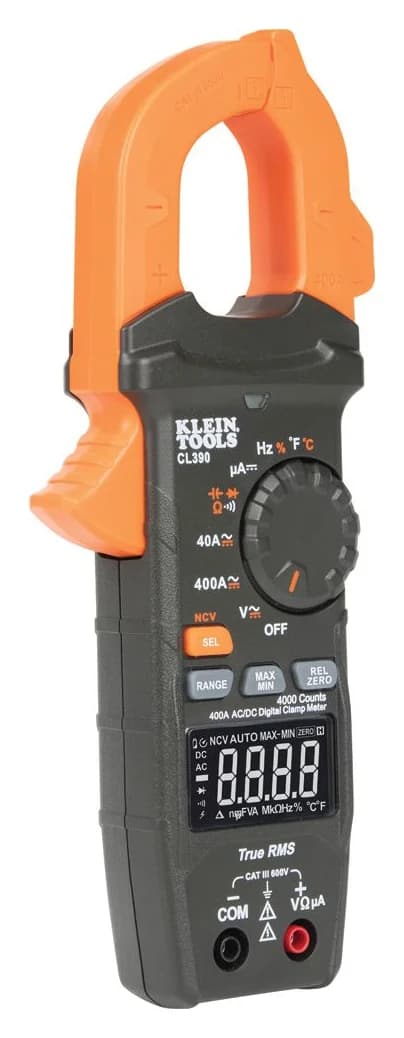
A 4,000-count True RMS clamp meter that measures AC and DC current to 400 A, voltage to 600 V and DC microamps, with non-contact voltage detection in the jaw and a thermocouple for temperature.
Check package and model options
- 600 V max
- 400 A max
- 4,000 counts
- CAT III 600V
The ET310KIT package bundles the 69411 Circuit Breaker Finder Accessory Kit: a light socket adapter for lighting circuits, an alligator clips adapter for bare wires, and a versatile three-prong to two-prong adapter, all in a premium carrying case with a foam insert. Confirm that your specific fixture and wiring connections are compatible before use.
- Wiring confidence: the transmitter's GFCI outlet tester inspects the wiring condition at the outlet and tests GFCI devices
- Battery discipline: the receiver powers off automatically after approximately three minutes of non-use, and a low battery indicator warns before a scan goes unreliable
- Storage: the transmitter docks in the receiver as a single item when not in use
The trade-offs: Klein specifies 90-120V AC live operation and a CAT II 120V utilization-point rating, so this is not the tool for maker-documented de-energized wire tracing — use the ET450 when that is required. Klein also warns that the tester is for indoor use and 120V AC systems only.
Best locator and wire tracer kit: Klein ET450
When the question extends past the breaker to the wire itself, Klein's ET450 page describes "reliable tracing of energized or non-energized breakers, fuses, and wires," with a receiver sensitivity you adjust to chase the signal through drywall, cement block and underground.
- CAT III 600V rating, with external AC/DC voltage indicators for 12V, 48V, 120V, 240V and 480V on the transmitter
- Kit contents: transmitter, receiver, blade and ground prongs, alligator clips, 3-Foot and 20-Foot lead adapters, AC plug leads, instructions, all required batteries and a hard carrying case
- Receiver aids: audible beep and visual indicators for signal strength, plus a flashlight and an NCV function to test whether wires are energized
- Power: transmitter takes 6 × 1.5V AA alkaline batteries and the receiver 4 × 1.5V AA alkaline, with battery life up to 24 hr
The trade-offs: at 2849 g in its case this is a bag tool, not a pocket tool; and Klein's manual (see our ET450 vs Fluke 2062 comparison) warns that the remote-ground connection that maximizes signal strength will trip GFCI receptacles — the direct ground, clip or de-energized methods work around it. If your only need is outlet breaker ID, this kit is more than the job requires.
Best for professionals: Fluke 2062
Fluke's 2062 page is blunt about the difference: the 2062R receiver and 2000T transmitter are each rated CAT IV 600 V, "the highest protection available on any wire tracer," designed for transients that occur in industrial and utility environments.
What that buys in a locator context:
- Eight receiver sensitivity levels, with a numeric and bar graph display plus an audible beep, and a tip sensor that pinpoints to about five centimeters in the air
- The Smart Sensor on the 3.5-inch TFT LCD color display visualizes and pinpoints the orientation of energized wires in walls, floors and ceilings
- The i400 AC Current Clamp induces a tracing signal on a cable when there is no access to bare conductors, used with loop mode on eligible closed circuits
- Automatic mode selection: the 2000T transmitter senses whether the system is energized or de-energized and selects a 6 kHz or 33 kHz output frequency; the kit's leads, probes, blade and round outlet adapters and alligator clips connect it to the circuit, and everything ships in a premium hard carrying case with a magnetic hanger strap
The trade-offs: it is the professional price class for a household job, and the open-air detection distances in Fluke's spec table are not wall or burial guarantees. For a deeper kit-by-kit comparison, see our Klein ET450 vs Fluke 2062 page.
Best budget pick for live circuits: IDEAL 61-535
IDEAL's 61-535 page "quickly and easily identifies circuit breakers/fuses without disrupting power on energized 120V AC circuits," and its spec sheet lists a limited two-year warranty, a GFCI test and two 9V batteries.
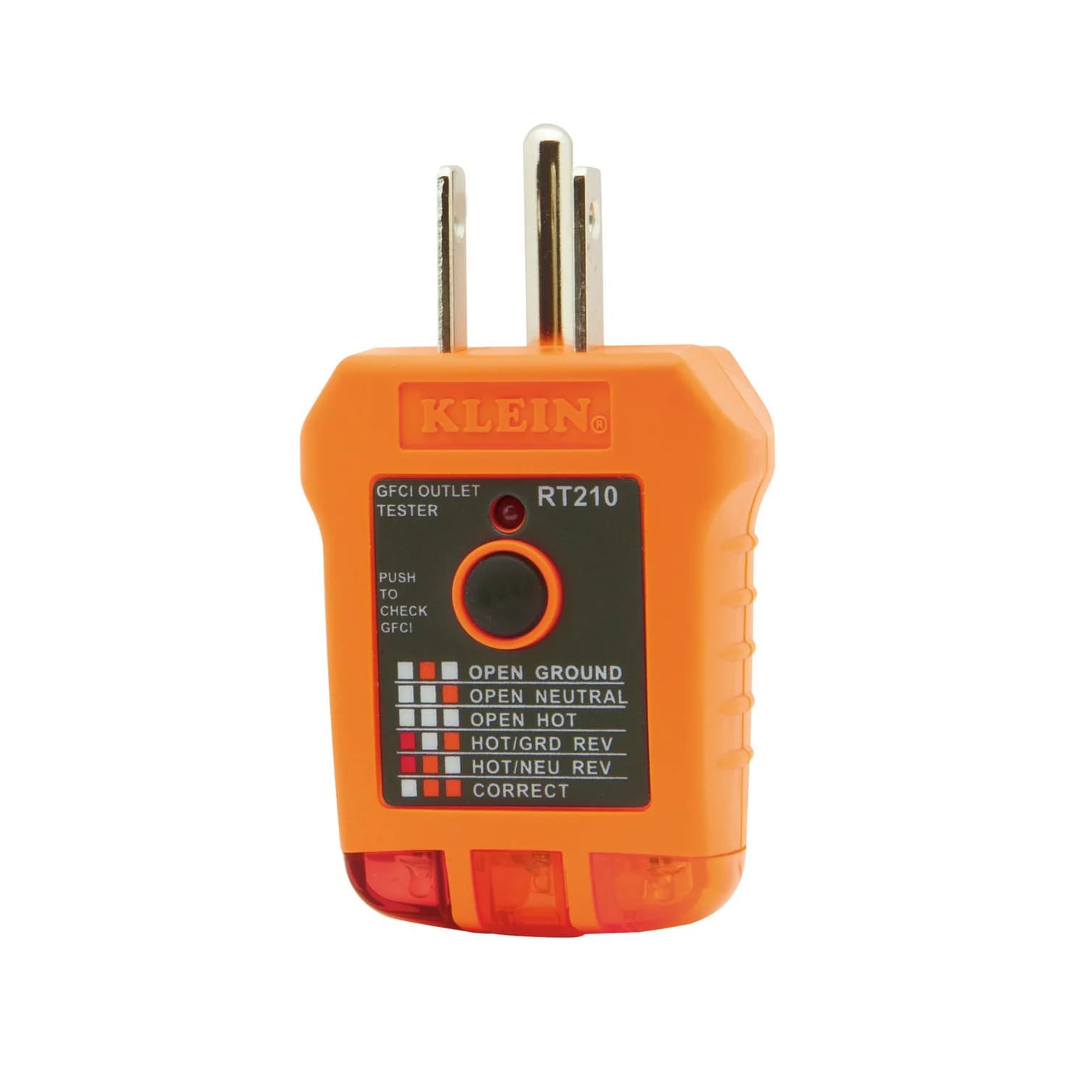
Klein Tools
A three-light plug-in tester for standard and GFCI receptacles that shows common wiring faults and has a button to trip a GFCI.
Check package and model options
- CAT II 300V
- Two layers of confirmation: the receiver's flashing green LED and beeps mark the strongest signal, and an NCVT in the receiver tip indicates AC voltage between 80 and 300 V — usable separately from the tracing function
- Considerate design: the audible tones can be muted with a button press for occupied buildings, and the receiver carries a built-in work light for dim panels; it powers off automatically after five minutes of non-use
- Certification: cULus certified to UL 1436 and CSA C22.2 No. 160, marked CAT II 150V
The trade-offs: its spec sheet lists no auto-ranging, no backlit display and no test leads included, and it is rated only for energized 120 V AC work. IDEAL's instructions state that the equipment is intended for use by qualified electricians following NFPA 70E, so homeowners should treat it accordingly. Like the standalone ET310, fixture and bare-wire connections need the optional TL-532A Circuit Breaker Adapter Kit, which IDEAL sells as the alligator plug lighting adaptor. Our Klein ET350 vs IDEAL 61-535 and IDEAL finder models pages compare the family.
Best for dead low-voltage and network wires: Fluke Networks Pro3000
Breaker locators work on building wiring; if the wires you're mapping are data, telephone or other low-voltage runs — typically de-energized — a tone and probe kit is the right instrument. Fluke Networks' Pro3000 page says the series "tone and trace inactive wiring."
- Pair verification, not just tone: SmartTone provides five distinct tones; when you momentarily short the far end of a pair, the cadence changes, positively verifying the correct pair
- Reach and loudness: the toner sends tone up to 10 miles on most cables, and the probe's loud large speaker makes the tone easier to hear through drywall, wood and other enclosures
- Connections: angled bed-of-nails clips and a ruggedized RJ-11 plug reach individual pairs and phone jacks without adapters; the toner doubles as a continuity tester
- In the kit: the analog tone generator, the analog probe, a belt-mount nylon pouch and a free spare tip; each unit runs one 9V alkaline battery
The trade-offs: this is not a breaker locator — it won't identify anything in a mains panel, and its over-voltage protection covers 60 Vdc, so it stays on low-voltage work. For mapping network cable pairs more precisely, our Ethernet cable tester guide covers wiremap testers.
Compare the exact kits
Source: each maker's product page or spec sheet (linked above)
Klein ET310KIT
- Category rating
- CAT II 120V
- What's in the box
- ET310, 69411 accessory kit (socket, clip and two-prong adapters), battery, foam case
- Important limit
- Match category and voltage; the lowest-rated lead or accessory limits the assembly.
All specifications
- Works on
- Live 90-120V AC circuits
- Distinct strength
- Adapters for fixtures out of the box
Klein ET450
- Category rating
- CAT III 600V
- What's in the box
- Transmitter, receiver, prongs, clips, 3-Foot and 20-Foot leads, AC plug leads, batteries, hard case
- Important limit
- Match category and voltage; the lowest-rated lead or accessory limits the assembly.
All specifications
- Works on
- Energized and de-energized tracing
- Distinct strength
- Follows the wire, not just the breaker
Fluke 2062
- Category rating
- CAT IV 600 V
- What's in the box
- 2062R, 2000T, i400 clamp, lead accessory kit, magnetic hanger, batteries, hard case
- Important limit
- Match category and voltage; the lowest-rated lead or accessory limits the assembly.
All specifications
- Works on
- Energized and de-energized, industrial class
- Distinct strength
- Highest category; Smart Sensor display
IDEAL 61-535
- Category rating
- CAT II 150V
- What's in the box
- Transmitter and receiver (product page lists 2 x 9V batteries; inclusion is not separately stated)
- Important limit
- Match category and voltage; the lowest-rated lead or accessory limits the assembly.
All specifications
- Works on
- Energized 120V AC circuits
- Distinct strength
- Muteable tones; NCVT tip; two-year warranty
Fluke Networks Pro3000
- Category rating
- 60 Vdc over-voltage protection
- What's in the box
- Analog toner, analog probe, pouch, spare tip
- Important limit
- Match category and voltage; the lowest-rated lead or accessory limits the assembly.
All specifications
- Works on
- Inactive wiring
- Distinct strength
- Pair-level identification on dead wires
Full comparison table
Swipe to compare. Row labels stay visible.
| Kit | What's in the box | Works on | Category rating | Distinct strength |
|---|---|---|---|---|
| Klein ET310KIT | ET310, 69411 accessory kit (socket, clip and two-prong adapters), battery, foam case | Live 90-120V AC circuits | CAT II 120V | Adapters for fixtures out of the box |
| Klein ET450 | Transmitter, receiver, prongs, clips, 3-Foot and 20-Foot leads, AC plug leads, batteries, hard case | Energized and de-energized tracing | CAT III 600V | Follows the wire, not just the breaker |
| Fluke 2062 | 2062R, 2000T, i400 clamp, lead accessory kit, magnetic hanger, batteries, hard case | Energized and de-energized, industrial class | CAT IV 600 V | Highest category; Smart Sensor display |
| IDEAL 61-535 | Transmitter and receiver (product page lists 2 x 9V batteries; inclusion is not separately stated) | Energized 120V AC circuits | CAT II 150V | Muteable tones; NCVT tip; two-year warranty |
| Fluke Networks Pro3000 | Analog toner, analog probe, pouch, spare tip | Inactive wiring | 60 Vdc over-voltage protection | Pair-level identification on dead wires |
Scroll horizontally to see every column
| Kit | What's in the box | Works on | Category rating | Distinct strength |
|---|---|---|---|---|
| Klein ET310KIT | ET310, 69411 accessory kit (socket, clip and two-prong adapters), battery, foam case | Live 90-120V AC circuits | CAT II 120V | Adapters for fixtures out of the box |
| Klein ET450 | Transmitter, receiver, prongs, clips, 3-Foot and 20-Foot leads, AC plug leads, batteries, hard case | Energized and de-energized tracing | CAT III 600V | Follows the wire, not just the breaker |
| Fluke 2062 | 2062R, 2000T, i400 clamp, lead accessory kit, magnetic hanger, batteries, hard case | Energized and de-energized, industrial class | CAT IV 600 V | Highest category; Smart Sensor display |
| IDEAL 61-535 | Transmitter and receiver (product page lists 2 x 9V batteries; inclusion is not separately stated) | Energized 120V AC circuits | CAT II 150V | Muteable tones; NCVT tip; two-year warranty |
| Fluke Networks Pro3000 | Analog toner, analog probe, pouch, spare tip | Inactive wiring | 60 Vdc over-voltage protection | Pair-level identification on dead wires |
Klein publishes ET310KIT package contents on its product page. Check each maker's current page for exact package contents, and confirm whether accessory kits are sold separately or bundled.
- Yes: Outlet connection on grounded North American receptacles (ET310KIT; check each maker's documentation for receptacle compatibility)
- Yes: Light socket adapter for fixtures (ET310KIT; optional elsewhere)
- Yes: Alligator clips for bare wires, used only after confirming the circuit is not energized (ET310KIT, ET450, 2062)
- Yes: De-energized circuit tracing (ET450, 2062; Pro3000 only for inactive communication and low-voltage wiring)
- No: Breaker identification inside a live panel by a homeowner (call an electrician)
- No: Plug-in breaker finders are not designed for communication-pair identification (use a tone and probe kit on inactive communication wiring)
Set sensitivity, label, verify — then de-energize
The workflow that makes a locator worth owning is short, and it ends before you touch anything:
Plug in or clip on
Connect the transmitter at the outlet, socket or fixture on the circuit you'll work on.
Scan and narrow
Start at low receiver sensitivity, scan the breakers, and raise sensitivity only until one breaker answers strongest.
Switch and confirm
Shut the identified breaker off and confirm the transmitter's indicators — and a voltage tester — show the circuit is dead.
Label the breaker
Write the circuit on the panel schedule or a breaker label now, so the next job starts with the answer.
Sensitivity is where false positives come from: a receiver set too high responds to adjacent breakers and parallel runs. The ET450 has an adjustable sensitivity level, while the Fluke 2062 has eight levels to step down. Panels with shared neutrals or tightly packed branch circuits are the usual offenders; narrowing sensitivity until exactly one breaker indicates is the fix. The 2062's numeric and bar graph display makes signal strength visible, while the ET450 provides audible and visual signal-strength indicators.
While the panel is open for labeling, resist doing more: our outlet tester guide covers receptacle wiring checks, and actual panel work — breaker replacement, service upgrades, anything behind the dead front — needs a licensed electrician.
How we choose
We compared maker product pages, spec sheets and instruction warnings for Klein, Fluke, Fluke Networks and IDEAL, checked November 5, 2026, favoring current kits with documented package contents and marked category ratings. These are research-based recommendations; we have not physically tested the tools. Our selection method explains the process, and our how we measure page covers our instrument policy.
Verdict
Buy the ET310KIT if your need is the classic one — knowing which breaker to shut off before working on an outlet or fixture — because its adapters cover fixtures and bare wires the plug-in finders can't reach. Buy the ET450 when the wire's route matters as much as its breaker, the Fluke 2062 when the environment is industrial and the category rating has to match, the IDEAL 61-535 for straightforward live-circuit breaker ID on a budget, and the Pro3000 for mapping dead low-voltage pairs. Whatever you buy, use it to label the panel: the cheapest locator pays for itself the second time you never have to scan.
Frequently asked questions
How does a circuit breaker locator work?
A transmitter plugged into an outlet (or connected with a compatible adapter) puts a signal on the circuit, and a receiver scanned down the panel indicates the correct breaker. Klein's ET310 transmitter is powered by the outlet itself on 90 to 120 V AC circuits and identifies the breaker after a reset-and-learn procedure, when the beep becomes continuous, the circuit-status indicator turns red and the green sensing-tip indicator turns off. The ET450 and Fluke 2062 inject their own signal and work on de-energized circuits too; other receivers display signal strength differently.
Can I use a breaker locator on a light fixture, not an outlet?
Yes, if the kit has the adapter. Klein's ET310KIT includes a light socket adapter and alligator clips for bare wires, plus a three-prong to two-prong adapter; the standalone ET310 transmitter needs the optional accessories. IDEAL's TL-532A adapter kit does the same for the 61-535. Klein warns to confirm the circuit is not energized before connecting clips to bare wires.
Why does my breaker finder light up several breakers?
Because sensitivity is set too high or the panel is crowded. Start at low sensitivity, find the strongest single indication, then narrow it. The ET450's receiver sensitivity is adjustable and Fluke's 2062 has eight levels. After identification, switch the breaker off and verify the circuit with a separate voltage tester before you work — that verification step is what separates a locator from a guess.
Do I need a circuit tracer or just a breaker locator?
If the job is only 'which breaker controls this outlet,' a plug-in breaker locator like the ET310 or 61-535 is the simpler, cheaper tool. If you also need to follow a wire's route through walls or trace a dead circuit, the ET450 and Fluke 2062 are built for energized and de-energized tracing; our circuit tracer guide covers that class in depth.
Identify the breaker for outlets and fixtures
Klein ET310KIT
Related guides
Buying guide · Voltage & Outlet Testers
Circuit Tracer Tools: How to Choose a Kit That Finds the Right Wire
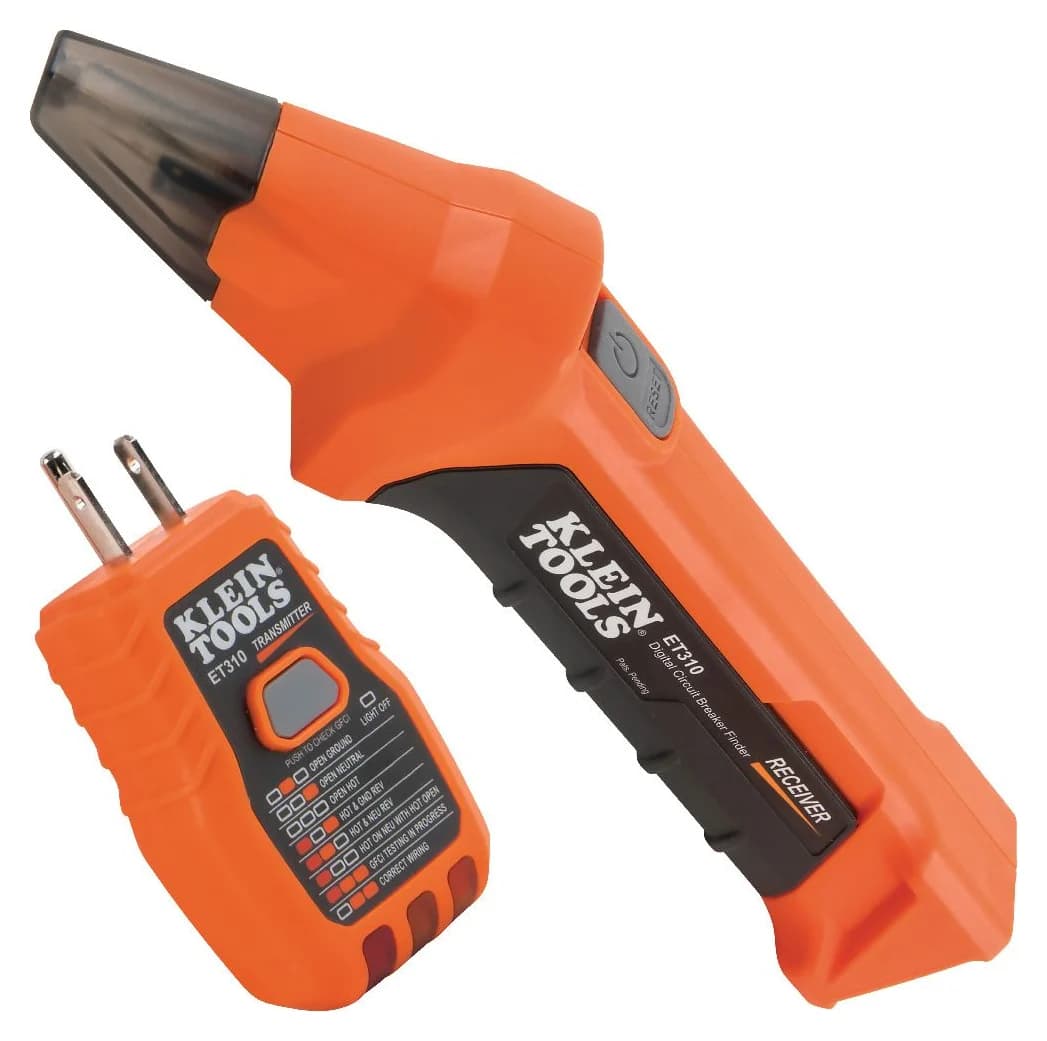
Choose a circuit tracer kit for breaker ID, dead-wire tracing, live circuits or buried cable. Compare the Klein ET310, ET450, Fluke 2062 and NOYAFA NF-820 kits.
Buying guide · Voltage & Outlet Testers
Circuit Breaker Finders for Tool Selection: Which Family Should You Buy?
Decide between a breaker finder, a wire tracer, an outlet tester and a tone-and-probe kit. Compare Klein ET310, ET350, ET450, Fluke 2052 and kit contents.
Buying guide · Voltage & Outlet Testers
Breaker Finder Kit Buying Guide: Compare What Is Actually Included
Compare breaker finder kits by included transmitters, receivers, adapters, leads, batteries and cases, so you pay for the package your job needs.