

Best picks
Best Analog Multimeters
Moving-Needle Picks and Buying Advice
Compare analog multimeters by circuit loading, scale reading and protection. Choose the right Simpson variant, a Sanwa FET meter, or a digital alternative.
By thisMETER EditorialUpdated November 3, 20267 min read
On this page · Quick picks: compare the exact instruments
For following slow changes on appropriate low-voltage bench circuits, our best analog multimeter pick is the Simpson 260-8P, whose moving-needle display comes with an added resettable overload relay and audible continuity. Choose the Sanwa EM7000 when reducing DC circuit loading matters, the standard 260-8 when you deliberately want the version without that relay, or the Klein Tools MM420 when you mainly need numerical readings.
Quick picks: compare the exact instruments
Compare specifications and all conditions
Simpson 260-8P
- Our reason to choose it
- Added relay protection and audible continuity
- DC voltage input
- 20,000 Ω/V
- Required battery types
- One D cell and one alkaline 9 V
Simpson 260-8
- Our reason to choose it
- Standard version without the added relay
- DC voltage input
- 20,000 Ω/V
- Required battery types
- One D cell and one 9 V
Sanwa EM7000
- Our reason to choose it
- Higher DC input resistance through a FET amplifier
- DC voltage input
- Approximately 2.5–12 MΩ, range dependent
- Required battery types
- Two AA and one 9 V manganese
Klein Tools MM420
- Our reason to choose it
- Auto-ranging numerical display and True RMS
- DC voltage input
- 10 MΩ
- Required battery types
- Two AAA
Full comparison table
Swipe to compare. Row labels stay visible.
| Instrument | Our reason to choose it | DC voltage input | Required battery types |
|---|---|---|---|
| Simpson 260-8P | Added relay protection and audible continuity | 20,000 Ω/V | One D cell and one alkaline 9 V |
| Simpson 260-8 | Standard version without the added relay | 20,000 Ω/V | One D cell and one 9 V |
| Sanwa EM7000 | Higher DC input resistance through a FET amplifier | Approximately 2.5–12 MΩ, range dependent | Two AA and one 9 V manganese |
| Klein Tools MM420 | Auto-ranging numerical display and True RMS | 10 MΩ | Two AAA |
Scroll horizontally to see every column
| Instrument | Our reason to choose it | DC voltage input | Required battery types |
|---|---|---|---|
| Simpson 260-8P | Added relay protection and audible continuity | 20,000 Ω/V | One D cell and one alkaline 9 V |
| Simpson 260-8 | Standard version without the added relay | 20,000 Ω/V | One D cell and one 9 V |
| Sanwa EM7000 | Higher DC input resistance through a FET amplifier | Approximately 2.5–12 MΩ, range dependent | Two AA and one 9 V manganese |
| Klein Tools MM420 | Auto-ranging numerical display and True RMS | 10 MΩ | Two AAA |
The Simpson manuals specify 2% of full scale for DC voltage; Sanwa specifies ±3% of full scale on ordinary DC voltage ranges. Those are different specifications from the MM420's ±(0.5% of reading + 5 digits) on its lower DC voltage ranges. A moving pointer by itself establishes neither better accuracy nor a higher safety rating.
- Yes: Follow the direction of a changing reading: consider the Simpson models.
- Partly: Measure high-resistance electronics: compare input loading; consider the Sanwa FET design or digital.
- Yes: Prefer automatic ranging and a numerical readout: choose the digital alternative.
Best analog choice: Simpson 260-8P
The protected Simpson is our default analog recommendation because it adds a resettable overload relay and audible continuity to the family. Simpson's 260-8P manual specifies a mirrored dial, 20,000 Ω/V DC sensitivity and 5,000 Ω/V AC sensitivity. The dial helps address parallax; the input figures explain why the selected range matters to the circuit.
The protection needs qualification. The manual excludes 1 V, 10 A, 50 µA, 250 mV and 500/1000 V AC/DC ranges from the electronic overload system. It explicitly says the 10 A range is not fused. Treat the relay as protection against some instrument overloads, with limits, rather than a reason to take additional electrical risks.
The alkaline 9 V battery powers the overload circuit as well as the highest resistance range. Simpson requires installing and testing it, including the manual's overload-circuit check, before use. That requirement belongs on your purchase checklist alongside the meter itself.
See the Simpson family and manuals.
Standard alternative: Simpson 260-8
Choose this version only when the absence of the added relay and continuity alarm is intentional. Its DC voltage sensitivity and full-scale accuracy match the protected model's specifications; the letter P does not buy finer voltage accuracy.
The 260-8 manual describes fuse protection and two diodes across the movement. There is a documentation conflict: Simpson's family datasheet labels a diode-protection bullet as applying only to the protected versions, while the standard model's manual explicitly describes those diodes. Consult the exact model manual; do not assume that the standard meter has no movement protection.
Check the case and lighting variant. The datasheet lists roll-top packages separately. The 260-8P LED Lighted adds a lighted dial and USB-rechargeable lighting system; those features are not included in this standard-model recommendation.
Best for reducing DC loading: Sanwa EM7000
This is the meaningful alternative to a conventional passive voltage input. Sanwa specifies approximately 2.5–12 MΩ DC input resistance for its FET electronic tester. Its manual's range table makes the variation clear: approximately 2.5 MΩ on 0.3 V, 12 MΩ on 1.2 V, and 10 MΩ on 12 V. Do not turn the highest value into an all-range claim.
Choose it when you want a needle while reducing the loading discussed below. Higher input resistance does not turn its ±3% full-scale DC voltage specification into digital-meter accuracy.
The trade-off is preparation: the electronic design requires power and electrical zero adjustment. Sanwa specifies two AA cells and one 9 V manganese battery. Its accessory list includes TL-21a leads; the C-CA carrying case is optional. Arrange storage when buying the instrument, and follow its own startup procedure rather than the Simpson procedure.
Choose digital instead: Klein Tools MM420
For a first meter or mainly numerical checks, this is our recommendation. Klein's MM420 page lists auto-ranging, True RMS, a 4,000-count display, CAT III 600V, and temperature, capacitance and frequency functions.
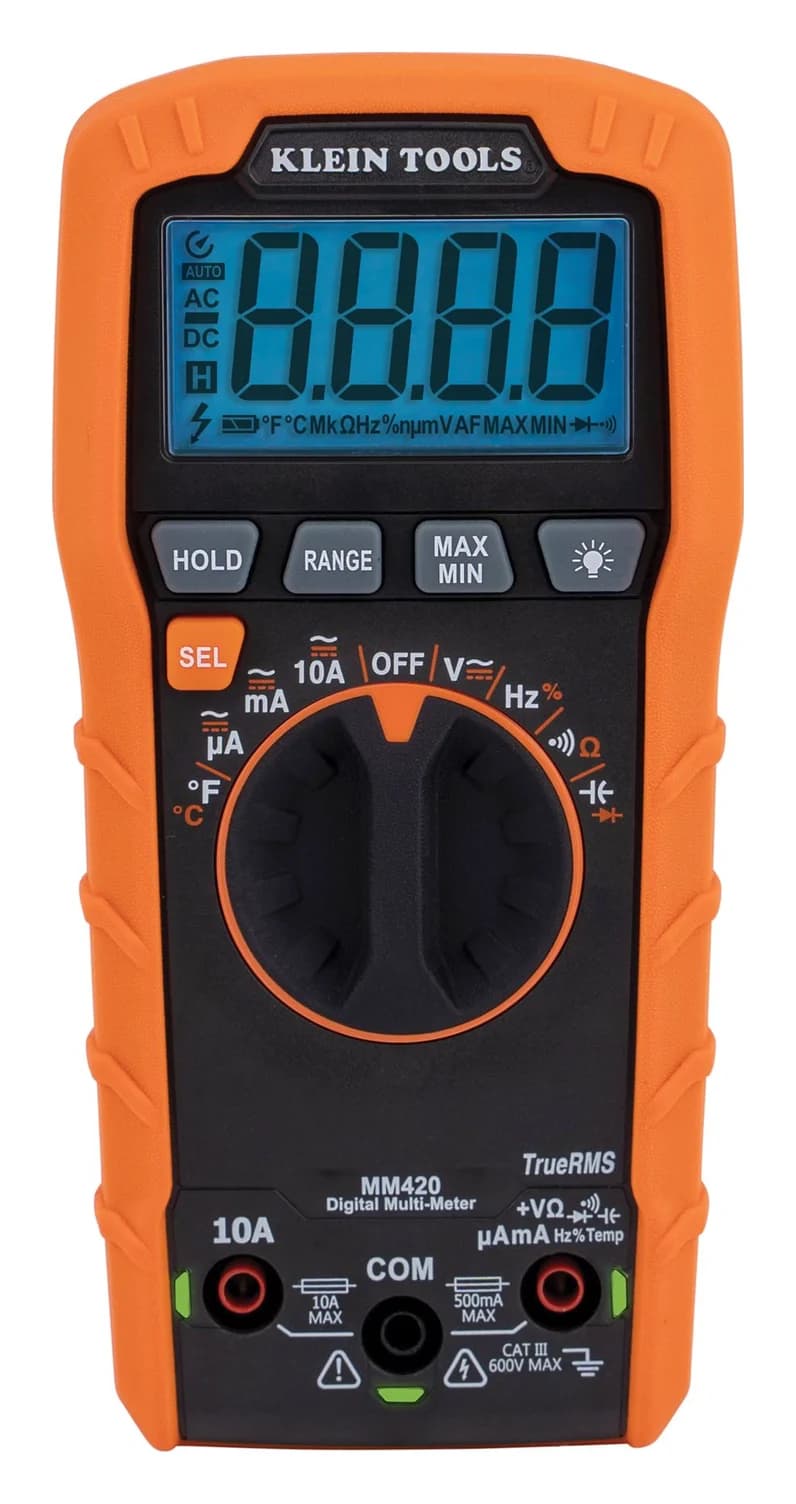
Klein Tools
A 4,000-count auto-ranging True RMS multimeter rated CAT III 600V that measures up to 600 V and 10 A, plus temperature, capacitance, frequency and duty cycle.
Check package and model options
- 600 V max
- 10 A max
- 4,000 counts
- CAT III 600V
Its manual specifies 10 MΩ input impedance for voltage. Choose it for automatic ranging and a numerical result; choose an analog pick when the pointer is the feature you actually want. The Simpson manual describes average-responding AC measurement calibrated for a pure sine wave, so it is not interchangeable with the Klein's True RMS function.
Check price on Amazon. For other digital options, see our best multimeters.
How we choose
This is a document-based shortlist, with no original instrument measurements. We compared official product pages, exact-model manuals, input loading, protection exceptions and supplied accessories on November 2, 2026. Recommendations describe the use each documented design suits; they do not claim a lab-verified performance ranking. Our selection method explains the broader approach.
Why no Triplett 630 pick? Its official 3030 datasheet specifies a glass window, mirrored scale, fuse protection on all ranges, 1.5 V and 30 V batteries, and leads with alligator clips. However, its range table assigns 0.3 V to AC, while the linked manual identifies a 630 Type 6. We could not verify the current US retail revision and matching input-sensitivity specification from the fetched documents; it stays off this shortlist. Ask Triplett to confirm those details and replacement-battery supply before substituting it.
We also excluded the Hioki 3030-10, whose official page marks it discontinued.
Buying guide: loading, scale reading and the complete package
Input sensitivity changes the measurement
Ohms per volt is not a fixed impedance. Simpson's glossary explains that analog voltage-input resistance scales with the selected range. Using the manuals' sensitivity figures, the Simpson's 10 V DC range presents 200,000 Ω: 20,000 Ω/V × 10 V. This is a calculation from the specifications, not a measured value. Its AC sensitivity is 5,000 Ω/V, so do not reuse the DC input-resistance figure for AC.
By comparison, the Sanwa's 12 V DC range is approximately 10 MΩ, and Klein specifies 10 MΩ for its voltage input. Hioki explains the consequence: a voltmeter sits in parallel with the circuit, and a low input resistance can pull the indicated voltage down in a high-resistance circuit. That is the reason to compare loading before buying for delicate electronics.
Read the scale, then assess the accuracy
Here is a hypothetical low-voltage scale exercise, not a recorded measurement. On the Simpson's 2.5 V DC range, the manual says to use the black 0–250 scale and divide by 100. An imagined pointer at 100 therefore means 1 V. Reading the printed number without the range conversion would give the wrong result.
Match function and scale
Use the black DC scale for this DC voltage exercise.
Match the selected range
The 2.5 V range uses the 0–250 figures, divided by 100.
Convert the pointer position
An illustrative indication of 100 becomes 1 V.
Simpson's own accuracy example is equally useful: 2% of full scale on the 10 V range allows ±0.20 V anywhere on that dial. A small reading on a large range does not get a proportionally smaller error allowance. The manual recommends an indication nearer full scale, within the instrument's limits. It also favors the horizontal operating position because that is its calibration position.
Resistance uses a different scale. The Simpson manual says its ohms scale increases from right to left, and the reading is multiplied by the selected resistance factor. It requires zero-ohms adjustment for each resistance range. Make resistance checks only on a de-energized circuit, as the manual directs; our multimeter basics guide provides the wider introduction.
Buy the instrument, leads and storage together
Both Simpsons include batteries, a manual and threaded-tip leads with screw-on alligator clips, according to the family page. Their manuals identify replacement lead set 00043, which matters because the meters use reverse/recessed jacks. Specify the compatible lead set when ordering replacements rather than assuming an arbitrary lead fits.
The Simpson fuse specification is 1 A, 250 V, type 312001, plus 2 A, 600 V, type BLS or BBS; the unfused 10 A input remains an exception. Replace only with the specified types. Sanwa instead lists its own 0.5 A and 6.3 A ceramic fuses; its parts are not a substitution list for a Simpson.
Budget space for a case, confirm whether a roll-top or separate case is included, and protect the movement during storage. Both Simpson manuals recommend removing batteries when storage will exceed 30 days.
Verdict
Get the Simpson 260-8P for the conventional analog format with its added, limited relay protection. Choose the 260-8 deliberately for the standard configuration, or the Sanwa EM7000 for an analog display with higher input resistance at the low-voltage DC settings compared here. If you mainly need to read numbers, start with the Klein MM420 and buy an analog instrument when you have a specific reason to watch the needle.
Frequently asked questions
Is an analog multimeter better than a digital multimeter?
Choose by task. Simpson positions its moving-needle meters for following fluctuating trends; that does not establish superior accuracy or safety. Its voltage accuracy is a percentage of full scale, and its input resistance depends on the selected range. For everyday numerical checks, our recommendation is the auto-ranging Klein MM420. Sanwa's FET-based EM7000 offers an analog display with high input resistance on its low-voltage DC ranges.
What does 20,000 ohms per volt mean?
It is sensitivity, not a fixed input resistance. Multiply it by the selected voltage range: the Simpson's 10 V DC range presents 200,000 Ω across the circuit. Hioki explains that this parallel load can lower the voltage in high-resistance circuits. Compare that with the MM420's specified 10 MΩ voltage input before choosing an instrument for delicate electronics.
What is the difference between Simpson 260-8 and 260-8P?
The 260-8P adds a resettable overload relay and audible continuity. Both specify 20,000 Ω/V DC sensitivity and DC voltage accuracy of 2% of full scale. The added protection has important range exceptions, and both models' 10 A ranges are unfused. The P model also requires its alkaline 9 V battery and the manual's overload-circuit check before use.
Do analog multimeters need batteries?
It depends on the circuit design. The standard Simpson 260-8 uses its D cell and 9 V battery for resistance measurements. The 260-8P also uses the 9 V battery for its overload circuit, so it must be installed and checked before use. Sanwa's electronic EM7000 requires power and electrical zero adjustment for measurements; specify the required battery types rather than assuming every analog meter works without them.
Related guides
Best picks · Multimeters
Best Multimeters for Beginners: Choose a First Meter You Can Learn On
Choose a first multimeter by its controls, current ranges, jack reminders and included leads. Compare Klein MM420, MM325 and Fluke 107 for learning and gifts.
Best picks · Multimeters
Best Multimeters for HVAC: Microamps, Temperature and Complete Kits
Choose an HVAC multimeter by job: compare Fluke 116, Fieldpiece SC260 and Klein alternatives for flame sensors, clamp current, probe limits and kit contents.
Comparison · Multimeters
Fluke 101 vs 107: Current Ranges, Backlight and Regional Support
Compare the Fluke 101 and 107 by current inputs, backlight, accuracy and kit contents, with manual references and regional warranty checks before you buy.