

Comparison
Fluke 101 vs 107: Current Ranges, Backlight and Regional Support
Compare the Fluke 101 and 107 by current inputs, backlight, accuracy and kit contents, with manual references and regional warranty checks before you buy.
By thisMETER EditorialUpdated November 3, 20268 min read
On this page · Quick picks
Choose the Fluke 107 if you want a pocket meter with direct AC/DC current measurement and a backlit display; choose the Fluke 101 if voltage and component checks cover your work and local supply and support are confirmed. Their manuals specify the same headline DC-voltage accuracy, so the 107 buys extra functions rather than a tighter DC specification. If True RMS is required, choose the Fluke 117 instead, and confirm seller and regional warranty eligibility before buying either pocket model.
Quick picks
- Smallest carry: Fluke 101. Pick it for voltage, resistance, continuity, diode, capacitance and frequency checks when you do not need a direct current input. Fluke's regional product page is the buying route pending exact seller and region checks.
- More pocket functions: Fluke 107. Pick it for the current input, documented backlight and standard SmartStrap package.
- True RMS required: Fluke 117. Pick it for that AC requirement and electrician features; look elsewhere for a dedicated microamp range.
Fluke 101 vs 107: the feature matrix
The measurement values below come from the 101 manual and 106/107 manual, using the 107 column. They describe manufacturer specifications, not readings taken by thisMETER.
Fluke 101
- Direct current measurement
- None; common and measurement terminals
- AC/DC voltage ceiling
- 600 V
- DC-voltage accuracy
- ±(0.5% of reading + 3 digits)
All specifications
- AC-voltage accuracy, 6–600 V ranges
- ±(1.0% + 3), 40–500 Hz
- Millivolts
- 600 mV AC range; no DC mV range listed
- Display
- 6,000 counts
- Resistance ceiling
- 40 MΩ
- Capacitance ceiling
- 1,000 µF in manual; conflicting older specifications below
- Frequency / duty cycle
- 10 Hz–100 kHz / 1–99% in manual
- Continuity / diode / data hold
- All described in manual
- Backlight
- No control described in manual
- True RMS
- Not claimed in cited manual or data sheet
- Size / weight
- 130 × 65 × 27 mm / 160 g
- Power / manufacturer battery-life figure
- Two AAA / 200 hours minimum
- Measurement rating / ingress rating
- CAT III 600 V / IP40
Fluke 107
- Direct current measurement
- Separate A input; 4 A and 10 A AC/DC ranges
- AC/DC voltage ceiling
- 600 V
- DC-voltage accuracy
- ±(0.5% of reading + 3 digits)
All specifications
- AC-voltage accuracy, 6–600 V ranges
- ±(1.0% + 3), 40–500 Hz
- Millivolts
- 600 mV AC range; no DC mV range listed
- Display
- 6,000 counts
- Resistance ceiling
- 40 MΩ
- Capacitance ceiling
- 1,000 µF
- Frequency / duty cycle
- 10 Hz–100 kHz / 1–99%
- Continuity / diode / data hold
- All described in manual
- Backlight
- Yes; automatic shutoff after 2 minutes of inactivity
- True RMS
- No, explicitly confirmed by Fluke
- Size / weight
- 142 × 69 × 28 mm / 200 g
- Power / manufacturer battery-life figure
- Two AAA / 200 hours minimum
- Measurement rating / ingress rating
- CAT III 600 V / IP40
Full comparison table
Swipe to compare. Row labels stay visible.
| Feature | Fluke 101 | Fluke 107 |
|---|---|---|
| AC/DC voltage ceiling | 600 V | 600 V |
| DC-voltage accuracy | ±(0.5% of reading + 3 digits) | ±(0.5% of reading + 3 digits) |
| AC-voltage accuracy, 6–600 V ranges | ±(1.0% + 3), 40–500 Hz | ±(1.0% + 3), 40–500 Hz |
| Millivolts | 600 mV AC range; no DC mV range listed | 600 mV AC range; no DC mV range listed |
| Direct current measurement | None; common and measurement terminals | Separate A input; 4 A and 10 A AC/DC ranges |
| Display | 6,000 counts | 6,000 counts |
| Resistance ceiling | 40 MΩ | 40 MΩ |
| Capacitance ceiling | 1,000 µF in manual; conflicting older specifications below | 1,000 µF |
| Frequency / duty cycle | 10 Hz–100 kHz / 1–99% in manual | 10 Hz–100 kHz / 1–99% |
| Continuity / diode / data hold | All described in manual | All described in manual |
| Backlight | No control described in manual | Yes; automatic shutoff after 2 minutes of inactivity |
| True RMS | Not claimed in cited manual or data sheet | No, explicitly confirmed by Fluke |
| Size / weight | 130 × 65 × 27 mm / 160 g | 142 × 69 × 28 mm / 200 g |
| Power / manufacturer battery-life figure | Two AAA / 200 hours minimum | Two AAA / 200 hours minimum |
| Measurement rating / ingress rating | CAT III 600 V / IP40 | CAT III 600 V / IP40 |
Scroll horizontally to see every column
| Feature | Fluke 101 | Fluke 107 |
|---|---|---|
| AC/DC voltage ceiling | 600 V | 600 V |
| DC-voltage accuracy | ±(0.5% of reading + 3 digits) | ±(0.5% of reading + 3 digits) |
| AC-voltage accuracy, 6–600 V ranges | ±(1.0% + 3), 40–500 Hz | ±(1.0% + 3), 40–500 Hz |
| Millivolts | 600 mV AC range; no DC mV range listed | 600 mV AC range; no DC mV range listed |
| Direct current measurement | None; common and measurement terminals | Separate A input; 4 A and 10 A AC/DC ranges |
| Display | 6,000 counts | 6,000 counts |
| Resistance ceiling | 40 MΩ | 40 MΩ |
| Capacitance ceiling | 1,000 µF in manual; conflicting older specifications below | 1,000 µF |
| Frequency / duty cycle | 10 Hz–100 kHz / 1–99% in manual | 10 Hz–100 kHz / 1–99% |
| Continuity / diode / data hold | All described in manual | All described in manual |
| Backlight | No control described in manual | Yes; automatic shutoff after 2 minutes of inactivity |
| True RMS | Not claimed in cited manual or data sheet | No, explicitly confirmed by Fluke |
| Size / weight | 130 × 65 × 27 mm / 160 g | 142 × 69 × 28 mm / 200 g |
| Power / manufacturer battery-life figure | Two AAA / 200 hours minimum | Two AAA / 200 hours minimum |
| Measurement rating / ingress rating | CAT III 600 V / IP40 | CAT III 600 V / IP40 |
- 6,000 countsBoth pocket meters have the same display count
- ±(0.5% + 3)Both manuals' DC-voltage accuracy specification
Display count and accuracy answer different questions: do not interpret equal counts as proof of equal performance on every function. Both manuals specify voltage accuracy for one year after calibration at 18–28 °C; consult their humidity conditions and range footnotes for the full specification.
The 101 documents disagree: hold, capacitance and duty cycle
The Philippines page says Hold: No, but its linked manual explains the HOLD button. The same page's general summary says 100.0 µF, while its detailed capacitance table reaches 1000.0 µF. The older data sheet also stops at 100.0 µF and lists 0.1–99.9% duty cycle; the linked manual lists 1,000 µF and 1–99%.
The matrix identifies the manual's values without hiding those conflicts. If capacitance ceiling or duty-cycle endpoints decide the purchase, obtain specifications matching the supplied unit from Fluke. Do not assume a differently worded listing establishes a revised meter.
Smallest carry: Fluke 101
The 101 makes sense as a compact voltage and component-check meter. Its manual documents continuity, diode testing, capacitance, frequency and hold alongside AC/DC voltage and resistance. It has no direct current range; the terminal diagram identifies only a common connection and a measurement input. The 107's current capability is therefore a real functional difference.
The 101 is smaller and lighter according to the manufacturers' dimensions above. Keep one you already own if it covers your work; switching for better DC-voltage accuracy alone has no support in these headline specifications. For a new purchase, resolve the regional support question below before choosing it for its size.
See Fluke 101 specifications and manuals.
More pocket functions: Fluke 107
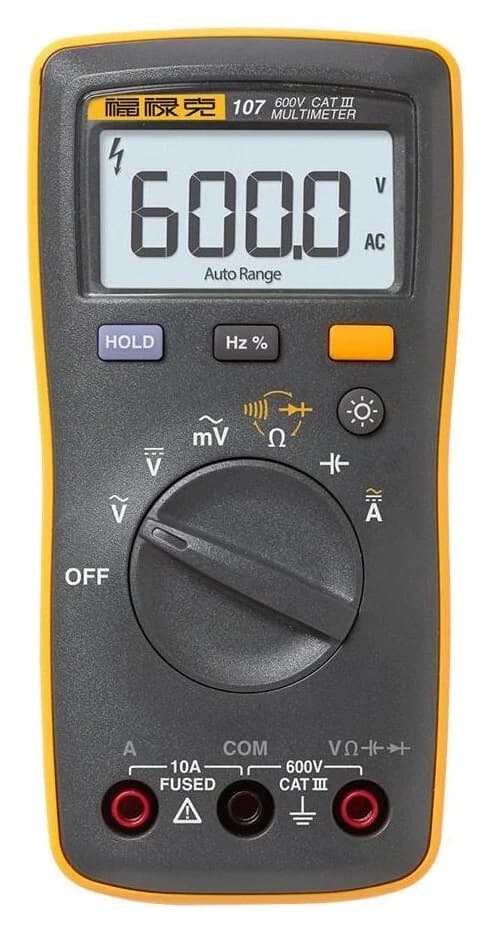
Fluke
A palm-size 6,000-count multimeter rated CAT III 600V that measures AC and DC voltage and current to 600 V and 10 A, plus resistance, capacitance, frequency and duty cycle; it is not True RMS.
Check package and model options
- 600 V max
- 10 A max
- 6,000 counts
- CAT III 600V
The US 107 page confirms a backlit display, data hold, TL75 leads and SmartStrap. Those are the reasons to choose it when illumination, support at a viewing angle or direct current measurement matters. Capacitance and frequency alone are not reasons to move from a 101: its manual already describes them.
Current jacks and the small-current trade-off
The 107 manual specifies 4.000 A with 0.001 A resolution, and 10.00 A with 0.01 A resolution, for AC and DC current. Accuracy is ±(1.5% + 3 digits); the AC-current specification covers 40–200 Hz. Its smallest display step is not a separate sensitive milliamp or microamp range. Our recommendation: choose a meter with an explicitly documented small-current range for low-power electronics or sensor work.
Do not read the headline as continuous operation at maximum current: the manual specifies a 10 A duty cycle of less than 7 minutes on, 20 minutes off, at 25–40 °C. It lists 11 A, 1000 V, IR 17 kA protection for the A input. Follow the matching manual's current-measurement and fuse requirements; this comparison is buying advice, not a live-circuit procedure.
Check price on Amazon. Confirm the seller and regional coverage before ordering.
Leads, strap and kits: compare the actual box
The 101 data sheet, India kit page and US 107 page describe different packages:
FLUKE-101 standard, data sheet
- Included equipment relevant to the choice
- Meter, TL75 leads, two installed AAA batteries, user manual; SmartStrap is not listed
Fluke 101 Kit, India page
- Included equipment relevant to the choice
- Meter, TL75 leads, two installed AAA batteries, Smart Strap
Fluke 101/i400E Kit, India page
- Included equipment relevant to the choice
- Meter, i400E AC current clamp, TL75 leads; that list does not promise a strap
Fluke 107 standard, US page
- Included equipment relevant to the choice
- Meter, TL75 leads, two installed AAA batteries, SmartStrap
Full comparison table
Swipe to compare. Row labels stay visible.
| Exact documented package | Included equipment relevant to the choice |
|---|---|
| FLUKE-101 standard, data sheet | Meter, TL75 leads, two installed AAA batteries, user manual; SmartStrap is not listed |
| Fluke 101 Kit, India page | Meter, TL75 leads, two installed AAA batteries, Smart Strap |
| Fluke 101/i400E Kit, India page | Meter, i400E AC current clamp, TL75 leads; that list does not promise a strap |
| Fluke 107 standard, US page | Meter, TL75 leads, two installed AAA batteries, SmartStrap |
Scroll horizontally to see every column
| Exact documented package | Included equipment relevant to the choice |
|---|---|
| FLUKE-101 standard, data sheet | Meter, TL75 leads, two installed AAA batteries, user manual; SmartStrap is not listed |
| Fluke 101 Kit, India page | Meter, TL75 leads, two installed AAA batteries, Smart Strap |
| Fluke 101/i400E Kit, India page | Meter, i400E AC current clamp, TL75 leads; that list does not promise a strap |
| Fluke 107 standard, US page | Meter, TL75 leads, two installed AAA batteries, SmartStrap |
Fluke describes the i400E as an AC clamp with a voltage output. That is a separate way to measure current, not an added jack or DC-current function on the 101. For the broader tool decision, see clamp meter vs multimeter.
The shared 106/107 manual also marks diode, frequency and duty-cycle tests as 107-only functions. A 106 listing is not an interchangeable substitute for this feature set.
Regional availability and warranty: what is actually verified?
Documentation checked November 2, 2026 establishes the following, not the provenance of any marketplace seller:
Manufacturer documentation
- Fluke 101
- Philippines model page, manual and distributor route
- Fluke 107
- US model page, manual and standard package
US web presence
- Fluke 101
- Former US product address opens the general multimeter listing
- Fluke 107
- Model-specific US product page
Stated warranty term
- Fluke 101
- One year in manual
- Fluke 107
- Two years in manual and US product page
Exact seller, stock origin and local eligibility
- Fluke 101
- Must be confirmed for the purchase
- Fluke 107
- Must be confirmed for the purchase
Full comparison table
Swipe to compare. Row labels stay visible.
| Evidence | Fluke 101 | Fluke 107 |
|---|---|---|
| Manufacturer documentation | Philippines model page, manual and distributor route | US model page, manual and standard package |
| US web presence | Former US product address opens the general multimeter listing | Model-specific US product page |
| Stated warranty term | One year in manual | Two years in manual and US product page |
| Exact seller, stock origin and local eligibility | Must be confirmed for the purchase | Must be confirmed for the purchase |
Scroll horizontally to see every column
| Evidence | Fluke 101 | Fluke 107 |
|---|---|---|
| Manufacturer documentation | Philippines model page, manual and distributor route | US model page, manual and standard package |
| US web presence | Former US product address opens the general multimeter listing | Model-specific US product page |
| Stated warranty term | One year in manual | Two years in manual and US product page |
| Exact seller, stock origin and local eligibility | Must be confirmed for the purchase | Must be confirmed for the purchase |
The former US 101 address opening a category page does not establish worldwide discontinuation. Equally, a regional product page is not proof that an imported unit qualifies for local support.
There is a material conflict to resolve: Fluke's warranty page names 101, 106 and 107 among models intended for Chinese and high-growth markets, with protection restricted to authorized sales, purchase and use within those territories. Yet the US 107 product page advertises a two-year warranty. We cannot reconcile those statements for an individual unit from its model name alone.
Fluke's grey-market guidance says genuine tools can still come through unauthorized channels, and warranty services are tied to authorized supply and the original country of purchase. Use its US distributor finder, then obtain Fluke's confirmation for the seller, intended country of use and stock origin. A marketplace listing or shipping location alone is insufficient evidence of manufacturer coverage.
When True RMS is required: Fluke 117
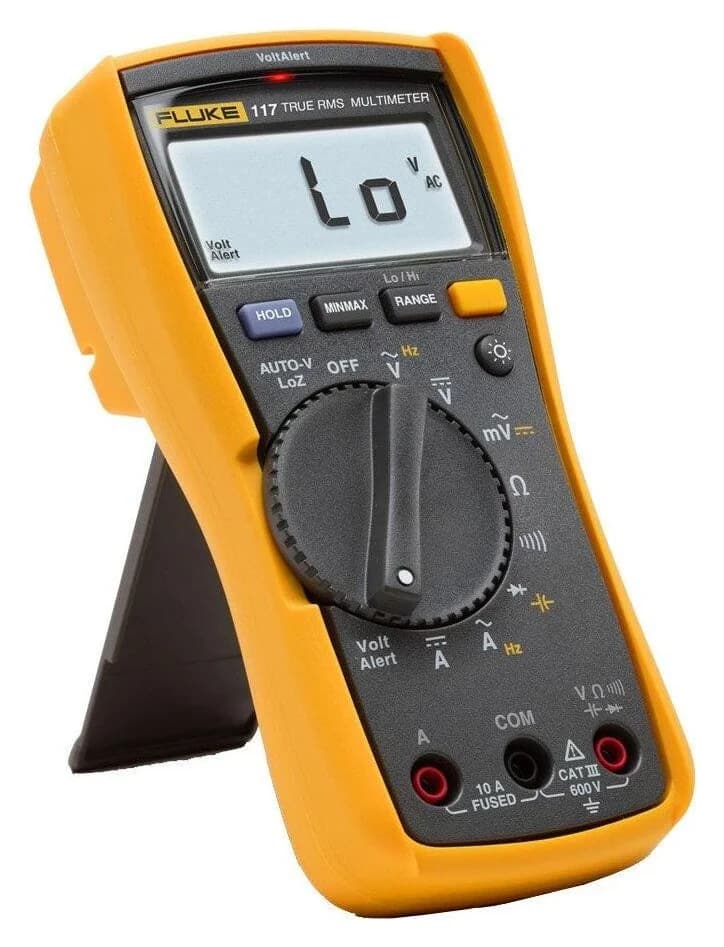
Fluke
A compact 6,000-count True RMS multimeter for electricians, rated CAT III 600V, with built-in VoltAlert non-contact voltage detection, automatic AC/DC selection and a low-impedance mode.
Check package and model options
- 600 V max
- 10 A max
- 6,000 counts
- CAT III 600V
Fluke explicitly says the 107 is not True RMS; the cited 101 documents make no True RMS claim. Its True RMS explanation says average-responding meters accurately handle pure sine waves but have uncertain accuracy on distorted waveforms, including those associated with computers and variable-speed drives. Prefer documented True RMS when the AC waveform is unknown or distorted, within the instrument's frequency and waveform limits.
The 117 provides True RMS, VoltAlert non-contact detection, automatic AC/DC voltage selection and a low-impedance mode for ghost voltages. It is our alternative for that requirement, but its current specification still has a finest resolution of 1 mA: do not choose it as a dedicated microamp meter. Compare other task-specific choices in best multimeters.
Buying guide: a compact-meter gift checklist
Choose by the recipient's work before choosing a bundle. The package table shows why a strap pictured beside a meter should be checked against the exact kit inventory.
Match the function
Ask whether direct current measurement, illumination or documented True RMS is essential; use the comparison above.
Match the package
Confirm standard meter versus strap kit versus clamp kit, and check the supplied leads and batteries against that package's official list.
Match the support
Confirm the seller's authorization, stock origin, country of use, warranty route and return terms before ordering.
For more gift options, use gifts for electricians. Keep the exact model and included-equipment list with the gift receipt so the recipient can check the package and arrange support.
How we choose
This comparison is based on documents, with no physical performance results. Ranges and operating limits come from Fluke's model-specific manuals, package contents from product pages and the data sheet, and regional caveats from its warranty and distribution guidance. We checked the shared manual's model columns and have kept conflicting manufacturer statements visible. Recommendations are our judgment about those documented capabilities; local stock and individual seller eligibility remain purchase-specific checks. Our research method explains the site's approach.
Verdict
Choose the 101 for compact voltage and component checks once local support is established. Choose the 107 for its direct current input, documented illumination and standard SmartStrap package. Keep a working 101 unless those additions solve a real need; for True RMS, choose the 117, and for small-current work insist on a suitable documented range.
Frequently asked questions
Can the Fluke 101 measure current?
The standalone Fluke 101 has no direct current input or current ranges: its manual lists a common terminal and a measurement terminal. The 107 adds an A input and AC/DC current ranges. Fluke also documents a separate 101/i400E kit, whose AC clamp provides a voltage output to the meter. That accessory does not give the standalone 101 a current jack.
Does the Fluke 101 have data hold and a backlight?
The 101 manual describes a HOLD button, although the Philippines product page's general table says Hold: No. The manual does not describe a backlight control. Choose the 107 if illumination matters: its US product page explicitly lists a backlit display, and its manual describes automatic backlight shutoff. Hold freezes the displayed reading; follow the manual's warning against using it to assess unknown potentials.
Are the Fluke 101 and 107 True RMS?
Fluke explicitly says the 107 is not True RMS. The 101 manual and linked data sheet do not claim True RMS either, so we do not recommend it for a True RMS requirement. Fluke explains that average-responding meters suit pure sine waves but have uncertain accuracy on distorted AC. The 117 is our documented True RMS alternative here, within its specified ranges.
Is the Fluke 101 discontinued or replaced by the 107?
The former US 101 product address opens Fluke's general multimeter listing, while the Philippines site still provides a model-specific 101 page, manual and distributor route. That establishes regional documentation, not worldwide discontinuation or guaranteed stock. The US 107 page documents a different model with current measurement and backlighting. Confirm the actual model, local availability and support rather than treating them as interchangeable listings.
Does an imported Fluke 101 or 107 have a US warranty?
Do not assume it does. Fluke's warranty page names both models in a territorial restriction, while its US 107 product page advertises a two-year warranty. Its grey-market guidance also ties warranty services to authorized sources and the original country of purchase. Obtain confirmation from Fluke for the exact seller, stock origin and country of use before relying on local warranty coverage.
Related guides
Best picks · Multimeters
Best Multimeters for Beginners: Choose a First Meter You Can Learn On
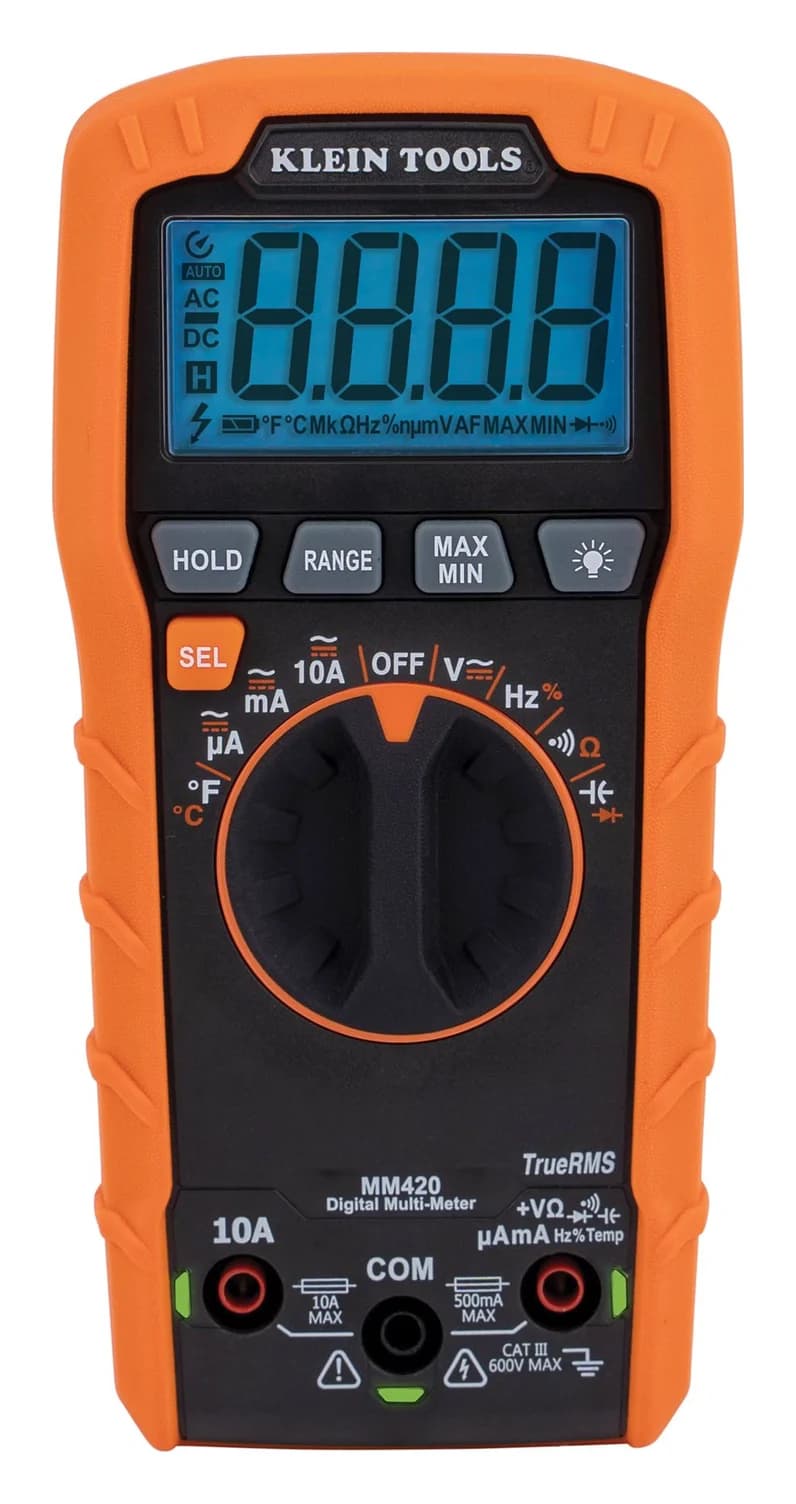
Choose a first multimeter by its controls, current ranges, jack reminders and included leads. Compare Klein MM420, MM325 and Fluke 107 for learning and gifts.
Best picks · Multimeters
Best Multimeters for HVAC: Microamps, Temperature and Complete Kits
Choose an HVAC multimeter by job: compare Fluke 116, Fieldpiece SC260 and Klein alternatives for flame sensors, clamp current, probe limits and kit contents.
Comparison · Multimeters
Fluke 87V vs 87V MAX: Ruggedness, Accuracy and Kits
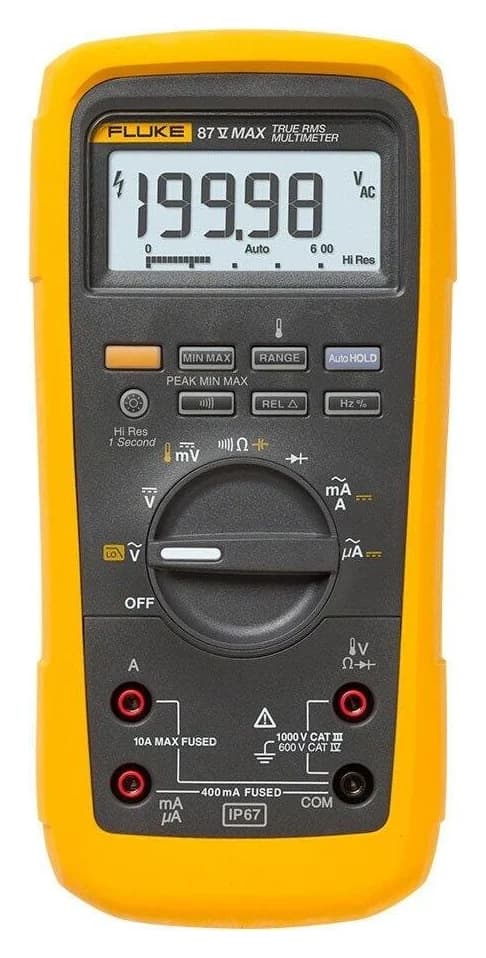
Compare Fluke 87V and 87V MAX accuracy, ruggedness, size and exact US kit contents, with clear buying picks and a keep-or-upgrade decision for existing owners.