

Comparison
Clamp Meter vs Multimeter: Choose by Current Range and Job
Choose a clamp meter or multimeter by AC/DC current, small-current resolution and lead functions, with clear Klein and Fluke picks and an appliance alternative.
By thisMETER EditorialUpdated November 2, 20268 min read6 picks
Our picks at a glance
- See on Amazon1
Best first meter for DIY and electronics
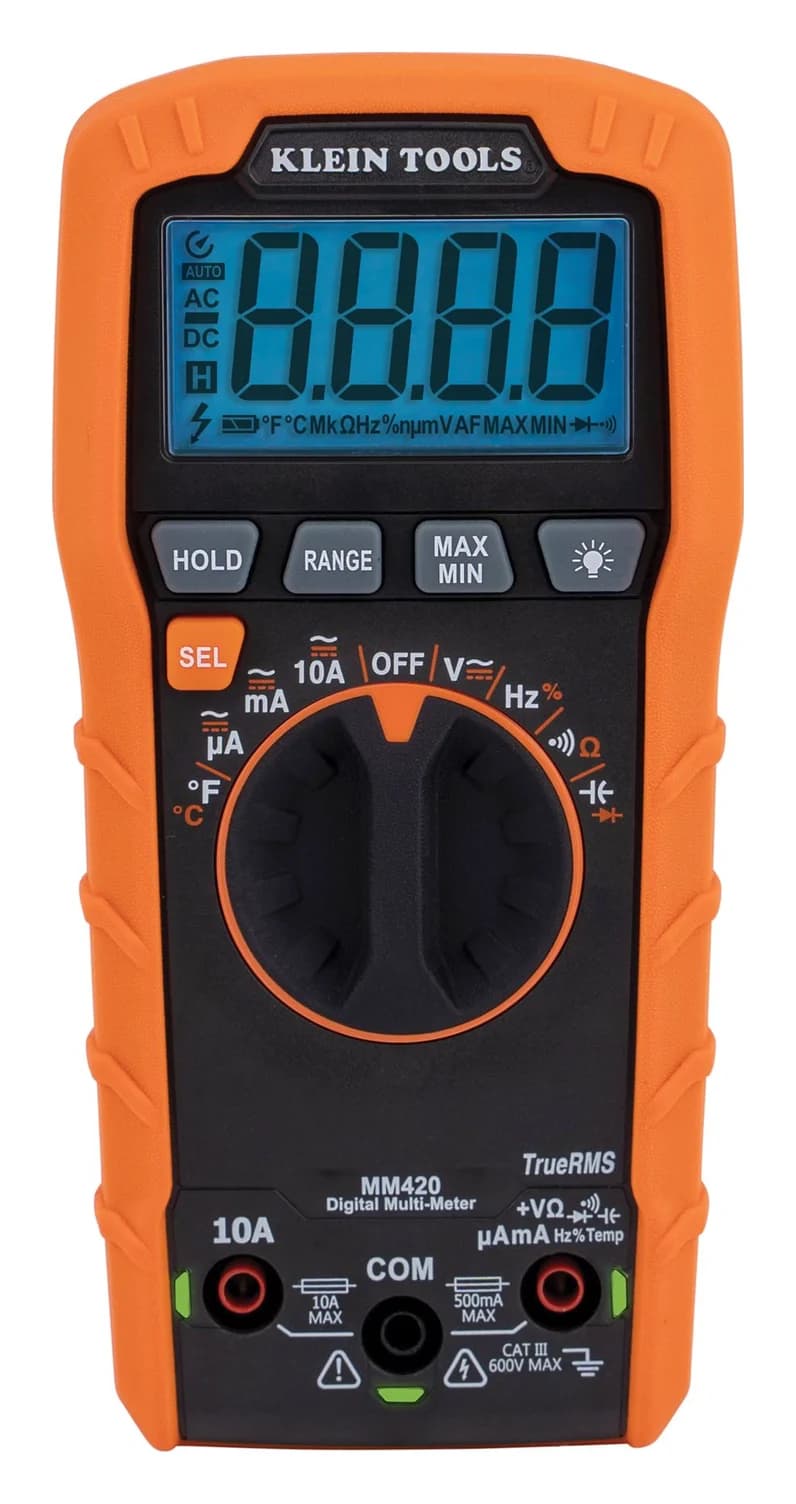
Klein Tools MM420 Auto-Ranging True RMS Digital Multimeter (600V)600V max · 10A max · 4000 counts · CAT III 600V
- See on Amazon2
Best for higher AC/DC current
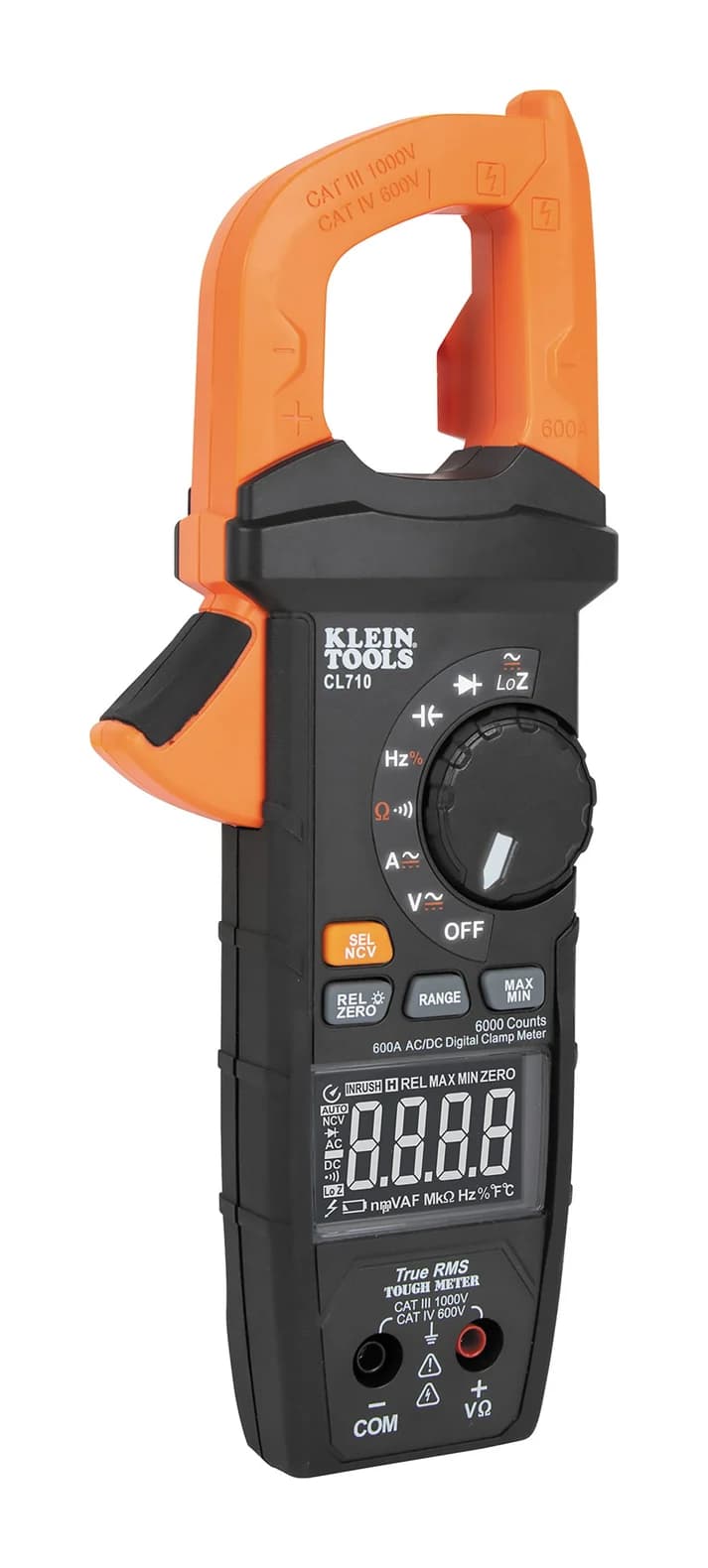
Klein Tools CL710 600A AC/DC Auto-Ranging True RMS Clamp Meter1000V max · 600A max · 6000 counts · CAT IV 600V, CAT III 1000V
- See on Amazon3
Best clamp with DC microamps and temperature
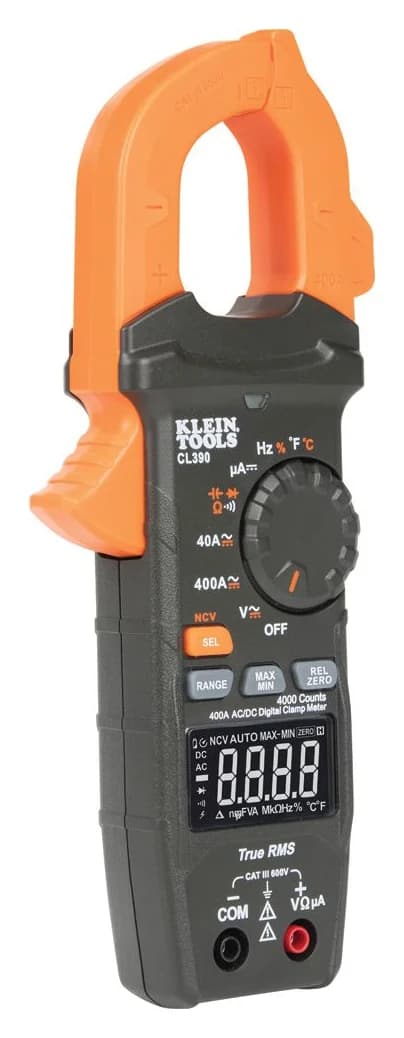
Klein Tools CL390 400A AC/DC Auto-Ranging True RMS Clamp Meter600V max · 400A max · 4000 counts · CAT III 600V
- See on Amazon4
Best simple AC-only clamp
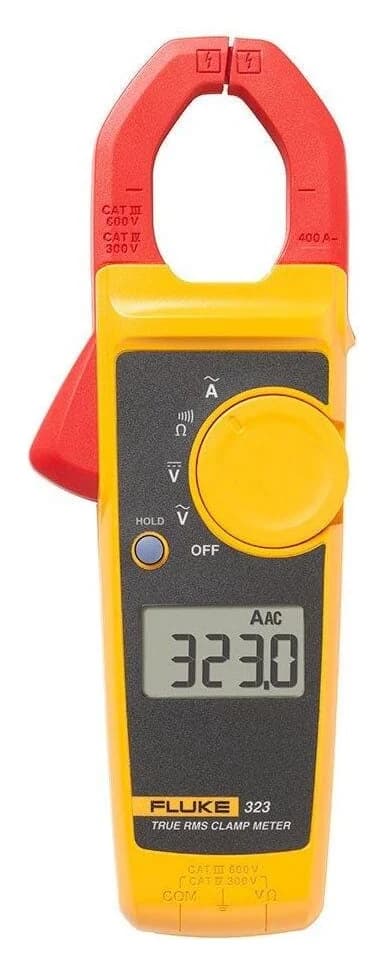
Fluke 323 True RMS Clamp Meter600V max · 400A max · CAT III 600V, CAT IV 300V
- See on Amazon5
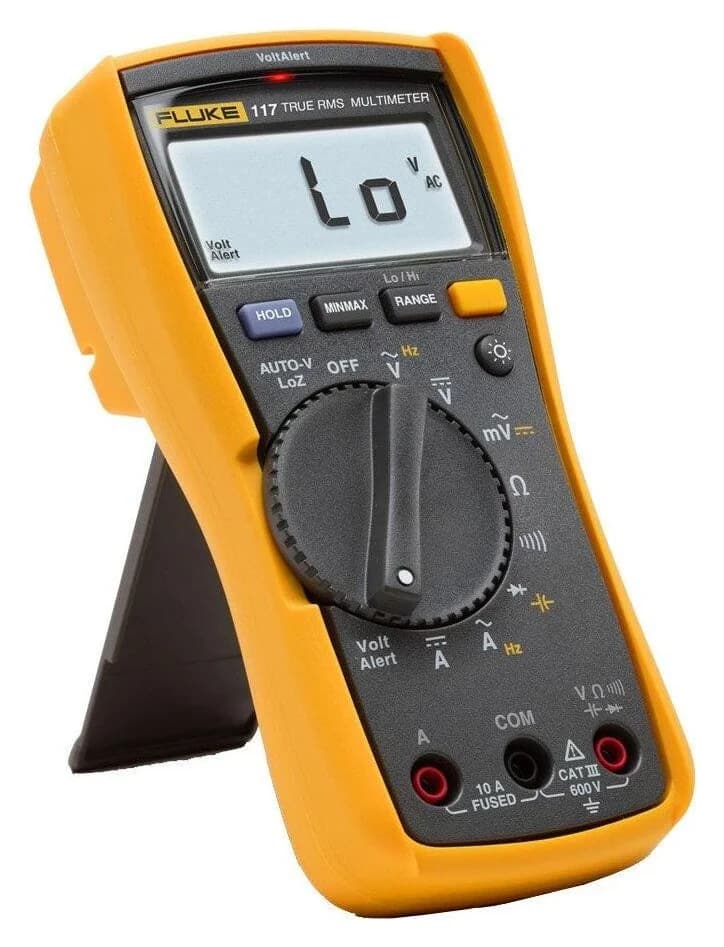
Best for electrician voltage troubleshooting
Fluke 117 Electrician's True RMS Multimeter with Non-Contact Voltage600V max · 10A max · 6000 counts · CAT III 600V
- See on Amazon6
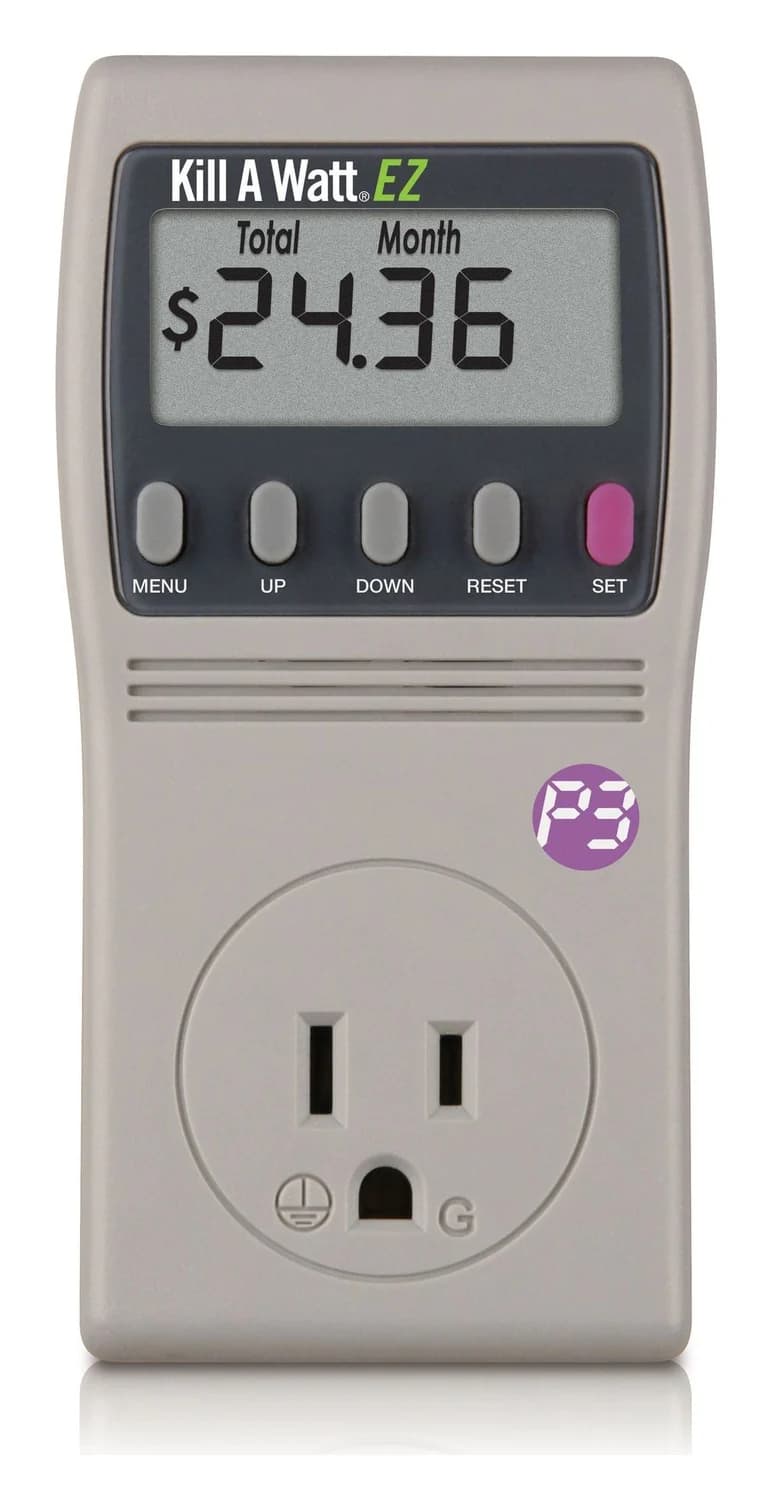
Best for plug-in appliance energy
P3 International Kill A Watt EZ P4460 Electricity Usage Monitor15A max
Buy the Klein MM420 multimeter first for small circuit currents and general troubleshooting; choose the Klein CL710 clamp meter first for larger AC/DC currents without opening the circuit. The MM420's 400 µA lead range resolves 0.1 µA, while the CL710's jaw measures up to 600 A. If the question is an appliance's watts or accumulated kWh, the P3 Kill A Watt EZ P4460 is the more direct purchase.
- 0.1 µAMM420 lead resolution on its 400 µA range
- 600 ACL710 maximum jaw current, AC or DC
thisMETER is reader-supported: when you buy through our links, we may earn a commission at no extra cost to you. As an Amazon Associate, thisMETER earns from qualifying purchases.
Quick picks: choose the job first
| Your main question | Pick | Why it fits |
|---|---|---|
| Small circuit currents, voltage and continuity? | Klein MM420 | Microamp and milliamp lead ranges; temperature and capacitance |
| Higher current on a battery, vehicle or electrical circuit? | Klein CL710 | AC/DC jaw current, plus LoZ for ghost voltage |
| DC microamps and temperature as well as clamp current? | Klein CL390 | Separate DC microamp lead function and thermocouple |
| AC load current, with no DC-current requirement? | Fluke 323 | AC-only jaw; AC/DC voltage through leads |
| Electrician voltage troubleshooting? | Fluke 117 | AutoVolt, LoZ and non-contact voltage detection |
| An appliance's energy use over time? | P3 P4460 EZ | Watts, accumulated kWh and cost estimates |
Current through a jaw versus current through leads
A clamp senses the magnetic field around a conductor, so its current measurement does not require opening the circuit. A conventional multimeter's lead-based current measurement puts the instrument in series, requiring the circuit to be opened with power removed first. Voltage, resistance and continuity remain lead measurements on the handheld clamps here; the jaw does not replace probes for those functions. See Fluke's clamp FAQ and the MM420 manual.
Compare the actual ranges
These are manufacturer specifications, not readings from thisMETER. A range is its full scale; a step is display resolution, not guaranteed accuracy. Extra lead functions matter as much as the jaw.
| Instrument | Current route and capability | Lowest current range → step | Other measurements | CAT rating, as marked |
|---|---|---|---|---|
| Klein MM420 | Leads: AC/DC to 10 A | 400 µA → 0.1 µA | 600 V AC/DC; resistance, continuity, capacitance, temperature | CAT III 600V |
| Klein CL710 | Jaw: AC/DC to 600 A | 60 A → 10 mA | 1000 V AC/DC; resistance, continuity, capacitance, LoZ | CAT IV 600V, CAT III 1000V |
| Klein CL390 | Jaw: AC/DC to 400 A; leads: DC to 200 µA | Jaw 40 A → 0.01 A; leads 200 µA → 0.1 µA | 600 V AC/DC; resistance, continuity, capacitance, temperature | CAT III 600V |
| Fluke 323 | Jaw: AC to 400 A; no DC amps | 400 A → 0.1 A | 600 V AC/DC; resistance, continuity | CAT III 600 V, CAT IV 300 V |
| Fluke 117 | Leads: AC/DC to 10 A | 6 A → 1 mA | 600 V AC/DC; resistance, continuity, capacitance, LoZ | CAT III 600V |
| P3 P4460 EZ | Plug-through: AC to 15 A | Appliance monitor; no probe ranges | Watts, kWh, power factor; 115 VAC operating voltage, 125 VAC maximum | Plug-in appliance monitor |
Small current: read the minimum, not just the decimals
The CL390 specifies a 0.3 A minimum jaw measurement, even though its lower jaw range displays 0.01 A steps. Its 200 µA DC mode uses leads, resolving 0.1 µA; that sensitivity does not apply to the jaw. The MM420 instead offers AC/DC microamp and milliamp ranges. The 117 resolves 1 mA on its 6 A range but has no dedicated microamp range.
Fluke defines resolution as the smallest displayed increment; accuracy describes allowable error under specified conditions. Klein specifies ±(2.0% + 9 digits) for CL390 jaw current. Those extra digits can matter greatly near the bottom of a range. For small standby loads, buy against the accuracy table and minimum measurable current, rather than the largest amp number on the box.
Why clamping the whole appliance cord does not work
An ordinary cord carries current outward and back. Enclosing both conductors cancels the load-current reading, as Fluke's accessory-clamp explanation describes. The diagram shows the distinction: parentheses represent the jaw; arrows represent the outward and return current paths.
Tap a label to explore. You can also hover or use your keyboard.
What is inside the jaw?
A load-current measurement uses a single conductor through the jaw.
Sources: 1: Load-current measurement requires a single conductor in the jaw.Jaw ( → ): load current
Outward conductor inside; return conductor outside. The jaw can read the current in the enclosed conductor.
Outcome
Sources: 1: Load-current measurement requires a single conductor in the jaw.Jaw ( → ← ): cancellation
Outward and return conductors both inside. Their fields cancel the load-current reading; a zero reading here does not prove the cord is safe.
Outcome
Sources: 2: Clamping line and neutral together cancels the load-current reading.Source notes2 references
Load-current measurement requires a single conductor in the jaw.
www.fluke.com — source for Load-current measurement requires a single conductor in the jaw.Place the clamp jaws around only one conductor of the circuit to be tested.
Clamping line and neutral together cancels the load-current reading.
www.fluke.com — source for Clamping line and neutral together cancels the load-current reading.will cancel the current flow reading.
For an appliance clamp measurement, use a compatible, correctly rated line splitter rather than modifying a cord. Klein's splitter page explains the separated current paths and its multiplied measurement section. For appliance energy, choose the plug-in meter below. Operating instructions stay in our clamp-meter guide.
Best first meter for DIY and electronics: Klein MM420
The MM420 is our first-tool pick because it combines small-current ranges with voltage, resistance, continuity, diode, capacitance and temperature functions. Its Lead-Alert LEDs indicate lead placement, and it is auto-ranging and True RMS.
Klein Tools
Klein Tools MM420 Auto-Ranging True RMS Digital Multimeter (600V)
A 4,000-count auto-ranging True RMS multimeter rated CAT III 600V that measures up to 600 V and 10 A, plus temperature, capacitance, frequency and duty cycle.
Comes in 4 versions: see which to buy
- 600V max
- 10A max
- 4000 counts
- CAT III 600V
Its limitation is current through leads: 10 A maximum. Klein recommends 30-second measurements followed by 10-minute recovery above 6 A. Choose a clamp when the job needs higher current without opening the circuit; retain the MM420 for small-current work.
Best for higher AC/DC current: Klein CL710
The CL710 is our clamp-first pick for AC/DC current, with LoZ and non-contact detection alongside its lead functions. It adds current reach, not the MM420's microamp ranges.
Klein Tools
Klein Tools CL710 600A AC/DC Auto-Ranging True RMS Clamp Meter
A 6,000-count True RMS clamp meter that measures AC and DC current to 600 A and voltage to 1000 V, with a low-impedance mode and non-contact voltage detection in the jaw.
Comes in 2 versions: see which to buy
- 1000V max
- 600A max
- 6000 counts
- CAT IV 600V, CAT III 1000V
Variant trap: Klein's feature bullet says a thermocouple is included, but the same page's temperature field is blank, its included-items table omits it, and the manual specifies no temperature function. Do not buy the CL710 for temperature. The separate CL810 explicitly adds temperature, DC microamps, inrush and a worklight.
Best clamp with DC microamps and temperature: Klein CL390
Choose the CL390 when you need AC/DC jaw current plus a separate DC microamp function and temperature probe. Its lead-based microamp mode makes it a different purchase from the CL710.
Klein Tools
Klein Tools CL390 400A AC/DC Auto-Ranging True RMS Clamp Meter
A 4,000-count True RMS clamp meter that measures AC and DC current to 400 A, voltage to 600 V and DC microamps, with non-contact voltage detection in the jaw and a thermocouple for temperature.
Comes in 2 versions: see which to buy
- 600V max
- 400A max
- 4000 counts
- CAT III 600V
It does not turn the jaw into a microamp sensor. The included thermocouple also has its own limit: Klein's manual rates that probe below 230 °C, despite the instrument's higher temperature range. Check the probe specification as well as the meter specification.
Best simple AC-only clamp: Fluke 323
The 323 suits buyers who need AC current, AC/DC voltage, resistance and continuity. It is True RMS, but does not measure DC current. A DC-voltage setting does not change that.
Fluke
Fluke 323 True RMS Clamp Meter
A basic True RMS clamp meter rated CAT III 600V and CAT IV 300V that measures AC current to 400 A, AC and DC voltage to 600 V, resistance and continuity; it doesn't measure DC current.
Comes in 6 versions: see which to buy
- 600V max
- 400A max
- CAT III 600V, CAT IV 300V
The shared manual includes the 325, whose DC-jaw specification must not be attributed to the 323. Also check the exact marked category: the 323 is CAT IV 300 V, not the CL710's CAT IV 600V. Choose by current type and work location, rather than brand alone.
Best for electrician voltage troubleshooting: Fluke 117
The 117 earns its place through AutoVolt AC/DC selection, VoltAlert non-contact detection and LoZ to address ghost voltage. Choose it for those voltage functions; choose the MM420 when microamp ranges are essential.
Fluke
Fluke 117 Electrician's True RMS Multimeter with Non-Contact Voltage
A compact 6,000-count True RMS multimeter for electricians, rated CAT III 600V, with built-in VoltAlert non-contact voltage detection, automatic AC/DC selection and a low-impedance mode.
Comes in 5 versions: see which to buy
- 600V max
- 10A max
- 6000 counts
- CAT III 600V
Package check: the 117 CAL adds calibration documentation. The 117/323 kit adds a separate AC-current clamp. Neither package turns the 323 into a DC-current clamp. That kit suits an AC-clamp requirement; pair a multimeter with an AC/DC clamp when battery current is also on the list.
Best for plug-in appliance energy: P3 Kill A Watt EZ P4460
The P4460 answers the appliance question directly: its manual distinguishes active watts from apparent VA and accumulates kWh. Separate voltage and current readings alone do not give the same energy record.
P3 International
P3 International Kill A Watt EZ P4460 Electricity Usage Monitor
A plug-in meter for 120 V appliances that adds the running cost at your utility rate, with projections by hour, day, week, month and year, to the Kill A Watt's electrical readings, and keeps its totals on a backup battery.
Comes in 2 versions: see which to buy
- 15A max
P3 specifies 15 A maximum, 115 VAC operating voltage and 125 VAC maximum. It is not suitable for a 240 V appliance. Choose the P4460 EZ for on-screen cost estimates and retained totals; the standard P4400 resets its counters when power is removed, according to its manual. Our plug-in watt-meter guide covers that choice further.
Buying guide: first tool, upgrade or pair?
Decide AC-only versus AC/DC current before comparing brands. All the handhelds here are True RMS; that does not make the 323 DC-capable. Also check bandwidth: the CL710 and CL390 specify AC jaw current at 50–60 Hz. Do not assume their voltage-frequency specifications apply to current.
Starting with small circuits
Choose the MM420 for its microamp and milliamp lead ranges.
Already own a suitable multimeter
Add an AC/DC clamp when you need higher current without opening the circuit; choose the AC-only 323 only when DC current is unnecessary.
Need both on the same job
Keep the multimeter for small-current and voltage work and the clamp for higher current. Match each tool's functions to the job.
Only investigating an appliance's energy use
Choose the P4460 for watts and accumulated kWh.
For more model shopping, see our multimeter picks. For low-voltage operating basics, use how to use a multimeter.
How we choose
We compare manufacturer product pages and manuals, including the function path, lowest range, resolution, stated accuracy and CAT markings. These are research-based recommendations; thisMETER has no original readings for these picks. Documents checked November 2, 2026. We flag the CL710 thermocouple conflict rather than treating a feature bullet as a temperature specification. Read How we choose and How we measure for our standards.
Verdict
Choose MM420 first for small-current and general circuit troubleshooting, CL710 first for higher AC/DC jaw current, or P4460 for appliance energy. Choose CL390 when separate DC microamps and temperature matter, 323 for an AC-only clamp requirement, and 117 for its electrician voltage functions. Buy a pair when those jobs overlap.
Frequently asked questions
Can a clamp meter replace a multimeter?
For voltage, resistance and continuity, a clamp with the right lead functions can cover those jobs. Small current is the deciding limitation: the CL710 has no microamp input, while the CL390 has a separate DC microamp function through leads. Choose by the required measurement and specified range; a jaw does not promise every multimeter function.
Can an AC clamp meter measure DC amps?
Only a model specifying DC current can do that. The Fluke 323 measures DC voltage through leads but its jaw measures AC current only. Klein's CL710 and CL390 specify AC and DC jaw current. True RMS does not establish DC-current capability: the 323 is True RMS too. Read the current row, rather than relying on AC/DC voltage wording.
Why does a clamp meter read zero around an appliance cord?
A normal cord carries outward and return current together. Fluke explains that enclosing line and neutral in the same jaw cancels the load-current reading. That reading does not establish that the appliance is off or the cord is safe. Use a maker-approved line splitter within its ratings for clamp measurements, or choose a plug-in watt meter for appliance watts and energy.
Which is better for small battery-drain measurements?
Prioritize the specified low-current range and accuracy. The CL390's jaw has a 0.3 A minimum despite displaying 0.01 A steps; its microamp function is a separate lead measurement. The MM420 offers microamp and milliamp ranges, whereas the Fluke 117 starts on a 6 A range with 1 mA resolution. Follow the meter and vehicle procedures before choosing a connection method.
Best first meter for DIY and electronics
Klein Tools MM420 Auto-Ranging True RMS Digital Multimeter (600V)