

Best picks
Best Multimeters for Beginners
Choose a First Meter You Can Learn On
Choose a first multimeter by its controls, current ranges, jack reminders and included leads. Compare Klein MM420, MM325 and Fluke 107 for learning and gifts.
By thisMETER EditorialUpdated November 3, 20268 min read2 picks
Our recommendation: Klein Tools MM420
A first meter with room for electronics lessons
Limit: Rated CAT III 600V: not for service-entrance (CAT IV) work
On this page · Our picks at a glance
Our picks at a glance
- 1
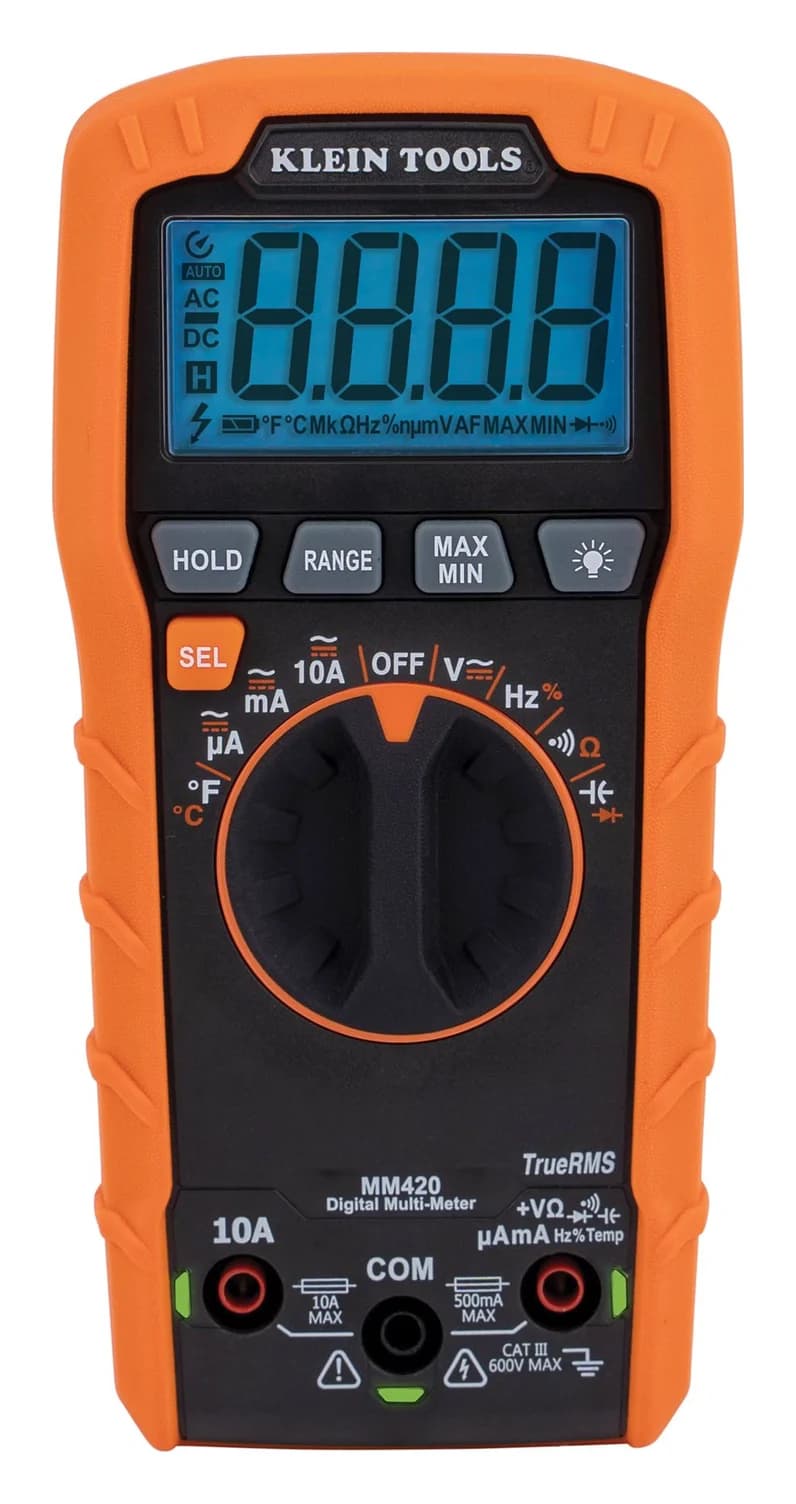
Choose for: A first meter with room for electronics lessons
Limit: Rated CAT III 600V: not for service-entrance (CAT IV) work
- 2
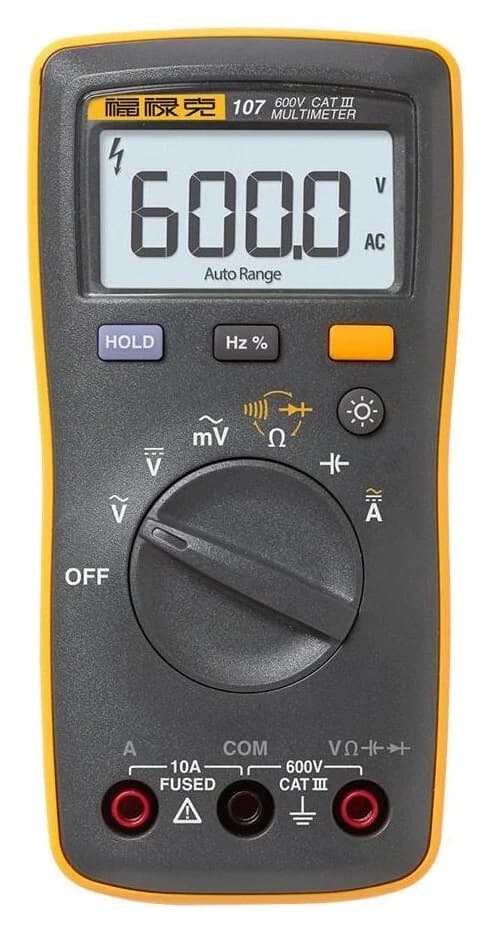
Choose for: A compact meter to carry and hang nearby
Limit: Pocket-size body and included SmartStrap; no dedicated µA/mA ranges
The Klein Tools MM420 is our best multimeter for most beginners: it combines auto-ranging with manual range control, illuminated jack reminders and AC/DC microamp ranges. Choose the Klein MM325 when you specifically want to learn manual ranging, or the Fluke 107 when pocket size matters more than dedicated small-current ranges. These recommendations come from official specifications and manuals; start with low-voltage learning and use our how to use a multimeter guide for measurement procedures.
Quick picks: choose the lesson, then the meter
Compare specifications and all conditions
A first meter with room for electronics lessons
- Our choice
- Klein MM420
- Deciding trade-off
- Automatic ranging and manual override; includes AC/DC microamp ranges
A course that teaches selecting every range
- Our choice
- Klein MM325
- Deciding trade-off
- Manual ranging, including DC microamps; no AC current function listed
A compact meter to carry and hang nearby
- Our choice
- Fluke 107
- Deciding trade-off
- Pocket-size body and included SmartStrap; no dedicated µA/mA ranges
Full comparison table
Swipe to compare. Row labels stay visible.
| Your priority | Our choice | Deciding trade-off |
|---|---|---|
| A first meter with room for electronics lessons | Klein MM420 | Automatic ranging and manual override; includes AC/DC microamp ranges |
| A course that teaches selecting every range | Klein MM325 | Manual ranging, including DC microamps; no AC current function listed |
| A compact meter to carry and hang nearby | Fluke 107 | Pocket-size body and included SmartStrap; no dedicated µA/mA ranges |
Scroll horizontally to see every column
| Your priority | Our choice | Deciding trade-off |
|---|---|---|
| A first meter with room for electronics lessons | Klein MM420 | Automatic ranging and manual override; includes AC/DC microamp ranges |
| A course that teaches selecting every range | Klein MM325 | Manual ranging, including DC microamps; no AC current function listed |
| A compact meter to carry and hang nearby | Fluke 107 | Pocket-size body and included SmartStrap; no dedicated µA/mA ranges |
For a choice led by cost, use the budget multimeter guide. For a tool chosen by trade or specialist job, start with our broader best multimeters selector.
Compare the controls and learning limits
Range selection
- Klein MM420
- Automatic; manual Range button
- Klein MM325
- Manual, on the dial
- Fluke 107
- Automatic; no Range button documented
Jack reminder
- Klein MM420
- Lead Alert LEDs; switch off after 2 minutes
- Klein MM325
- Lead Alert LEDs; switch off after 2 minutes
- Fluke 107
- No illuminated jack reminder documented
Display
- Klein MM420
- 4,000 counts; backlight
- Klein MM325
- 2,000 counts; backlight
- Fluke 107
- 6,000 counts; backlight
Smallest current range, not smallest measurable current
- Klein MM420
- 400.0 µA, AC/DC
- Klein MM325
- 200.0 µA, DC only
- Fluke 107
- 4.000 A, AC/DC
Finest current resolution
- Klein MM420
- 0.1 µA
- Klein MM325
- 0.1 µA DC
- Fluke 107
- 0.001 A (1 mA)
Current inputs
- Klein MM420
- VΩ for µA/mA; separate 10A input
- Klein MM325
- VΩ for µA/mA; separate 10A input
- Fluke 107
- A input; no dedicated µA/mA ranges
Extra learning functions
- Klein MM420
- Temperature, capacitance, frequency, duty cycle
- Klein MM325
- Battery test
- Fluke 107
- Capacitance, frequency, duty cycle
True RMS
- Klein MM420
- Yes
- Klein MM325
- Documentation differs; see below
- Fluke 107
- No
Safety rating as marked
- Klein MM420
- CAT III 600V
- Klein MM325
- CAT III 600V
- Fluke 107
- CAT III 600V
Full comparison table
Swipe to compare. Row labels stay visible.
| Learning feature | Klein MM420 | Klein MM325 | Fluke 107 |
|---|---|---|---|
| Range selection | Automatic; manual Range button | Manual, on the dial | Automatic; no Range button documented |
| Jack reminder | Lead Alert LEDs; switch off after 2 minutes | Lead Alert LEDs; switch off after 2 minutes | No illuminated jack reminder documented |
| Display | 4,000 counts; backlight | 2,000 counts; backlight | 6,000 counts; backlight |
| Smallest current range, not smallest measurable current | 400.0 µA, AC/DC | 200.0 µA, DC only | 4.000 A, AC/DC |
| Finest current resolution | 0.1 µA | 0.1 µA DC | 0.001 A (1 mA) |
| Current inputs | VΩ for µA/mA; separate 10A input | VΩ for µA/mA; separate 10A input | A input; no dedicated µA/mA ranges |
| Extra learning functions | Temperature, capacitance, frequency, duty cycle | Battery test | Capacitance, frequency, duty cycle |
| True RMS | Yes | Documentation differs; see below | No |
| Safety rating as marked | CAT III 600V | CAT III 600V | CAT III 600V |
Scroll horizontally to see every column
| Learning feature | Klein MM420 | Klein MM325 | Fluke 107 |
|---|---|---|---|
| Range selection | Automatic; manual Range button | Manual, on the dial | Automatic; no Range button documented |
| Jack reminder | Lead Alert LEDs; switch off after 2 minutes | Lead Alert LEDs; switch off after 2 minutes | No illuminated jack reminder documented |
| Display | 4,000 counts; backlight | 2,000 counts; backlight | 6,000 counts; backlight |
| Smallest current range, not smallest measurable current | 400.0 µA, AC/DC | 200.0 µA, DC only | 4.000 A, AC/DC |
| Finest current resolution | 0.1 µA | 0.1 µA DC | 0.001 A (1 mA) |
| Current inputs | VΩ for µA/mA; separate 10A input | VΩ for µA/mA; separate 10A input | A input; no dedicated µA/mA ranges |
| Extra learning functions | Temperature, capacitance, frequency, duty cycle | Battery test | Capacitance, frequency, duty cycle |
| True RMS | Yes | Documentation differs; see below | No |
| Safety rating as marked | CAT III 600V | CAT III 600V | CAT III 600V |
All include resistance, continuity and diode testing. Sources: the MM420 manual, MM325 manual and Fluke 106/107 manual; Fluke confirms the 107's non-True-RMS status on its model page.
Read the current rows together. The range is its full-scale setting; resolution is the size of a displayed step. A smaller range number alone does not establish better accuracy or guarantee useful readings near zero. Both Klein manuals specify the same finest DC current step here, despite different range capacities.
Best first meter for most learners: Klein Tools MM420
The MM420 gets our main recommendation because you can start with automatic range selection and later practise manual ranging on the same instrument. Its manual documents a Range button, a Select button for secondary functions, Hold and Min/Max. Those controls offer a learning path without requiring you to begin with a different meter.
Klein Tools
A 4,000-count auto-ranging True RMS multimeter rated CAT III 600V that measures up to 600 V and 10 A, plus temperature, capacitance, frequency and duty cycle.
Check package and model options
- 600 V max
- 10 A max
- 4,000 counts
- CAT III 600V
Its Lead Alert LEDs illuminate the appropriate jacks for the selected function. Treat them as placement reminders and independently check the function and inputs: the lights time out after two minutes and can be disabled. The manual describes illumination, without claiming a physical jack lockout.
Klein's MM420 product page includes leads with CAT III/CAT IV caps, a thermocouple, instructions and two AAA batteries. Temperature is the extra function to check carefully: the manual limits the supplied thermocouple to below 180°C / 356°F, even though the meter's temperature range extends higher. A magnetic hanger is an accessory in Klein's selection chart.
Choose it for: a learner who wants automatic and manual ranging, small-current capability and temperature measurement. Skip it if: the course requires a particular instrument or a smaller carry format is your overriding priority.
Best for learning manual ranging: Klein Tools MM325
The MM325 puts the ranges on the dial. We recommend it for a learner whose syllabus deliberately includes range selection, rather than as a default gift. Its official page lists AC/DC voltage, DC current, resistance, continuity, batteries and diodes; its manual confirms DC microamp capability. Do not mistake its DC-only current specification for the MM420's AC/DC current functions.
The MM325 retains illuminated Lead Alert reminders, a backlight and Hold. Leads with CAT III/CAT IV caps, instructions and two AAA batteries are included. Compared with the MM420, its documented function set omits temperature, capacitance, frequency and duty cycle.
Two documentation differences matter. Klein's current multimeter selection chart marks the MM325 as True RMS, but the model page and linked manual omit that claim. Confirm the supplied revision with Klein if True RMS decides the purchase; our recommendation rests on its documented manual-ranging and DC functions. Also, the web page's broad accuracy line says “Voltage +/- 2%,” while the manual supplies range-specific percentage-plus-digits specifications. Use those individual manual entries when comparing accuracy.
Choose it for: deliberate manual-range lessons and basic DC electronics. Skip it if: you need AC current, component capacitance or temperature measurement.
See the MM325 and buying options at Klein Tools
Best pocket option: Fluke 107
The 107's appeal is its carry format: Fluke lists 142 × 69 × 28 mm, a backlit display and an included magnetic SmartStrap. The standard package also includes TL75 leads and two installed AAA batteries, according to the US product page.
Fluke
A palm-size 6,000-count multimeter rated CAT III 600V that measures AC and DC voltage and current to 600 V and 10 A, plus resistance, capacitance, frequency and duty cycle; it is not True RMS.
Check package and model options
- 600 V max
- 10 A max
- 6,000 counts
- CAT III 600V
Its manual shows an Auto Range indicator and function selection using the dial and yellow button, without documenting a manual Range button or illuminated jack reminder. That makes the MM420 our preference if experimenting with manual range control is part of your learning plan.
The important limit is current resolution. The 107 has AC/DC current ranges, but its finest current step is 1 mA. We would choose a Klein for lessons requiring finer DC current changes. The 107 still provides capacitance, frequency and duty cycle; Fluke explicitly says it is not True RMS.
Choose it for: portability and the supplied hanging strap. Skip it if: microamp lessons or manual range selection are on the syllabus.
Buying guide: controls, protection and the complete kit
Automatic ranging still leaves decisions to you
Automatic ranging chooses a measurement range. You still choose the function, AC/DC mode where applicable, and input terminals. For our general recommendation, the MM420's manual override is the useful distinction: it lets the same instrument support lessons about range selection. With the MM325, choosing a dial range is part of using the meter.
True RMS concerns AC waveform measurement: Fluke explains that average-responding meters can accurately read pure sine waves but have uncertain accuracy on distorted waveforms. Choose it for an AC requirement in your course or future work; it does not replace checking the current range and resolution for DC learning.
Name the next lesson
Check the syllabus for voltage, continuity, small DC current, capacitance or temperature.
Choose how to learn ranges
Pick manual dial ranges deliberately, or automatic ranging with manual control available later.
Match the exact package
Check the meter model, supplied leads, accessories and manual before buying.
Make replacement fuses part of the buying decision
Here are the exact replacements specified by the manuals. The two Klein small-current fuses differ; do not order a spare solely because it fits the holder.
MM420
- Small-current fuse
- 500 mA / 600 V fast-blow; Klein 69033
- Amp-input fuse
- 10 A / 600 V fast-blow; Klein 69032
MM325
- Small-current fuse
- 200 mA / 600 V fast-blow, 1 kA interrupting rating; Klein 69031
- Amp-input fuse
- 10 A / 600 V fast-blow, 10 kA interrupting rating; Klein 69032
Fluke 107
- Small-current fuse
- No separate µA/mA input
- Amp-input fuse
- 11 A / 1000 V fast fuse, 17 kA interrupting rating; Fluke 803293
Full comparison table
Swipe to compare. Row labels stay visible.
| Meter | Small-current fuse | Amp-input fuse |
|---|---|---|
| MM420 | 500 mA / 600 V fast-blow; Klein 69033 | 10 A / 600 V fast-blow; Klein 69032 |
| MM325 | 200 mA / 600 V fast-blow, 1 kA interrupting rating; Klein 69031 | 10 A / 600 V fast-blow, 10 kA interrupting rating; Klein 69032 |
| Fluke 107 | No separate µA/mA input | 11 A / 1000 V fast fuse, 17 kA interrupting rating; Fluke 803293 |
Scroll horizontally to see every column
| Meter | Small-current fuse | Amp-input fuse |
|---|---|---|
| MM420 | 500 mA / 600 V fast-blow; Klein 69033 | 10 A / 600 V fast-blow; Klein 69032 |
| MM325 | 200 mA / 600 V fast-blow, 1 kA interrupting rating; Klein 69031 | 10 A / 600 V fast-blow, 10 kA interrupting rating; Klein 69032 |
| Fluke 107 | No separate µA/mA input | 11 A / 1000 V fast fuse, 17 kA interrupting rating; Fluke 803293 |
The Klein manuals and Fluke manual describe replacement precautions; Fluke requires specified replacement parts. A headline current range also needs its duty-cycle limits: consult the exact manual before planning sustained current measurements.
Leads and ratings belong to the whole setup
Both Klein manuals warn that omitting the CAT III/CAT IV probe shields in those locations increases arc-flash risk. Fluke says the setup must stay within the CAT rating of its lowest-rated component, including probes and accessories. Keep the supplied caps with the leads and check their condition against the manual.
Check model names and bundles before giving one
MM325, MM320 and MM420 are different models. For example, Klein's 69149P test kit contains an MM320 with an NCVT1P pen and RT110 receptacle tester. A kit photograph with more tools does not establish that you are receiving either recommended Klein model.
Fluke 106 and 107 also differ. Their shared manual makes diode, frequency and duty-cycle tests 107-only functions; both have capacitance measurement. Ask for the model number when comparing packages.
- Yes: Match the recipient's course requirements and existing tools
- Yes: Read the included-accessories list before adding duplicate leads or batteries
- Partly: Add a case or hanger after checking the exact package
- No: Substitute a similarly named kit without checking which meter it contains
Give the recipient the matching manual link as well. Klein also has an official multimeter-family overview video; use the model manual for operating details. Our low-voltage multimeter tutorial is the next stop for practice, and gifts for electricians helps with a more experienced recipient.
How we choose
This is a document-based comparison, with no physical testing. We checked official model pages, linked manuals and Klein's current selection chart on November 2, 2026, prioritising controls, current resolution, lead reminders, fuse identification and package contents. We distinguish manual specifications from web-page summaries and flag the MM325 documentation differences above. Awards reflect our judgement about learning fit; read our full selection method.
Verdict
Get the MM420 for the most flexible start: automatic ranging, manual control and small AC/DC current ranges. Choose the MM325 for intentional manual-range learning, or the Fluke 107 for its compact format and included SmartStrap. Match the course and exact package before adding accessories, then begin with the low-voltage tutorial.
Frequently asked questions
Is an auto-ranging or manual-ranging multimeter better for beginners?
We recommend the auto-ranging Klein MM420 for most learners because its manual range control also lets you practise choosing ranges later. The MM325 makes range selection part of every lesson. Either way, you still select the measurement function and correct inputs. Choose the MM325 when a course specifically teaches manual ranging; choose the MM420 when you want both approaches in the same meter.
Does the Klein MM325 measure microamps?
Yes. Its official manual lists a 200.0 µA DC range with 0.1 µA resolution, alongside milliamp and amp ranges. It does not list AC current measurement. The small-current input shares the VΩ jack, so jack labels alone do not describe every function. Check the manual's input limits and fuse specifications before choosing it for a course or project.
Is the Fluke 107 a good first multimeter for electronics?
It suits a learner who values a pocket-size meter and wants voltage, resistance, continuity, diode and capacitance functions. Its current ranges are 4 A and 10 A, with 1 mA as the finest current resolution. For lessons involving smaller current changes, we prefer the Klein MM420 or the MM325's DC microamp range. Fluke explicitly says the 107 is not True RMS.
Do these starter multimeters include test leads and batteries?
The standard MM420 and MM325 packages include test leads with CAT III/CAT IV safety caps and two AAA batteries; the MM420 also includes a thermocouple. Fluke lists TL75 leads, two installed AAA batteries and a magnetic SmartStrap with the standard 107. Check the exact package before adding accessories to a gift, and ask the recipient whether their course specifies a particular meter or probe set.
Klein Tools MM420
AmazonRelated guides
Best picks · Multimeters
Best Multimeters for HVAC: Microamps, Temperature and Complete Kits
Choose an HVAC multimeter by job: compare Fluke 116, Fieldpiece SC260 and Klein alternatives for flame sensors, clamp current, probe limits and kit contents.
Comparison · Multimeters
Fluke 101 vs 107: Current Ranges, Backlight and Regional Support
Compare the Fluke 101 and 107 by current inputs, backlight, accuracy and kit contents, with manual references and regional warranty checks before you buy.
Comparison · Multimeters
Fluke 87V vs 87V MAX: Ruggedness, Accuracy and Kits
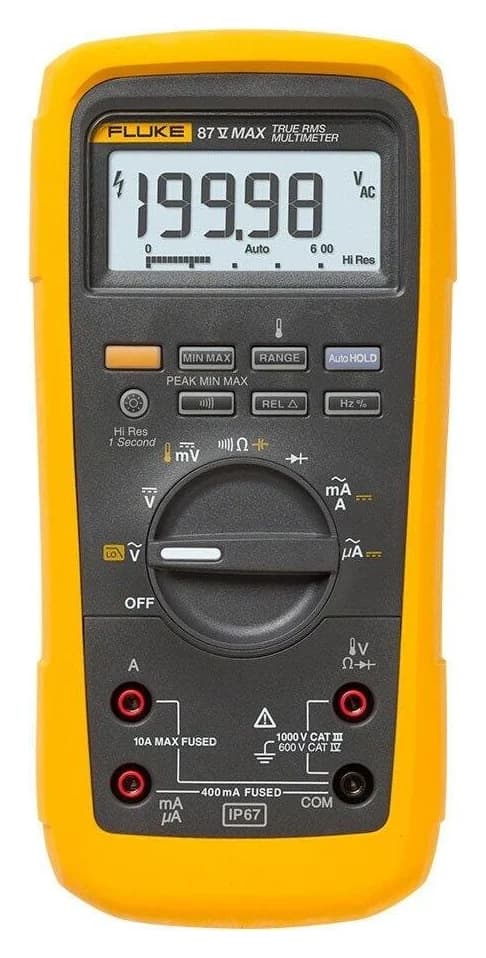
Compare Fluke 87V and 87V MAX accuracy, ruggedness, size and exact US kit contents, with clear buying picks and a keep-or-upgrade decision for existing owners.