

Comparison
Fluke 87V vs 87V MAX
Ruggedness, Accuracy and Kits
Compare Fluke 87V and 87V MAX accuracy, ruggedness, size and exact US kit contents, with clear buying picks and a keep-or-upgrade decision for existing owners.
By thisMETER EditorialUpdated November 3, 20269 min read1 pick
Our recommendation: Fluke 87V MAX
New purchase where accidental exposure and rough handling are concerns
Limit: The trade-off is bulk: the holstered MAX weighs 698.5 g, against 624 g for the holstered base model.
On this page · Our picks at a glance
Our picks at a glance
- 1
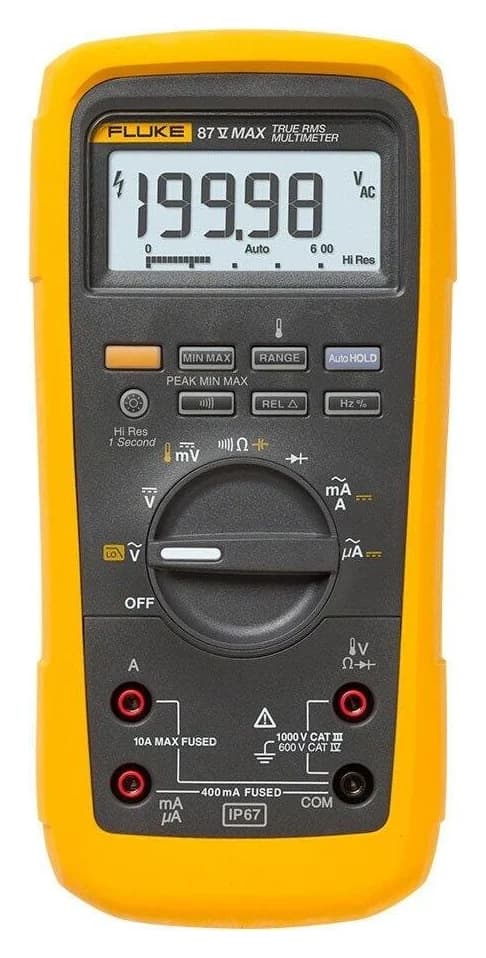
Choose for: New purchase where accidental exposure and rough handling are concerns
Check before buying: The trade-off is bulk: the holstered MAX weighs 698.5 g, against 624 g for the holstered base model.
For a new industrial meter, choose the Fluke 87V MAX when enclosure protection and illuminated controls matter: Fluke specifies IP67 and a 4 m drop rating with the holster. Choose the base Fluke 87V for dry, controlled work when its smaller, lighter body suits you, and keep a serviceable existing 87V if it already meets your requirements. The main MAX gains are protection and usability, but some measurement specifications also differ—check your actual function and range before upgrading.
Quick picks
Compare specifications and all conditions
New purchase where accidental exposure and rough handling are concerns
- Our pick
- 87V MAX
- Why
- IP67 enclosure, backlit buttons and the stated 4 m drop protection with holster
Dry, controlled work; carrying size matters
- Our pick
- Base 87V
- Why
- Smaller and lighter with its holster; retains True RMS and the VFD low-pass filter
Already own an undamaged, appropriately calibrated 87V
- Our pick
- Keep it unless a specific MAX benefit solves a problem
- Why
- The CAT ratings and matched-range DC voltage accuracy are the same
Full comparison table
Swipe to compare. Row labels stay visible.
| Your situation | Our pick | Why |
|---|---|---|
| New purchase where accidental exposure and rough handling are concerns | 87V MAX | IP67 enclosure, backlit buttons and the stated 4 m drop protection with holster |
| Dry, controlled work; carrying size matters | Base 87V | Smaller and lighter with its holster; retains True RMS and the VFD low-pass filter |
| Already own an undamaged, appropriately calibrated 87V | Keep it unless a specific MAX benefit solves a problem | The CAT ratings and matched-range DC voltage accuracy are the same |
Scroll horizontally to see every column
| Your situation | Our pick | Why |
|---|---|---|
| New purchase where accidental exposure and rough handling are concerns | 87V MAX | IP67 enclosure, backlit buttons and the stated 4 m drop protection with holster |
| Dry, controlled work; carrying size matters | Base 87V | Smaller and lighter with its holster; retains True RMS and the VFD low-pass filter |
| Already own an undamaged, appropriately calibrated 87V | Keep it unless a specific MAX benefit solves a problem | The CAT ratings and matched-range DC voltage accuracy are the same |
These are purchase recommendations from Fluke's US specifications and model-specific manuals, without physical product testing. For broader alternatives, use our Fluke versus Klein comparison or multimeter shortlist.
Best for enclosure protection: Fluke 87V MAX
Fluke
A rugged industrial True RMS multimeter rated CAT IV 600V and CAT III 1000V, with an IP67 case, a 4 m drop rating, a low-pass filter for motor-drive readings and temperature measurement.
Check package and model options
- 1,000 V max
- 10 A max
- 6,000 counts
- CAT IV 600V, CAT III 1000V
Choose MAX when accidental water exposure, dust, handling or dark controls are the buying problem. Alongside its enclosure, Fluke lists backlit keypad buttons and typical battery life of 800 hours without the backlight, using three AA batteries. The standard package supplies TL175 TwistGuard leads.
The trade-off is bulk: the holstered MAX weighs 698.5 g, against 624 g for the holstered base model. Its CAT III 1000V / CAT IV 600V markings match the base meter's; MAX does not increase that rating. See the MAX product page for the exact package.
Best for dry, controlled work: base Fluke 87V

The original remains a sensible choice when enclosure protection is not the deciding factor. It already provides True RMS AC, microamp and milliamp ranges, temperature, a motor-drive low-pass filter and high-resolution display mode. Fluke's US 87V page still offers the base model; MAX is a distinct choice rather than a reason to discard a working meter.
The base uses a 9 V battery, with about 400 hours typical life without the backlight, and has no backlit keypad in Fluke's comparison chart. Its standard US leads are TL75, so do not assume a US box contains the MAX's TL175 leads.
See the standard US 87V package at Fluke
Measurement functions and ranges compared
The 80 Series V users manual covers the base meter: read its Model 87 column, not the adjacent Model 83 column. MAX has a separate users manual. These are maker specifications, not readings from thisMETER.
Base 87V
- AC/DC current headline limit
- 10 A, with duty restrictions below
- Lowest current range / standard resolution
- 600 µA / 0.1 µA
- AC/DC voltage ceiling
- 1000 V
All specifications
- Standard / high-resolution display
- 6,000 / 19,999 counts
- True RMS AC; motor-drive low-pass filter
- Both present
- Peak min/max capture
- 250 µs
- Resistance ceiling
- 50 MΩ
- Capacitance ceiling
- 9,999 µF
- Highest specified frequency range
- 199.99 kHz
- Temperature input, excluding probe error
- -200 to 1090 °C
- DC volts accuracy, 6 V through 1000 V ranges
- ±(0.05% + 1 count)
- Resistance accuracy, 600 kΩ and 6 MΩ ranges
- ±(0.6% + 1 count)
- Diode range / accuracy
- 3 V / ±(2% + 1 count)
87V MAX
- AC/DC current headline limit
- 10 A, with duty restrictions below
- Lowest current range / standard resolution
- 600 µA / 0.1 µA
- AC/DC voltage ceiling
- 1000 V
All specifications
- Standard / high-resolution display
- 6,000 / 19,999 counts
- True RMS AC; motor-drive low-pass filter
- Both present
- Peak min/max capture
- 250 µs
- Resistance ceiling
- 50 MΩ
- Capacitance ceiling
- 9,999 µF
- Highest specified frequency range
- 199.99 kHz
- Temperature input, excluding probe error
- -200 to 1090 °C
- DC volts accuracy, 6 V through 1000 V ranges
- ±(0.05% + 1 count)
- Resistance accuracy, 600 kΩ and 6 MΩ ranges
- ±(0.2% + 1 count)
- Diode range / accuracy
- 2 V / ±(1% + 1 count)
Full comparison table
Swipe to compare. Row labels stay visible.
| Specification | Base 87V | 87V MAX |
|---|---|---|
| AC/DC voltage ceiling | 1000 V | 1000 V |
| AC/DC current headline limit | 10 A, with duty restrictions below | 10 A, with duty restrictions below |
| Lowest current range / standard resolution | 600 µA / 0.1 µA | 600 µA / 0.1 µA |
| Standard / high-resolution display | 6,000 / 19,999 counts | 6,000 / 19,999 counts |
| True RMS AC; motor-drive low-pass filter | Both present | Both present |
| Peak min/max capture | 250 µs | 250 µs |
| Resistance ceiling | 50 MΩ | 50 MΩ |
| Capacitance ceiling | 9,999 µF | 9,999 µF |
| Highest specified frequency range | 199.99 kHz | 199.99 kHz |
| Temperature input, excluding probe error | -200 to 1090 °C | -200 to 1090 °C |
| DC volts accuracy, 6 V through 1000 V ranges | ±(0.05% + 1 count) | ±(0.05% + 1 count) |
| Resistance accuracy, 600 kΩ and 6 MΩ ranges | ±(0.6% + 1 count) | ±(0.2% + 1 count) |
| Diode range / accuracy | 3 V / ±(2% + 1 count) | 2 V / ±(1% + 1 count) |
Scroll horizontally to see every column
| Specification | Base 87V | 87V MAX |
|---|---|---|
| AC/DC voltage ceiling | 1000 V | 1000 V |
| AC/DC current headline limit | 10 A, with duty restrictions below | 10 A, with duty restrictions below |
| Lowest current range / standard resolution | 600 µA / 0.1 µA | 600 µA / 0.1 µA |
| Standard / high-resolution display | 6,000 / 19,999 counts | 6,000 / 19,999 counts |
| True RMS AC; motor-drive low-pass filter | Both present | Both present |
| Peak min/max capture | 250 µs | 250 µs |
| Resistance ceiling | 50 MΩ | 50 MΩ |
| Capacitance ceiling | 9,999 µF | 9,999 µF |
| Highest specified frequency range | 199.99 kHz | 199.99 kHz |
| Temperature input, excluding probe error | -200 to 1090 °C | -200 to 1090 °C |
| DC volts accuracy, 6 V through 1000 V ranges | ±(0.05% + 1 count) | ±(0.05% + 1 count) |
| Resistance accuracy, 600 kΩ and 6 MΩ ranges | ±(0.6% + 1 count) | ±(0.2% + 1 count) |
| Diode range / accuracy | 3 V / ±(2% + 1 count) | 2 V / ±(1% + 1 count) |
Both have voltage ranges of 600 mV, 6 V, 60 V, 600 V and 1000 V, and current ranges of 600 µA, 6000 µA, 60 mA, 400 mA, 6 A and 10 A. Use the detailed range tables when choosing a meter for small signals.
The resistance row comes from the detailed manuals, not the product pages' headline resistance accuracy. The base page's 10 µV maximum DC resolution also needs context: its manual specifies 0.1 mV on the standard 600 mV range. Resolution and accuracy are different quantities, and display mode matters.
Both manuals restrict 10 A continuous operation to ambient temperatures up to 35 °C. Above that, up to 55 °C, they impose a 20-minute measurement limit and 5-minute rest; the MAX wording is less than 20 minutes. Above 10 A through 20 A, the limit is 30 seconds followed by 5 minutes off, and accuracy above 10 A is unspecified. Do not read the headline as a continuous 20 A capability.
Same reading, same DC tolerance
For a calculated example, assume a 12 V DC reading in standard mode on the 60 V range. Both manuals specify 0.01 V resolution there and ±(0.05% of reading + 1 count). The calculation is ±(0.05% × 12 V + 1 × 0.01 V) = ±16 mV for either meter; this is a specification calculation, not a measurement.
The conditions differ: the base manual specifies accuracy for one year after calibration at 18–28 °C, with relative humidity up to 90%; MAX specifies two years at 18–28 °C, with 0–95% relative humidity. These are accuracy conditions, not permission to extend your workplace's calibration schedule. Both manuals require multiplying the counts term by 10 in high-resolution mode; extra displayed digits alone do not prove tighter accuracy.
The MAX AC-current correction matters
The MAX manual prints competing AC-current accuracy values. Fluke's users manual supplement explicitly replaces that column with ±(1.0% + 2 counts), 45 Hz to 2 kHz, subject to its range and duty restrictions. Save the supplement with the MAX manual so you use the corrected table.
Enclosure, operating conditions and carrying size
Base 87V
- Ingress rating in Fluke's comparison
- IP30
- Drop claim
- Conflict: comparison says 3 m; general specifications say 1 m
- Operating temperature
- -20 to 55 °C in current safety sheet
All specifications
- Holstered size, H × W × L
- 5.2 × 9.8 × 20.1 cm
- Weight with holster and stand
- 624 g
- Batteries / typical life without backlight
- 9 V / 400 hours
- Backlit keypad
- No
87V MAX
- Ingress rating in Fluke's comparison
- IP67
- Drop claim
- Up to 4 m with casing and holster
- Operating temperature
- -15 to 55 °C; -40 °C for 20 minutes when taken from 20 °C
All specifications
- Holstered size, H × W × L
- 6.0 × 10.1 × 21.5 cm
- Weight with holster and stand
- 698.5 g
- Batteries / typical life without backlight
- Three AA / 800 hours
- Backlit keypad
- Yes
Full comparison table
Swipe to compare. Row labels stay visible.
| Specification | Base 87V | 87V MAX |
|---|---|---|
| Ingress rating in Fluke's comparison | IP30 | IP67 |
| Drop claim | Conflict: comparison says 3 m; general specifications say 1 m | Up to 4 m with casing and holster |
| Operating temperature | -20 to 55 °C in current safety sheet | -15 to 55 °C; -40 °C for 20 minutes when taken from 20 °C |
| Holstered size, H × W × L | 5.2 × 9.8 × 20.1 cm | 6.0 × 10.1 × 21.5 cm |
| Weight with holster and stand | 624 g | 698.5 g |
| Batteries / typical life without backlight | 9 V / 400 hours | Three AA / 800 hours |
| Backlit keypad | No | Yes |
Scroll horizontally to see every column
| Specification | Base 87V | 87V MAX |
|---|---|---|
| Ingress rating in Fluke's comparison | IP30 | IP67 |
| Drop claim | Conflict: comparison says 3 m; general specifications say 1 m | Up to 4 m with casing and holster |
| Operating temperature | -20 to 55 °C in current safety sheet | -15 to 55 °C; -40 °C for 20 minutes when taken from 20 °C |
| Holstered size, H × W × L | 5.2 × 9.8 × 20.1 cm | 6.0 × 10.1 × 21.5 cm |
| Weight with holster and stand | 624 g | 698.5 g |
| Batteries / typical life without backlight | 9 V / 400 hours | Three AA / 800 hours |
| Backlit keypad | No | Yes |
Sources: the base product page, current base safety sheet, MAX page and both users manuals. The base page's Q&A additionally describes operation down to -40 °F for 20 minutes, which conflicts with its formal operating specification. Seek Fluke clarification for a cold-site requirement; do not assume MAX is colder-rated in every circumstance or present either disputed base drop claim as settled.
Source: Fluke's model-specific users manuals; these figures exclude the rest of the kit
Exact US box contents: standard, CAL and E2
Match the suffix and region before comparing an offer. These inventories come from the US pages' Models / Includes sections, not photographs or regional assumptions.
Meter
- Standard base 87V
- 87V, part 2074974
- Standard 87V MAX
- 87V MAX, part 5140033
Leads
- Standard base 87V
- TL75; Fluke specifies TL175 for Europe
- Standard 87V MAX
- TL175 TwistGuard
Clips
- Standard base 87V
- AC175
- Standard 87V MAX
- AC175
Temperature probe
- Standard base 87V
- 80BK
- Standard 87V MAX
- 80BK-A
Holster
- Standard base 87V
- Included
- Standard 87V MAX
- Included
Batteries
- Standard base 87V
- Installed 9 V
- Standard 87V MAX
- Three AA, installed
Carrying case / magnetic hanger
- Standard base 87V
- Neither listed
- Standard 87V MAX
- Neither listed
Full comparison table
Swipe to compare. Row labels stay visible.
| Package | Standard base 87V | Standard 87V MAX |
|---|---|---|
| Meter | 87V, part 2074974 | 87V MAX, part 5140033 |
| Leads | TL75; Fluke specifies TL175 for Europe | TL175 TwistGuard |
| Clips | AC175 | AC175 |
| Temperature probe | 80BK | 80BK-A |
| Holster | Included | Included |
| Batteries | Installed 9 V | Three AA, installed |
| Carrying case / magnetic hanger | Neither listed | Neither listed |
Scroll horizontally to see every column
| Package | Standard base 87V | Standard 87V MAX |
|---|---|---|
| Meter | 87V, part 2074974 | 87V MAX, part 5140033 |
| Leads | TL75; Fluke specifies TL175 for Europe | TL175 TwistGuard |
| Clips | AC175 | AC175 |
| Temperature probe | 80BK | 80BK-A |
| Holster | Included | Included |
| Batteries | Installed 9 V | Three AA, installed |
| Carrying case / magnetic hanger | Neither listed | Neither listed |
E2 changes the accessory package. The 87V/E2, part 2670150, contains the base meter; the 87V MAX E2, part 5160712, contains MAX. Both list TL224 leads, AC220 clips, TL238 probes, ToolPak magnetic hanging kit, 80BK-A temperature probe and C35 soft case. The base kit lists an installed 9 V battery; MAX E2 lists three installed AA batteries. Choose an E2 package when you need those accessories together.
CAL adds documentation. The standard 87V CAL, part 5160456, and 87V MAX CAL, part 5206068, each list their corresponding standard package plus a traceable calibration certificate with data from Fluke. CAL does not turn a base meter into MAX, and E2 does not by itself mean the CAL package.
The supplied temperature probe is the limit. Both standard pages specify -40 to 260 °C for the included probe, with error of ±2.2 °C or 2%, whichever is greater. The meter input's -200 to 1090 °C specification excludes probe error. For a temperature job, check the probe rating and its error as well as the meter; the E2 page's broad temperature headline does not extend the supplied probe's range.
Keep or upgrade your existing 87V?
Keep an undamaged meter within your required calibration schedule if its ranges and permitted conditions already cover your work. Its True RMS, VFD filter, temperature input and high-resolution display are already present. Upgrade for a concrete benefit: enclosure protection against accidental exposure, illuminated buttons, AA power or a documented range advantage that matters to you.
- Yes: Keep: your existing meter meets the job's ranges and permitted conditions
- Partly: Upgrade: enclosure protection or illuminated controls solve a specific problem
- No: Replace solely for CAT rating or the matched DC-voltage accuracy: those specifications are shared
For service documents, use the 80 Series V calibration manual for the base and 87V MAX calibration manual for MAX. Fluke's MAX service instructions identify seals and assembly details that affect IP67 and direct owners to a qualified Fluke service center to ensure the rating. Condition and service history therefore matter when assessing an existing or used unit.
Buying guide: compare the complete package
Match the meter
Confirm base 87V or 87V MAX on the exact package.
Match the accessories
Compare standard, E2 and CAL inventories, including leads, probe, case and paperwork.
Match the documents
Save the correct users manual, safety sheet and any supplement; check the range and operating conditions your job requires.
How we choose
We compared Fluke's US product pages, detailed users manuals, safety information, manual supplement and calibration documents. Recommendations reflect those specifications and package contents; no independent performance or durability measurements are claimed. Where Fluke's documents disagree, we identify the conflict. Read our research method and measurement policy.
Verdict
Buy MAX for its enclosure and handling benefits; buy the base 87V for dry, controlled work when its smaller body fits better. Keep a suitable existing 87V. The matched DC example gives no accuracy reason to replace it, while detailed resistance, diode and accuracy-period specifications deserve attention for specialist work. Choose the meter first, then the exact accessory and calibration package.
Frequently asked questions
What is the difference between the Fluke 87V and 87V MAX?
The MAX adds an IP67 enclosure, a 4 m drop specification with its holster, backlit buttons and three AA batteries. Both offer True RMS AC, a motor-drive low-pass filter, microamp ranges, temperature and high-resolution display mode. The base model is smaller and lighter with its holster. Choose by environment and handling needs, then check the exact range specifications.
Is the Fluke 87V MAX more accurate than the 87V?
Both manuals specify ±(0.05% + 1 count) on their standard DC voltage ranges from 6 V through 1000 V. That does not make every specification identical: their detailed resistance and diode tables differ, and the MAX manual specifies accuracy for two years after calibration versus one year for the base model. Compare the function, range, conditions and counts term your work actually needs.
Does the Fluke 87V include a temperature probe and carrying case?
Fluke's standard US 87V package lists an 80BK temperature probe and a holster, but no carrying case. The standard MAX package lists an 80BK-A probe and a holster, also without a case. The E2 packages list a C35 soft case and a ToolPak magnetic hanging kit. The included probes cover -40 to 260 °C; the meter's wider temperature input range does not extend the probe's rating.
Is the Fluke 87V MAX waterproof?
Fluke specifies IP67 enclosure protection and describes the MAX as waterproof and dustproof. Its safety information nevertheless prohibits use in damp or wet environments and connections to hazardous live conductors in those conditions. Buy the enclosure protection for accidental exposure, and follow the safety instructions for actual measurements. The IP rating does not override those instructions or the ratings of probes and accessories.
Should I replace an existing Fluke 87V with the MAX?
Keep an undamaged 87V within your required calibration schedule when its functions and permitted operating conditions already fit the work. Upgrade when the MAX's enclosure protection, backlit buttons or AA power solve a specific problem. Both have the same marked CAT ratings and matched-range DC voltage accuracy, so those features alone do not justify replacement. Check the detailed specifications if resistance or diode measurements drive your decision.
Fluke 87V MAX
AmazonRelated guides
Best picks · Multimeters
Best Multimeters for Beginners: Choose a First Meter You Can Learn On
Choose a first multimeter by its controls, current ranges, jack reminders and included leads. Compare Klein MM420, MM325 and Fluke 107 for learning and gifts.
Best picks · Multimeters
Best Multimeters for HVAC: Microamps, Temperature and Complete Kits
Choose an HVAC multimeter by job: compare Fluke 116, Fieldpiece SC260 and Klein alternatives for flame sensors, clamp current, probe limits and kit contents.
Comparison · Multimeters
Fluke 101 vs 107: Current Ranges, Backlight and Regional Support
Compare the Fluke 101 and 107 by current inputs, backlight, accuracy and kit contents, with manual references and regional warranty checks before you buy.