

Comparison
Fluke vs Klein Multimeters: MM420, 117 and 87V MAX by Job
Choose Fluke vs Klein by job: compare MM420, 117, 87V MAX and 107 accuracy, small-current ranges, LoZ, CAT ratings, included leads and exact meter kit contents.
By thisMETER EditorialUpdated November 2, 20268 min read4 picks
Our picks at a glance
- See on Amazon1
Best for home and hobby electronics
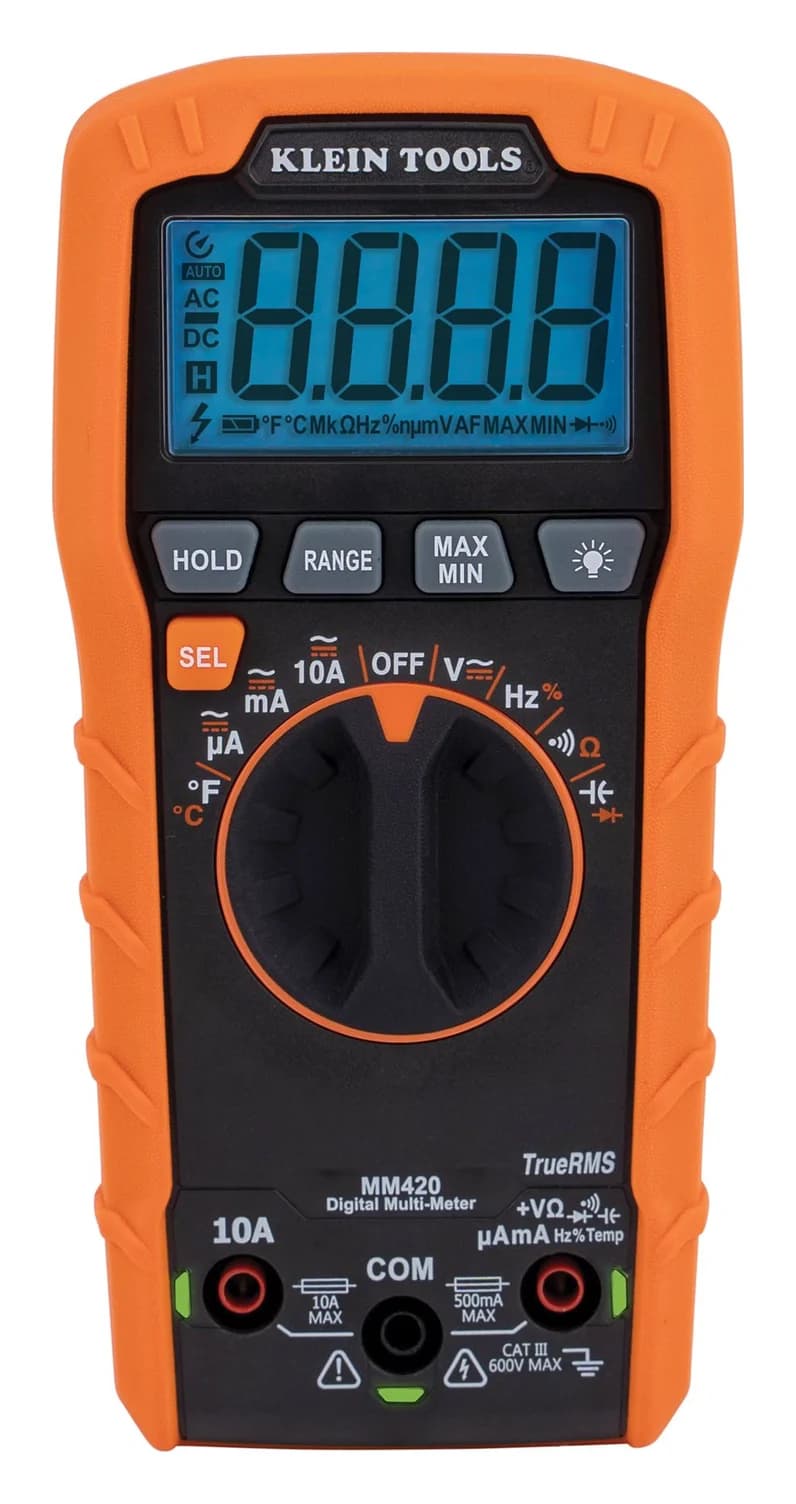
Klein Tools MM420 Auto-Ranging True RMS Digital Multimeter (600V)600V max · 10A max · 4000 counts · CAT III 600V
- See on Amazon2
Best for electrical troubleshooting
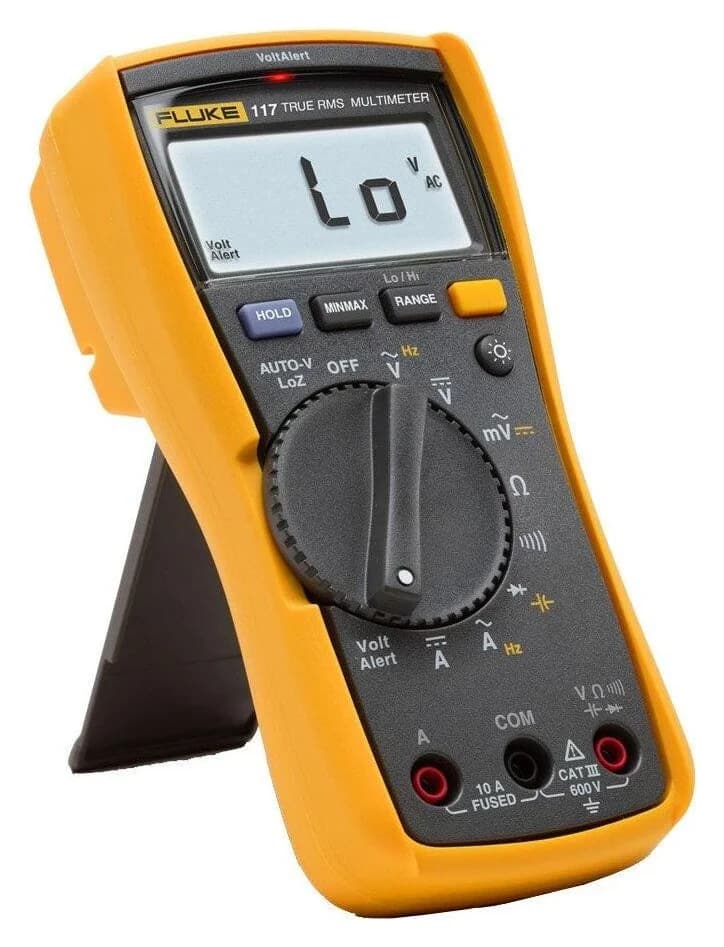
Fluke 117 Electrician's True RMS Multimeter with Non-Contact Voltage600V max · 10A max · 6000 counts · CAT III 600V
- See on Amazon3
Best for demanding industrial work
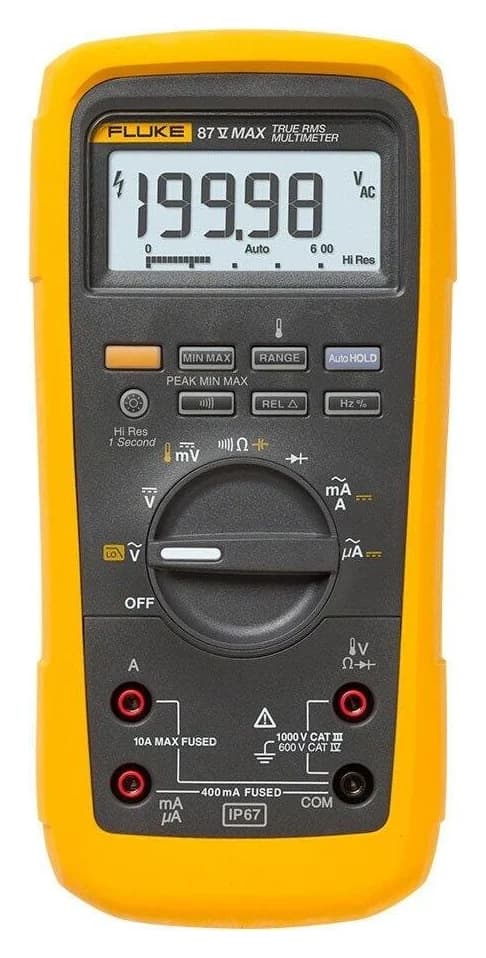
Fluke 87V MAX True RMS Digital Multimeter1000V max · 10A max · 6000 counts · CAT IV 600V, CAT III 1000V
- See on Amazon4
Best pocket option
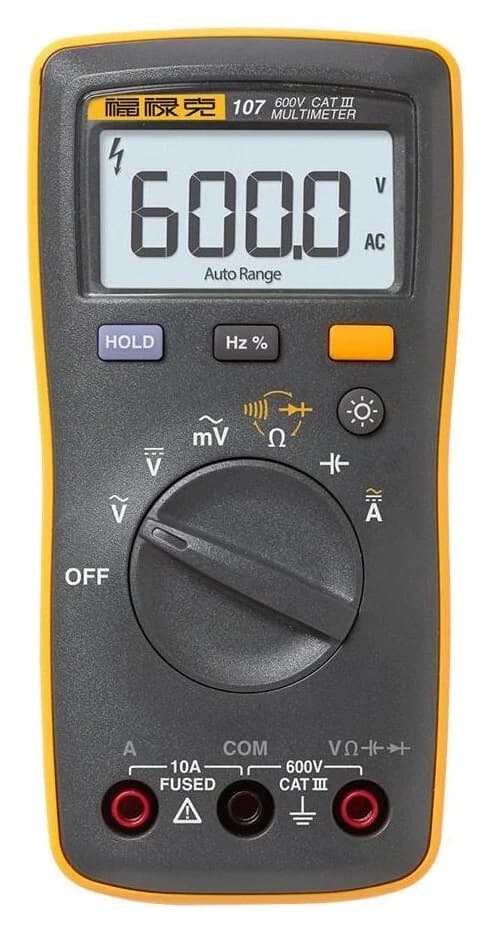
Fluke 107 Pocket Digital Multimeter600V max · 10A max · 6000 counts · CAT III 600V
Choose the Klein MM420 for home checks and hobby electronics when you want True RMS, temperature and small-current ranges in one meter. Choose the Fluke 117 for electrical troubleshooting when LoZ and built-in non-contact detection matter; choose the Fluke 87V MAX for its industrial functions, tighter DC-voltage specification and rugged enclosure. The Fluke 107 is the pocket alternative when you can accept non-True-RMS AC measurement.
Quick picks: choose the work before the brand
| Your main job | Our pick | The deciding feature | Choose differently when… |
|---|---|---|---|
| Home maintenance and low-voltage hobby circuits | Klein MM420 | Temperature and dedicated µA/mA ranges | You specifically need LoZ or non-contact detection |
| Electrical troubleshooting | Fluke 117 | VoltAlert, AutoVolt and LoZ | You need temperature or fine current readings |
| Industrial work, motor drives, demanding DC checks | Fluke 87V MAX | Low-pass filter, microamps and IP67 enclosure | A simpler meter covers the task |
| A small carry-along meter | Fluke 107 | Pocket format, backlight and SmartStrap | Distorted AC requires True RMS |
These are recommendations from documented capabilities, not physical testing. For choices across other brands, start with our best multimeters guide.
Fluke vs Klein comparison table
The MM420 manual, 117 manual, 87V MAX manual and 107 manual are the basis for this table. “Not listed” means the model's own function list does not document it.
| Function | Klein MM420 | Fluke 117 | Fluke 87V MAX | Fluke 107 |
|---|---|---|---|---|
| True RMS AC | Yes | Yes | Yes | No |
| Voltage ceiling, AC/DC | 600 V | 600 V | 1000 V | 600 V |
| Meter CAT marking | CAT III 600V | CAT III 600V | CAT IV 600V / CAT III 1000V | CAT III 600V |
| Standard display | 4,000 counts | 6,000 counts | 6,000; 19,999 in high-resolution mode | 6,000 counts |
| Lowest current range; resolution | 400 µA; 0.1 µA | 6 A; 1 mA | 600 µA; 0.1 µA | 4 A; 1 mA |
| Ghost-voltage LoZ / non-contact detection | Neither listed | Both | Neither listed | Neither listed |
| Temperature | Yes | Not listed | Yes | Not listed |
| Motor-drive low-pass filter | Not listed | Not listed | Yes | Not listed |
Best for home and hobby electronics: Klein MM420
The MM420 is our default for someone who wants household basics plus low-voltage component work. It combines auto-ranging and True RMS with capacitance, frequency, duty cycle, continuity and diode testing. Lead-Alert LEDs indicate the input jacks for the selected function.
Klein Tools
Klein Tools MM420 Auto-Ranging True RMS Digital Multimeter (600V)
A 4,000-count auto-ranging True RMS multimeter rated CAT III 600V that measures up to 600 V and 10 A, plus temperature, capacitance, frequency and duty cycle.
Comes in 4 versions: see which to buy
- 600V max
- 10A max
- 4000 counts
- CAT III 600V
Its dedicated microamp and milliamp ranges are the reason to choose it over the 117 for small-current work. Its limitations are equally useful buying information: Klein lists neither LoZ nor built-in non-contact voltage detection. The standard package includes leads with CAT III/CAT IV safety caps, a thermocouple and batteries; the meter itself remains CAT III 600V.
The temperature input covers −40 to 1000 °C, but the included thermocouple is suitable only below 180 °C. Buy an appropriately rated probe for hotter measurements. Also, “10 A” is not an unlimited-duration promise: Klein recommends 30 seconds followed by 10 minutes of recovery above 6 A.
Best for electrical troubleshooting: Fluke 117
The 117 earns its place through VoltAlert non-contact detection, AutoVolt automatic AC/DC selection and LoZ. Its manual specifies approximately 3 kΩ input impedance in AutoVolt to reduce ghost-voltage readings. That is a concrete function advantage over the MM420 for this kind of troubleshooting.
Fluke
Fluke 117 Electrician's True RMS Multimeter with Non-Contact Voltage
A compact 6,000-count True RMS multimeter for electricians, rated CAT III 600V, with built-in VoltAlert non-contact voltage detection, automatic AC/DC selection and a low-impedance mode.
Comes in 5 versions: see which to buy
- 600V max
- 10A max
- 6000 counts
- CAT III 600V
The trade-off is small-current work: the 6 A range resolves 1 mA, without dedicated mA or µA ranges. It is not our first choice for low-current electronics. Fluke's page also contains temperature figures in comparison and footnote material, while the 117's own specification table and manual list no temperature function. Treat temperature as unsupported.
VoltAlert is a detection aid: the manual warns that voltage can still be present without an indication, and not to rely on it with shielded wire. The standard package lists silicone leads and a holster; check the supplied leads' markings rather than assuming a model number from a bundle photograph.
Best for demanding industrial work: Fluke 87V MAX
Choose the 87V MAX when you actually need its combination of CAT IV 600V / CAT III 1000V, IP67, and a 4 m drop rating with the holster. Its low-pass filter is intended for variable-frequency motor-drive measurements. A low-pass filter is a different function from the 117's low-impedance voltage mode.
Fluke
Fluke 87V MAX True RMS Digital Multimeter
A rugged industrial True RMS multimeter rated CAT IV 600V and CAT III 1000V, with an IP67 case, a 4 m drop rating, a low-pass filter for motor-drive readings and temperature measurement.
Comes in 4 versions: see which to buy
- 1000V max
- 10A max
- 6000 counts
- CAT IV 600V, CAT III 1000V
It also fits more demanding electronics work: dedicated microamp ranges, temperature and ±(0.05% + 1 count) DC-voltage accuracy on the 6 V through 1000 V ranges. The 600 mV range has a different specification, ±(0.1% + 1). Do not apply the headline accuracy to every range.
The standard box contains TL175 TwistGuard leads, AC175 clips, an 80BK-A temperature probe, a holster and batteries. The included probe covers −40 to 260 °C, less than the meter's −200 to 1090 °C input range. Its 698.5 g with holster is another reason to prefer a smaller meter when those capabilities are unnecessary.
Best pocket option: Fluke 107
The US-listed 107 weighs 200 g and includes TL75 leads and a magnetic SmartStrap. It measures AC/DC voltage and current, capacitance, frequency and duty cycle, with a backlight.
Fluke
Fluke 107 Pocket Digital Multimeter
A palm-size 6,000-count multimeter rated CAT III 600V that measures AC and DC voltage and current to 600 V and 10 A, plus resistance, capacitance, frequency and duty cycle; it is not True RMS.
Comes in 3 versions: see which to buy
- 600V max
- 10A max
- 6000 counts
- CAT III 600V
Fluke explicitly says it is not True RMS. Its True RMS explanation describes why distorted AC from nonlinear loads calls for a True RMS instrument. Choose MM420 or 117 for that requirement. The 107's 4 A lowest current range also makes it a poor substitute for dedicated microamp ranges.
Accuracy at the same reading: include the counts
For an illustrative 12 V DC display value, use each meter's applicable range and 0.01 V resolution below. Accuracy means ±(percentage of reading + counts × resolution). These are calculations from the linked manufacturer tables, not readings taken by thisMETER; use normal DC volts, with the MAX in standard display mode. The 117's AutoVolt/LoZ mode has a separate accuracy specification.
| Meter | DC range | Published accuracy on that range | Calculated tolerance at 12 V |
|---|---|---|---|
| MM420 | 40 V | ±(0.5% + 5 counts) | ±110 mV |
| Fluke 117 | 60 V | ±(0.5% + 2 counts) | ±80 mV |
| Fluke 87V MAX | 60 V | ±(0.05% + 1 count) | ±16 mV |
For example, the MM420 allowance is 60 mV from the percentage plus 50 mV from the counts; the 117 has the same percentage allowance plus 20 mV. Comparing only “0.5%” conceals that difference.
Source: Calculation from the manufacturer accuracy tables linked above; standard display mode.
Conditions matter: Klein specifies accuracy at 18–28 °C and for one year; the 117 manual also specifies one year after calibration at 18–28 °C. The MAX manual specifies two years at 18–28 °C and changes the count term in high-resolution mode. Resolution alone does not establish accuracy. See How we measure for our approach.
CAT ratings: include the leads and their caps
Fluke's safety guide puts feeders and short branch circuits in CAT III, and service-entrance equipment in CAT IV. Choose the category and voltage for the location, rather than comparing voltage ceilings alone.
Tap a label to explore. You can also hover or use your keyboard.
CAT IIPlug-in appliances & tools
Receptacle-connected loads, such as household appliances and portable tools. The category describes the measurement environment; it does not give permission to work on live equipment.
Sources: 1: CAT II includes household appliances, portable tools and other receptacle-connected loads.CAT IIIFixed wiring & distribution
The distribution part of the building installation, including distribution-panel devices and fixed-installation equipment. This is a different environment from a plug-in appliance.
Sources: 2: CAT III includes equipment in fixed installations and distribution-panel devices.CAT IVUtility meter & service entry
The origin of the low-voltage installation, including electricity meters and the service entrance. Fluke also identifies the run between the meter and panel as CAT IV.
Sources: 3: CAT IV includes electricity meters, the service entrance and the run between meter and panel.Illustrative locations, not a testing procedure. Match both the measurement category and voltage rating to the job. The lowest-rated meter, lead, probe or accessory limits the setup.
Source notes5 references
CAT II includes household appliances, portable tools and other receptacle-connected loads.
media.fluke.com — source for CAT II includes household appliances, portable tools and other receptacle-connected loads.Appliance, portable tools, and other household and similar
CAT III includes equipment in fixed installations and distribution-panel devices.
media.fluke.com — source for CAT III includes equipment in fixed installations and distribution-panel devices.distribution panel devices
CAT IV includes electricity meters, the service entrance and the run between meter and panel.
media.fluke.com — source for CAT IV includes electricity meters, the service entrance and the run between meter and panel.Electricity meters, primary overcurrent protection equipment
Probes, test leads and adapters need the correct measurement category, voltage and amperage ratings.
assets.fluke.com — source for Probes, test leads and adapters need the correct measurement category, voltage and amperage ratings.Use only correct measurement category (CAT), voltage, and amperage
The lowest-rated component limits the measurement-category rating of the setup.
assets.fluke.com — source for The lowest-rated component limits the measurement-category rating of the setup.Do not exceed the Measurement Category (CAT) rating of the lowest
The 107 manual says the lowest-rated meter, probe or accessory limits the system. Higher-rated leads do not upgrade an MM420 or 117 to CAT IV.
| Lead arrangement | Manufacturer-stated rating or instruction |
|---|---|
| MM420 supplied leads | Klein requires the CAT III/CAT IV shields for those measurement locations; the meter remains CAT III 600V |
| TL75 supplied with 107 | CAT II 1000V without protective caps; CAT III 1000V / CAT IV 600V with caps |
| TL175 supplied with 87V MAX | CAT II 1000V / CAT III 1000V / CAT IV 600V; the visible rating changes with tip exposure |
Those lead details come from Klein's manual, TL75 documentation and TL175 documentation.
Resolve the model and kit before ordering
| Similar search or label | What the maker documents | Buying decision |
|---|---|---|
| Klein MM400 / MM420 | MM400 is no longer in production; Klein points to MM420 | Choose MM420 for a new purchase; do not transfer its features to MM400 |
| Fluke 87V / 87V MAX | Original 87V already has the same CAT ratings, microamp ranges, low-pass filtering and high-resolution mode; its comparison chart lists IP30 against MAX's IP67 | A working 87V need not be replaced just to obtain those shared functions |
| Fluke 101 / 107 | 101 has a Philippines page; 107 has a US page. The 101 manual shows no dedicated current input; 107 specifies current ranges | Check regional supply and support; these sources establish no replacement relationship |
| 117 CAL / MAX CAL | Their model pages specify a traceable calibration certificate with data | Choose CAL if your workplace requires that paperwork |
| 117/323 kit | Kit page adds a separate 323 clamp meter | Useful if you need both instruments; compare our clamp meter picks |
| 87V MAX E2 | E2 kit lists TL224 leads, AC220 clips, TL238 probes, a magnetic hanger, temperature probe and C35 case | Different accessories around the MAX meter; not the standard TL175 package |
One unresolved 87V conflict: its page's comparison chart claims a 3 m drop test, but its general specifications say 1 m. We cannot reconcile those claims. The MAX's documented 4 m with holster is the clearer choice when drop protection drives the purchase.
The 101 manual also documents Data Hold, while its regional page says “Hold: No.” Check the exact locally supplied model and manual before relying on that feature.
Match the model
Confirm MM420, 117, 87V or 87V MAX on the instrument and package.
Match the needed function
Check small-current ranges, temperature, LoZ and the location's CAT requirement.
Match the accessories
Compare standard leads and probes with CAL, clamp-meter and E2 packages; confirm local support.
How we choose
We researched manufacturer product pages, manuals and accuracy tables; we have not physically tested these meters. The picks prioritize documented functions, category ratings, included accessories and the task a reader needs to complete. Conflicting maker claims remain identified rather than resolved by guesswork. Our selection method explains the wider process; beginners can continue with how to use a multimeter.
Verdict
Buy MM420 for home and hobby work needing temperature and small-current ranges, 117 for LoZ and non-contact electrical troubleshooting, or 87V MAX when its ruggedness and industrial functions earn their place. Pick 107 for pocket carry when True RMS is unnecessary. If you already own an 87V, identify the missing capability before buying a MAX.
Frequently asked questions
Is Fluke better than Klein for a multimeter?
Choose the model around the work. The Klein MM420 has temperature and microamp ranges that the Fluke 117 lacks. The 117 adds VoltAlert, AutoVolt and LoZ for electrical troubleshooting. The Fluke 87V MAX adds higher CAT ratings, IP67 protection and tighter DC-voltage specifications. Those are reasons to choose particular models; they do not establish that every meter from one brand beats every meter from the other.
Does the Fluke 117 measure milliamps and temperature?
The 117 resolves 1 mA on its 6 A range, but it has no dedicated mA or µA range. Its manual and model-specific specification table do not list temperature measurement. Fluke's product page contains temperature entries in comparison and footnote material, so do not treat those as confirmation of a temperature function. Choose the MM420 for small-current ranges and temperature, or the 87V MAX when its industrial features also matter.
Should I buy a Klein MM400 or MM420?
For a new purchase, choose the MM420. Klein explicitly marks the MM400 as no longer in production and identifies MM420 as the newer model. The MM420 documents True RMS, Lead-Alert jack illumination and a 2 m drop rating. An old MM400 listing is not evidence of those MM420 features. Existing MM400 owners should assess what function they need before replacing a working meter.
Is the Fluke 107 the replacement for the Fluke 101?
The documents checked do not establish a replacement relationship. Fluke has a 107 product page for the US and a 101 page for the Philippines. The 101 manual shows common and measurement terminals, without a separate current input; the 107 specifies AC/DC current ranges. Check local availability, support and the exact functions before importing a 101 or treating it as equivalent to the 107.
Best for home and hobby electronics
Klein Tools MM420 Auto-Ranging True RMS Digital Multimeter (600V)
Related guides
How to Test a Car Battery: Voltage, Charge and a Winter Decision Tree
Test a car battery with a multimeter, interpret flooded and AGM voltage, and decide whether to charge, retest, buy a battery tester or get a free assessment.
Updated November 2, 2026Read
Klein Tools Black Friday: Compare Meter Kits Before You Buy
Compare Klein Tools Black Friday meter and tester kits by exact model, included accessories and CAT rating, with Fluke alternatives and a printable checklist.
Updated November 2, 2026Read
Best Multimeters in 2026: for Home, Electricians, Electronics and Cars
Multimeters picked by job, from the Klein MM420 to the Fluke 117 and 87V MAX, plus how to read CAT ratings and per-range accuracy, and when True RMS matters.
Updated November 2, 2026Read