

Buying guide
How to Test a Car Battery: Voltage, Charge and a Winter Decision Tree
Test a car battery with a multimeter, interpret flooded and AGM voltage, and decide whether to charge, retest, buy a battery tester or get a free assessment.
By thisMETER EditorialUpdated November 2, 20268 min read2 picks
Our picks at a glance
- See on Amazon1
Best for the initial voltage check
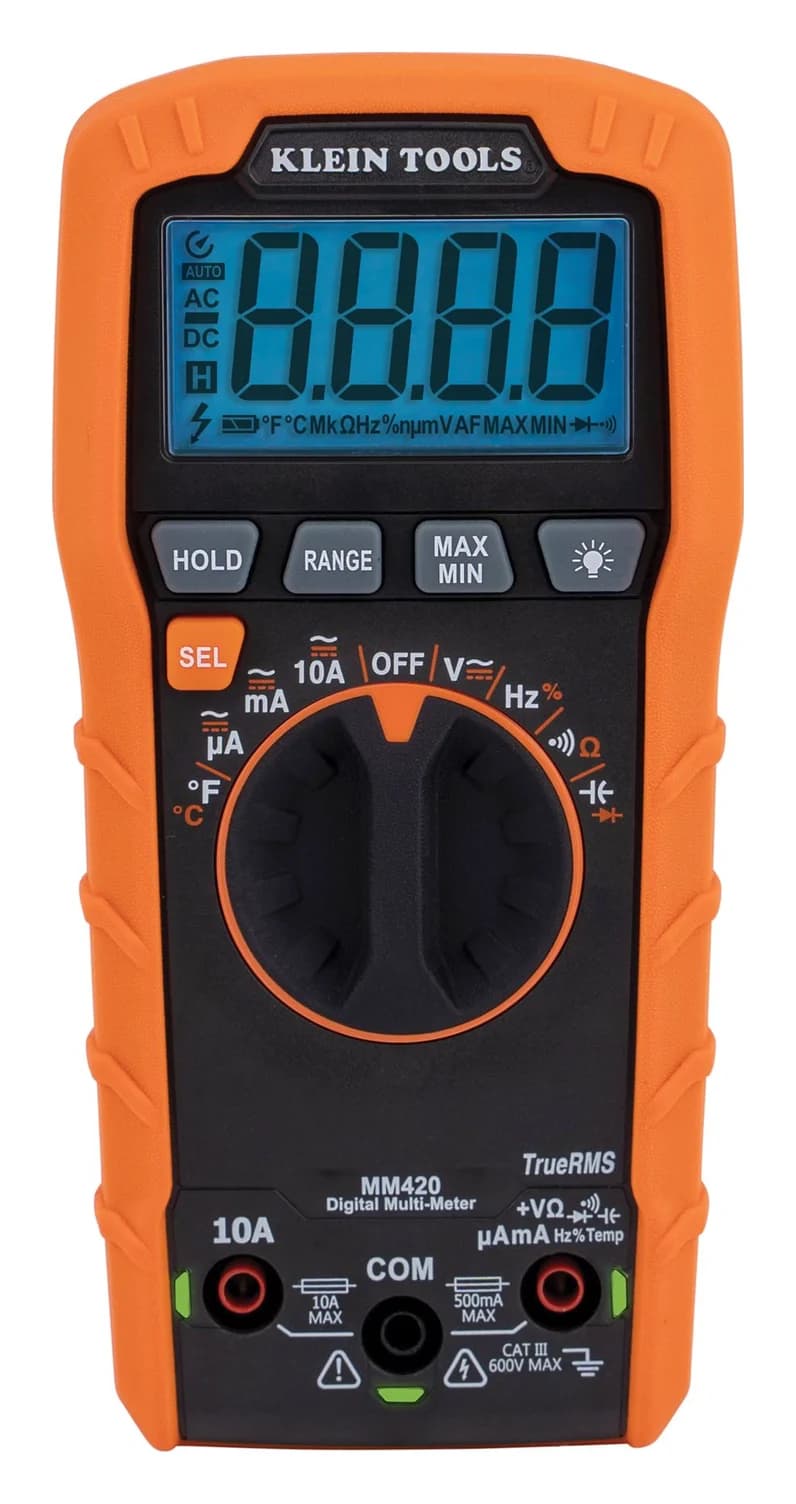
Klein Tools MM420 Auto-Ranging True RMS Digital Multimeter (600V)600V max · 10A max · 4000 counts · CAT III 600V
- See on Amazon
To test a car battery, measure its resting DC voltage, compare it with the battery maker's charge chart, then investigate starting performance if trouble remains: voltage alone cannot prove battery health. For repeat battery checks, our pick is the TOPDON BT100 for its documented lead-acid support and battery, cranking and charging tests; for the initial voltage check, use a suitable meter you own or choose the Klein MM420.
thisMETER is reader-supported: when you buy through our links, we may earn a commission at no extra cost to you. As an Amazon Associate, thisMETER earns from qualifying purchases.
Quick picks: buy for the unanswered question
| Tool | Our pick | What it answers | Main limit |
|---|---|---|---|
| Multimeter | Klein MM420 | DC voltage; automatic ranging and Lead-Alert LEDs | Voltage alone cannot establish battery health |
| Conductance tester | TOPDON BT100 | Battery condition; 12 V flooded, AGM, gel and EFB; 100–2000 CCA | Its listed support is lead-acid, not lithium |
| Physical load tester | Schumacher BT-100 | Voltage response to a 100 A load on 12 V, or 50 A on 6 V | Maximum 10 seconds under load; 5-minute cooling interval |
| Automotive multimeter | Innova 3340 | Voltage plus engine-work functions including RPM and dwell | Buy the extra functions only if you need them |
| Professional assessment | Start with Interstate's free-test offer | An alternative to buying a tool for one concern | Ask what the local service includes |
Before connecting: identify the battery and a safe test
This workflow covers an accessible 12 V lead-acid starting battery. Read the vehicle, battery and instrument manuals first; use the vehicle's approved access points. Leave inaccessible installations and any uncertain procedure to a professional.
Read the label for flooded, AGM or EFB, the starting-current rating and its standard, such as CCA or EN. TOPDON's manual requires the battery type, standard and rating to match that label. Do not substitute an amp-hour figure for a starting-current rating. If the label is unreadable, get the battery identified before interpreting an electronic test.
How to test a car battery with a multimeter
Turn off the engine, ignition, accessories and other loads. A recent drive or charge belongs in your notes; follow the battery maker's resting procedure. For example, East Penn's heavy-duty guide requires at least 4 hours after charging, with the battery disconnected. Follow your vehicle manual before disconnecting anything; that example is not an instruction to remove every car battery.
An engine-off reading with the battery connected is a preliminary screen. A true open-circuit reading means no load, as Interstate's glossary defines it; do not silently treat the two setups as identical.
Use Fluke's DC-voltage procedure, subject to your meter's manual:
Select voltage, not current
Black lead in COM; red lead in V/Ω. Select DC volts and a suitable range above the expected battery voltage, or use automatic ranging. Check that the display says DC.
Match the polarity
Touch black to battery negative and red to positive at the approved test points. Keep the probes from bridging the terminals.
Read and record
Note voltage and conditions. Remove red first, then black. A minus sign can mean reversed probe polarity; check the connections.
MM420 detail: turn to V, then press SEL to select DC; Klein's manual says it defaults to AC. Fluke warns that measuring voltage with the red lead in A or mA creates a short circuit. Do not try to measure the battery's available amps by putting a meter across its terminals.
Interpret resting voltage: charge is not condition
The East Penn heavy-duty AGM guide supplies this example. Use your own battery maker's table for the actual decision; these figures are not a universal car-battery scale.
| Charge in East Penn's table | Flooded open-circuit voltage | AGM open-circuit voltage |
|---|---|---|
| 100% | 12.60–12.70 V | 12.8 V or higher |
| 75% | 12.40 V | 12.60 V |
| 50% | 12.20 V | 12.30 V |
The useful distinction: 12.60 V falls in the full-charge flooded range but represents 75% in the AGM column. East Penn directs recharging below 75% before its load-test procedure. Apply that instruction within its stated application, rather than condemning every battery below a single voltage.
Midtronics explains that normal voltage can coexist with poor condition, and low voltage can reflect short trips, a load left on or a charging fault. A jump-start or successful warm-weather start is not a complete health assessment.
Winter decision tree: what to do with the result
Cold-weather starting trouble warrants a test, but a cold test failure is not automatically a replacement verdict. GM's service bulletin warns that cold batteries can falsely fail testing; follow the applicable battery and vehicle procedure. The path below separates safety, charge and persistent starting trouble.
Tap a label to explore. You can also hover or use your keyboard.
Damaged case or suspected freezing?
Inspect before connecting. A cracked battery must not be tested; do not charge a frozen battery.
Sources: 1: Do not test a damaged battery., 2: Do not charge a frozen battery.Stop; arrange professional help
Have the safety concern assessed before proceeding.
Outcome
Sources: 1: Do not test a damaged battery., 2: Do not charge a frozen battery.Resting voltage low for this battery?
Use its maker's charge table. Low voltage alone does not establish failure.
Sources: 3: Low voltage does not by itself establish end of battery life.Charge correctly, rest and retest
Follow the battery and vehicle manuals; record the result again before deciding.
Sources: 3: Low voltage does not by itself establish end of battery life.Starting trouble remains?
A normal voltage reading cannot clear the battery of an internal problem.
Sources: 4: Normal voltage does not prove good condition.Battery and system assessment
Use a supported battery test and investigate the starting or charging problem. Bring the log below.
Outcome
Sources: 3: Low voltage does not by itself establish end of battery life., 4: Normal voltage does not prove good condition.Record; revisit if symptoms return
Keep the result without treating it as a promise of remaining life.
Outcome
Sources: 4: Normal voltage does not prove good condition.Source notes4 references
Do not test a damaged battery.
images.salsify.com — source for Do not test a damaged battery.If the battery is damaged, do not use the tester.
Do not charge a frozen battery.
no.co — source for Do not charge a frozen battery.NEVER charge a frozen battery.
Low voltage does not by itself establish end of battery life.
www.midtronics.com — source for Low voltage does not by itself establish end of battery life.If the voltage is low, it does not mean the battery has served its useful life.
Normal voltage does not prove good condition.
www.midtronics.com — source for Normal voltage does not prove good condition.But the battery voltage might appear to be completely normal while the battery is bad.
Best for the initial voltage check: Klein Tools MM420
Choose the MM420 if you also want a general multimeter: it has automatic ranging and Lead-Alert LEDs for lead placement. Its standard package includes leads, a thermocouple and batteries. That makes it our first meter choice here; the extra functions do not turn voltage into a health test.
Klein Tools
Klein Tools MM420 Auto-Ranging True RMS Digital Multimeter (600V)
A 4,000-count auto-ranging True RMS multimeter rated CAT III 600V that measures up to 600 V and 10 A, plus temperature, capacitance, frequency and duty cycle.
Comes in 4 versions: see which to buy
- 600V max
- 10A max
- 4000 counts
- CAT III 600V
Best for repeat battery checks: TOPDON BT100
The BT100 uses conductance testing and specifies 12 V lead-acid, 100–2000 CCA, including flooded, AGM flat-plate, AGM spiral, gel and EFB. Its manual requires selecting the label's battery type, standard and rating. Select EN only with the corresponding EN rating, rather than entering that number under CCA.
Use its cranking and charging modes only as the manuals direct. Keep leads clear of moving engine parts. Even a satisfactory CCA result cannot guarantee adequate reserve capacity, as Midtronics notes. Its lead-acid list gives no basis to recommend it for a lithium starting battery.
Version trap: TOPDON's BT200 marketing claims battery testing on both 12 V and 24 V systems, but its V3 manual says battery test 12 V only, with cranking and charging tests on both. Confirm the exact capability before buying the BT200 for a complete bank; do not assume it is simply a higher-voltage BT100.
Best for a prescribed physical load test: Schumacher BT-100
This is a different brand and instrument from TOPDON's BT100. Schumacher specifies 100 A on 12 V and 50 A on 6 V. Its manual limits the load switch to 10 seconds maximum, then 5 minutes cooling; the housing can burn skin. Use the handle and the supplied instructions.
Do not borrow another test's threshold. East Penn's 9.6 V at 70°F belongs to its 15-second, half-CCA load test, not every engine's cranking test. That duration exceeds Schumacher's limit. Schumacher's own page also conflicts: prose says up to 1,000 CA, specifications say 200–1000 CCA (SAE). CA and CCA are different ratings; confirm suitability before buying.
Best for broader automotive work: Innova 3340
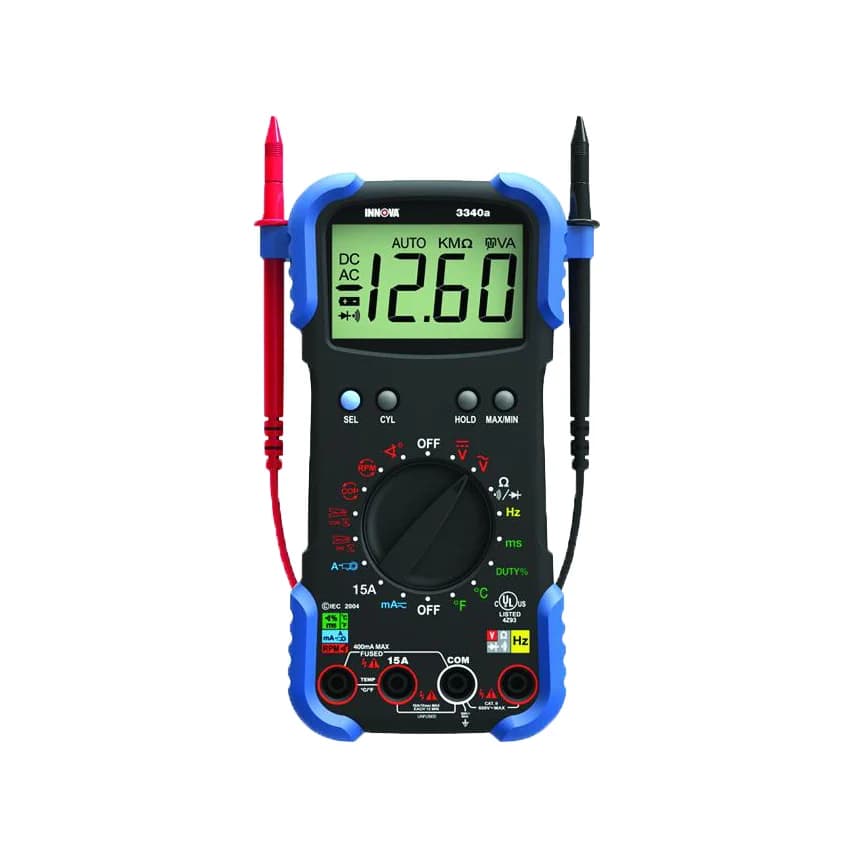
Choose the 3340 when you also need its included inductive RPM pickup, dwell, pulse width and temperature functions. Those are reasons to buy an automotive meter beyond the battery check. For this voltage procedure, the red lead still belongs in the voltage jack.
Innova
Innova 3340 Automotive Digital Multimeter
An auto-ranging automotive multimeter that adds RPM (with an inductive pickup), dwell, pulse width, duty cycle, frequency and temperature to the usual electrical tests, with a 15 A unfused current input.
- 15A max
Buying advice: when a shop test is the better next step
Conductance uses a small AC signal to assess the battery's internal response; a physical load tester observes voltage under an applied load. Neither a voltage number nor CCA alone explains every starting problem. If charging and retesting do not resolve it, ask for a battery assessment plus checks of connections, starting and charging systems.
For a one-off concern, Interstate advertises a free battery test. Use its location finder, then call to confirm availability and scope. Do not assume a free battery screen includes full fault diagnosis.
For more instrument choices, see our battery tester comparison and multimeter picks. Our multimeter tutorial covers the general controls and low-voltage technique.
Printable result log
Print this section and fill both columns before comparing results. The BT100 stores only the last test result, so copy it before another check. Bring the log to the shop if the starting problem remains.
| Record | Initial check | After charging and resting |
|---|---|---|
| Date/time; last drive/charge; rest duration | __________ | __________ |
| Battery maker/model; chemistry | __________ | __________ |
| Label rating and standard; tester settings | __________ | __________ |
| Temperature; test points; connected/disconnected; loads | __________ | __________ |
| Resting voltage; maker's charge band | __________ | __________ |
| Tester/model/mode; complete result | __________ | __________ |
| Starting symptom; agreed next action | __________ | __________ |
How we choose
These are document-based recommendations, not results from physical evaluation. We checked official product pages, manuals and battery-maker guidance, kept their application limits visible and named conflicting specifications. Recommendations do not imply verified accuracy or remaining-life predictions. See How we choose and How we measure.
Verdict
Use a suitable multimeter for the initial charge screen; choose the MM420 if you need one. Our dedicated tester pick is the TOPDON BT100; choose the Schumacher BT-100 only when you want its prescribed physical load test, or the Innova 3340 for broader engine work. Charge and retest when appropriate, and seek diagnosis when the battery reading does not explain the symptom.
Frequently asked questions
Can a multimeter tell if a car battery is bad?
It can measure voltage, but voltage alone cannot establish battery condition. Midtronics explains that a deteriorated battery can show normal resting voltage, while low voltage can reflect insufficient charging or another vehicle problem. Compare the reading with the battery maker's charge chart, then arrange a battery and system assessment if starting trouble remains.
What voltage should a car battery read?
Use the battery maker's table. As an example, East Penn's heavy-duty guide lists full charge at 12.60–12.70 V for flooded batteries and 12.8 V or higher for AGM. Its 12.60 V AGM entry represents 75% charge. These are charge estimates within that guide, not universal replacement thresholds for every car battery.
How long should a battery rest before testing?
Follow your battery maker's procedure rather than choosing one waiting time for every battery. East Penn's heavy-duty AGM guide recommends at least 4 hours after charging and requires disconnection for its procedure. Recent charging can diminish conductance-test accuracy too. Follow the vehicle manual before disconnecting anything, or have a professional perform the prescribed check.
Where can I get a car battery tested for free?
Interstate Batteries advertises free battery tests through its pros and provides a location finder. Contact the location before travelling to confirm the service and ask whether it includes charging-system assessment. If the vehicle will not start, arrange assistance; buying a tester does not solve the immediate transport problem.
Best for the initial voltage check
Klein Tools MM420 Auto-Ranging True RMS Digital Multimeter (600V)
Related guides
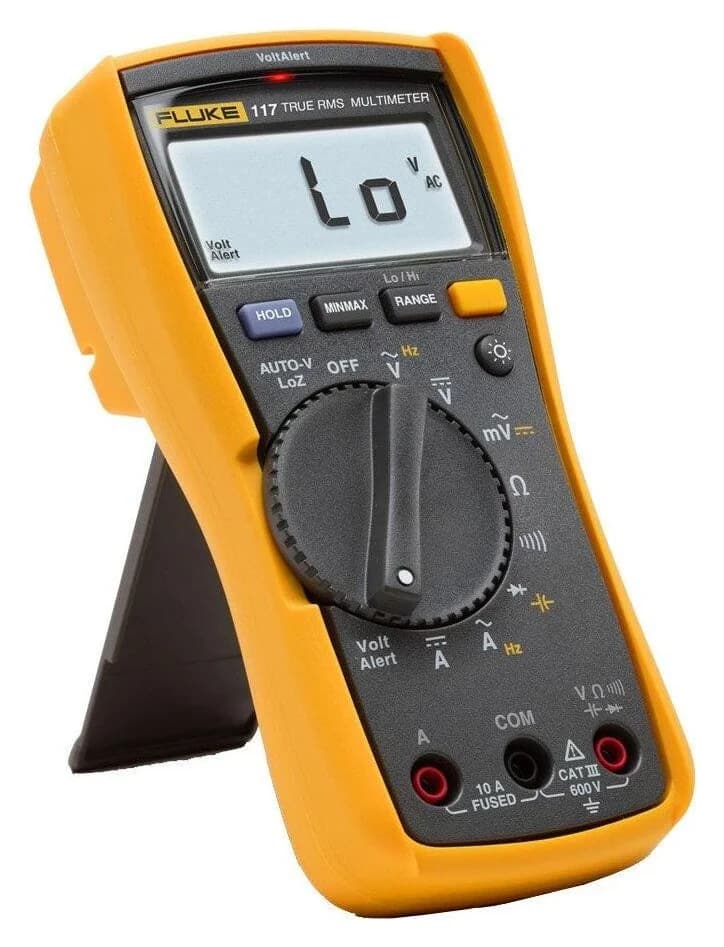
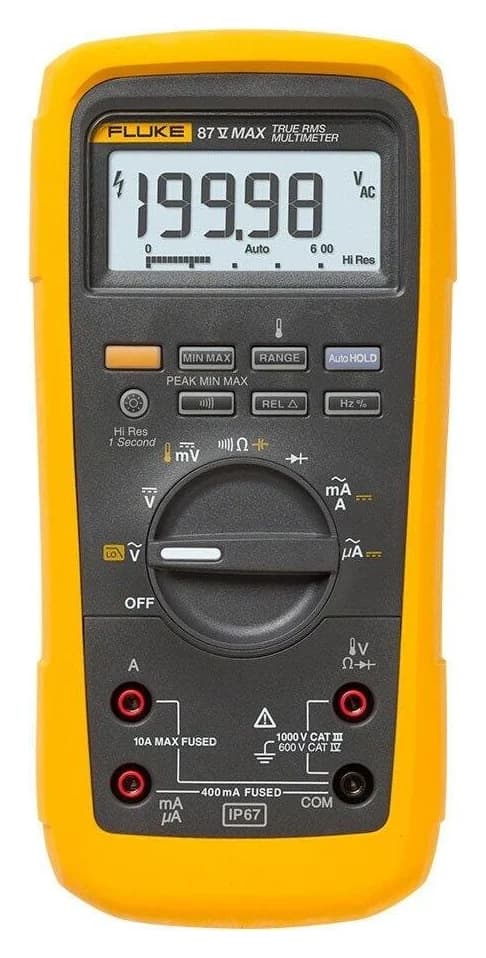
Fluke vs Klein Multimeters: MM420, 117 and 87V MAX by Job
Choose Fluke vs Klein by job: compare MM420, 117, 87V MAX and 107 accuracy, small-current ranges, LoZ, CAT ratings, included leads and exact meter kit contents.
Updated November 2, 2026Read
Klein Tools Black Friday: Compare Meter Kits Before You Buy
Compare Klein Tools Black Friday meter and tester kits by exact model, included accessories and CAT rating, with Fluke alternatives and a printable checklist.
Updated November 2, 2026Read
Best Multimeters in 2026: for Home, Electricians, Electronics and Cars
Multimeters picked by job, from the Klein MM420 to the Fluke 117 and 87V MAX, plus how to read CAT ratings and per-range accuracy, and when True RMS matters.
Updated November 2, 2026Read