

Best picks
Best Budget Multimeters for Beginners
Functions, Fuses and Kits
Find the best budget multimeter for your first jobs: compare exact models, current-input fuses, supplied accessories, ranging choices and beginner kit gaps.
By thisMETER EditorialUpdated November 3, 20267 min read2 picks
Our recommendation: Klein Tools MM420
Best for most beginners
Limit: Rated CAT III 600V: not for service-entrance (CAT IV) work
On this page · Our picks at a glance
Our picks at a glance
- 1
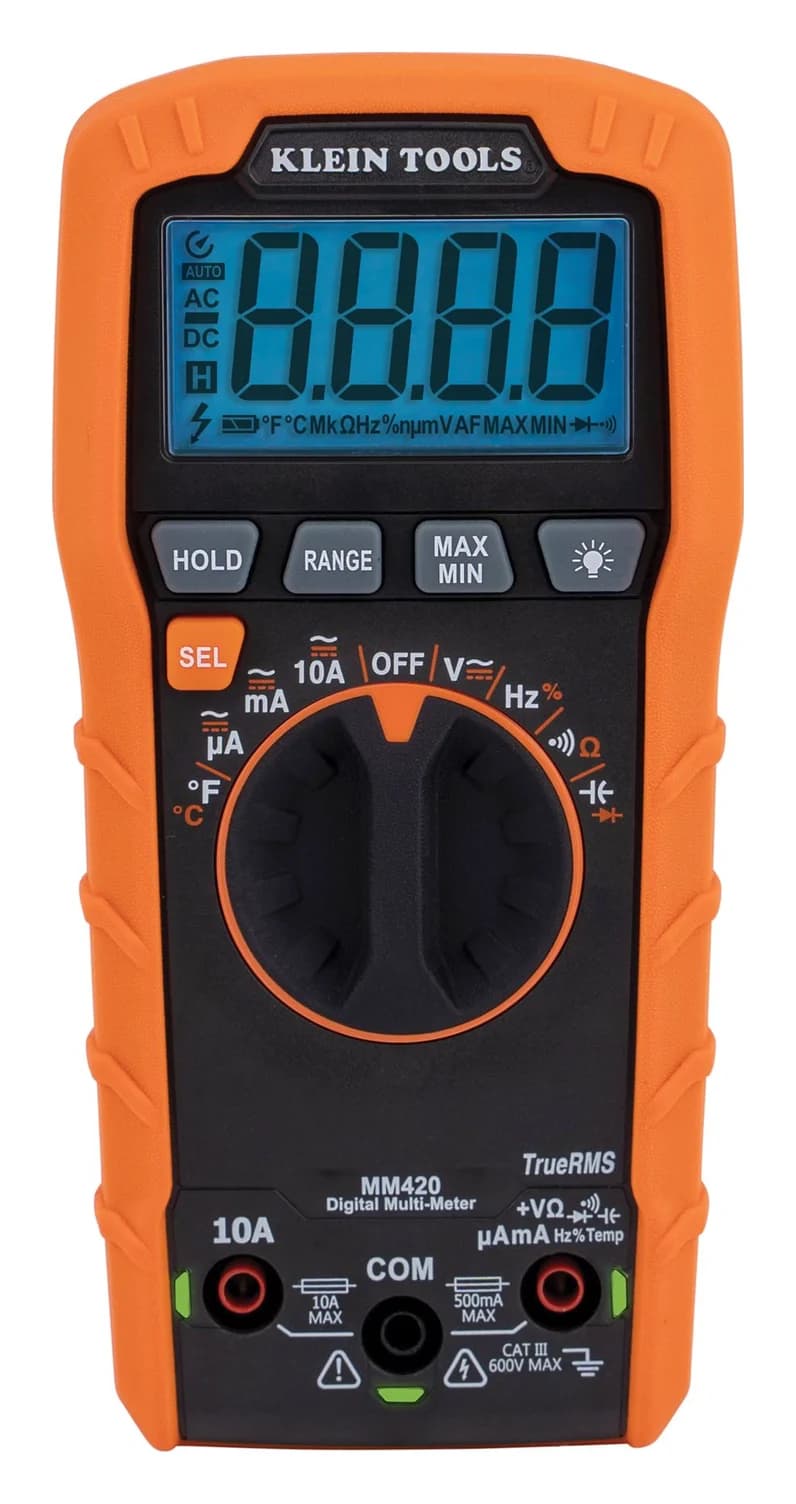
Choose for: Best for most beginners
Check before buying: Rated CAT III 600V: not for service-entrance (CAT IV) work
- 2
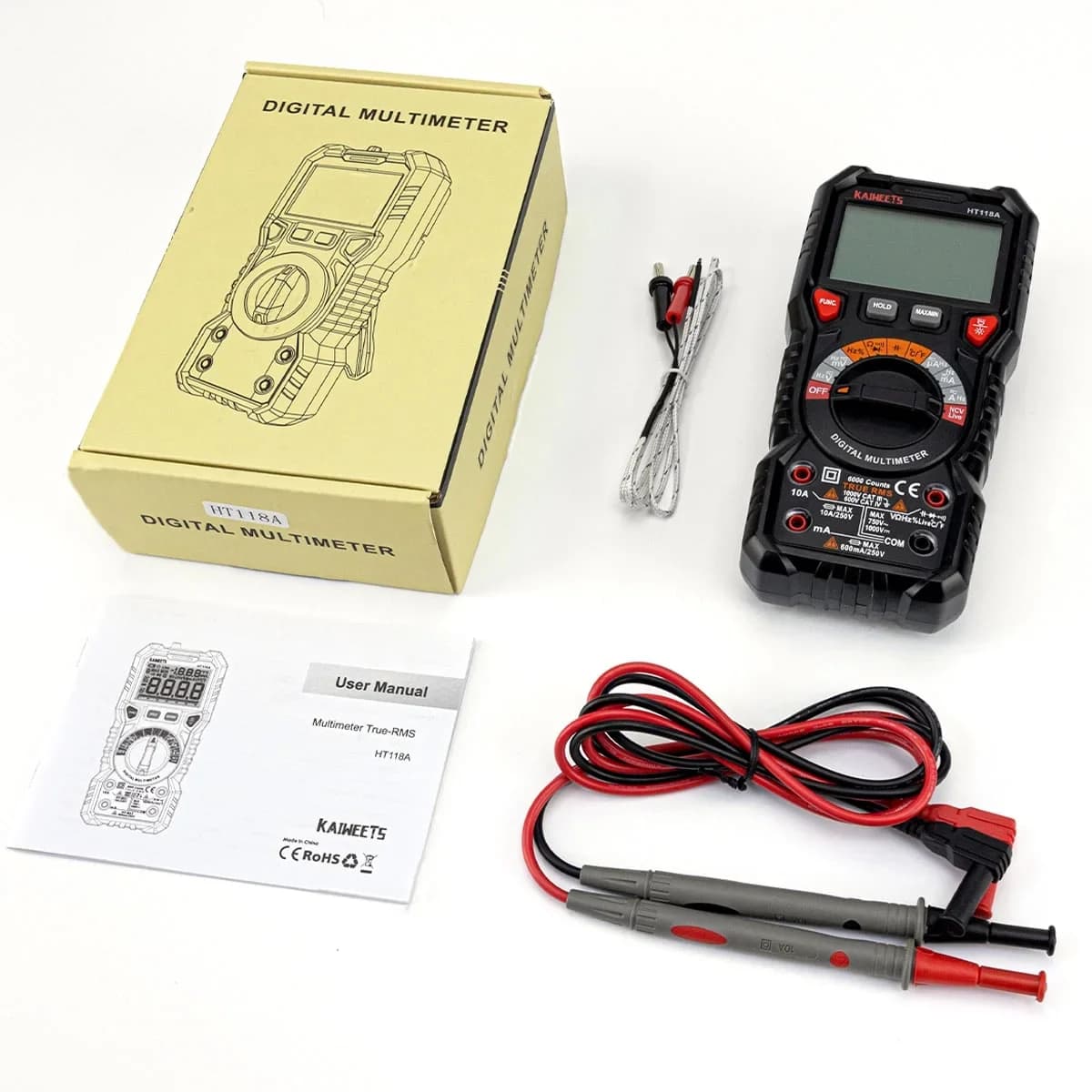
Choose for: Feature alternative
Check before buying: The official HT118A manual specifies 1000 V DC and 750 V AC; the 1000 V headline is not the AC measurement limit
For most beginners, the Klein Tools MM420 is our best budget multimeter pick if the complete package fits your budget: it combines auto-ranging, True RMS and illuminated input jacks.
Choose the MM325 for a simpler battery-and-continuity toolkit; consider the KAIWEETS HT118A or AstroAI DM6000AR for low-voltage learning when their extra functions match your projects. Compare complete checkout totals against the checklist below before choosing a winner.
Quick picks
Compare specifications and all conditions
Klein MM420 — best for most beginners
- CAT rating stated by maker
- CAT III 600V
- Current functions
- AC/DC, including µA; up to 10 A
- Important limit
- Match category and voltage; the lowest-rated lead or accessory limits the assembly.
All specifications
- Ranging / display
- Auto; True RMS; 4,000 counts
Klein MM325 — best basic toolkit
- CAT rating stated by maker
- CAT III 600V
- Current functions
- DC only; up to 10 A
- Important limit
- Match category and voltage; the lowest-rated lead or accessory limits the assembly.
All specifications
- Ranging / display
- Manual; 2,000 counts; True RMS not claimed
KAIWEETS HT118A — feature alternative for low-voltage learning
- CAT rating stated by maker
- CAT III 1000V, CAT IV 600V
- Current functions
- AC/DC; up to 10 A
- Important limit
- Match category and voltage; the lowest-rated lead or accessory limits the assembly.
All specifications
- Ranging / display
- Auto; True RMS; 6,000 counts
AstroAI DM6000AR — component-socket alternative
- CAT rating stated by maker
- CAT III 600V, CAT II 1000V
- Current functions
- AC/DC; up to 10 A
- Important limit
- Match category and voltage; the lowest-rated lead or accessory limits the assembly.
All specifications
- Ranging / display
- Auto/manual; True RMS; 6,000 counts
Full comparison table
Swipe to compare. Row labels stay visible.
| Meter and our pick | Ranging / display | Current functions | CAT rating stated by maker |
|---|---|---|---|
| Klein MM420 — best for most beginners | Auto; True RMS; 4,000 counts | AC/DC, including µA; up to 10 A | CAT III 600V |
| Klein MM325 — best basic toolkit | Manual; 2,000 counts; True RMS not claimed | DC only; up to 10 A | CAT III 600V |
| KAIWEETS HT118A — feature alternative for low-voltage learning | Auto; True RMS; 6,000 counts | AC/DC; up to 10 A | CAT III 1000V, CAT IV 600V |
| AstroAI DM6000AR — component-socket alternative | Auto/manual; True RMS; 6,000 counts | AC/DC; up to 10 A | CAT III 600V, CAT II 1000V |
Scroll horizontally to see every column
| Meter and our pick | Ranging / display | Current functions | CAT rating stated by maker |
|---|---|---|---|
| Klein MM420 — best for most beginners | Auto; True RMS; 4,000 counts | AC/DC, including µA; up to 10 A | CAT III 600V |
| Klein MM325 — best basic toolkit | Manual; 2,000 counts; True RMS not claimed | DC only; up to 10 A | CAT III 600V |
| KAIWEETS HT118A — feature alternative for low-voltage learning | Auto; True RMS; 6,000 counts | AC/DC; up to 10 A | CAT III 1000V, CAT IV 600V |
| AstroAI DM6000AR — component-socket alternative | Auto/manual; True RMS; 6,000 counts | AC/DC; up to 10 A | CAT III 600V, CAT II 1000V |
These are manufacturer specifications, not independently verified performance. Our budget-brand recommendations are for low-voltage learning; a larger CAT marking alone does not settle the purchase. Fluke recommends checking the category, voltage and independent verification symbols together.
Best for most beginners: Klein Tools MM420
Klein Tools
A 4,000-count auto-ranging True RMS multimeter rated CAT III 600V that measures up to 600 V and 10 A, plus temperature, capacitance, frequency and duty cycle.
Check package and model options
- 600 V max
- 10 A max
- 4,000 counts
- CAT III 600V
The MM420 is the choice when your first jobs include components as well as batteries: capacitance, frequency, duty cycle and temperature accompany voltage, resistance and continuity. Lead-Alert LEDs indicate the input jacks for the selected function; automatic ranging chooses a suitable display range.
Its manual specifies a 400 µA range, AC/DC current and a 400 mA low-current input limit. That is a useful distinction from the MM325’s DC-only current functions.
Package: leads with CAT III/CAT IV safety caps, a thermocouple and two AAA batteries. The supplied thermocouple is suitable only below 180°C / 356°F; the meter’s temperature range is not the supplied probe’s limit.
Buy it if: you want automatic ranging and component functions immediately. Skip the upgrade if: your existing basic meter already covers your job list.
Best basic toolkit: Klein Tools MM325
The MM325 covers AC/DC voltage, DC current, resistance, continuity and diodes. Its dedicated battery settings apply a load for 1.5 V and 9 V battery checks.
Manual ranging means choosing the range yourself. Lead-Alert provides jack guidance, and its current manual lists a 200 µA range for small DC currents.
Limits: current measurement is DC only; capacitance, frequency and temperature are outside its listed functions. Choose the MM420 if those are already on your project list.
Package: capped test leads and two AAA batteries; Klein lists its carrying case separately as an accessory. Buy the standard MM325 package for this recommendation, and check the actual meter model in any multi-tool bundle.
See MM325 specifications at Klein Tools
Feature alternative: KAIWEETS HT118A
KAIWEETS
A 6,000-count auto-ranging True RMS multimeter with non-contact voltage and live-wire detection, LED-lit input jacks, a flashlight and temperature measurement, rated CAT III 1000V and CAT IV 600V.
- 1,000 V max
- 10 A max
- 6,000 counts
- CAT III 1000V, CAT IV 600V
The HT118A manual, linked by KAIWEETS, documents True RMS, automatic ranging, non-contact detection, a flashlight and temperature measurement. Choose it for those functions on low-voltage projects, rather than its headline CAT rating.
Read the current-input limit: the manual specifies 250 V fuses and says not to use current measurement above 250 V AC or DC. Its CAT III 1000V / CAT IV 600V marking does not change that current-function restriction.
Package check: the cited manual specifies two AA batteries and requires the supplied probe or an electrically matching replacement. Confirm battery format, leads and thermocouple in the exact package before buying, and match HT118A on the meter and manual.
Component-socket alternative: AstroAI DM6000AR
The exact DM6000AR adds a multi-function socket for capacitor and transistor checks, alongside True RMS and automatic/manual ranging. Its box list includes the socket, test leads and K-type thermocouple.
Documentation caveats: operating instructions send currents below 600 mA to the low-current jack, while the specification table limits that input to 500 mA and the replacement fuse is 500 mA. Do not treat the displayed range as permission to exceed the stated input limit.
Voltage documentation also disagrees: operating instructions warn against exceeding 600 V AC/DC, while range tables discuss 1000 V DC and 750 V AC with category qualifications. We therefore do not make this a high-voltage recommendation.
Variant and battery check: the maker’s selectors also offer M6K0R and CM600; select DM6000AR. Its manual specifies an included 9 V 6F22 battery, while generic page metadata mentions lithium-metal and zinc-carbon batteries. Confirm the package rather than resolving that conflict by guesswork.
See DM6000AR specifications at AstroAI
How we choose
These are document-based recommendations, with no original meter readings. We compare exact-model manuals, maker specifications, function limits, supplied accessories and replacement parts; awards reflect the jobs each package covers. We do not rank by an assumed price order or fixed budget ceiling. See our research method and How we measure.
Buying guide: match functions to your first jobs
Check a loose battery’s voltage
- Function to look for
- DC volts; a loaded test is a separate function
- Buying decision
- MM325 has dedicated battery tests; every pick measures DC voltage
Check an unpowered cable, switch or fuse
- Function to look for
- Continuity / resistance
- Buying decision
- All four cover these functions
Explore capacitors or temperature
- Function to look for
- Capacitance / temperature, plus the right probe
- Buying decision
- MM420, HT118A or DM6000AR; not MM325
Measure current in a low-voltage project
- Function to look for
- Correct AC/DC function, jack and input limit
- Buying decision
- MM325 is DC only; read the fuse table before choosing
Full comparison table
Swipe to compare. Row labels stay visible.
| First job | Function to look for | Buying decision |
|---|---|---|
| Check a loose battery’s voltage | DC volts; a loaded test is a separate function | MM325 has dedicated battery tests; every pick measures DC voltage |
| Check an unpowered cable, switch or fuse | Continuity / resistance | All four cover these functions |
| Explore capacitors or temperature | Capacitance / temperature, plus the right probe | MM420, HT118A or DM6000AR; not MM325 |
| Measure current in a low-voltage project | Correct AC/DC function, jack and input limit | MM325 is DC only; read the fuse table before choosing |
Scroll horizontally to see every column
| First job | Function to look for | Buying decision |
|---|---|---|
| Check a loose battery’s voltage | DC volts; a loaded test is a separate function | MM325 has dedicated battery tests; every pick measures DC voltage |
| Check an unpowered cable, switch or fuse | Continuity / resistance | All four cover these functions |
| Explore capacitors or temperature | Capacitance / temperature, plus the right probe | MM420, HT118A or DM6000AR; not MM325 |
| Measure current in a low-voltage project | Correct AC/DC function, jack and input limit | MM325 is DC only; read the fuse table before choosing |
For a low-voltage first project, start with a loose battery or an unpowered continuity check using our beginner tutorial. Keep resistance and continuity checks on unpowered circuits, as Klein instructs.
Manual ranging, auto-ranging and True RMS are separate
Auto-ranging selects a range; you still select the measurement function and use its required input jacks. True RMS describes AC measurement: Fluke explains why distorted waveforms need different treatment from clean sine waves. Read the per-range accuracy specification alongside these features.
Display counts are also separate from accuracy. On their applicable low DC-voltage ranges, Klein specifies ±(0.5% + 3 digits) for MM325 and ±(0.5% + 5 digits) for MM420. Read both the percentage and digits term for the range you will actually use.
List your first jobs
Use the function table to rule out missing functions.
Choose the ranging style
Decide whether manual range selection fits how you want to learn.
Compare the complete package
Include required leads, batteries, probes and exact replacement fuses in your checkout comparison.
Read the fuses and time limits before buying
The low-current fuse and the main current fuse are different consumables. Use the matching manual’s replacement specification; a cartridge that fits physically is not enough.
MM325
- Low-current fuse / input
- 200 mA / 600 V fast-blow; 200 mA input
- Main current fuse / replacement
- 10 A / 600 V fast-blow; Klein 69031 small fuse, 69032 main fuse
MM420
- Low-current fuse / input
- 500 mA / 600 V fast-blow; 400 mA input
- Main current fuse / replacement
- 10 A / 600 V fast-blow; Klein 69033 small fuse, 69032 main fuse
HT118A
- Low-current fuse / input
- F600 mA / 250 V
- Main current fuse / replacement
- F10 A / 250 V; match the manual and existing fuse
DM6000AR
- Low-current fuse / input
- 500 mA / 600 V; 500 mA maximum input
- Main current fuse / replacement
- 10 A / 600 V; both cartridges specified as 6 × 30 mm
Full comparison table
Swipe to compare. Row labels stay visible.
| Meter | Low-current fuse / input | Main current fuse / replacement |
|---|---|---|
| MM325 | 200 mA / 600 V fast-blow; 200 mA input | 10 A / 600 V fast-blow; Klein 69031 small fuse, 69032 main fuse |
| MM420 | 500 mA / 600 V fast-blow; 400 mA input | 10 A / 600 V fast-blow; Klein 69033 small fuse, 69032 main fuse |
| HT118A | F600 mA / 250 V | F10 A / 250 V; match the manual and existing fuse |
| DM6000AR | 500 mA / 600 V; 500 mA maximum input | 10 A / 600 V; both cartridges specified as 6 × 30 mm |
Scroll horizontally to see every column
| Meter | Low-current fuse / input | Main current fuse / replacement |
|---|---|---|
| MM325 | 200 mA / 600 V fast-blow; 200 mA input | 10 A / 600 V fast-blow; Klein 69031 small fuse, 69032 main fuse |
| MM420 | 500 mA / 600 V fast-blow; 400 mA input | 10 A / 600 V fast-blow; Klein 69033 small fuse, 69032 main fuse |
| HT118A | F600 mA / 250 V | F10 A / 250 V; match the manual and existing fuse |
| DM6000AR | 500 mA / 600 V; 500 mA maximum input | 10 A / 600 V; both cartridges specified as 6 × 30 mm |
MM325’s manual additionally specifies interrupt ratings of 1 kA for the small fuse and 10 kA for the main fuse. Keep those requirements with the part numbers when ordering replacements.
10 A is not a continuous-use promise. Both Klein manuals recommend 30-second measurements followed by 10-minute recovery above 6 A; AstroAI specifies less than 10 seconds with more than 15 minutes between measurements above 5 A. HT118A limits large-current measurements to 15 seconds.
What must be in a complete beginner kit?
For the low-voltage projects above, our shopping checklist is:
- Yes: Exact model and matching manual, with all required functions
- Yes: Compatible test leads, intact insulation and the required safety caps
- Yes: Correct batteries and a thermocouple if temperature is on your job list
- Yes: A source for the exact replacement fuses
- Partly: Carrying case, clips or magnetic hanger: confirm the selected package
The Klein packages specify capped leads; keep those shields for the measurement locations described in the manual. AstroAI describes a magnetic hanger in its accessories section, but does not name it in the box list, so confirm it separately. Budget for needed consumables before paying for extra accessories.
Keep a basic meter, or upgrade?
Keep it when voltage, unpowered continuity and its existing ranges cover your jobs and the meter and leads remain undamaged. Upgrade when you need a specific missing function, automatic ranging or a suitably documented rating for a different environment. Do not replace a functioning basic meter solely for a larger count display.
For broader choices, see our multimeter shortlist; compare the brands in Fluke vs Klein. If the budget-brand pair is your final decision, use the DM6000AR vs HT118A comparison.
Verdict
Choose MM420 for automatic ranging and component functions, or MM325 when the basics cover your first jobs. Choose HT118A for its extra detection functions or DM6000AR for its component socket only after accepting the documented limits. The winning budget purchase is the least costly complete package that meets your actual job list.
Frequently asked questions
What is the best budget multimeter for beginners?
Our first choice is the Klein MM420 when its complete package fits your budget. Auto-ranging, True RMS and Lead-Alert jack illumination make it a useful starting point, with capacitance and temperature functions already included. Choose MM325 when batteries, resistance, continuity and DC current cover your jobs and you are happy selecting ranges manually.
Do beginners need True RMS or just auto-ranging?
They solve different problems. Auto-ranging chooses the measurement range, while True RMS concerns AC readings, especially distorted waveforms. For loose-battery DC checks, prioritise the correct voltage ranges and accuracy specification. If AC measurement is part of your plans, the MM420, HT118A and DM6000AR provide True RMS; still check each manual’s limits.
Can a budget multimeter measure 10 A continuously?
Do not assume so. Both Klein manuals recommend short measurements and recovery above 6 A. AstroAI specifies less than 10 seconds with more than 15 minutes between measurements above 5 A, while HT118A limits large-current readings to 15 seconds. Read the exact current-function instructions and fuse specification before treating any headline current range as suitable for your job.
What accessories should a first multimeter include?
Check for compatible leads, the correct batteries, a matching manual and an available source of exact replacement fuses. Add a thermocouple if you need temperature measurement. The standard MM325 and MM420 packages specify capped test leads and AAA batteries; MM420 also includes a thermocouple. Confirm optional cases, clips and hangers against the particular package.
Klein Tools MM420
AmazonRelated guides
Best picks · Multimeters
Best Multimeters for Beginners: Choose a First Meter You Can Learn On
Choose a first multimeter by its controls, current ranges, jack reminders and included leads. Compare Klein MM420, MM325 and Fluke 107 for learning and gifts.
Best picks · Multimeters
Best Multimeters for HVAC: Microamps, Temperature and Complete Kits
Choose an HVAC multimeter by job: compare Fluke 116, Fieldpiece SC260 and Klein alternatives for flame sensors, clamp current, probe limits and kit contents.
Comparison · Multimeters
Fluke 101 vs 107: Current Ranges, Backlight and Regional Support
Compare the Fluke 101 and 107 by current inputs, backlight, accuracy and kit contents, with manual references and regional warranty checks before you buy.