

Comparison
AstroAI DM6000AR vs KAIWEETS HT118A
Which Budget Multimeter?
Choose an AstroAI DM6000AR or KAIWEETS HT118A for your first meter: compare controls, voltage claims, fuses, accessories and safe low-voltage starter tasks.
By thisMETER EditorialUpdated November 3, 20268 min read2 picks
Our recommendation: KAIWEETS HT118A
Best budget choice for beginners
Limit: The official HT118A manual specifies 1000 V DC and 750 V AC; the 1000 V headline is not the AC measurement limit
On this page · Our picks at a glance
Our picks at a glance
- 1
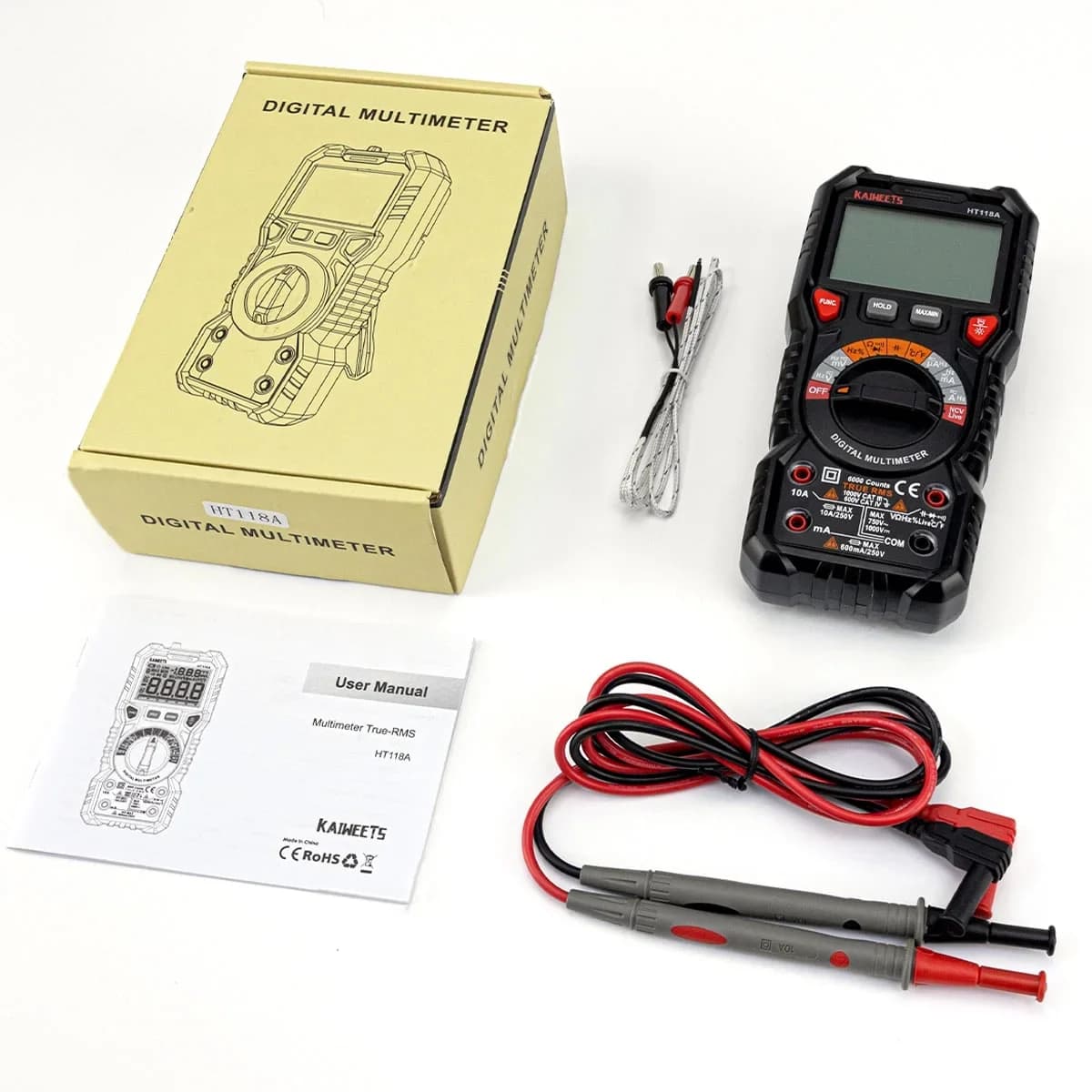
Choose for: Best budget choice for beginners
Check before buying: The official HT118A manual specifies 1000 V DC and 750 V AC; the 1000 V headline is not the AC measurement limit
- 2
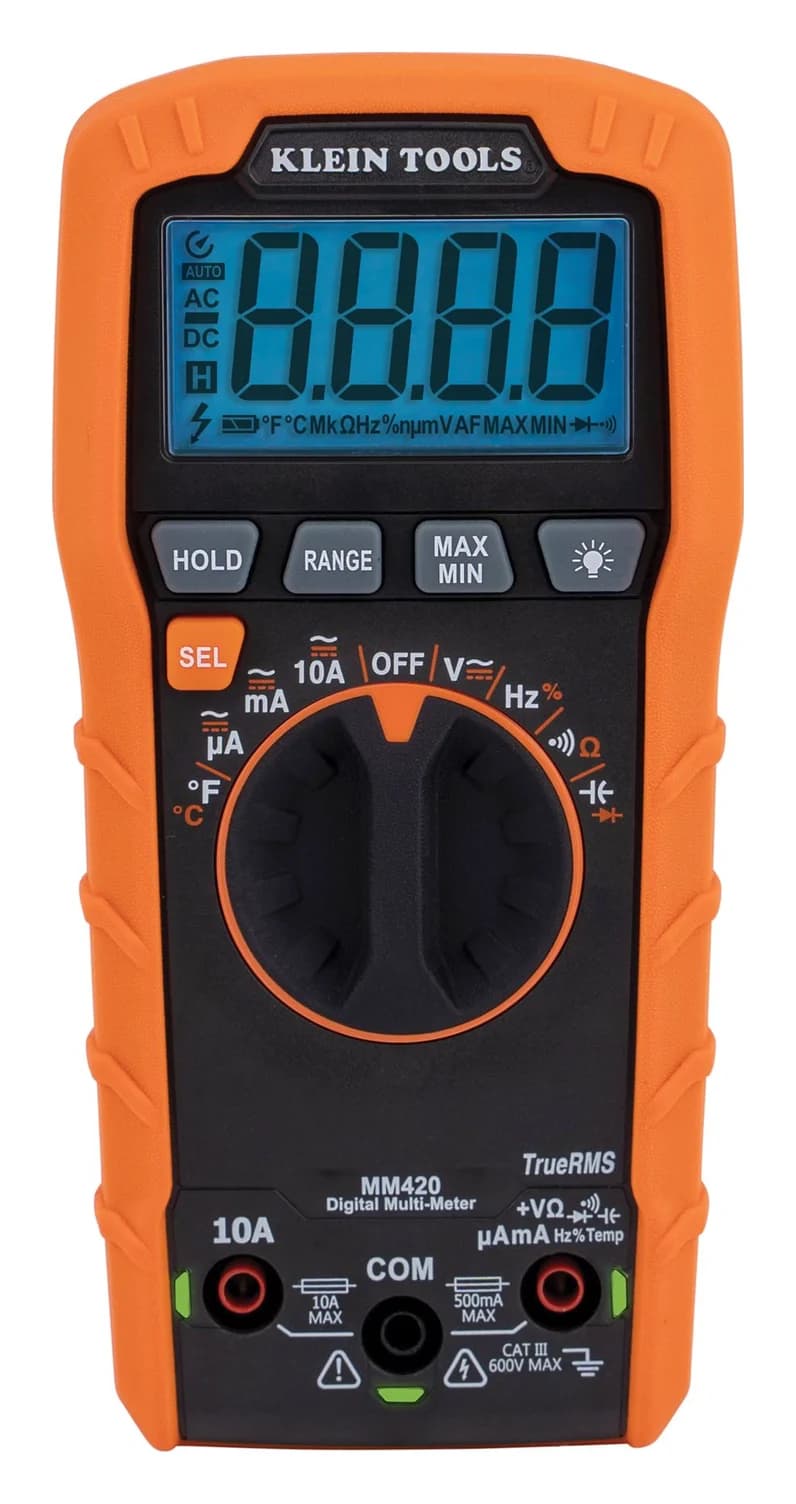
Choose for: the alternative for clearer safety documentation
Check before buying: Rated CAT III 600V: not for service-entrance (CAT IV) work
For a first meter used on household batteries and disconnected components, choose the KAIWEETS HT118A: its auto-ranging and illuminated input jacks make setup easier to follow. Choose the AstroAI DM6000AR if you specifically want automatic/manual range selection and a hanging magnet; consider the Klein MM420 if clearly documented safety standards matter more to your purchase than display count. These are recommendations based on manufacturer documents, with the budget picks aimed at low-voltage learning.
Quick picks
Compare specifications and all conditions
KAIWEETS HT118A
- Best reason to buy
- Illuminated jacks and auto-ranging for a first low-voltage kit
- Important buying check
- Match HT118A, its manual and the installed fuse markings
AstroAI DM6000AR
- Best reason to buy
- Automatic/manual ranging and a hanging magnet for bench or garage projects
- Important buying check
- Select DM6000AR; other AstroAI models share the storefront
Klein MM420
- Best reason to buy
- Lead-Alert and explicit safety-standard documentation
- Important buying check
- CAT III 600V; its lower display count is not an accuracy verdict
Full comparison table
Swipe to compare. Row labels stay visible.
| Choose | Best reason to buy | Important buying check |
|---|---|---|
| KAIWEETS HT118A | Illuminated jacks and auto-ranging for a first low-voltage kit | Match HT118A, its manual and the installed fuse markings |
| AstroAI DM6000AR | Automatic/manual ranging and a hanging magnet for bench or garage projects | Select DM6000AR; other AstroAI models share the storefront |
| Klein MM420 | Lead-Alert and explicit safety-standard documentation | CAT III 600V; its lower display count is not an accuracy verdict |
Scroll horizontally to see every column
| Choose | Best reason to buy | Important buying check |
|---|---|---|
| KAIWEETS HT118A | Illuminated jacks and auto-ranging for a first low-voltage kit | Match HT118A, its manual and the installed fuse markings |
| AstroAI DM6000AR | Automatic/manual ranging and a hanging magnet for bench or garage projects | Select DM6000AR; other AstroAI models share the storefront |
| Klein MM420 | Lead-Alert and explicit safety-standard documentation | CAT III 600V; its lower display count is not an accuracy verdict |
For a broader shortlist, use our best multimeters guide. This page owns the narrower budget-model decision.
Best budget choice for beginners: KAIWEETS HT118A
The HT118A product page describes LEDs that illuminate the appropriate jacks when you select a function. That is the feature we would prioritize for a novice: correct connections matter before extra measurement modes. Treat the lights as guidance and still check the dial, displayed function and red-lead position yourself.
KAIWEETS
A 6,000-count auto-ranging True RMS multimeter with non-contact voltage and live-wire detection, LED-lit input jacks, a flashlight and temperature measurement, rated CAT III 1000V and CAT IV 600V.
- 1,000 V max
- 10 A max
- 6,000 counts
- CAT III 1000V, CAT IV 600V
KAIWEETS specifies a 6,000-count, auto-ranging meter with True RMS, AC/DC current, resistance, capacitance, frequency, duty cycle, temperature and continuity. It also adds non-contact voltage detection, a Live function and a flashlight. Those extra modes are not needed for your first battery check; AstroAI's own beginner guidance explains that DC voltage and continuity do not depend on True RMS.
The drawback is documentation consistency. KAIWEETS gives conflicting headline and table voltage limits, discussed below. Its page names CE and RoHS alongside CAT claims; we would not turn that wording into an independent safety-test claim.
AstroAI DM6000AR: choose it for range control and the magnet
The exact US DM6000AR page identifies the selected model as DM6000AR, with 6,000 counts and automatic/manual ranging. Its product description also lists a hanging magnet, kickstand, backlight and True RMS. Choose it when holding the display in view and deliberately selecting a range fit your projects.
Do not substitute another “AstroAI multimeter.” The same storefront offers M6K0R and AM33D choices. AstroAI's comparison marks NCV detection absent on the DM6000AR and present on the M6K0R. A feature appearing elsewhere in that comparison is not automatically a DM6000AR feature.
AstroAI links the ASIMT5000A English manual from this exact listing. Match that identifier as well as DM6000AR when checking instructions; the manufacturer's wider manual catalogue also contains a separate ABMU6000ABK document. Use the manual linked to your actual unit rather than combining specifications from similarly named documents.
The trade-off against the HT118A is straightforward: the AstroAI's magnet and range control are its reasons to buy; the KAIWEETS page explicitly offers illuminated jack guidance. Neither feature establishes which meter is more accurate.
See the exact DM6000AR at AstroAI
Klein MM420: the alternative for clearer safety documentation
Klein's MM420 manual states CAT III 600V, conformity to UL standards and certification to CSA standards. That explicit documentation is our reason to consider it alongside these budget choices; it is not a comparative physical safety test.
Klein Tools
A 4,000-count auto-ranging True RMS multimeter rated CAT III 600V that measures up to 600 V and 10 A, plus temperature, capacitance, frequency and duty cycle.
Check package and model options
- 600 V max
- 10 A max
- 4,000 counts
- CAT III 600V
The MM420 provides True RMS, automatic ranging, Lead-Alert jack LEDs, 600 V AC/DC, 10 A AC/DC, temperature and continuity, with a 4,000-count display. Klein lists leads, a thermocouple with adapter and batteries in the package. Its manual limits the supplied thermocouple to below 180°C: a meter's temperature range does not establish the included probe's limit.
See our Fluke versus Klein comparison if the next decision is a broader upgrade.
DM6000AR vs HT118A: the useful comparison
Figures below are manufacturer specifications, not independently verified performance. The voltage maxima are measurement ranges, not blanket permission to use either instrument in any electrical environment.
AstroAI DM6000AR
- AC/DC current
- Listed; check the exact manual's input limits
- Display
- 6,000 counts
- Range selection
- Automatic and manual
All specifications
- Voltage table maximum
- 1000 V DC; 750 V AC
- True RMS
- Yes
- Temperature, capacitance, frequency, continuity
- Listed
- NCV detection
- Marked absent in AstroAI's model comparison
- Standout convenience
- Hanging magnet and kickstand
- Box list
- Pair of leads, multifunction socket, K-type thermocouple, manual
KAIWEETS HT118A
- AC/DC current
- Ranges from 600 µA to 10 A
- Display
- 6,000 counts
- Range selection
- Auto-ranging
All specifications
- Voltage table maximum
- 1000 V DC; 750 V AC, despite the 600V headline
- True RMS
- Yes
- Temperature, capacitance, frequency, continuity
- Listed
- NCV detection
- Listed, with Live mode
- Standout convenience
- Illuminated jacks and flashlight
- Box list
- Two leads, thermocouple, two AAA batteries, manual
Full comparison table
Swipe to compare. Row labels stay visible.
| Feature | AstroAI DM6000AR | KAIWEETS HT118A |
|---|---|---|
| Display | 6,000 counts | 6,000 counts |
| Range selection | Automatic and manual | Auto-ranging |
| Voltage table maximum | 1000 V DC; 750 V AC | 1000 V DC; 750 V AC, despite the 600V headline |
| True RMS | Yes | Yes |
| AC/DC current | Listed; check the exact manual's input limits | Ranges from 600 µA to 10 A |
| Temperature, capacitance, frequency, continuity | Listed | Listed |
| NCV detection | Marked absent in AstroAI's model comparison | Listed, with Live mode |
| Standout convenience | Hanging magnet and kickstand | Illuminated jacks and flashlight |
| Box list | Pair of leads, multifunction socket, K-type thermocouple, manual | Two leads, thermocouple, two AAA batteries, manual |
Scroll horizontally to see every column
| Feature | AstroAI DM6000AR | KAIWEETS HT118A |
|---|---|---|
| Display | 6,000 counts | 6,000 counts |
| Range selection | Automatic and manual | Auto-ranging |
| Voltage table maximum | 1000 V DC; 750 V AC | 1000 V DC; 750 V AC, despite the 600V headline |
| True RMS | Yes | Yes |
| AC/DC current | Listed; check the exact manual's input limits | Ranges from 600 µA to 10 A |
| Temperature, capacitance, frequency, continuity | Listed | Listed |
| NCV detection | Marked absent in AstroAI's model comparison | Listed, with Live mode |
| Standout convenience | Hanging magnet and kickstand | Illuminated jacks and flashlight |
| Box list | Pair of leads, multifunction socket, K-type thermocouple, manual | Two leads, thermocouple, two AAA batteries, manual |
Sources: AstroAI listing, including its selected-model description and box list, and KAIWEETS specifications. Do not carry an accessory or function across from a neighbouring model column.
Counts, resolution and accuracy at the same reading
Matching display counts do not establish matching accuracy. AstroAI's beginner guide makes that distinction explicitly. Accuracy must be read for the selected function and range, including the extra digits term.
For a calculated 12 V DC example, KAIWEETS lists a 60 V range and ±(0.5% + 3) DC-voltage accuracy. With its 6,000-count display, that range gives 10 mV display increments. The percentage contribution is 60 mV; three increments add 30 mV, giving a calculated allowance of ±90 mV either side of the indicated value.
At the same indicated voltage, Klein's 40 V range also resolves 10 mV, but its ±(0.5% + 5) specification gives ±110 mV. These are specification calculations, not readings from instruments we own. They also show why a lower-count meter does not necessarily lose useful resolution on the range you need.
Use the DM6000AR's listing-linked ASIMT5000A manual for its own per-range allowances; do not copy the HT118A formula onto it. We make no measured accuracy ranking between the two budget meters. Our measurement methodology explains the distinction between a specification and a measured result.
Resolve the HT118A voltage conflict before buying
KAIWEETS's feature text says “up to 600V AC/DC voltage”, while its table lists 1000 V DC and 750 V AC. The English manual linked from its official downloads page and its input-panel drawing agree with those higher voltage-function limits. The useful resolution is to distinguish the voltage function, the CAT category and the current jacks.
The product's stated categories are CAT III 1000V / CAT IV 600V. Those do not make its current inputs suitable for voltage measurements. Its fuse store separately lists 600mA/250V and 10A/250V options for HT118A, alongside other replacements. Check the manual and markings supplied with the delivered unit; the website's inconsistent headline remains a buying caution.
Fluke's safety guide explains that the measurement category and voltage must fit the environment, and advises checking independent verification symbols. We favor the MM420's explicit standards documentation when that is central to the purchase. Leave panels and service equipment to a licensed electrician.
Current jacks and fuses: buy for the input you will use
AstroAI's beginner guidance says to confirm the dial and red-lead jack before every measurement, then return the red lead to voltage/resistance after measuring current. Its automotive guidance also says that a current function alone does not establish suitability for a long parasitic-drain test: check the input, fuse and time limit.
For HT118A replacements, KAIWEETS's fuse page lists both lower- and higher-voltage options against this model. Match the exact manual, installed fuse specification and manufacturer advice; do not select a replacement by amperage alone or assume a listed alternative upgrades the meter's CAT rating. A ceramic-fuse claim by itself is not a complete replacement specification.
Buying guide: a low-voltage starter task card
AstroAI recommends beginning with a household battery, then continuity on a disconnected wire or fuse and resistance on a de-energized resistor. For voltage, use black in COM, red in V/Ω, select DC volts, and connect across the battery. For continuity or resistance, disconnect power first; confirm the function symbol rather than relying on the dial's shared position.
Inspect and select
Check the leads and meter for damage. Confirm COM, the voltage/resistance jack and the displayed function.
Read a household battery
Select DC volts, keep the red lead in the voltage jack and measure across the battery.
Check a disconnected part
Use continuity on an isolated wire or fuse, or resistance on a de-energized resistor.
Finish with a jack check
After any later current exercise, return the red lead to voltage/resistance before the next voltage check.
Our how to use a multimeter guide expands those basics. If your real task is measuring current without opening a circuit, start with clamp meter versus multimeter.
Check what arrives. KAIWEETS's box list includes its two AAA batteries but does not promise a separate carrying case. AstroAI's box list includes leads, a multifunction socket and a K-type thermocouple; its description lists the hanging magnet. Its technical-details battery fields conflict with each other, calling the battery both lithium metal and zinc carbon. Confirm the required battery and what is supplied against the matching manual and package rather than buying from that metadata. Neither box list promises a separate carrying case.
- Yes: HT118A when illuminated jack guidance is the priority
- Yes: DM6000AR when manual range control and a hanging magnet are useful
- Yes: MM420 when explicit safety-standard documentation drives the choice
- Partly: Confirm the exact battery, fuse and accessory package against the matching manual
- No: Do not choose a meter for mains work from display counts or a headline voltage alone
How we choose
We compared official product pages, the manuals they link, accessory lists and manufacturer safety guidance. The recommendation weighs setup clarity, model identity, documentation conflicts and low-voltage task fit. Calculated examples use published specifications; no independent performance or durability results are claimed. See How we choose for the site's selection policy.
Verdict
Get the HT118A for illuminated jack guidance in a first low-voltage kit. Get the exact DM6000AR when its hanging magnet and automatic/manual range selection are the features you will use. Choose the MM420 alternative when its explicit standards documentation is more important to you. Start with batteries and disconnected components, and match every purchase to its own manual, fuse requirements and accessory list.
Frequently asked questions
Is an AstroAI multimeter good for a beginner?
The exact model matters. The DM6000AR provides automatic and manual ranging, True RMS AC measurement, continuity and temperature, making it an option for a first low-voltage electronics kit. Choose the KAIWEETS HT118A instead if illuminated jack guidance is your priority. Start with a household battery and disconnected components; extra display counts and a printed CAT rating do not replace correct probe placement or training.
Is the KAIWEETS HT118A a 600V or 1000V multimeter?
Its product-page feature text says 600V AC/DC, but its range table reaches 1000V DC and 750V AC. Those are voltage-function ranges, distinct from its stated CAT III 1000V and CAT IV 600V categories and the current-input fuse ratings. Match the manual and markings on the delivered meter. We recommend this budget comparison for low-voltage learning, not as permission to work on mains equipment.
Does the HT118A include a case, batteries and temperature probe?
KAIWEETS lists the meter, two test leads, a user manual, a thermocouple and two AAA batteries. Its protective silicone covering is described separately; the package list does not promise a separate carrying case. AstroAI's DM6000AR box list includes leads, a multifunction socket and a K-type thermocouple. Check the exact package before buying a bundle because a protective covering, hanging magnet and storage case serve different purposes.
KAIWEETS HT118A
AmazonRelated guides
Best picks · Multimeters
Best Multimeters for Electricians: LoZ, CAT Ratings and Job Fit
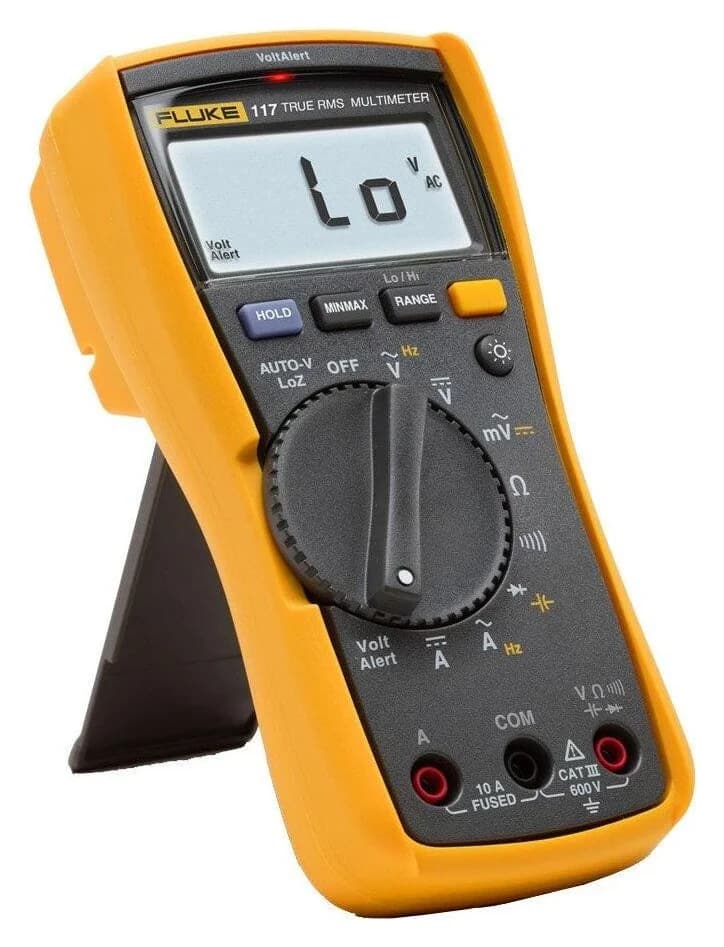
Choose an electrician's multimeter by job: Fluke 117 for branch circuits, 87V MAX for industry, Klein MM420 for extra functions, or the narrower Fluke 113.
Best picks · Multimeters
Best Multimeters for Automotive Work: Batteries, Sensors and RPM
Choose an automotive multimeter for voltage drop, sensors, RPM and small currents. Compare Klein, Innova and Fluke, kit contents and DC clamp limitations too.
Buying guide · Multimeters
How to Test Continuity With a Multimeter: Fuses, Wires and Switches
Test fuses, wires and switches with a multimeter. Read OL, account for lead resistance, find intermittent breaks and compare model-specific beep thresholds.