

Best picks
Best Multimeters for Electricians
LoZ, CAT Ratings and Job Fit
Choose an electrician's multimeter by job: Fluke 117 for branch circuits, 87V MAX for industry, Klein MM420 for extra functions, or the narrower Fluke 113.
By thisMETER EditorialUpdated November 3, 20268 min read3 picks
Our recommendation: Fluke 117
Electrical troubleshooting with True RMS and a low-impedance mode for ghost voltage.
Limit: CAT III 600 V, not CAT IV; no mA/µA current ranges (the 6 A range resolves 1 mA).
On this page · Our picks at a glance
Our picks at a glance
- 1
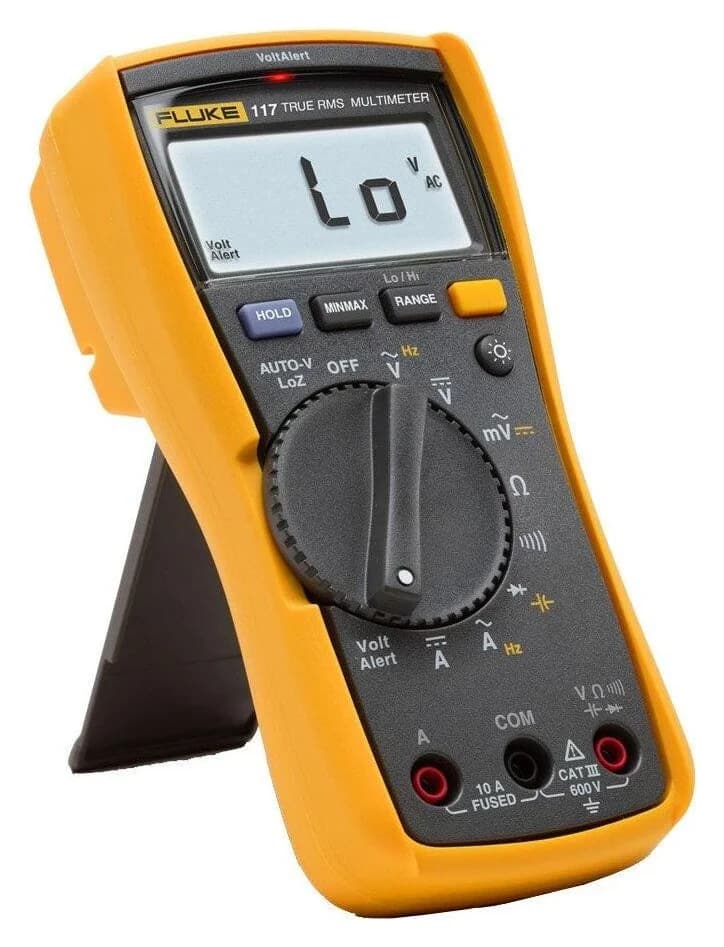
Choose for: Electrical troubleshooting with True RMS and a low-impedance mode for ghost voltage.
Limit: CAT III 600 V, not CAT IV; no mA/µA current ranges (the 6 A range resolves 1 mA).
- 2
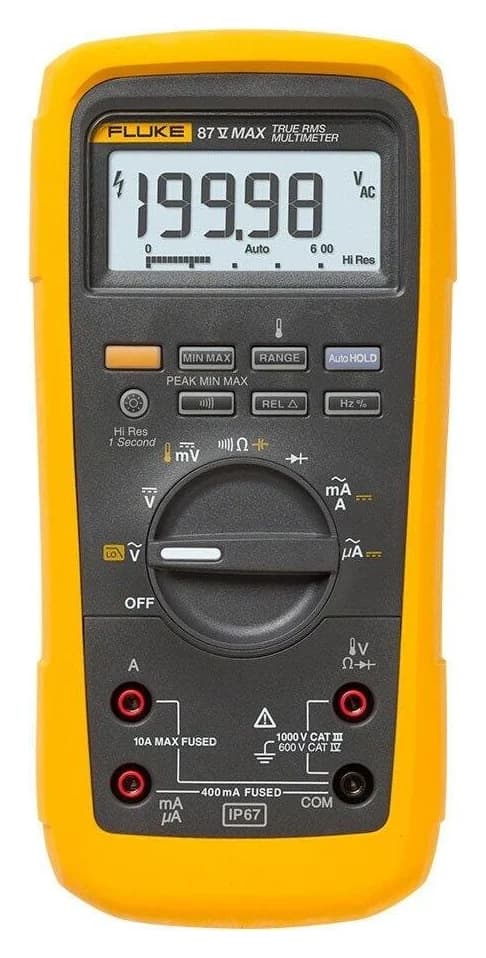
Choose for: Industrial maintenance and motor drives
Limit: Heavy for a handheld: 698.5 g with the holster and Flex-Stand
- 3
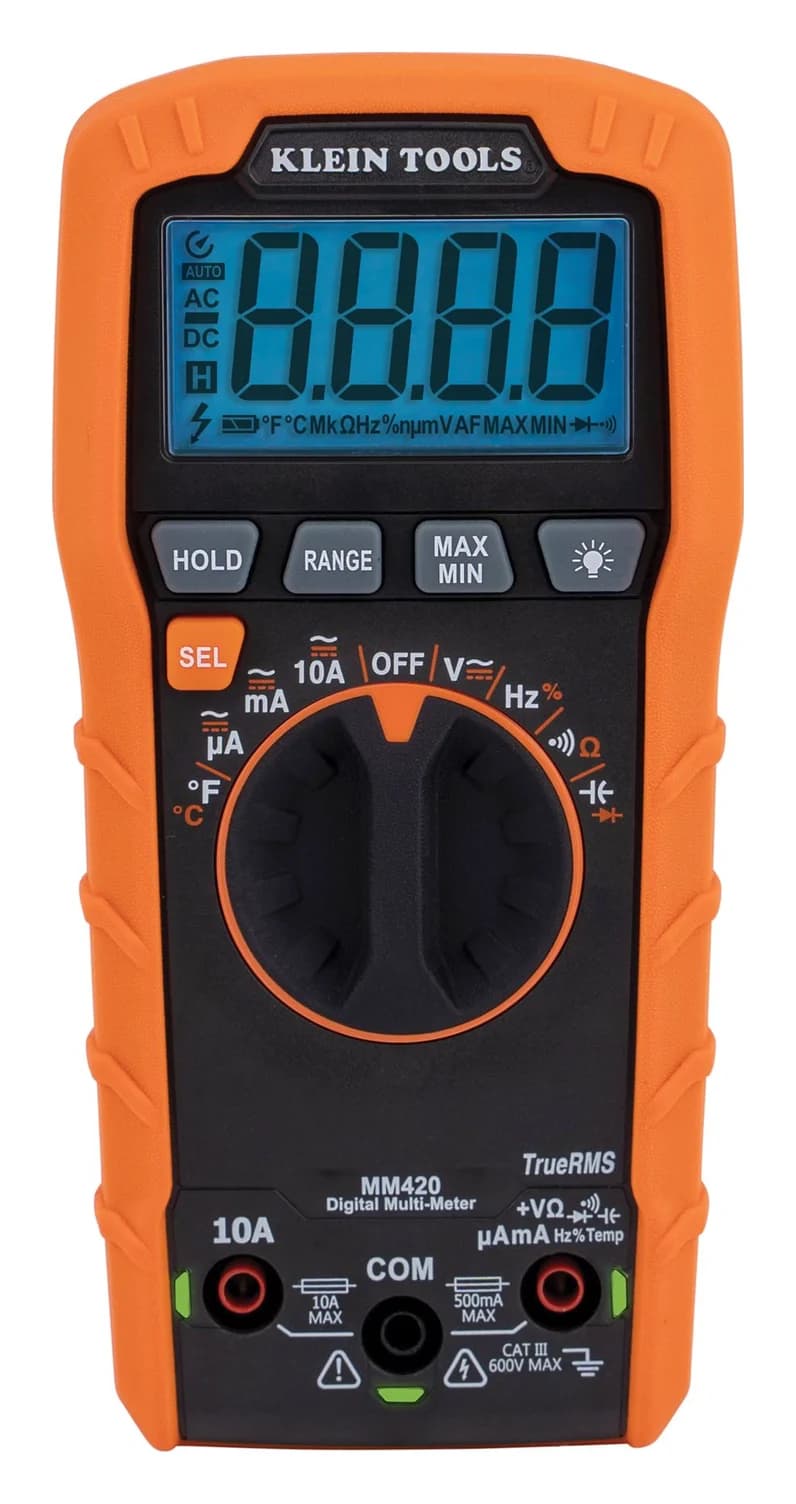
Choose for: Temperature and small-current checks
Limit: Rated CAT III 600V: not for service-entrance (CAT IV) work
The Fluke 117 is our best multimeter for electricians doing branch-circuit troubleshooting: True RMS, AutoVolt/LoZ and built-in VoltAlert address that job directly. Choose the Fluke 87V MAX for its higher voltage/category markings and motor-drive filter, or the Klein MM420 when temperature and small-current ranges matter more than LoZ. If a clamp already covers current and you mainly need voltage and continuity, consider the deliberately narrower Fluke 113.
Quick picks by electrical job
All four meters are True RMS; the differences below decide our recommendations. Ratings and functions are manufacturer specifications, not our measurements.
Compare specifications and all conditions
Branch-circuit troubleshooting
- Choose
- Fluke 117
- Voltage limit and CAT marking
- 600 V; CAT III 600V
- Deciding feature
- AutoVolt/LoZ and VoltAlert
All specifications
- Main reason to choose another
- No dedicated µA/mA ranges or temperature
Industrial maintenance and motor drives
- Choose
- Fluke 87V MAX
- Voltage limit and CAT marking
- 1000 V; CAT III 1000V / CAT IV 600V
- Deciding feature
- AC low-pass filter; IP67 case
All specifications
- Main reason to choose another
- No selectable LoZ voltage mode documented
Temperature and small-current checks
- Choose
- Klein MM420
- Voltage limit and CAT marking
- 600 V; CAT III 600V
- Deciding feature
- µA/mA ranges, thermocouple, Lead-Alert
All specifications
- Main reason to choose another
- No LoZ voltage mode documented
Voltage/continuity beside an existing clamp
- Choose
- Fluke 113
- Voltage limit and CAT marking
- 600 V; CAT IV 600V
- Deciding feature
- VCHEK low-impedance voltage/continuity
All specifications
- Main reason to choose another
- No current, frequency or temperature function
Full comparison table
Swipe to compare. Row labels stay visible.
| Job | Choose | Voltage limit and CAT marking | Deciding feature | Main reason to choose another |
|---|---|---|---|---|
| Branch-circuit troubleshooting | Fluke 117 | 600 V; CAT III 600V | AutoVolt/LoZ and VoltAlert | No dedicated µA/mA ranges or temperature |
| Industrial maintenance and motor drives | Fluke 87V MAX | 1000 V; CAT III 1000V / CAT IV 600V | AC low-pass filter; IP67 case | No selectable LoZ voltage mode documented |
| Temperature and small-current checks | Klein MM420 | 600 V; CAT III 600V | µA/mA ranges, thermocouple, Lead-Alert | No LoZ voltage mode documented |
| Voltage/continuity beside an existing clamp | Fluke 113 | 600 V; CAT IV 600V | VCHEK low-impedance voltage/continuity | No current, frequency or temperature function |
Scroll horizontally to see every column
| Job | Choose | Voltage limit and CAT marking | Deciding feature | Main reason to choose another |
|---|---|---|---|---|
| Branch-circuit troubleshooting | Fluke 117 | 600 V; CAT III 600V | AutoVolt/LoZ and VoltAlert | No dedicated µA/mA ranges or temperature |
| Industrial maintenance and motor drives | Fluke 87V MAX | 1000 V; CAT III 1000V / CAT IV 600V | AC low-pass filter; IP67 case | No selectable LoZ voltage mode documented |
| Temperature and small-current checks | Klein MM420 | 600 V; CAT III 600V | µA/mA ranges, thermocouple, Lead-Alert | No LoZ voltage mode documented |
| Voltage/continuity beside an existing clamp | Fluke 113 | 600 V; CAT IV 600V | VCHEK low-impedance voltage/continuity | No current, frequency or temperature function |
Start with the missing task in your bag. Buying another current range makes less sense if the unresolved problem is ghost voltage; buying LoZ alone makes less sense if the job requires temperature.
Best for branch-circuit troubleshooting: Fluke 117
The 117's official page lists AutoVolt automatic AC/DC selection, a low-impedance mode for ghost voltages and VoltAlert non-contact detection. That combination earns it our default recommendation for this job.
Fluke
A compact 6,000-count True RMS multimeter for electricians, rated CAT III 600V, with built-in VoltAlert non-contact voltage detection, automatic AC/DC selection and a low-impedance mode.
Check package and model options
- 600 V max
- 10 A max
- 6,000 counts
- CAT III 600V
The important distinction is a choice of voltage inputs. The shared users manual specifies approximately 3 kΩ for Auto-V/LoZ, versus greater than 10 MΩ for ordinary DC volts. You can choose the mode appropriate to the circuit; the 113's voltage input is always low impedance.
Its limits are equally useful buying information. The 117 is marked CAT III 600V, measures AC/DC current through leads up to 10 A, and has a smallest DC-current step of 1 mA on its 6 A range. That is not a dedicated microamp or milliamp range. Temperature is not a documented function: the product page contains temperature entries in its comparison material and footnotes, but the 117's own function table in the manual provides none. We do not count those entries as a 117 feature.
VoltAlert is a screening aid: the manual warns that voltage can be present with no indication and says not to rely on it with shielded wire.
For a broader brand decision, use our Fluke versus Klein comparison.
Best for industrial maintenance: Fluke 87V MAX
Choose the 87V MAX when the work calls for CAT III 1000V / CAT IV 600V, a 1000 V measurement limit or an AC low-pass filter for inverter and variable-frequency-drive measurements. Fluke specifies an IP67 case and a 4 m drop rating with the holster.
Fluke
A rugged industrial True RMS multimeter rated CAT IV 600V and CAT III 1000V, with an IP67 case, a 4 m drop rating, a low-pass filter for motor-drive readings and temperature measurement.
Check package and model options
- 1,000 V max
- 10 A max
- 6,000 counts
- CAT IV 600V, CAT III 1000V
Its dedicated µA/mA ranges and temperature function also broaden the job list. The standard package includes a temperature probe and TL175 TwistGuard leads. These are reasons to choose it for maintenance; simply wanting LoZ is not. The MAX manual describes a voltage input of approximately 10 MΩ, and documents no selectable LoZ voltage mode.
A low-pass filter and LoZ solve different problems. The filter rejects unwanted higher-frequency components; LoZ loads the circuit. Fluke also warns against using the low-pass filter to verify the presence of hazardous voltage. Follow the manual's limits rather than treating the filter as a general safety setting.
There is a documentation ambiguity worth preserving: the MAX manual prints two AC-current accuracy columns without labels distinguishing them, while the product page gives a single specification. We do not rank it by that AC-current accuracy figure.
Best for temperature and small currents: Klein Tools MM420
The MM420 is our alternative when a tool bag lacks a thermocouple input or dedicated small-current ranges. Klein specifies True RMS, automatic ranging, 600 V AC/DC, 10 A AC/DC and CAT III 600V, with Lead-Alert LEDs indicating lead placement.
Klein Tools
A 4,000-count auto-ranging True RMS multimeter rated CAT III 600V that measures up to 600 V and 10 A, plus temperature, capacitance, frequency and duty cycle.
Check package and model options
- 600 V max
- 10 A max
- 4,000 counts
- CAT III 600V
The manual starts its current ranges at 400 µA, alongside mA and A ranges. It lists 10 MΩ input impedance and no LoZ voltage mode. Choose it for the functions it adds; our branch-circuit pick remains the 117 when rejecting ghost voltage is the priority.
The included thermocouple needs a separate limit check. Although Klein lists a meter temperature range reaching 1000°C, the manual limits the supplied probe to below 180°C. The headline meter range does not describe the probe in the box. Test leads with CAT III/CAT IV safety caps, the thermocouple and batteries are included.
Narrower voltage/continuity choice: Fluke 113
The Fluke 113 Utility Multimeter earns consideration beside an existing clamp meter. Its VCHEK setting detects AC/DC voltage or provides continuity when voltage is not detected. It also measures resistance, capacitance and diodes; “voltage/continuity choice” describes the buying reason, not its entire function list.
The shared manual identifies it as True RMS and marks it CAT IV 600V. It has no current-measurement jack, frequency function or temperature function. Its voltage input is approximately 3 kΩ, with no ordinary high-impedance voltage mode. We would choose it only when that narrower scope fits the job.
Two restrictions make it less interchangeable with a general multimeter. Fluke's current US page specifies a 3 VDC minimum in VCHEK autorange. The manual requires a 1 minute wait after voltage measurements to maintain the accuracy of resistance, capacitance, diode and continuity readings. Both matter when your work extends beyond basic power-circuit checks.
- Yes: Your existing clamp covers the current measurements you need
- Yes: Low-impedance voltage and continuity are the missing functions
- No: You need a high-impedance voltage input for sensitive controls
- No: You need frequency or temperature in this meter
For the exact US package, Fluke lists part 3078875 with TL75 leads, a holster, users manual and an installed 9 V battery. R-FLUKE-113 is the separate factory-reconditioned option. Check the model and condition before ordering.
How we choose
Recommendations are based on official US product pages, function tables, manuals and accessory specifications. We prioritise the working location, voltage input and functions missing from an existing kit. The figures for accuracy, protection and durability belong to the manufacturers.
We read model-specific columns rather than assigning every comparison-table feature to the page's headline meter. We also preserve disagreements and distinguish the instrument's range from its supplied accessories. Our research method explains the approach; our general multimeter guide covers other uses.
Buying guide: match the meter to the whole job
When LoZ matters on branch circuits
Fluke's stray-voltage application note explains that capacitive coupling between energised wiring and adjacent disconnected wiring can produce a voltage reading on a high-impedance meter. LoZ places a load on that coupling. That makes it useful for this troubleshooting question; it does not turn every low reading into permission to touch a conductor.
The 113 instructions warn that its low-impedance input can alter electronic-control voltages or damage circuits sensitive to that load. Its US product page also warns of powered GFCI/RCD tripping during phase-to-earth LoZ measurements.
Compare the working location, meter and leads
Fluke's category guide places feeders, short branch circuits and fixed distribution equipment in CAT III, and service entrances and electricity meters in CAT IV. Select both the category and the voltage for the actual location. A high voltage limit alone does not settle the choice.
The Fluke safety instructions limit combinations to their lowest-rated component. Higher-rated leads cannot upgrade a lower-rated meter.
113: TL75
- What to check before buying
- Fluke lists CAT II 1000V without protective caps; CAT III 1000V / CAT IV 600V with caps.
117: generic silicone lead set
- What to check before buying
- The standard package names no exact lead model; check the markings and cap instructions on the supplied set.
87V MAX: TL175 TwistGuard
- What to check before buying
- Fluke lists CAT II 1000V, CAT III 1000V and CAT IV 600V; the applicable rating is visible for the selected tip exposure.
MM420: leads with safety caps
- What to check before buying
- Klein requires the CAT III/CAT IV shields in those locations; omitting them increases arc-flash risk. The meter remains CAT III 600V.
Full comparison table
Swipe to compare. Row labels stay visible.
| Supplied lead arrangement | What to check before buying |
|---|---|
| 113: TL75 | Fluke lists CAT II 1000V without protective caps; CAT III 1000V / CAT IV 600V with caps. |
| 117: generic silicone lead set | The standard package names no exact lead model; check the markings and cap instructions on the supplied set. |
| 87V MAX: TL175 TwistGuard | Fluke lists CAT II 1000V, CAT III 1000V and CAT IV 600V; the applicable rating is visible for the selected tip exposure. |
| MM420: leads with safety caps | Klein requires the CAT III/CAT IV shields in those locations; omitting them increases arc-flash risk. The meter remains CAT III 600V. |
Scroll horizontally to see every column
| Supplied lead arrangement | What to check before buying |
|---|---|
| 113: TL75 | Fluke lists CAT II 1000V without protective caps; CAT III 1000V / CAT IV 600V with caps. |
| 117: generic silicone lead set | The standard package names no exact lead model; check the markings and cap instructions on the supplied set. |
| 87V MAX: TL175 TwistGuard | Fluke lists CAT II 1000V, CAT III 1000V and CAT IV 600V; the applicable rating is visible for the selected tip exposure. |
| MM420: leads with safety caps | Klein requires the CAT III/CAT IV shields in those locations; omitting them increases arc-flash risk. The meter remains CAT III 600V. |
Start with the working location
Match its required category and voltage before comparing extra functions.
Check the meter marking
Its measurement range does not replace its CAT marking.
Read the lead and accessory markings
Include probes, caps and clips; the lowest component rating limits the combination.
Check the required probe configuration
Protective caps and tip exposure affect the applicable lead rating.
Choose the package without duplicating the clamp
If you already own a suitable clamp, our recommendation is to buy the multimeter for the missing voltage mode, temperature or small-current capability. If you are choosing both tools, see clamp meter versus multimeter and our clamp meter shortlist.
The 117/323 kit pairs the 117 with a clamp rated for 400 A AC; the 323 has no DC jaw-current range. Its kit page has an accessory discrepancy: the overview names TL175 leads and a TPAK hanger, while the box list names generic silicone leads and does not name the hanger. Confirm the accessory manifest for that package.
For the standalone 117, CAL adds a traceable calibration certificate with data. For the industrial pick, check that the model is 87V MAX, not simply 87V; Fluke's comparison lists IP67 for the MAX and IP30 for the original. These suffixes and bundles deserve checking before the purchase link.
Verdict
Our default electrician pick is the Fluke 117 for AutoVolt/LoZ and VoltAlert. Choose the 87V MAX when its industrial ratings and filter match the job, or the MM420 for temperature and small-current ranges. Consider the 113 beside an existing clamp when low-impedance voltage and continuity are enough. Buy to the required task, then check the complete meter-and-lead combination.
Frequently asked questions
What is the best multimeter for an electrician?
Our default is the Fluke 117 for branch-circuit troubleshooting because it combines True RMS, AutoVolt/LoZ and VoltAlert non-contact detection. Its marking is CAT III 600V. Choose the 87V MAX when the job requires its CAT III 1000V / CAT IV 600V markings or motor-drive low-pass filter. Choose the Klein MM420 when temperature and dedicated small-current ranges are the missing functions.
What is the difference between the Fluke 113 and 117?
The 113 uses low-impedance VCHEK for voltage or continuity and has resistance, capacitance and diode functions. It lacks current measurement, frequency and temperature. The 117 adds ordinary high-impedance voltage modes, AC/DC current, frequency and VoltAlert. The 113 is marked CAT IV 600V; the 117 is CAT III 600V. A higher CAT marking does not mean a longer function list.
Do electricians need a LoZ multimeter?
LoZ is useful when capacitive coupling makes adjacent disconnected wiring show a ghost voltage on a high-impedance meter. It is a reason to choose the 117 or the narrower 113. It is also a load on the circuit: Fluke warns that the 113's VCHEK can alter electronic control voltages and that phase-to-earth LoZ measurements can trip powered GFCI/RCD circuits. Follow the applicable manual.
Do CAT IV test leads make a CAT III meter suitable for CAT IV work?
No. Fluke's safety instructions limit the combination to its lowest-rated component. Higher-rated leads do not upgrade the meter. Caps and exposed probe length matter too: Fluke rates TL75 leads CAT II 1000V without their protective caps, and CAT III 1000V / CAT IV 600V with them. Check the actual meter, leads, probes and accessories against the working location.
Fluke 117
AmazonRelated guides
Best picks · Multimeters
Best Multimeters for Automotive Work: Batteries, Sensors and RPM
Choose an automotive multimeter for voltage drop, sensors, RPM and small currents. Compare Klein, Innova and Fluke, kit contents and DC clamp limitations too.
Comparison · Multimeters
AstroAI DM6000AR vs KAIWEETS HT118A: Which Budget Multimeter?
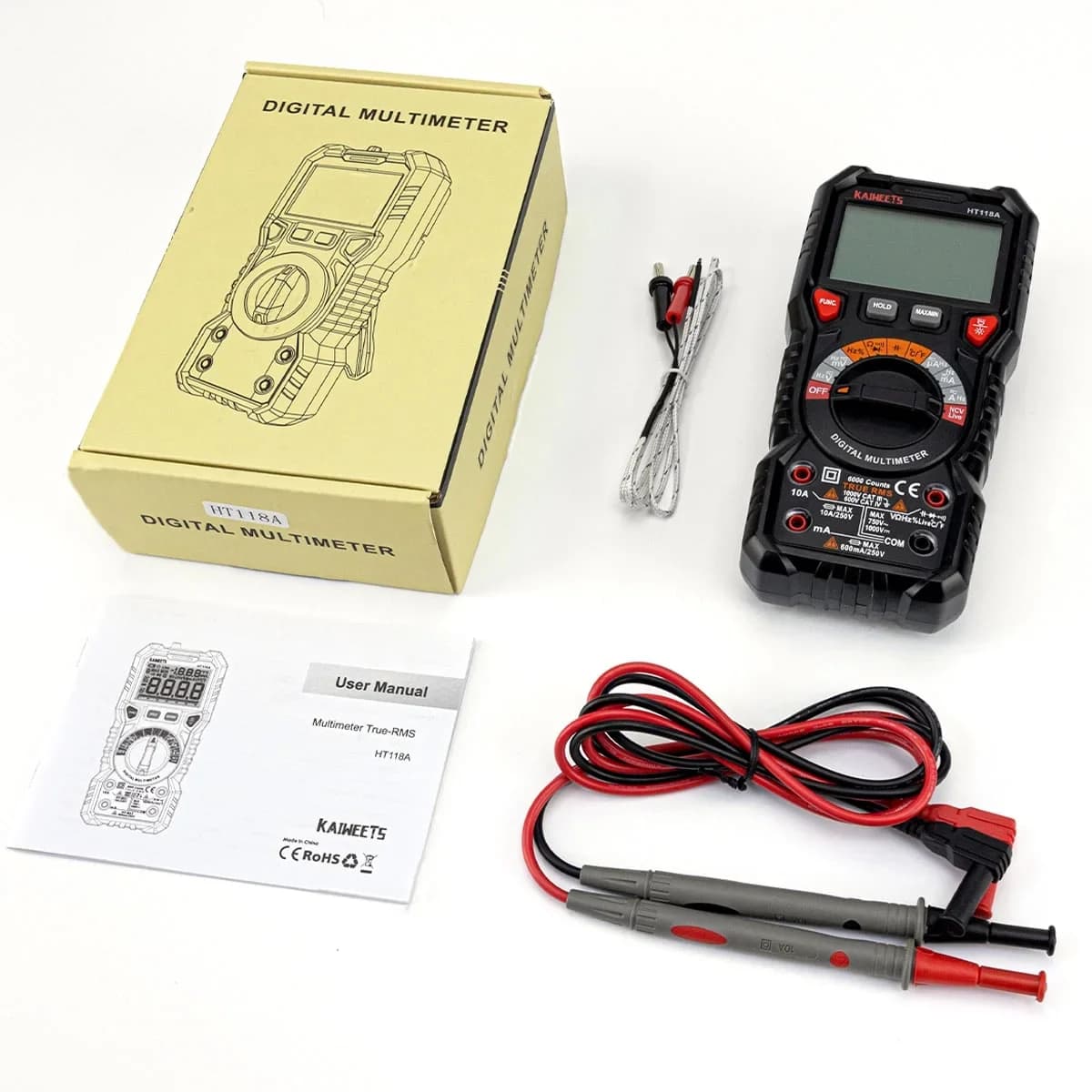
Choose an AstroAI DM6000AR or KAIWEETS HT118A for your first meter: compare controls, voltage claims, fuses, accessories and safe low-voltage starter tasks.
Buying guide · Multimeters
How to Test Continuity With a Multimeter: Fuses, Wires and Switches
Test fuses, wires and switches with a multimeter. Read OL, account for lead resistance, find intermittent breaks and compare model-specific beep thresholds.