

Best picks
Best Bench Multimeters for Electronics
Logging, Digits and Four-Wire Resistance
Choose a bench multimeter for electronics with clear B&K and Siglent picks, accuracy conditions, logging requirements, four-wire leads and calibration advice.
By thisMETER EditorialUpdated November 3, 20268 min read
On this page · Quick picks
The B&K Precision 5492C is our best bench multimeter for precision electronics when you need four-wire resistance, remote control and a more detailed DC voltage specification. Choose the Siglent SDM3045X for a first logging bench setup; keep your Fluke 87V MAX if handheld spot checks already do the job.
Quick picks
- Precision electronics: B&K 5492C. Our choice for its DC specifications, low-resistance range and documented standard kit. Order the non-GPIB model unless your system requires that interface.
- First logging setup: Siglent SDM3045X. Choose it for USB/LAN control and saved readings. Check its speed tradeoff and conflicting documentation below before buying for precision resistance.
- No upgrade: the 87V MAX you own. Keep it for occasional measurements. Start with our broader multimeter picks if you need a portable professional multimeter.
A bench purchase should solve a specific problem: computer-controlled captures, four-wire resistance or an accuracy requirement your existing meter cannot meet.
- Yes: You need computer-controlled captures
- Yes: You need four-wire resistance measurements
- Partly: You need better accuracy: compare the complete range-specific error
- No: You only need occasional voltage and continuity checks
Compare the capabilities that change the purchase
These are manufacturer specifications, not our measurements. Sources: the 5492C datasheet, SDM3045X datasheet and 87V MAX manual. Interfaces and counts also use the maker pages linked in each pick.
Display
- B&K Precision 5492C
- 5½ digits; 120,000 counts
- Siglent SDM3045X
- 4½ digits; 66,000 advertised; count conflict below
- Keep your Fluke 87V MAX
- 6,000 counts; 19,999 in HiRes
DC voltage error on the named range
- B&K Precision 5492C
- 10 V: ±(0.010% reading + 0.005% range)
- Siglent SDM3045X
- 6 V: ±(0.06% reading + 8 counts)
- Keep your Fluke 87V MAX
- 6 V: ±(0.05% reading + 1 count), normal display
DC voltage step on that range
- B&K Precision 5492C
- 100 µV
- Siglent SDM3045X
- 0.0001 V
- Keep your Fluke 87V MAX
- 0.001 V, normal display
Four-wire resistance
- B&K Precision 5492C
- Yes; 10 Ω range, 0.1 mΩ step
- Siglent SDM3045X
- Yes; conflicting range lists below
- Keep your Fluke 87V MAX
- Not documented in its manual
Computer interfaces
- B&K Precision 5492C
- USBTMC, LAN, RS232
- Siglent SDM3045X
- USB device, LAN
- Keep your Fluke 87V MAX
- No PC interface documented in its manual
Save without a PC
- B&K Precision 5492C
- Buffer export to USB flash drive
- Siglent SDM3045X
- Local or USB storage; CSV option
- Keep your Fluke 87V MAX
- Min/Max summaries; no documented CSV export
Standard calibration paperwork
- B&K Precision 5492C
- Test report and certificate
- Siglent SDM3045X
- Factory certificate
- Keep your Fluke 87V MAX
- CAL package separately lists certificate with data
Full comparison table
Swipe to compare. Row labels stay visible.
| Decision point | B&K Precision 5492C | Siglent SDM3045X | Keep your Fluke 87V MAX |
|---|---|---|---|
| Display | 5½ digits; 120,000 counts | 4½ digits; 66,000 advertised; count conflict below | 6,000 counts; 19,999 in HiRes |
| DC voltage error on the named range | 10 V: ±(0.010% reading + 0.005% range) | 6 V: ±(0.06% reading + 8 counts) | 6 V: ±(0.05% reading + 1 count), normal display |
| DC voltage step on that range | 100 µV | 0.0001 V | 0.001 V, normal display |
| Four-wire resistance | Yes; 10 Ω range, 0.1 mΩ step | Yes; conflicting range lists below | Not documented in its manual |
| Computer interfaces | USBTMC, LAN, RS232 | USB device, LAN | No PC interface documented in its manual |
| Save without a PC | Buffer export to USB flash drive | Local or USB storage; CSV option | Min/Max summaries; no documented CSV export |
| Standard calibration paperwork | Test report and certificate | Factory certificate | CAL package separately lists certificate with data |
Scroll horizontally to see every column
| Decision point | B&K Precision 5492C | Siglent SDM3045X | Keep your Fluke 87V MAX |
|---|---|---|---|
| Display | 5½ digits; 120,000 counts | 4½ digits; 66,000 advertised; count conflict below | 6,000 counts; 19,999 in HiRes |
| DC voltage error on the named range | 10 V: ±(0.010% reading + 0.005% range) | 6 V: ±(0.06% reading + 8 counts) | 6 V: ±(0.05% reading + 1 count), normal display |
| DC voltage step on that range | 100 µV | 0.0001 V | 0.001 V, normal display |
| Four-wire resistance | Yes; 10 Ω range, 0.1 mΩ step | Yes; conflicting range lists below | Not documented in its manual |
| Computer interfaces | USBTMC, LAN, RS232 | USB device, LAN | No PC interface documented in its manual |
| Save without a PC | Buffer export to USB flash drive | Local or USB storage; CSV option | Min/Max summaries; no documented CSV export |
| Standard calibration paperwork | Test report and certificate | Factory certificate | CAL package separately lists certificate with data |
The error formulas use different units: B&K's second term is a percentage of range; Siglent's and Fluke's are counts. A count is a least-significant displayed step. Use the selected range and resolution to evaluate the whole formula; extra digits alone do not establish accuracy.
Best for precision electronics: B&K Precision 5492C
The 5492C combines four-wire resistance, USBTMC, LAN and RS232. Its internal buffer holds up to 10,000 readings, and the manual documents CSV, DAT and TXT exports to internal storage or a front USB flash drive. That makes it our more complete choice for a permanent electronics bench.
Its accuracy has conditions. For the 5492C, the datasheet specifies a one-year calibration cycle, 23 °C ±5 °C, a 60-minute warm-up, 10 or 100 NPLC integration and auto zero enabled for DC specifications. The 0.010% basic DC figure belongs to this model. The family's 0.0035% / 35 ppm headline belongs to the 5493C.
For resistance, the 5492C's 10 Ω range has a 0.1 mΩ step. The datasheet applies its resistance accuracy with NULL offset compensation; without NULL it adds 0.2 Ω for two-wire measurements. That small step is useful, but it is not a promise of equally small error.
The limitation worth knowing: B&K's model-specific application note warns that its pulsed low-resistance measurement can produce inaccurate readings with reactive devices or long leads. For coils, relays or awkward wiring, read that guidance before selecting it for resistance characterization.
Variant check: this pick is 5492C, without GPIB. 5492CGPIB adds GPIB; 5493C changes to 6½ digits and adds rear measurement terminals. Those are meaningful differences, not interchangeable listing names.
Complete kit: the manual lists TL37 leads, USB cable, power cord, spare fuse, test report and calibration certificate. Its optional TL500B accessory kit explicitly includes two lead pairs for four-wire work. For a US order, confirm the regional cord and correct 110 V selector/fuse configuration; the instrument also has a 220 V configuration. Do not assume automatic voltage selection.
Check the exact 5492C package with B&K.
Best first logging bench meter: Siglent SDM3045X
The SDM3045X supplies USB device and host ports, LAN, four-wire resistance and a dual display. Its manual documents local/USB data storage with a CSV option. Choose it when remote captures and saved readings are the upgrade you need.
Speed changes resolution. The user manual specifies 5 readings/s in Slow mode and 50 readings/s in Middle, both at 4.5 digits; 150 readings/s drops to 3.5 digits. The datasheet's DC accuracy requires Slow mode, a 30-minute warm-up and 18–28 °C, over one year. It does not promise that accuracy at the headline capture rate.
Two documentation conflicts matter. The product page advertises 66,000 counts, while the datasheet introduction says 60,000 and its highlights say 66,000. Also, the datasheet's resistance table starts at 600 Ω, with a 0.01 Ω step, whereas the user manual's four-wire table starts at 200 Ω. We have not resolved these discrepancies. Ask Siglent which range/resolution applies to the delivered instrument if low-resistance performance decides your purchase.
Variant and kit check: order SDM3045X, not a similarly named SDM3055. Siglent explicitly excludes the SC1016 scanner card from the SDM3045X. Its manual lists red/black leads, a regional power cord, USB cable and spare fuse; its datasheet also lists alligator clips and a calibration certificate. Confirm the delivered accessory list, especially the four-wire connections, rather than assuming a Kelvin kit is included.
Check the SDM3045X package with Siglent.
Best no-upgrade option: keep your Fluke 87V MAX
Fluke
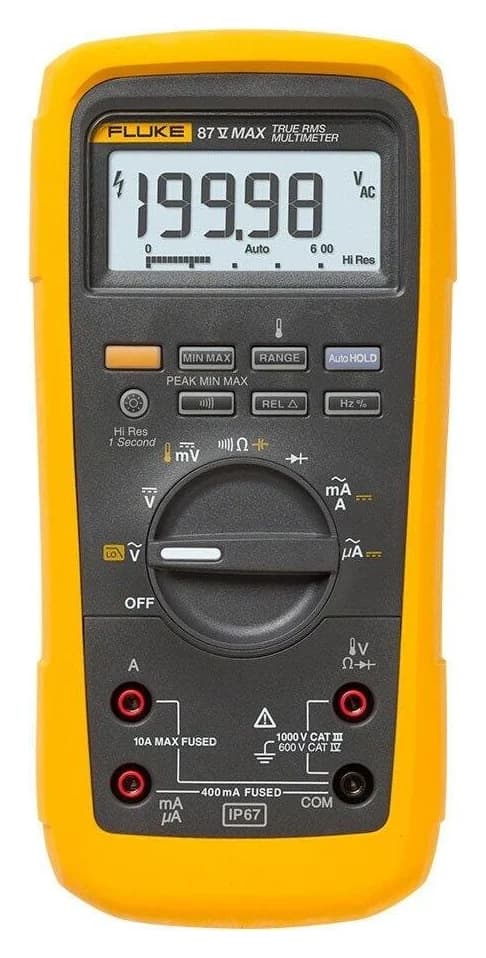
A rugged industrial True RMS multimeter rated CAT IV 600V and CAT III 1000V, with an IP67 case, a 4 m drop rating, a low-pass filter for motor-drive readings and temperature measurement.
Check package and model options
- 1,000 V max
- 10 A max
- 6,000 counts
- CAT IV 600V, CAT III 1000V
If you already own an 87V MAX, use it until you can name the missing capability. Fluke specifies 6,000 counts, a 19,999-count HiRes mode and ±(0.05% + 1) DC voltage accuracy on its 6 V through 1000 V ranges in normal mode. Its manual specifies accuracy for two years after calibration at 18–28 °C; HiRes changes how the counts term is expressed.
That is enough reason not to assume the Siglent's ±(0.06% + 8 counts) specification improves DC accuracy simply because it comes in a bench case. Evaluate the complete range-specific error. Buy a bench instrument when you need its documented remote interface or four-wire function.
Fluke lists Min/Max/Avg and Hold, but the cited manual does not document a PC logging interface or four-wire resistance. Those are reasons to add a bench meter. This is a recommendation to keep an existing meter, not buy another handheld to obtain bench functions.
How we choose
This shortlist is based on manufacturer documents, without physical testing. We compared the exact models' accuracy conditions, resolution, storage, interfaces, input limits and supplied accessories. Conflicts remain visible rather than being silently reconciled. These are our picks for the jobs described, not a claim that every bench instrument has been evaluated.
The research method and measurement policy explain our approach. For basic low-voltage work, start with how to use a multimeter.
Buying guide: the details to settle before ordering
Reading speed and integration time
B&K defines NPLC as integration over power-line cycles: longer integration improves resolution and slows measurement. Its 1,000 readings/s family headline should not be read as the 5492C's full-accuracy logging speed. The manual's detailed speed table is explicitly labelled 5493C / 5493CGPIB; we do not transfer it to the 5492C.
For repeatable captures, specify function, range, integration or speed, auto zero and settling time. Require a demonstration of your intended recording cadence and duration instead of treating a maximum reading rate as a complete logging specification.
Four-wire resistance and the leads it needs
B&K recommends four-wire Kelvin measurements to remove lead-resistance effects. Plan separate input and sense connections following the instrument's wiring diagram. A supplied red/black probe pair alone does not constitute a complete four-wire setup. NULL/REF compensation also matters: both makers attach it to their two-wire resistance accuracy specifications.
Choose fixtures suited to the component and keep leads short, following B&K's application note. If your requirement is inductance or ESR, make that a separate instrument requirement; a capacitance entry does not establish either capability.
Logging and computer requirements
Both bench picks support SCPI control. B&K provides operating software and a LabVIEW driver; its USB instructions require a USBTMC driver, supplied through VISA. Siglent's download hub lists EasyDMMX and EasyDMM, plus instrument drivers; its programming guide describes NI-VISA setup and LAN control.
Before buying for macOS, Windows or Linux, confirm the chosen application's supported OS and runtime. A remote interface is not proof of a native app for every platform. For unattended work, ask for a sample export showing the timestamps and units you need, and confirm what happens if the connection fails.
Calibration, power and input limits
An included certificate is not an automatic promise of accredited calibration with measurement data. Siglent's calibration policy describes SI-traceable factory certificates and separate services with data or ISO17025 accreditation. B&K's standard kit lists a report and certificate; confirm their scope against your quality requirements.
Both manuals require checking the line-voltage configuration before applying power. The Siglent uses a 110/220 selector; its manual calls for the destination-country power cord. Check that configuration, the fuse and the actual supplied accessories before ordering.
Define the measurement
Specify range, acceptable error and recording cadence.
Confirm the computer path
Check the application, OS, driver and example export.
Complete the kit
Confirm sense leads, regional cord, fuse configuration and calibration documents.
Verdict
Choose the 5492C for its precision-oriented specifications and documented kit; choose the SDM3045X for a first remote-logging setup after checking the relevant mode and documentation conflicts. Keep your 87V MAX when spot checks suffice. The best bench meter adds a capability your current setup actually needs.
Frequently asked questions
Is a bench multimeter more accurate than a handheld?
Compare the exact range and error formula. The SDM3045X specifies ±(0.06% of reading + 8 counts) for DC voltage, while the 87V MAX specifies ±(0.05% + 1 count) on its 6 V through 1000 V ranges in normal display mode. Bench format alone therefore does not establish an accuracy upgrade. The 5492C uses a different formula containing a percentage of range, so compare the complete expressions and their operating conditions.
Does the SDM3045X provide its full resolution at 150 readings per second?
No. Siglent's user manual specifies 4.5-digit resolution at 5 or 50 readings per second and 3.5 digits at 150 readings per second for the adjustable-speed functions. Its datasheet accuracy conditions require Slow mode and a 30-minute warm-up. Choose the capture speed for the change you need to observe, then check the resolution and accuracy available in that mode.
Do these bench multimeters include Kelvin leads and calibration paperwork?
The 5492C manual lists TL37 test leads, a test report and a calibration certificate; it does not list a Kelvin lead set in the standard package. Siglent's manual lists red and black test leads, while its datasheet lists a calibration certificate. Plan the four-wire connections separately. Siglent distinguishes its standard factory certificate from additional calibration services with data or ISO17025 accreditation; specify the paperwork your workplace actually requires.
Related guides
Best picks · Multimeters
Best Multimeters for Beginners: Choose a First Meter You Can Learn On
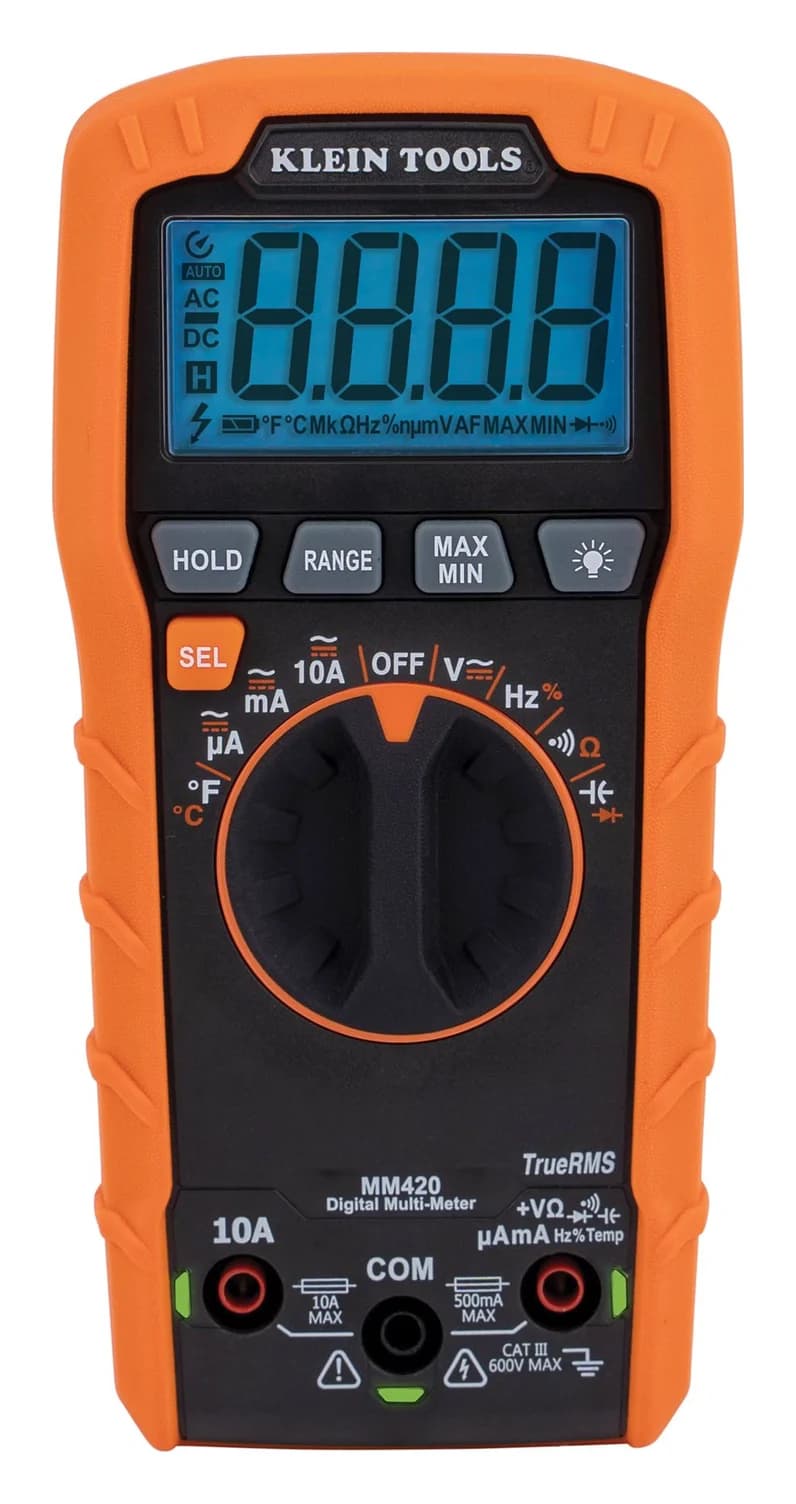
Choose a first multimeter by its controls, current ranges, jack reminders and included leads. Compare Klein MM420, MM325 and Fluke 107 for learning and gifts.
Best picks · Multimeters
Best Multimeters for HVAC: Microamps, Temperature and Complete Kits
Choose an HVAC multimeter by job: compare Fluke 116, Fieldpiece SC260 and Klein alternatives for flame sensors, clamp current, probe limits and kit contents.
Comparison · Multimeters
Fluke 101 vs 107: Current Ranges, Backlight and Regional Support
Compare the Fluke 101 and 107 by current inputs, backlight, accuracy and kit contents, with manual references and regional warranty checks before you buy.