

Best picks
Best LCR Meters: Which Component Tester Should You Buy?
Choose an LCR meter by test frequency, ESR, Kelvin fixtures and kit contents. Compare B&K handhelds, DE-5000 packages and when to keep your multimeter instead.
By thisMETER EditorialUpdated November 3, 20268 min read
On this page · Quick picks: choose the missing measurement
Our best LCR meter for a US electronics bench is the B&K Precision 880: its standard kit combines Kelvin clips and an SMD test lead with selectable test levels and a 100 kHz setting. Choose the 879B for leaded components when its 10 kHz ceiling and approximately 0.6 Vrms test signal meet the component’s specification. Keep a multimeter for voltage, current and continuity; add an LCR meter for inductance, ESR or component measurements at a chosen frequency.
Quick picks: choose the missing measurement
Compare specifications and all conditions
SMD parts and component characterization
- Our choice
- B&K Precision 880
- Why
- Kelvin clips, an SMD test lead and selectable signal levels
Through-hole parts and occasional ESR checks
- Our choice
- B&K Precision 879B
- Why
- Leaded sockets and alligator leads; test frequencies through 10 kHz
Occasional resistance, continuity or basic capacitance checks
- Our choice
- Keep your DMM
- Why
- Add an LCR meter when frequency-dependent values or losses are the missing information
Full comparison table
Swipe to compare. Row labels stay visible.
| Your work | Our choice | Why |
|---|---|---|
| SMD parts and component characterization | B&K Precision 880 | Kelvin clips, an SMD test lead and selectable signal levels |
| Through-hole parts and occasional ESR checks | B&K Precision 879B | Leaded sockets and alligator leads; test frequencies through 10 kHz |
| Occasional resistance, continuity or basic capacitance checks | Keep your DMM | Add an LCR meter when frequency-dependent values or losses are the missing information |
Scroll horizontally to see every column
| Your work | Our choice | Why |
|---|---|---|
| SMD parts and component characterization | B&K Precision 880 | Kelvin clips, an SMD test lead and selectable signal levels |
| Through-hole parts and occasional ESR checks | B&K Precision 879B | Leaded sockets and alligator leads; test frequencies through 10 kHz |
| Occasional resistance, continuity or basic capacitance checks | Keep your DMM | Add an LCR meter when frequency-dependent values or losses are the missing information |
For a general professional multimeter, start with our multimeter shortlist; choose an LCR instrument for the component measurements described here.
LCR meter vs multimeter: value, frequency and losses
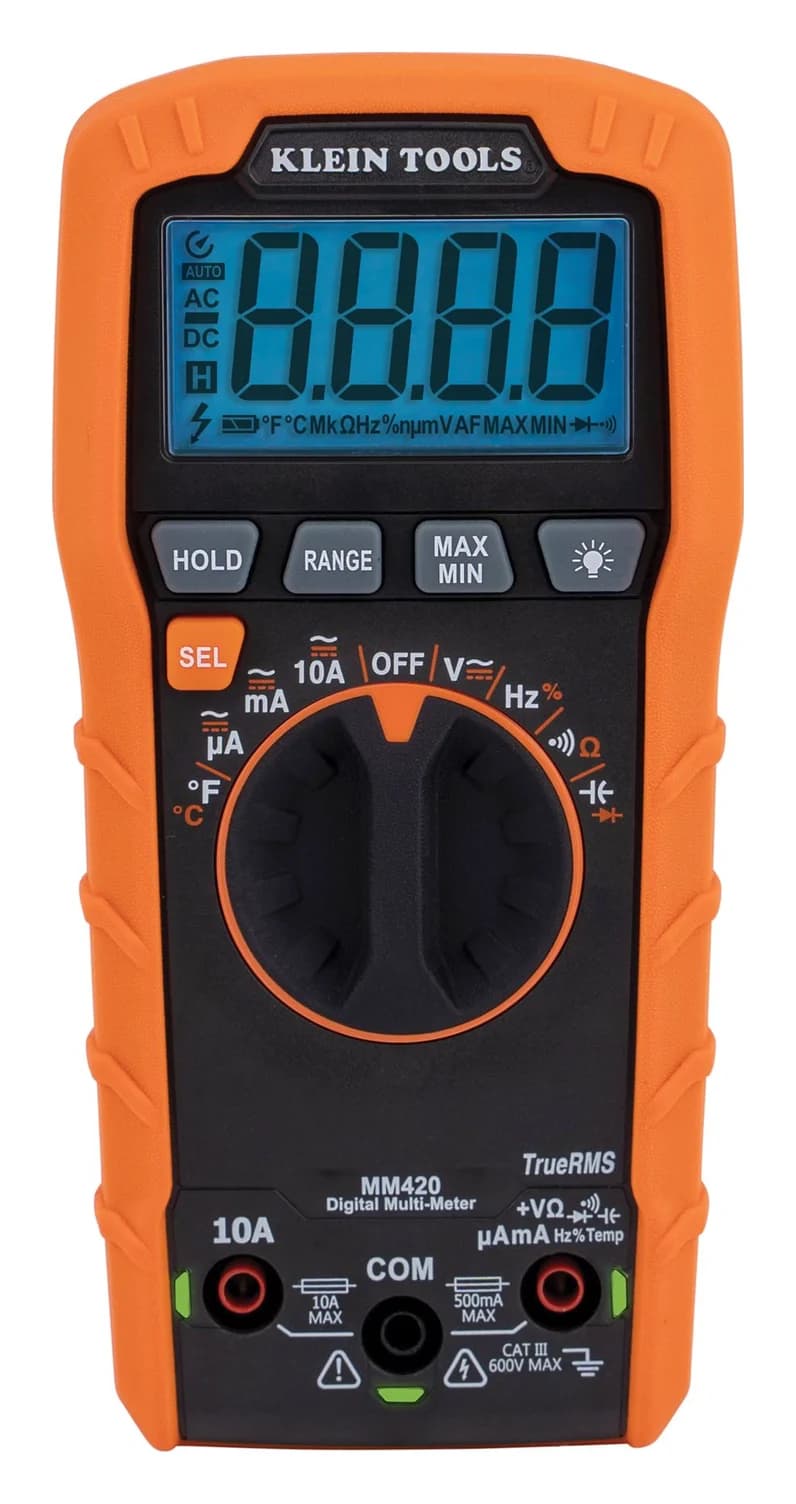
LCR means inductance (L), capacitance (C) and resistance (R). An LCR meter applies an AC test signal and calculates impedance from voltage, current and their phase relationship. For occasional capacitance checks, a DMM may already cover the need: Klein lists capacitance among the MM420’s functions. The reason to add LCR capability is to characterize a component at selected frequencies and inspect losses, rather than just obtain a capacitance value.
Compare the recommended handhelds
B&K 879B
- Selectable test frequencies
- 100 Hz, 120 Hz, 1 kHz, 10 kHz
- Typical AC test signal
- Approximately 0.6 Vrms
- Equivalent circuit
- Series or parallel
All specifications
- ESR / D / Q
- Yes
- DC resistance
- Manual says no; overview conflicts
- Maker’s basic accuracy
- 0.5%; consult range tables
- Component connection
- Two measurement terminals plus guard
B&K 880
- Selectable test frequencies
- 100 Hz, 120 Hz, 1 kHz, 10 kHz, 100 kHz
- Typical AC test signal
- 0.3 Vrms, 0.6 Vrms or 1 Vrms
- Equivalent circuit
- Series or parallel
All specifications
- ESR / D / Q
- Yes
- DC resistance
- Dedicated DCR mode
- Maker’s basic accuracy
- 0.1%; consult range tables
- Component connection
- Four-terminal Kelvin connection plus guard
Full comparison table
Swipe to compare. Row labels stay visible.
| Specification | B&K 879B | B&K 880 |
|---|---|---|
| Selectable test frequencies | 100 Hz, 120 Hz, 1 kHz, 10 kHz | 100 Hz, 120 Hz, 1 kHz, 10 kHz, 100 kHz |
| Typical AC test signal | Approximately 0.6 Vrms | 0.3 Vrms, 0.6 Vrms or 1 Vrms |
| Equivalent circuit | Series or parallel | Series or parallel |
| ESR / D / Q | Yes | Yes |
| DC resistance | Manual says no; overview conflicts | Dedicated DCR mode |
| Maker’s basic accuracy | 0.5%; consult range tables | 0.1%; consult range tables |
| Component connection | Two measurement terminals plus guard | Four-terminal Kelvin connection plus guard |
Scroll horizontally to see every column
| Specification | B&K 879B | B&K 880 |
|---|---|---|
| Selectable test frequencies | 100 Hz, 120 Hz, 1 kHz, 10 kHz | 100 Hz, 120 Hz, 1 kHz, 10 kHz, 100 kHz |
| Typical AC test signal | Approximately 0.6 Vrms | 0.3 Vrms, 0.6 Vrms or 1 Vrms |
| Equivalent circuit | Series or parallel | Series or parallel |
| ESR / D / Q | Yes | Yes |
| DC resistance | Manual says no; overview conflicts | Dedicated DCR mode |
| Maker’s basic accuracy | 0.5%; consult range tables | 0.1%; consult range tables |
| Component connection | Two measurement terminals plus guard | Four-terminal Kelvin connection plus guard |
Sources: B&K’s family datasheet, 879B manual and 880 manual. The accuracy figures are manufacturer specifications under stated conditions, not measured results or guarantees across every range.
Best complete handheld kit: B&K Precision 880
Choose the 880 when fixture quality and control of the measurement matter as much as the displayed value. Its separate current and sensing connections reduce the influence of lead impedance and contact resistance, especially for low-impedance parts. The extra 100 kHz setting and selectable AC level provide more ways to match a component’s specified conditions.
The documented kit includes alligator leads, a shorting plate, shielded Kelvin clips, an SMD test lead, a mini USB cable and a rechargeable Ni-MH battery. There is an accessory-name conflict: the datasheet calls the SMD tweezer TL8SM, while the manual calls the supplied SMD test lead TL LCR. Confirm that part with B&K when ordering replacements or an exact accessory-controlled kit.
The trade-off is that more settings require more care: the manual says to double its accuracy-table error allowances at the 0.3 V setting. It also explicitly prohibits external DC biasing, so selectable AC levels do not make it suitable for testing a coil under operating DC bias.
Check the US 880 kit with B&K Precision
Best for leaded components: B&K Precision 879B
The 879B is our simpler choice for through-hole components that fit its lead slots or supplied alligator leads. It measures L, C, R and impedance, with ESR, phase, D and Q available; it also provides series/parallel selection and tolerance sorting. Its fixed AC level and frequency ceiling are reasons to check the component datasheet before choosing it over the 880.
Do not transfer every feature from the shared family page to this model. B&K’s overview groups the 879B and 880 together as measuring DCR, but its feature list reserves DCR for the 880 and the 879B manual explicitly excludes DC resistance measurement. We therefore do not promise a DCR function on the 879B.
The 879B standard accessory list includes banana-to-alligator leads, a battery, a mini USB cable and a manual; it does not list the 880’s Kelvin clips or SMD accessory. Choose the 880 if those fixtures are central to your work.
Check the US 879B kit with B&K Precision
DER EE DE-5000: verify the US package before buying
The DE-5000 remains on DER EE’s product site, with four-wire Kelvin measurement, ESR, DCR, series/parallel modes and test frequencies from 100 Hz to 100 kHz. That makes it a capable alternative on paper, but the official accessory lists describe different packages.
DER EE lists TL-21 alligator test leads, TL-22 SMD tweezers, a TL-23 guard lead, an AC/DC adapter, battery, manual and case. IET’s 2011 branded DE-5000 manual instead puts the tweezers and adapter in its optional-accessory list. Its optical USB data-transfer kit is optional too; DER EE also lists the optical PC link separately.
IET now labels its separate DE-6000 handheld “Discontinued Replaced by 1920”; that does not establish global discontinuation of DER EE’s DE-5000. We have not established a current manufacturer-authorized US kit or current matching US manual, so the DE-5000 is outside our recommended US shortlist.
Sources: DER EE’s accessory list, IET’s older manual and IET’s current model status.
Ask DER EE about the exact kit and US supply. Require an itemized accessory list, adapter input rating, matching manual and warranty route before treating a package as equivalent.
How we choose
These recommendations compare official manufacturer pages, model-specific manuals, accuracy conditions and accessory lists. We favor a usable kit and reproducible measurement conditions over a longer feature list. This is document research, with no independent bench results. Conflicting descriptions and unconfirmed purchase configurations stay visible. See How we choose and our measurement policy.
Buying guide: match the component’s test conditions
Frequency and signal level come before the biggest number
Match the component maker’s specified frequency whenever possible. B&K’s measurement guidance identifies 100 Hz or 120 Hz as common choices for power-supply filter capacitors and chokes; smaller capacitors and inductors often need a higher frequency. Treat those as starting guidelines, not substitutes for the component datasheet.
Signal amplitude also affects some component readings. The 880’s selectable level helps match an AC test requirement; neither recommended handheld supports adding external DC bias. A capacitance or inductance measured without the specified bias can differ from the value expected in operation.
Series, parallel, ESR, D and Q: compare like with like
Series and parallel are equivalent circuit models of the measured impedance at the chosen frequency. B&K’s general guidance favors series mode for larger capacitors and smaller inductors, and parallel mode for smaller capacitors and larger inductors. Follow a required inspection method instead when one is specified.
ESR describes the resistive part of the series model; D is dissipation factor and Q is its reciprocal. A capacitor can show plausible capacitance yet excessive ESR, and ESR itself changes with frequency. Record frequency, AC level and circuit model alongside the value before comparing parts or instruments.
Do not read the shared 40,000-count display specification as an accuracy guarantee. Read the table for the particular range, frequency and loss conditions, including its percentage and least-significant-digit terms.
Fixtures and open/short compensation belong in the purchase
Leads and fixtures contribute their own impedance; Kelvin connections and open/short compensation address different parts of that problem. With the 880’s clip leads or SMD probe, the manual places the shorting plate at the probe ends so the compensation includes the probe. Both manuals call for compensation again after changing the test frequency for precision work.
Match the conditions
Select the required frequency, AC level and equivalent circuit.
Fit the actual fixture
Use the leads or tweezers that will make the measurement.
Compensate at the contacts
Follow the manual’s open and short procedure with that fixture.
Repeat after a frequency change
Recheck compensation before precision measurements.
Compare the exact US kits and paperwork
879B standard US
- Documented accessories
- Alligator leads, battery, mini USB cable, manual and AC adapter
- Variant check
- 120 V AC adapter; 879B-220V specifies 230 V
880 standard US
- Documented accessories
- Alligator leads, Kelvin clips, SMD lead, shorting plate, rechargeable battery, mini USB cable and quick-start insert
- Variant check
- 120 V AC adapter; 880-220V specifies 230 V
Full comparison table
Swipe to compare. Row labels stay visible.
| Package | Documented accessories | Variant check |
|---|---|---|
| 879B standard US | Alligator leads, battery, mini USB cable, manual and AC adapter | 120 V AC adapter; 879B-220V specifies 230 V |
| 880 standard US | Alligator leads, Kelvin clips, SMD lead, shorting plate, rechargeable battery, mini USB cable and quick-start insert | 120 V AC adapter; 880-220V specifies 230 V |
Scroll horizontally to see every column
| Package | Documented accessories | Variant check |
|---|---|---|
| 879B standard US | Alligator leads, battery, mini USB cable, manual and AC adapter | 120 V AC adapter; 879B-220V specifies 230 V |
| 880 standard US | Alligator leads, Kelvin clips, SMD lead, shorting plate, rechargeable battery, mini USB cable and quick-start insert | 120 V AC adapter; 880-220V specifies 230 V |
The adapter input is a regional power-supply specification, not a voltage-measurement rating for the LCR inputs. Both meters can transfer readings to a PC through mini USB using B&K software or SCPI commands. B&K lists Windows drivers and operating software separately, so check the application’s supported operating systems as well as the driver.
Open/short compensation does not supply a traceable calibration certificate. Check the standard accessory list and specify the paperwork separately: B&K offers a certificate without data, after data, or before and after data. Its service documentation says it is not ISO/IEC 17025 accredited, which matters if your quality system requires an accredited certificate.
When to keep the DMM or move to a bench LCR meter
Keep the DMM when ordinary electrical measurements and basic component checks cover the job. Consider a bench LCR instrument when you need frequency sweeps, more suitable accuracy ranges or explicitly supported DC-bias measurements. Select for those documented capabilities rather than assuming every bench model supplies them.
- Yes: Keep a DMM for voltage, current and continuity.
- Yes: Add an LCR meter for selectable-frequency component measurements and loss information.
- Partly: Match a bench instrument to a required sweep, accuracy range or permitted bias setup.
Our multimeter beginner guide covers the companion instrument; use each manufacturer’s manual for the actual measurement procedure.
Verdict
Choose the B&K Precision 880 for its complete fixture kit, Kelvin connection and selectable test levels. Choose the 879B when leaded-component work fits its signal and frequency limits. Treat the DE-5000 as a configuration to resolve with the manufacturer before a US purchase. Keep the DMM alongside either LCR meter, and buy the conditions and fixtures your components require.
Frequently asked questions
Is an LCR meter better than a professional multimeter?
It answers a different measurement question. A multimeter such as the Klein MM420 covers voltage, current, continuity and capacitance; an LCR meter adds impedance-based component measurements at a chosen AC frequency. Keep the multimeter for electrical troubleshooting and choose an LCR meter when inductance, ESR, dissipation or frequency-dependent component values are the reason for buying.
Can a capacitor have the right capacitance but still be faulty?
Yes: B&K explains that excessive equivalent series resistance can accompany an apparently correct capacitance value. ESR and dissipation provide additional information, but the test frequency and circuit model matter. Compare the result with the capacitor manufacturer’s limits under matching conditions, rather than applying an arbitrary ESR threshold to every capacitor.
Does every DE-5000 kit include SMD tweezers and an adapter?
Do not assume that. DER EE’s product page lists TL-22 tweezers and an AC/DC adapter among its accessories, while IET’s older branded manual lists them as optional. Confirm the exact package, supplied manual, adapter input and US support before ordering. Our verified configuration evidence supports discussing the DE-5000, but does not establish a current manufacturer-authorized US kit.
Is open/short compensation the same as a calibration certificate?
No: open/short compensation corrects for the measurement leads and fixture. B&K separately offers calibration with a certificate only, with after data, or with before and after data. Specify the paperwork your quality system needs when ordering; do not assume it accompanies the standard handheld package. B&K states that its service is not ISO/IEC 17025 accredited.
Related guides
Best picks · Multimeters
Best Multimeters for Beginners: Choose a First Meter You Can Learn On
Choose a first multimeter by its controls, current ranges, jack reminders and included leads. Compare Klein MM420, MM325 and Fluke 107 for learning and gifts.
Best picks · Multimeters
Best Multimeters for HVAC: Microamps, Temperature and Complete Kits
Choose an HVAC multimeter by job: compare Fluke 116, Fieldpiece SC260 and Klein alternatives for flame sensors, clamp current, probe limits and kit contents.
Comparison · Multimeters
Fluke 101 vs 107: Current Ranges, Backlight and Regional Support
Compare the Fluke 101 and 107 by current inputs, backlight, accuracy and kit contents, with manual references and regional warranty checks before you buy.