

Best picks
Best Oscilloscopes for Beginners
Bench Scopes and USB Alternatives
Choose a first oscilloscope with exact Rigol, Siglent and PicoScope picks, simultaneous-channel specs, probe kits, grounding advice and a first-project route.
By thisMETER EditorialUpdated November 3, 20268 min read
On this page · Quick picks by first project
For a first scope for low-voltage electronics, our pick is the Rigol DHO804: four analog channels, 70 MHz bandwidth and native 12-bit resolution in a standalone touchscreen instrument. Choose the DHO802 for a deliberate two-channel setup, the Siglent SDS804X HD for deeper simultaneous captures if delivery fits, or the PicoScope 2204A probe-inclusive kit if you prefer working through a laptop and can accept 10 MHz bandwidth.
Quick picks by first project
- Breadboard circuits and room to grow: Rigol DHO804. Our default standalone choice.
- Comparing circuit input and output: Rigol DHO802. Choose this when you can name the signals you need and two suffice.
- Longer records before zooming in: Siglent SDS804X HD. More acquisition memory than the Rigol picks in the matching channel modes; check availability.
- Laptop-based learning: PicoScope 2204A with two probes. A computer-connected alternative with a built-in signal generator.
Prefer knobs and a dedicated screen? Start with a bench model. Prefer a computer interface? Read our broader USB oscilloscope guide alongside the Pico pick.
Compare the exact models, with channels enabled
These are manufacturer maxima, not independent performance results. Rates are real-time, per enabled channel; bench memory figures are per channel in the stated mode. Pico's hardware memory is shared. Sources: Rigol datasheet, Siglent datasheet and Pico datasheet.
Rigol DHO802
- Analog channels / native bits
- 2 / 12-bit
- Bandwidth
- 70 MHz
- Maximum rate: one / two / all four channels
- 1.25 GSa/s / 625 MSa/s / —
All specifications
- Maximum memory: one / two / all four channels
- 25 Mpts / 10 Mpts / —
Rigol DHO804
- Analog channels / native bits
- 4 / 12-bit
- Bandwidth
- 70 MHz
- Maximum rate: one / two / all four channels
- 1.25 GSa/s / 625 MSa/s / 312.5 MSa/s
All specifications
- Maximum memory: one / two / all four channels
- 25 Mpts / 10 Mpts / 5 Mpts
Siglent SDS804X HD
- Analog channels / native bits
- 4 / 12-bit
- Bandwidth
- 70 MHz
- Maximum rate: one / two / all four channels
- 2 GSa/s / 1 GSa/s / 500 MSa/s
All specifications
- Maximum memory: one / two / all four channels
- 50 Mpts / 25 Mpts / 10 Mpts
PicoScope 2204A
- Analog channels / native bits
- 2 / 8-bit
- Bandwidth
- 10 MHz
- Maximum rate: one / two / all four channels
- 100 MS/s / 50 MS/s / —
All specifications
- Maximum memory: one / two / all four channels
- 8 kS total, shared with both channels enabled; no four-channel mode
Full comparison table
Swipe to compare. Row labels stay visible.
| Exact model | Analog channels / native bits | Bandwidth | Maximum rate: one / two / all four channels | Maximum memory: one / two / all four channels |
|---|---|---|---|---|
| Rigol DHO802 | 2 / 12-bit | 70 MHz | 1.25 GSa/s / 625 MSa/s / — | 25 Mpts / 10 Mpts / — |
| Rigol DHO804 | 4 / 12-bit | 70 MHz | 1.25 GSa/s / 625 MSa/s / 312.5 MSa/s | 25 Mpts / 10 Mpts / 5 Mpts |
| Siglent SDS804X HD | 4 / 12-bit | 70 MHz | 2 GSa/s / 1 GSa/s / 500 MSa/s | 50 Mpts / 25 Mpts / 10 Mpts |
| PicoScope 2204A | 2 / 8-bit | 10 MHz | 100 MS/s / 50 MS/s / — | 8 kS total, shared with both channels enabled; no four-channel mode |
Scroll horizontally to see every column
| Exact model | Analog channels / native bits | Bandwidth | Maximum rate: one / two / all four channels | Maximum memory: one / two / all four channels |
|---|---|---|---|---|
| Rigol DHO802 | 2 / 12-bit | 70 MHz | 1.25 GSa/s / 625 MSa/s / — | 25 Mpts / 10 Mpts / — |
| Rigol DHO804 | 4 / 12-bit | 70 MHz | 1.25 GSa/s / 625 MSa/s / 312.5 MSa/s | 25 Mpts / 10 Mpts / 5 Mpts |
| Siglent SDS804X HD | 4 / 12-bit | 70 MHz | 2 GSa/s / 1 GSa/s / 500 MSa/s | 50 Mpts / 25 Mpts / 10 Mpts |
| PicoScope 2204A | 2 / 8-bit | 10 MHz | 100 MS/s / 50 MS/s / — | 8 kS total, shared with both channels enabled; no four-channel mode |
Rigol also puts the DHO804 in its slowest channel mode when three channels are enabled. Its datasheet has an internal conflict: the overview assigns the DHO802's 25 Mpts to single-channel mode, but the acquisition table calls that condition dual-channel; both give 10 Mpts with both channels enabled. Plan around the latter for two-channel work.
Best first bench scope: Rigol DHO804
We prefer the DHO804 for a first bench because four channels leave more ways to investigate a fault without reconnecting probes. For example, our suggested microcontroller setup is clock, data, supply and reset; a two-channel scope cannot display all those signals together.
The DHO800 model table confirms 70 MHz for the DHO804; the family's 100 MHz headline belongs to other variants. The 7-inch touchscreen and USB, LAN and HDMI interfaces are standard. Rigol lists four PVP3150 passive probes in the DHO804 package, plus a destination-country power adaptor and a ground cable in its datasheet.
The compromise is sharing: four sockets do not mean four channels each running at 1.25 GSa/s. With all four enabled, the limits are 312.5 MSa/s and 5 Mpts per channel. Buy it for the extra observation points, with those limits understood.
See the DHO804 specification and included kit at Rigol
Best two-channel bench choice: Rigol DHO802
Choose the DHO802 for a planned two-signal workflow: comparing circuit input and output, or observing I2C clock and data. It retains the DHO804's 70 MHz, native 12-bit conversion and 7-inch touchscreen, but has two analog inputs and comes with two PVP3150 probes.
With both channels active, its maximum is 625 MSa/s and 10 Mpts per channel. That is the same two-channel ceiling as the DHO804; buying the DHO802 does not improve that mode. The DHO812 and DHO814 are the 100 MHz two- and four-channel alternatives. Choose those only if your bandwidth requirement justifies them; our recommendations use the stated, unmodified specifications.
See the DHO802 model row at Rigol
Best for deeper captures: Siglent SDS804X HD
The SDS804X HD is the stronger choice on paper when you need more samples around an event. Its exact column specifies 70 MHz, four analog channels and native 12-bit conversion. With all four active, it offers 500 MSa/s and 10 Mpts per channel, versus the DHO804's 312.5 MSa/s and 5 Mpts.
Do not assign it the family's 100 Mpts headline. The model-specific datasheet gives this model 50 Mpts with one channel, 25 Mpts with two and 10 Mpts with four. Siglent's standard probe list specifies four PB470 probes, rather than the PP510 probes bundled with its 100 MHz variants.
Expansion is useful but separate: the SLA1016 adds digital channels, the SAG1021I supplies an external waveform generator, and SDS800XHD-PA is optional power-analysis software. Common serial decoders are already standard; see the kit table below.
Delivery matters: the US product page currently estimates inventory for January 6, 2027. Confirm dispatch before choosing it for immediate learning.
Best laptop alternative: PicoScope 2204A with probes
Reuse a supported computer if that is how you want to work. Pico's 2204A specifications describe a USB-connected instrument; the datasheet confirms two channels, 10 MHz bandwidth, native 8-bit resolution and a built-in function/arbitrary waveform generator.
Its important limit is 8 kS of shared hardware capture memory, alongside 100 MS/s on one channel or 50 MS/s per channel with both enabled. Long software recordings are a different mode; they do not turn that hardware buffer into bench-scope memory. Likewise, equivalent-time sampling reconstructs repetitive signals and does not replace real-time capture of a one-off event.
Order the probe-inclusive 2204A. The datasheet lists two passive probes for this channel count unless the kit is specified without them; 2204A-D2 is explicitly probe-free. Pico's product page calls the probes optional, so confirm two probes on the selected order instead of relying on the family name.
PicoScope software supports Windows, macOS and Linux, but the product page and downloads page list different OS versions. Check the chosen release's requirements and try its demo before buying.
Buy a complete kit
The maker documents above and the linked manuals specify these contents and requirements. Select the correct regional power package.
DHO802
- Probes to verify
- 2 × PVP3150, rated 150 MHz in 10X mode
- Power and ground
- Supplied adaptor; 15 V, 3 A instrument supply; supplied ground cable required
- Decoders and additions
- Parallel, RS232/UART, I2C, SPI, CAN standard
DHO804
- Probes to verify
- 4 × PVP3150, rated 150 MHz in 10X mode
- Power and ground
- Same power and grounding requirements
- Decoders and additions
- Same standard decoders; plan any separate signal generator around your project
SDS804X HD
- Probes to verify
- 4 × PB470, 70 MHz
- Power and ground
- Supplied regional power cord; protective earth required
- Decoders and additions
- I2C, SPI, UART, CAN, LIN standard; SLA1016, SAG1021I and power-analysis software optional
2204A probe-inclusive
- Probes to verify
- 2 passive probes; exclude D2
- Power and ground
- USB-powered; USB ground is a measurement connection
- Decoders and additions
- PicoScope serial decoding included; built-in generator; supported computer required
Full comparison table
Swipe to compare. Row labels stay visible.
| Pick | Probes to verify | Power and ground | Decoders and additions |
|---|---|---|---|
| DHO802 | 2 × PVP3150, rated 150 MHz in 10X mode | Supplied adaptor; 15 V, 3 A instrument supply; supplied ground cable required | Parallel, RS232/UART, I2C, SPI, CAN standard |
| DHO804 | 4 × PVP3150, rated 150 MHz in 10X mode | Same power and grounding requirements | Same standard decoders; plan any separate signal generator around your project |
| SDS804X HD | 4 × PB470, 70 MHz | Supplied regional power cord; protective earth required | I2C, SPI, UART, CAN, LIN standard; SLA1016, SAG1021I and power-analysis software optional |
| 2204A probe-inclusive | 2 passive probes; exclude D2 | USB-powered; USB ground is a measurement connection | PicoScope serial decoding included; built-in generator; supported computer required |
Scroll horizontally to see every column
| Pick | Probes to verify | Power and ground | Decoders and additions |
|---|---|---|---|
| DHO802 | 2 × PVP3150, rated 150 MHz in 10X mode | Supplied adaptor; 15 V, 3 A instrument supply; supplied ground cable required | Parallel, RS232/UART, I2C, SPI, CAN standard |
| DHO804 | 4 × PVP3150, rated 150 MHz in 10X mode | Same power and grounding requirements | Same standard decoders; plan any separate signal generator around your project |
| SDS804X HD | 4 × PB470, 70 MHz | Supplied regional power cord; protective earth required | I2C, SPI, UART, CAN, LIN standard; SLA1016, SAG1021I and power-analysis software optional |
| 2204A probe-inclusive | 2 passive probes; exclude D2 | USB-powered; USB ground is a measurement connection | PicoScope serial decoding included; built-in generator; supported computer required |
Probe bandwidth does not upgrade the oscilloscope. Follow the probe manual and match the physical attenuation switch to the channel setting; compensate passive probes before use. For the Rigols, specify the US destination-country adaptor and cord when ordering for a US bench, plus the supplied grounding lead.
Buying advice: channels, bandwidth and memory
Count signals before choosing bandwidth. Siglent's manual shows I2C using clock and data, while SPI configuration can use clock, chip select and both data directions. Our recommendation: buy four channels if that is your likely next project.
- Yes: Two channels: circuit input/output or I2C clock/data
- Partly: Four channels: our recommendation for observing more signals together
- No: More enabled channels do not retain the single-channel sample-rate headline
Bandwidth is not a clock-speed guarantee. Pico's scope tutorial explains attenuation at the bandwidth limit and the higher harmonics in square waves; it suggests bandwidth around five times the signal frequency as a rule of thumb. Select for the edges you need to inspect. Native ADC bits describe resolution, not a guarantee of voltage accuracy.
Memory buys context. Capture duration equals stored samples divided by sample rate. A longer time window may force a lower sampling rate, so check the actual acquisition readout after enabling channels and changing timebase. The table compares hardware records; Pico streaming is a separate, slower acquisition path.
Grounding and input limits come first
The Rigol quick guide describes a non-isolated instrument whose port grounds share the chassis and requires its ground cable. The Siglent manual connects the input shells to chassis and protective earth. The Pico quick-start guide says USB ground provides measurement grounding, with no protective safety ground.
Input limits are also different: Rigol specifies CAT I 300 Vrms / 400 Vpk with no transient overvoltage; Siglent specifies 400 Vpk, DC to 10 kHz; Pico's full-scale input range reaches ±20 V. These are conditional maker limits, not permissions to probe household mains. Pico distinguishes its ±100 V input overvoltage protection from its measurement range; protection is not a usable range extension.
A first-project route
Start with the bench scope's own compensation output; Rigol and Siglent document this in their setup instructions. Our suggested next exercise is comparing signals in a battery-powered learning circuit. Use our multimeter basics guide for preliminary DC checks.
Prepare the bench
Read the grounding instructions and inspect the probe and cable.
Learn on the compensation output
Follow the maker's connection procedure, match attenuation settings and compensate the probe.
Stabilize and inspect
Adjust the edge trigger, timebase and vertical scale; check the displayed sample rate.
Move to your learning circuit
Compare signals, then save the capture and settings before changing the circuit.
For the Pico, its built-in generator offers a learning signal; follow its connection instructions. Add digital acquisition when your project needs more logic signals together: see our logic analyzer guide before buying an expansion accessory.
How we choose
This shortlist uses official model tables, datasheets, kit lists and setup manuals checked November 2, 2026. It is a manufacturer-specification comparison; thisMETER has no physical test results for these scopes. We favor a complete learning setup and disclose simultaneous-channel limits, document conflicts and optional hardware. See How we choose and How we measure.
Verdict
Choose the DHO804 for a first standalone bench with room to observe more signals. Choose the DHO802 when two channels cover your plan, the SDS804X HD for deeper records if availability suits, or the 2204A with two probes for laptop-based learning within its bandwidth and memory limits.
Frequently asked questions
What is the best oscilloscope for a beginner?
Our default choice is the Rigol DHO804 for its four analog channels, 70 MHz bandwidth and native 12-bit resolution. Choose the DHO802 if two channels cover your planned projects. The PicoScope 2204A probe-inclusive kit suits laptop-based learning, but its 10 MHz bandwidth and shared 8 kS hardware memory are substantial limits compared with these bench scopes.
Are two channels enough for a first oscilloscope?
Two channels let you compare signals and observe I2C clock and data together. Choose four if you want to keep those signals visible while watching a supply rail and reset, or observe SPI clock, chip select and both data directions together. These are project-based recommendations; enabling more channels also reduces the maximum sample rate on these picks.
Is 70 MHz enough for a beginner?
Choose bandwidth for the signal you need to see, including its edges and harmonics. Pico's buying tutorial suggests bandwidth around five times the signal frequency as a rule of thumb. A scope's bandwidth rating is its attenuation boundary, so a 70 MHz rating does not promise faithful reproduction of a 70 MHz square wave. Fast digital work may need a different instrument.
Is a USB-powered oscilloscope electrically isolated?
USB power alone does not establish isolation. Rigol describes the DHO800 as non-isolated and requires proper grounding with its supplied ground cable. Pico says the USB ground is a measurement connection, not a protective safety ground. Follow the exact instrument and probe manuals; begin with low-voltage learning circuits and never treat a laptop or power bank as an isolation accessory.
Related guides
Best picks · Multimeters
Best Multimeters for Beginners: Choose a First Meter You Can Learn On
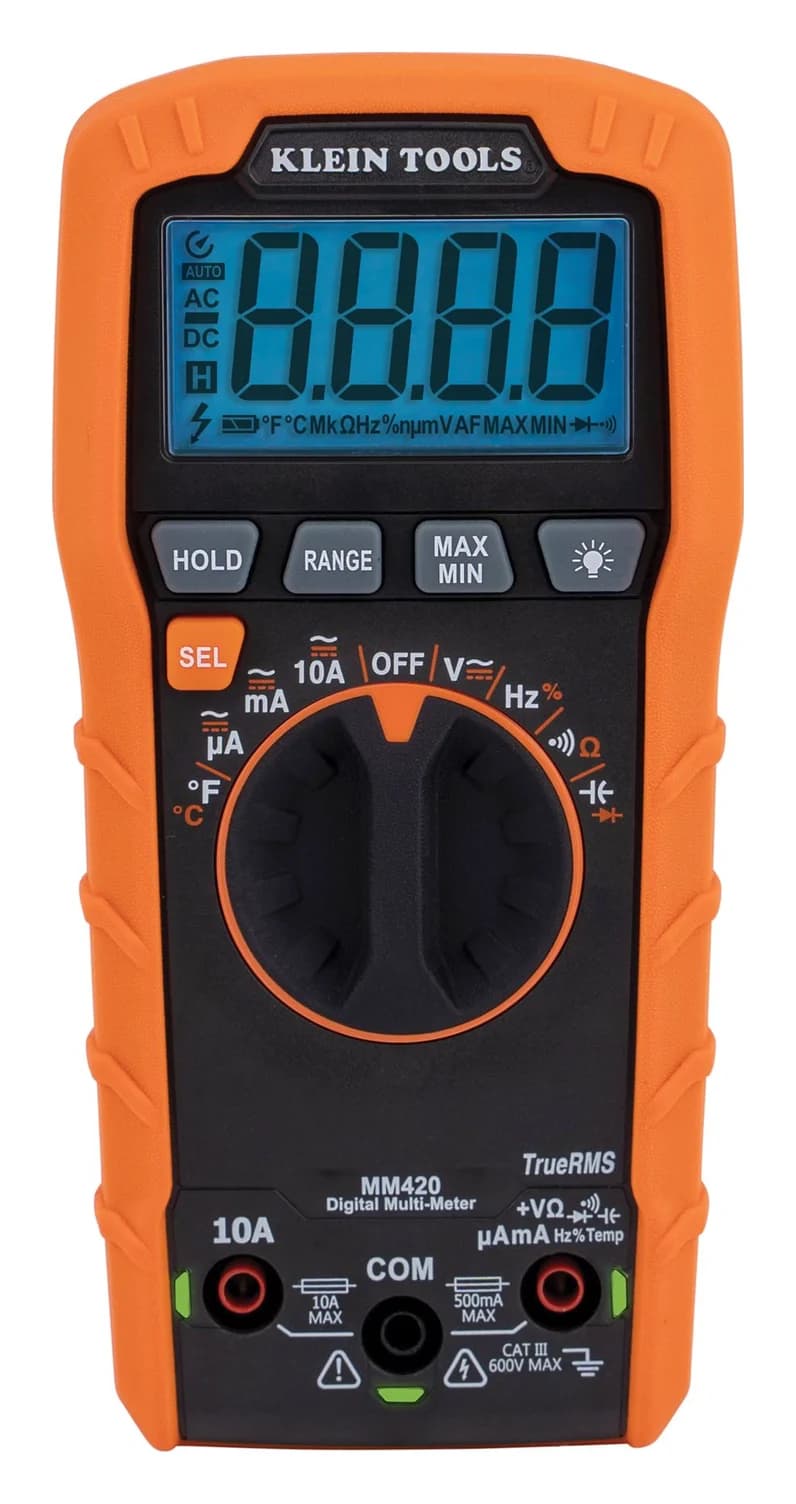
Choose a first multimeter by its controls, current ranges, jack reminders and included leads. Compare Klein MM420, MM325 and Fluke 107 for learning and gifts.
Best picks · Multimeters
Best Multimeters for HVAC: Microamps, Temperature and Complete Kits
Choose an HVAC multimeter by job: compare Fluke 116, Fieldpiece SC260 and Klein alternatives for flame sensors, clamp current, probe limits and kit contents.
Comparison · Multimeters
Fluke 101 vs 107: Current Ranges, Backlight and Regional Support
Compare the Fluke 101 and 107 by current inputs, backlight, accuracy and kit contents, with manual references and regional warranty checks before you buy.