

Buying guide
Digital Circuit Breaker Finder Buying Guide
What to Check Before You Buy
Buying a digital circuit breaker finder? Match the transmitter, receiver and sensitivity controls to your outlets, panel and dead-circuit jobs with these picks.
By thisMETER EditorialUpdated November 5, 202610 min read5 picks
On this page · Our picks at a glance
Our picks at a glance
- 1
Matching outlets and fixtures to breakers in a home
Choose for: Matching outlets and fixtures to breakers in a home
- 2
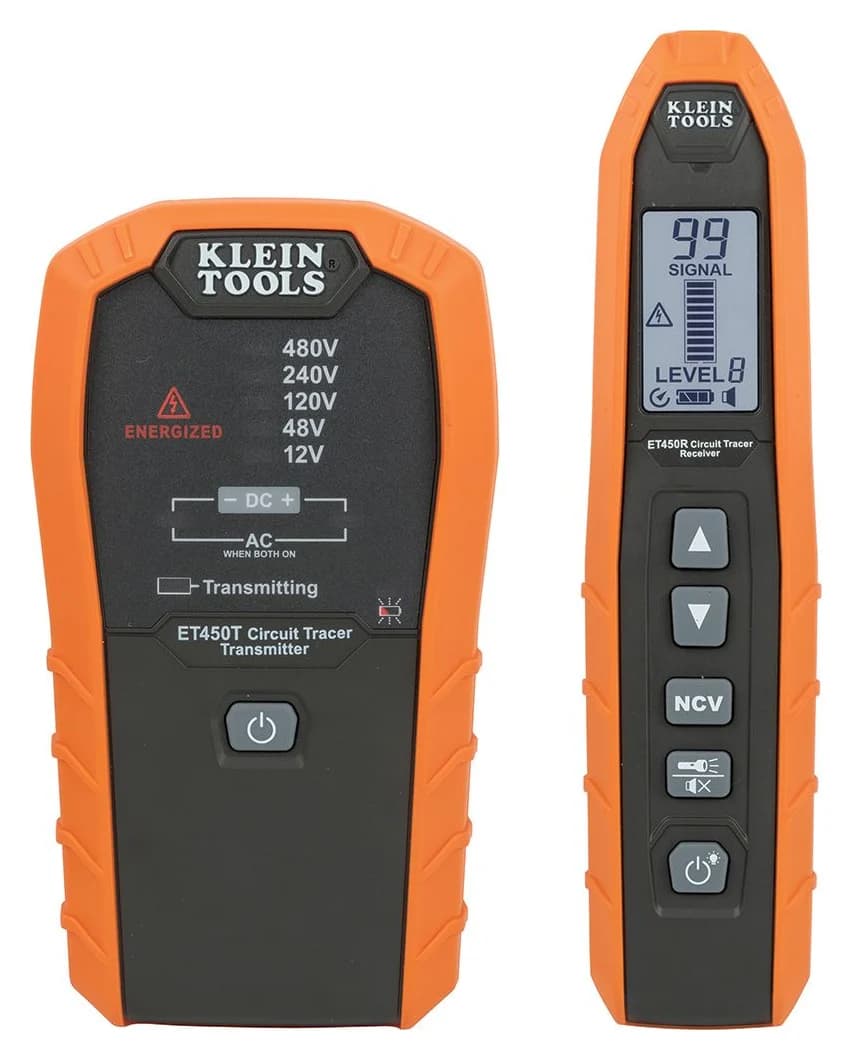
Breakers, fuses and wire routes, energized or not
480 V max · CAT III 600V
Choose for: Breakers, fuses and wire routes, energized or not
Limit: A large, 6-plus-pound kit; overkill for someone who only wants to identify outlet breakers
- 3
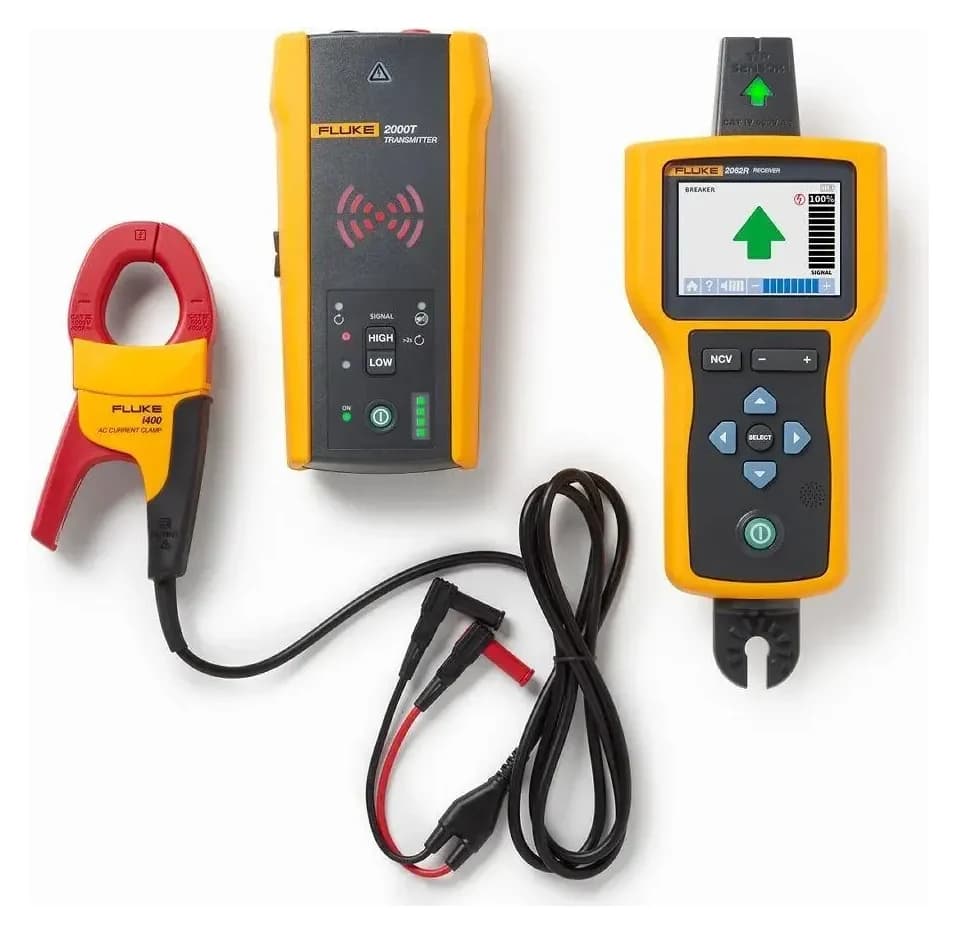
Professional tracing with a display and clamp
600 V max · CAT IV 600 V, CAT III 1000 V
Choose for: Professional tracing with a display and clamp
Limit: Confirm the complete kit: receiver, transmitter, i400, 2000ACC leads and case
Show all 5 picks
- 4
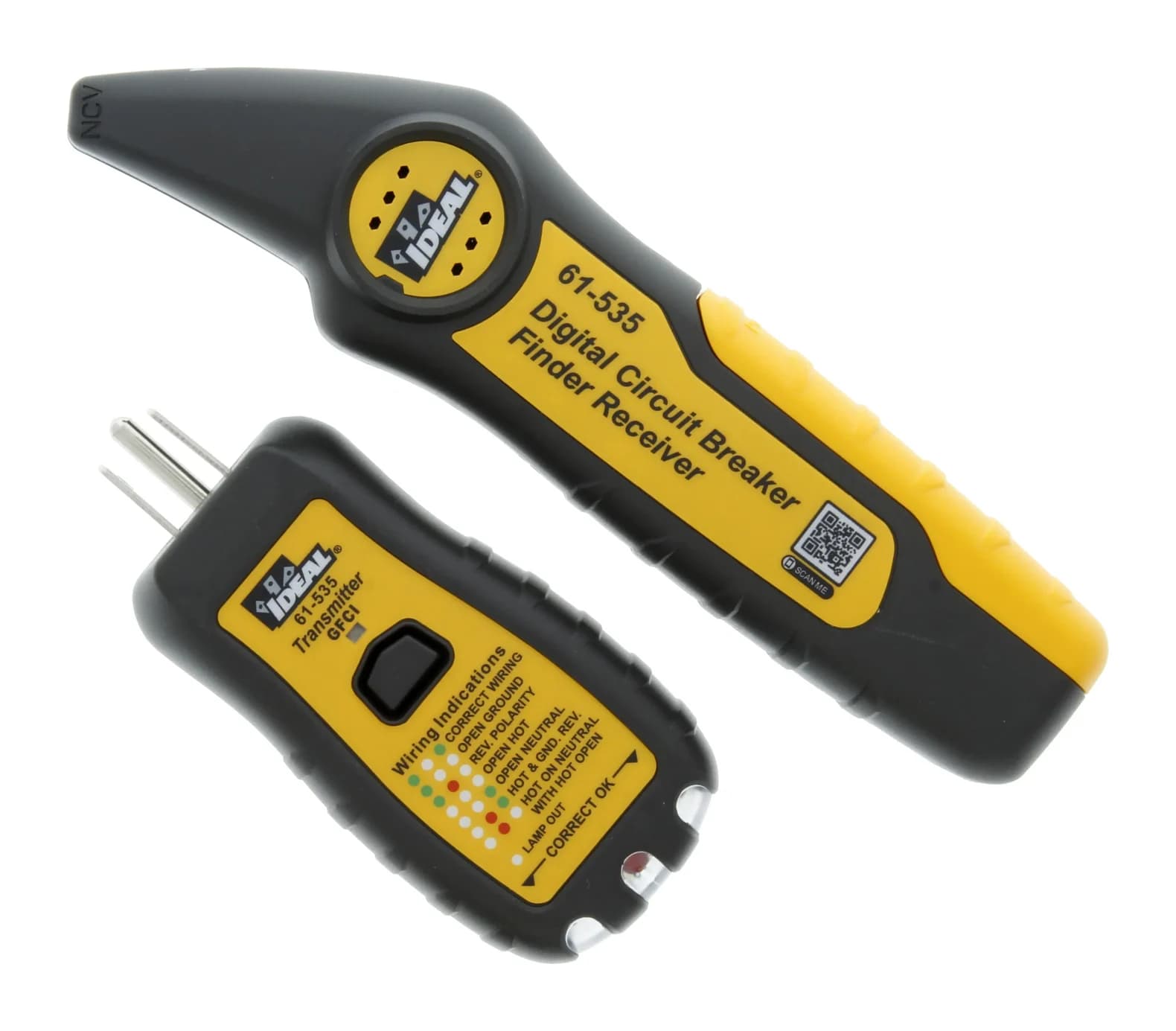
A compact live-circuit finder with NCV and work light
300 V max · CAT II 150 V
Choose for: A compact live-circuit finder with NCV and work light
Limit: TL-532A fixture adapters are sold separately
- 5
Tone tracing on non-energized wiring and active-network data cables
Choose for: Tone tracing on non-energized wiring and active-network data cables
Limit: Generator and probe are sold separately; each is useless alone
For outlet-and-fixture identification, the Klein Tools ET310KIT is our compact home recommendation: its plug-in transmitter pairs to the panel with a two-scan learning routine, and the kit includes the light-socket and alligator-clip adapters that turn an outlet tool into a whole-house one. Move up to the Klein Tools ET450 when the job includes de-energized circuits or following wire routes, and to the Fluke 2062 Advanced Pro when you want a color display with Smart Sensor wire visualization and a CAT IV 600 V rating. If your wiring is data or other low-voltage wiring rather than mains, a tone-and-probe pair such as the Klein Tools VDV500-163 with VDV500-223 is the right tool instead.
Everything below comes from manufacturer pages and instruction manuals, not from our own measurements. For a broader comparison including the Klein ET350, see our circuit breaker finder roundup.
Quick picks and comparison
Compare specifications and all conditions
Klein ET310KIT
- Choose it for
- Matching outlets and fixtures to breakers in a home
- Circuit must be live?
- Yes: transmitter is powered by the circuit
- Dead-circuit wire tracing
- No
All specifications
- Kit trap to check
- Standalone ET310 omits the adapters; the KIT includes them
Klein ET450
- Choose it for
- Breakers, fuses and wire routes, energized or not
- Circuit must be live?
- No
- Dead-circuit wire tracing
- Yes
All specifications
- Kit trap to check
- Watch the 480V AC/DC disconnect limit and GFCI-tripping connection methods
Fluke 2062
- Choose it for
- Professional tracing with a display and clamp
- Circuit must be live?
- No
- Dead-circuit wire tracing
- Yes
All specifications
- Kit trap to check
- Confirm the complete kit: receiver, transmitter, i400, 2000ACC leads and case
IDEAL 61-535
- Choose it for
- A compact live-circuit finder with NCV and work light
- Circuit must be live?
- Yes: transmitter is line powered
- Dead-circuit wire tracing
- No
All specifications
- Kit trap to check
- TL-532A fixture adapters are sold separately
Klein VDV500-163 + VDV500-223
- Choose it for
- Tone tracing on non-energized wiring and active-network data cables
- Circuit must be live?
- No (low-voltage wiring)
- Dead-circuit wire tracing
- Yes, on de-energized wiring
All specifications
- Kit trap to check
- Generator and probe are sold separately; each is useless alone
Full comparison table
Swipe to compare. Row labels stay visible.
| Pick | Choose it for | Circuit must be live? | Dead-circuit wire tracing | Kit trap to check |
|---|---|---|---|---|
| Klein ET310KIT | Matching outlets and fixtures to breakers in a home | Yes: transmitter is powered by the circuit | No | Standalone ET310 omits the adapters; the KIT includes them |
| Klein ET450 | Breakers, fuses and wire routes, energized or not | No | Yes | Watch the 480V AC/DC disconnect limit and GFCI-tripping connection methods |
| Fluke 2062 | Professional tracing with a display and clamp | No | Yes | Confirm the complete kit: receiver, transmitter, i400, 2000ACC leads and case |
| IDEAL 61-535 | A compact live-circuit finder with NCV and work light | Yes: transmitter is line powered | No | TL-532A fixture adapters are sold separately |
| Klein VDV500-163 + VDV500-223 | Tone tracing on non-energized wiring and active-network data cables | No (low-voltage wiring) | Yes, on de-energized wiring | Generator and probe are sold separately; each is useless alone |
Scroll horizontally to see every column
| Pick | Choose it for | Circuit must be live? | Dead-circuit wire tracing | Kit trap to check |
|---|---|---|---|---|
| Klein ET310KIT | Matching outlets and fixtures to breakers in a home | Yes: transmitter is powered by the circuit | No | Standalone ET310 omits the adapters; the KIT includes them |
| Klein ET450 | Breakers, fuses and wire routes, energized or not | No | Yes | Watch the 480V AC/DC disconnect limit and GFCI-tripping connection methods |
| Fluke 2062 | Professional tracing with a display and clamp | No | Yes | Confirm the complete kit: receiver, transmitter, i400, 2000ACC leads and case |
| IDEAL 61-535 | A compact live-circuit finder with NCV and work light | Yes: transmitter is line powered | No | TL-532A fixture adapters are sold separately |
| Klein VDV500-163 + VDV500-223 | Tone tracing on non-energized wiring and active-network data cables | No (low-voltage wiring) | Yes, on de-energized wiring | Generator and probe are sold separately; each is useless alone |
- 8Receiver sensitivity levels on the ET450 and Fluke 2062
- 0–99ET450 numerical signal-strength range; 99 means saturated
- 480VET450 manual's immediate-disconnect ceiling
- 6.25 / 32.768 kHzFluke transmitter output frequencies it selects automatically
How digital breaker identification works
Every finder here is a two-piece system: a transmitter attaches to the circuit — usually by plugging into an outlet — and sends a signal along the wiring, while a battery-powered receiver is scanned past the breakers to find where that signal appears. Klein describes exactly this arrangement for the ET310: the transmitter connects to the outlet or fixture and the receiver scans the panel, with clear visual and audible indications when the correct breaker is located.
The digital part is the pairing and display logic, and it is what separates these tools from the analog finders of earlier generations:
- Learning scan. On the ET310 and the sibling ET350, you scan every breaker once while the receiver learns the panel, then scan again; only on the second pass does the tool commit to an answer. The instructions also require resetting the receiver away from the panel, because a reset done next to live breakers corrupts the learned data.
- Numerical signal strength. The ET450 receiver shows signal strength as a number from 0 to 99 with a bar display. The number lets you compare adjacent breakers instead of guessing which beep was louder — but the manual is explicit that a continuous beep or solid LED, the reading of 99, means the receiver is saturated, so back the sensitivity down rather than trusting it more.
- Adjustable sensitivity. Eight levels, on both the ET450 and the Fluke 2062, are the difference between a tool that works at a residential panel and one that flails. Klein says energized circuits typically use sensitivity levels 1-3, and de-energized circuits may need higher levels 4-8.
Plug the transmitter into the outlet, directly
Klein warns that on the ET350 an indirect connection through an extension cord or surge protector may interfere with operation.
Reset the receiver away from the panel
A reset next to live breakers can corrupt the learned panel data on both ET310 and ET350.
Scan every breaker once (learning pass)
Ignore the beeps on this pass.
Scan again (identification pass)
The strongest response identifies the breaker.
Best for most homes: Klein Tools ET310KIT
The ET310 is the current digital circuit breaker finder we recommend for outlet-and-fixture identification. Per Klein's product page, it operates on 90–120V AC circuits, carries a CAT II 120V safety rating, and its transmitter is powered by the circuit itself — only the receiver needs its one 9V battery. The transmitter docks in the receiver for storage, and the housing is built to withstand a 6.6-foot (2 m) drop.
Buy the KIT, not the standalone package. The standalone ET310 includes transmitter, receiver, manual and 9V battery; ET310KIT adds a light-socket adapter, a three-prong to two-prong adapter, an alligator-clip adapter for bare-wire connections, and a premium hard case with foam insert. Without those adapters, a lighting circuit or an ungrounded older outlet can leave the tool with nowhere to plug in.
Two limits to respect: the three-pin transmitter wants North-American grounded outlets, and the GFCI test button checks ground-fault tripping and outlet wiring condition — it is not an AFCI test and does not prove ground quality. For a deeper comparison with the step-up ET450, see Klein ET310 vs ET450.
Best for dead circuits and wire routes: Klein Tools ET450
The ET450 is where a breaker finder becomes a circuit tracer. Klein's kit page specifies reliable tracing of energized or non-energized breakers, fuses and wires. The receiver has eight sensitivity levels, while Klein markets detection through drywall, cement block and underground and the manual gives only conditional tracing-depth figures. Its transmitter carries external AC/DC voltage indicators for 12V, 48V, 120V, 240V and 480V, and the kit includes transmitter, receiver, blade and ground prongs, alligator clips, 3-foot and 20-foot lead adapters, AC plug leads, batteries and a hard case.
Read its two voltage statements together. The transmitter is marked CAT III 600V, but the operating instructions say that if voltage greater than 480V AC/DC is detected you must disconnect the transmitter from the circuit immediately. The category marking is not an operating license.
The connection method matters as much as the tool: the manual warns that the remote-ground connection method — preferred for signal strength — will trip GFCI receptacles, and lists workarounds including the direct-ground method, alligator clips, or de-energizing the circuit at the panel. Tracing depth is specified as 0 to 0.5 m, depending on medium and application, so treat it as conditional. See also Klein ET450 vs Fluke 2062.
Best professional kit: Fluke 2062 Advanced Pro
The Fluke 2062 is the pick when the display and the ratings both matter. Per Fluke's kit page, it locates energized and de-energized wires in walls, ceilings and floors; the patented Smart Sensor (2062-only) locates and displays energized wires on a 3.5-inch TFT LCD color display, while the tip sensor provides an audible tone and Breaker mode identifies breakers and fuses based on the highest recorded signal from the transmitter. The 2000-T transmitter works on energized and de-energized circuits up to CAT IV 600 V with high, low and loop modes, and automatically selects a 6.25 kHz or 32.768 kHz output frequency. The receiver offers eight sensitivity levels.
The complete kit includes the 2062R receiver, 2000-T transmitter, i400 AC Current Clamp, 2000ACC test lead accessories, batteries and a hard case. The i400 is the standout: Fluke includes it for inducing a tracing signal on a cable when there is no access to bare conductors. The kit is a professional investment — but the predecessor Fluke 2052 covers most of the same tracing without the Smart Sensor display, which Fluke reserves for the 2062, so choose the upgrade for the visualization rather than the tracing capability.
Best compact alternative: IDEAL 61-535
The IDEAL 61-535 is a current US-market finder that takes the same job as the ET310 with a different feature mix. IDEAL describes it as automatically identifying the breakers or fuses protecting live branch circuits using its transmitter and receiver; because its line-powered transmitter requires an energized circuit, it does not automatically identify de-energized circuits. The transmitter indicates outlet wiring condition with green and red LEDs and tests GFCIs, and the receiver adds a non-contact voltage sensor in the tip that detects AC voltage from 80 to 300 V, a mute button, a work light and a five-minute auto power-off. It is cULus certified (UL 1436, CSA C22.2 No. 160) and marked CAT II 150V.
Like the standalone ET310, the transmitter is line powered, so it needs a live circuit, and its fixture adapters (the TL-532A kit) are sold separately. We cover the model family in IDEAL circuit breaker finder models and compare it directly with the ET350 in Klein ET350 vs IDEAL 61-535.
Best for network and low-voltage wiring: Klein VDV500-163 with VDV500-223
None of the mains finders above belong on low-voltage cabling. For that wiring, the two-piece tone-and-probe method is the standard: the VDV500-163 Digital Tone Generator attaches to cable pairs or its RJ45 port, and the VDV500-223 Digital Tracing Probe follows the tone along the run. Klein says the probe traces cables and wires on active and non-active networks when used with the separately sold generator, with a 60Hz filter for accurate tracing near power wiring, a work light and a 3.5 mm headphone jack for noisy environments. The generator tests continuity and polarity, offers three tone cadences, and its RJ45 port tests RJ45, RJ11 and RJ12 data cables; with the separately required probe it supports wire mapping to check pin-to-pin connections with shield detection.
Both pieces are sold separately and each is useless without the other — a genuine buying trap. If you also maintain Ethernet runs, Klein's Scout Pro Max tester offers digital and analog tone generation with the separately required VDV500-223, measures cable length and distance to fault, and can trace up to 20 locations with its included ID remotes; see our Ethernet cable tester guide.
How we choose
These recommendations come from manufacturer product pages and instruction manuals — we have no physical test results for these tools. We compared pairing method, circuit-power requirements, safety category markings versus documented operating limits, included accessories and documented failure modes such as GFCI tripping and signal saturation. Our How we choose page describes the approach, and How we measure explains why we publish no readings of our own.
Buying guide: what separates a good digital finder
The transmitter decides the jobs you can do
A plug-in transmitter limits you to live, grounded outlets unless you add adapters; alligator clips and prongs extend you to fixtures and terminals; a self-powered transmitter with its own output, like the ET450's or Fluke's, extends you to de-energized circuits. Buy for the connections you actually have.
Digital display is not accuracy
A number on an LCD is a confidence aid, not a specification of correctness. The documented pairing procedure — learning scan, second scan, reset away from the panel — does the real work. Sensitivity controls then keep the number meaningful: an ET450 reading of 99 is defined as saturation, and Klein says de-energized circuits may need higher sensitivity levels.
Outlet, panel and dead-circuit boundaries
- Yes: ET310KIT finds breakers for live 90–120V AC outlets, sockets and bare-wire fixtures via adapters.
- Yes: ET450 and Fluke 2062 also trace de-energized breakers, fuses and wires.
- Yes: Klein's page says the ET450 transmitter has external voltage indicators for 12V, 48V, 120V, 240V and 480V; the manual says to disconnect immediately above 480V AC/DC.
- No: ET310 and IDEAL 61-535 transmitters need an energized circuit.
- No: None of these is a voltage-proving instrument; verify de-energization separately.
GFCI, AFCI and higher-voltage limits
GFCI features trip the device deliberately — the ET350 creates a 6mA to 9mA ground fault to test it, within a 102V to 135V AC GFCI operating range — and none of them tests arc-fault protection. Tracing can also interact with protection: ET450's remote-ground method will trip GFCI receptacles. On voltage, keep the numbers straight: ET310 CAT II 120V, IDEAL 61-535 CAT II 150V, ET450 CAT III 600V with a 480V disconnect instruction, Fluke 2062 CAT IV 600 V. A CAT rating describes transient-overvoltage protection, not permission to connect to any supply.
Verdict
Buy the ET310KIT for home outlet and fixture identification — the included adapters are what make it complete. Buy the ET450 when dead circuits, fuses or wire routes are in scope, and the Fluke 2062 when a professional budget wants the Smart Sensor display, CAT IV 600 V rating and signal clamp. The IDEAL 61-535 is a solid compact live-circuit alternative, and the VDV500-163 with VDV500-223 is the correct pair for network and low-voltage wiring rather than a mains finder. For the full field including the ET350, start from our best circuit breaker finders roundup.
Frequently asked questions
What makes a circuit breaker finder digital?
On the simplest finders, digital means the pairing method: the receiver learns the panel on a first scan and identifies the breaker on a second. Step-up models add a numerical signal-strength readout, adjustable sensitivity levels and a mode display. Digital indication improves confidence, but a correct transmitter-to-receiver pairing and a reset away from the panel still decide whether the identification is right.
Can a digital breaker finder work on a dead circuit?
Only models specified for it. Klein's ET310 transmitter is powered by the outlet it plugs into, so the circuit must be live. The ET450 and Fluke 2062 are documented for tracing energized and de-energized breakers, fuses and wires. Check the maker's operating instructions before assuming battery power in the tool means dead-circuit capability.
Will a breaker finder work on 240V or higher-voltage circuits?
Do not assume it will. The ET310 is built for 90–120V AC outlets with a CAT II 120V rating, and IDEAL marks the 61-535 CAT II 150V. The ET450 transmitter is marked CAT III 600V, but its instructions say to disconnect it immediately if voltage greater than 480V AC/DC is detected. Buy for the highest voltage you will actually touch, and treat the safety category and the operating limit as two separate numbers.
Why does my breaker finder point at two breakers?
Reset and rescan first. Both the ET310 and ET350 instructions require an initial learning scan of the whole panel, a second identification scan, and a reset away from the panel so stored data is not corrupted by nearby signals. On the ET450, a continuous beep or a solid LED means the reading of 99 is saturated, not extra certainty; drop the sensitivity. If the result is still ambiguous, stop and have an electrician investigate.
Is a GFCI test button the same as an AFCI test?
No. A finder's GFCI function creates a ground fault and checks that the outlet or breaker trips; it says nothing about arc-fault protection. Use the protective device manufacturer's own test procedure for AFCI. Also expect tracing itself to interact with protection: the ET450 manual warns its remote-ground connection method will trip GFCI receptacles.
Matching outlets and fixtures to breakers in a home
Klein ET310KIT
Related guides
Buying guide · Voltage & Outlet Testers
Circuit Tracer Tools: How to Choose a Kit That Finds the Right Wire
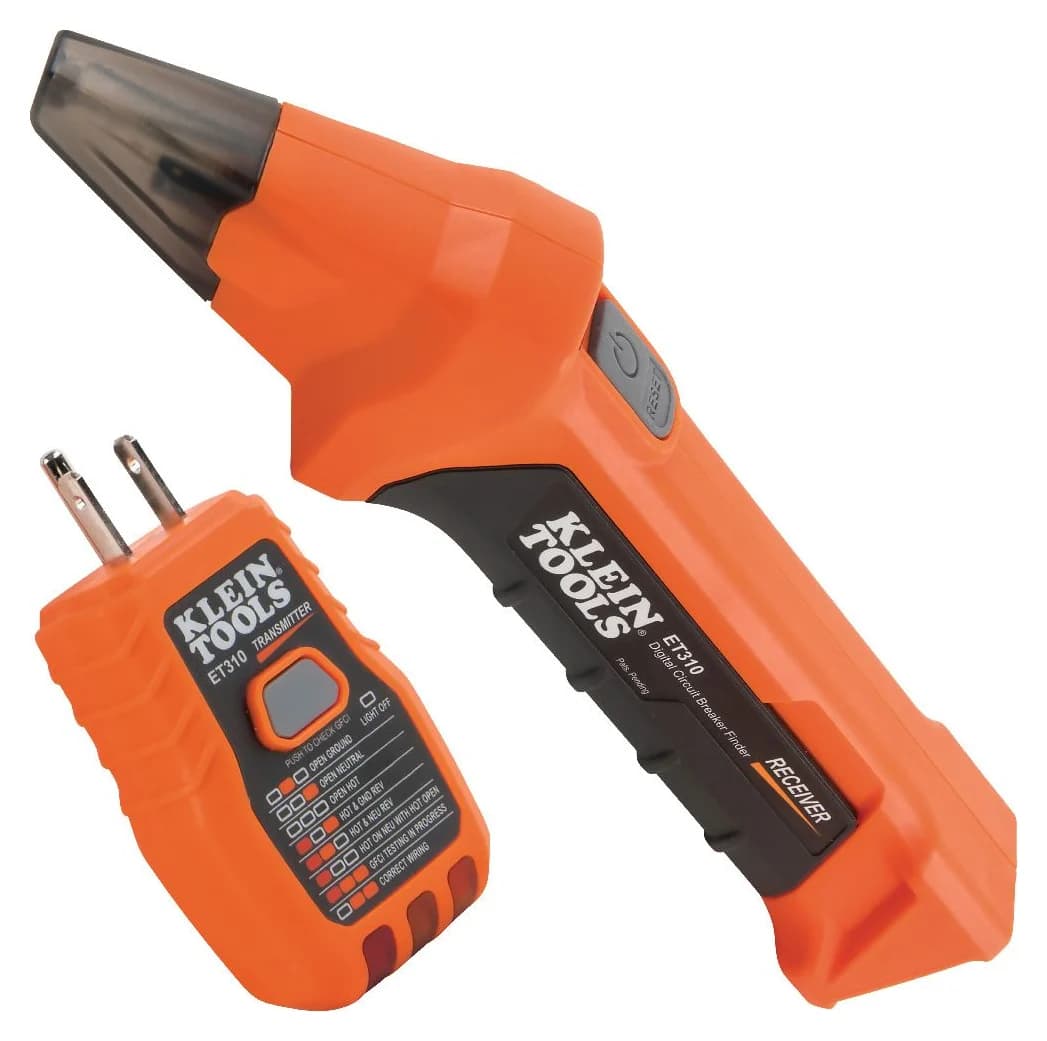
Choose a circuit tracer kit for breaker ID, dead-wire tracing, live circuits or buried cable. Compare the Klein ET310, ET450, Fluke 2062 and NOYAFA NF-820 kits.
Buying guide · Voltage & Outlet Testers
Circuit Breaker Finders for Tool Selection: Which Family Should You Buy?
Decide between a breaker finder, a wire tracer, an outlet tester and a tone-and-probe kit. Compare Klein ET310, ET350, ET450, Fluke 2052 and kit contents.
Buying guide · Voltage & Outlet Testers
Circuit Breaker Locator Buying Guide: Find the Right Breaker Safely
Choose a circuit breaker locator for outlet, lighting and panel jobs. Compare the Klein ET310, ET450, Fluke 2062 and IDEAL 61-535 kits before you buy.