

Comparison
FLIR DM285 vs DM286: Buy New, Upgrade, or Choose Separate Tools?
Choose FLIR DM286 or separate meter and camera tools. Compare the discontinued DM285, real thermal detail, electrical ranges, exports, batteries and US kits.
By thisMETER EditorialUpdated November 3, 20268 min read
On this page · Quick picks: choose the working setup
Choose FLIR DM286 for a new thermal multimeter when you want electrical troubleshooting and thermal documentation in one instrument. FLIR marks DM285 discontinued and recommends DM286 as its replacement. Choose a separate meter and camera when thermal detail matters more than carrying one instrument, provided the meter covers your electrical work.
Quick picks: choose the working setup
Compare specifications and all conditions
Buying a thermal multimeter now
- Our pick
- DM286
- Why
- Current US package, MSX imaging and METERLiNK recording workflow
Already own a working DM285
- Our pick
- Keep it if its ranges and records suffice
- Why
- DM286 has the same native thermal resolution; upgrade for the features below
Want a separate electrical meter and more thermal detail
- Our pick
- Fluke 117 + FLIR C8
- Why
- LoZ electrical troubleshooting plus a higher-resolution thermal detector; check the 117's limits
Need fine microamp measurements
- Our pick
- Compare the actual current ranges first
- Why
- DM285's documented finest µA step is smaller than DM286's
Full comparison table
Swipe to compare. Row labels stay visible.
| Your situation | Our pick | Why |
|---|---|---|
| Buying a thermal multimeter now | DM286 | Current US package, MSX imaging and METERLiNK recording workflow |
| Already own a working DM285 | Keep it if its ranges and records suffice | DM286 has the same native thermal resolution; upgrade for the features below |
| Want a separate electrical meter and more thermal detail | Fluke 117 + FLIR C8 | LoZ electrical troubleshooting plus a higher-resolution thermal detector; check the 117's limits |
| Need fine microamp measurements | Compare the actual current ranges first | DM285's documented finest µA step is smaller than DM286's |
Scroll horizontally to see every column
| Your situation | Our pick | Why |
|---|---|---|
| Buying a thermal multimeter now | DM286 | Current US package, MSX imaging and METERLiNK recording workflow |
| Already own a working DM285 | Keep it if its ranges and records suffice | DM286 has the same native thermal resolution; upgrade for the features below |
| Want a separate electrical meter and more thermal detail | Fluke 117 + FLIR C8 | LoZ electrical troubleshooting plus a higher-resolution thermal detector; check the 117's limits |
| Need fine microamp measurements | Compare the actual current ranges first | DM285's documented finest µA step is smaller than DM286's |
For broader professional multimeter choices, use our multimeter shortlist. Camera alternatives belong in our thermal-camera guide.
DM285 vs DM286: the changes that affect the purchase
Manufacturer status
- DM285: existing-owner reference
- Discontinued; FLIR points to DM286
- DM286: current purchase
- Listed with a US purchase option
Native thermal detector
- DM285: existing-owner reference
- 160 × 120; 19,200 pixels
- DM286: current purchase
- 160 × 120; 19,200 pixels
Infrared temperature range
- DM285: existing-owner reference
- −10 to 150°C
- DM286: current purchase
- −5 to 300°C
Image modes
- DM285: existing-owner reference
- Thermal image, with or without DMM overlay
- DM286: current purchase
- MSX, thermal-only and visible-only
Electrical ceiling / display
- DM285: existing-owner reference
- 1000 V AC/DC; 10 A AC/DC; 6,000 counts
- DM286: current purchase
- 1000 V AC/DC; 10 A AC/DC; 6,000 counts
Category rating
- DM285: existing-owner reference
- CAT IV 600V / CAT III 1000V
- DM286: current purchase
- CAT IV 600V / CAT III 1000V
Finest documented DC µA range
- DM285: existing-owner reference
- 400 µA range; 0.1 µA resolution
- DM286: current purchase
- 4000 µA range; 1 µA resolution
Stored thermal images
- DM285: existing-owner reference
- Up to 100; radiometric
- DM286: current purchase
- Up to 30,000; radiometric; video recording too
Power
- DM285: existing-owner reference
- Three AA cells; optional TA04 system
- DM286: current purchase
- TA04 packs only; two supplied
Published drop / enclosure rating
- DM285: existing-owner reference
- 3 m / IP40
- DM286: current purchase
- 2 m / IP40
Full comparison table
Swipe to compare. Row labels stay visible.
| Decision point | DM285: existing-owner reference | DM286: current purchase |
|---|---|---|
| Manufacturer status | Discontinued; FLIR points to DM286 | Listed with a US purchase option |
| Native thermal detector | 160 × 120; 19,200 pixels | 160 × 120; 19,200 pixels |
| Infrared temperature range | −10 to 150°C | −5 to 300°C |
| Image modes | Thermal image, with or without DMM overlay | MSX, thermal-only and visible-only |
| Electrical ceiling / display | 1000 V AC/DC; 10 A AC/DC; 6,000 counts | 1000 V AC/DC; 10 A AC/DC; 6,000 counts |
| Category rating | CAT IV 600V / CAT III 1000V | CAT IV 600V / CAT III 1000V |
| Finest documented DC µA range | 400 µA range; 0.1 µA resolution | 4000 µA range; 1 µA resolution |
| Stored thermal images | Up to 100; radiometric | Up to 30,000; radiometric; video recording too |
| Power | Three AA cells; optional TA04 system | TA04 packs only; two supplied |
| Published drop / enclosure rating | 3 m / IP40 | 2 m / IP40 |
Scroll horizontally to see every column
| Decision point | DM285: existing-owner reference | DM286: current purchase |
|---|---|---|
| Manufacturer status | Discontinued; FLIR points to DM286 | Listed with a US purchase option |
| Native thermal detector | 160 × 120; 19,200 pixels | 160 × 120; 19,200 pixels |
| Infrared temperature range | −10 to 150°C | −5 to 300°C |
| Image modes | Thermal image, with or without DMM overlay | MSX, thermal-only and visible-only |
| Electrical ceiling / display | 1000 V AC/DC; 10 A AC/DC; 6,000 counts | 1000 V AC/DC; 10 A AC/DC; 6,000 counts |
| Category rating | CAT IV 600V / CAT III 1000V | CAT IV 600V / CAT III 1000V |
| Finest documented DC µA range | 400 µA range; 0.1 µA resolution | 4000 µA range; 1 µA resolution |
| Stored thermal images | Up to 100; radiometric | Up to 30,000; radiometric; video recording too |
| Power | Three AA cells; optional TA04 system | TA04 packs only; two supplied |
| Published drop / enclosure rating | 3 m / IP40 | 2 m / IP40 |
Sources: FLIR's DM285 manual, DM285/284 datasheet, DM286 US page and DM286 manual. Range and resolution describe display capability, not guaranteed accuracy at every reading.
Existing owners should upgrade for MSX, the higher infrared temperature ceiling, storage or video—not for more thermal pixels. Both manuals already describe radiometric stills, meaning saved pixels carry temperature data. Before buying leftover DM285 stock, establish the exact package, warranty eligibility and service route; a remaining listing does not establish current manufacturer supply.
Current thermal-multimeter pick: FLIR DM286
The DM286 makes sense when the same technician needs thermal context and electrical readings during a service visit. FLIR documents True RMS, LoZ, a VFD low-pass-filter mode, non-contact voltage detection, capacitance, thermocouple temperature and dedicated A/mA/µA inputs. MSX adds visible-light outlines to the thermal image; the visible camera is 2 MP, distinct from the thermal detector. The product page specifies fixed focus, so do not assume a selectable close-focus or macro mode.
Check small-current detail before replacing DM285. The legacy manual lists a 400 µA DC range resolving 0.1 µA; DM286's manual lists 4000 µA resolving 1 µA. Our recommendation is to keep the finer-range instrument, or choose another suitable meter, when that detail is essential. A higher maximum-current specification does not answer this question.
Those conflicting figures appear in the datasheet and manual's DC-voltage table. This is a material limit on recommending DM286 as an electrical-accuracy upgrade.
See the current DM286 package at FLIR.
Separate electrical-meter pick: Fluke 117
Choose the Fluke 117 with a separate camera when AutoVolt, VoltAlert and LoZ cover the electrical job. Fluke specifies True RMS, 600 V, 10 A and CAT III 600V. This route lets you choose the camera independently.
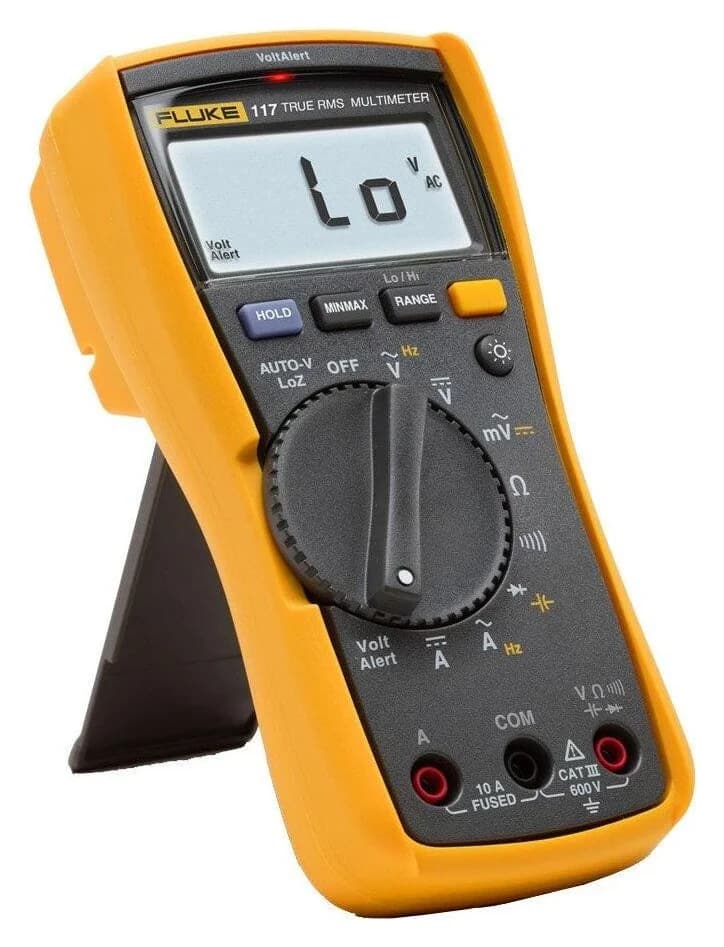
Fluke
A compact 6,000-count True RMS multimeter for electricians, rated CAT III 600V, with built-in VoltAlert non-contact voltage detection, automatic AC/DC selection and a low-impedance mode.
Check package and model options
- 600 V max
- 10 A max
- 6,000 counts
- CAT III 600V
The important limits are no dedicated µA range and no contact-temperature function. Its manual specifies a 6 A current range with 1 mA resolution; a camera does not add the missing electrical functions. If you need finer current detail, VFD filtering or a different category rating, choose the meter from our main guide before choosing its camera partner.
Fluke's page also carries shared temperature footnotes; its 117 function and range tables list no contact-temperature function. Do not interpret those footnotes as an extra 117 capability.
The standard US package lists silicone leads, holster and quick-reference guide. A 117/323 kit is a separate meter-and-clamp package, not this proposed meter-and-camera pairing; our Fluke vs Klein guide explains package checks.
Separate thermal-camera pick: FLIR C8
The C8 supplies 320 × 240 native thermal pixels, or 76,800, and a 3.5-inch touchscreen. That is the route here for more native thermal detail. Its published 0.4 m minimum focus distance still needs matching to target size; do not choose a small-component inspection setup on pixel count alone.
Source: FLIR DM285/284 datasheet, DM286 datasheet and C8 datasheet
FLIR's C8 datasheet specifies JPEG stills with 14-bit measurement data, Wi-Fi connectivity to Ignite, and non-radiometric USB video streaming. Buy it for the documented still-image workflow; do not assume its USB video contains per-pixel temperature records. Its battery is built in, with 3 hours specified operating time and USB-C charging.
The C8 package lists the camera, documentation, wrist strap, USB cable and pouch. This proposed pairing is two separately selected products. Compare complete current quotes, including any required reporting plan, charger and calibration paperwork; we make no unsupported claim that separate tools cost less.
Buying guide: prove the export workflow before ordering
Stills and reports: DM286's manual directs users to METERLiNK for iOS or Android to inspect saved radiometric image data. The current app manual describes reports combining images, log graphs and notes, plus CSV exports. DM285's older manual instead describes FLIR Tools. Do not assume the shared METERLiNK name proves identical app support; confirm the existing meter and phone combination with FLIR.
PC exports: DM286 exposes storage over USB so you can copy images, videos and CSV logs. The supplied USB-A to Micro-USB data cable connects behind the battery; USB powers the meter during transfer. Keep the supplied cable: the manual warns that oversized replacement connector housings may not fit.
Video limits conflict: FLIR documents 50-minute local recordings, but the US page and datasheet limit transmitted clips to 20 seconds; the meter manual says 30 seconds. Plan on USB for long clips. Confirm the actual firmware/app behavior if wireless clip delivery is essential, and do not treat the still-image radiometry claim as proof of radiometric video.
Logging rate also needs care: the datasheet specifies 1–99-second storage intervals; the manual describes 1–100 seconds. Both differ from the meter's three readings per second measuring rate. For an unattended trend, confirm the selected storage interval and exported timestamps rather than assuming every displayed update is logged.
Capacity wording also differs: the US page and datasheet specify 40,000 readings per memory set, while the manual says up to 40,000 readings without that qualification. Confirm total capacity for your recording plan rather than multiplying an assumed file count.
Choose the required file
Decide whether the job needs radiometric stills, a spreadsheet log, or a viewable video.
Choose the transfer route
Use the documented app route for mobile reports; plan USB access for long video and PC file copies.
Check a representative file
Confirm that the intended phone, computer and reporting software preserve the information the customer needs.
US package, batteries and service
The DM286 US contents list two TA04 rechargeable packs, CAT IV 600V leads and alligator clips, a USB data cable, K-type probe rated −30 to 260°C, soft case, quick-start guide and warranty card. Its contact-temperature input covers −40 to 400°C; the supplied probe's narrower limit still governs that probe. The contents list does not name a wall charger: confirm charging accessories rather than importing a regional bundle description.
The separate TA04-KIT accessory includes a rechargeable battery and AC charging adapter with international inlet clips. The discontinued DM285-KIT paired that accessory with DM285; it is not a higher-resolution DM286 variant.
DM286 is specified for approximately 6.5 hours in IGM mode or 10 hours in multimeter mode, at medium brightness. Its replaceable packs suit carrying a charged spare, but it accepts TA04 only. DM285 documentation contains a battery conflict: its specifications and product page say three AA cells, while its manual's replacement paragraph says four AAA cells. Follow the actual compartment marking and obtain FLIR clarification before ordering replacements.
FLIR recommends annual calibration for DM286. Confirm service turnaround and any required calibration certificate with the supplier. A thermal image is also not proof that a circuit is de-energized.
How we choose
We compared official US product pages, linked manuals and datasheets, checked November 2, 2026. These are document-based recommendations, without physical testing. We keep manufacturer conflicts visible, distinguish detector pixels from image enhancement, and judge the complete electrical and reporting workflow. Read our selection method.
Verdict
Buy DM286 for an integrated thermal multimeter, once its electrical ranges and documented export routes fit the job. Keep a suitable existing DM285 when MSX, storage and video would not solve a real limitation. Choose Fluke 117 plus C8 when the 117 covers the electrical work and the C8's native thermal detail matters more than carrying one instrument.
Frequently asked questions
Is the FLIR DM285 discontinued, and what replaces it?
Yes. FLIR labels DM285 discontinued and recommends DM286 as its replacement. Its DM285-KIT page also marks that package discontinued; the kit paired DM285 with TA04-KIT rechargeable power. For a new purchase, choose the documented DM286 package if its functions fit. For an existing DM285, decide whether its electrical ranges and thermal records still meet your work, then confirm repair and calibration options with FLIR.
Does DM286 have better thermal resolution than DM285?
Both have a native 160 × 120 thermal detector, or 19,200 thermal pixels. DM286 adds MSX, which uses visible-camera detail to make the thermal scene easier to recognize; its 2 MP visible camera does not increase the native thermal pixel count. Choose a separate C8 if native 320 × 240 thermal detail is the priority, while checking its minimum focus distance against your target.
Can FLIR DM286 export logs without the phone app?
Yes. The DM286 manual documents USB transfer to a PC as an external storage drive, including CSV logs that a spreadsheet can open. The connector sits behind the battery in the battery compartment, and USB powers the meter during transfer. Images and videos can also be copied this way. METERLiNK provides a separate mobile route for viewing radiometric images, sharing records and assembling reports.
Can DM286 use AA batteries like DM285?
No. The DM286 manual specifies TA04 rechargeable battery packs only, and the US package lists two packs. FLIR specifies approximately 6.5 hours in IGM mode or 10 hours in multimeter mode at medium display brightness. DM285's product page instead lists three AA cells with optional TA04 rechargeable power. Check the exact charging accessories supplied with any proposed bundle before ordering.
Can a Fluke 117 and FLIR C8 replace every DM286 function?
That pair suits electrical troubleshooting when the 117's functions fit, but it is not functionally identical. The 117 is rated CAT III 600V and lacks dedicated microamp ranges and a contact-temperature function. DM286 supplies microamp measurement, thermocouple temperature and a CAT IV 600V / CAT III 1000V rating. Choose the meter for the electrical task first, then add the camera; thermal resolution cannot supply missing electrical functions.
Related guides
Best picks · Multimeters
Best Multimeters for Beginners: Choose a First Meter You Can Learn On
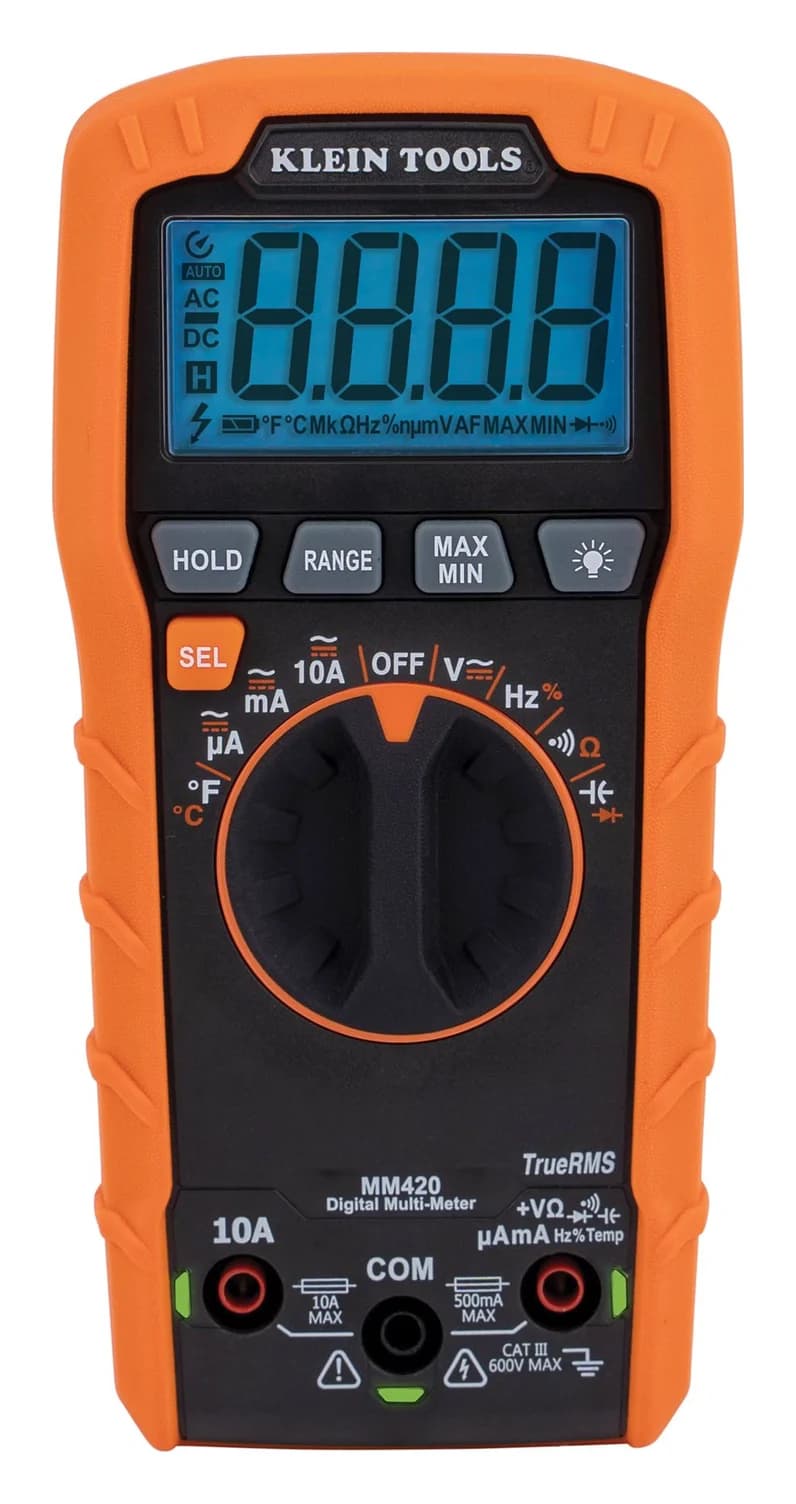
Choose a first multimeter by its controls, current ranges, jack reminders and included leads. Compare Klein MM420, MM325 and Fluke 107 for learning and gifts.
Best picks · Multimeters
Best Multimeters for HVAC: Microamps, Temperature and Complete Kits
Choose an HVAC multimeter by job: compare Fluke 116, Fieldpiece SC260 and Klein alternatives for flame sensors, clamp current, probe limits and kit contents.
Comparison · Multimeters
Fluke 101 vs 107: Current Ranges, Backlight and Regional Support
Compare the Fluke 101 and 107 by current inputs, backlight, accuracy and kit contents, with manual references and regional warranty checks before you buy.