

Comparison
Klein CL390 vs Fieldpiece SC440
Which HVAC Clamp Meter?
Compare Klein CL390 and Fieldpiece SC440 for heating service: inrush, DC clamp current, flame-sensor microamps, temperature probes and complete kit choices.
By thisMETER EditorialUpdated November 3, 20267 min read1 pick
On this page · Our picks at a glance
Our picks at a glance
- 1
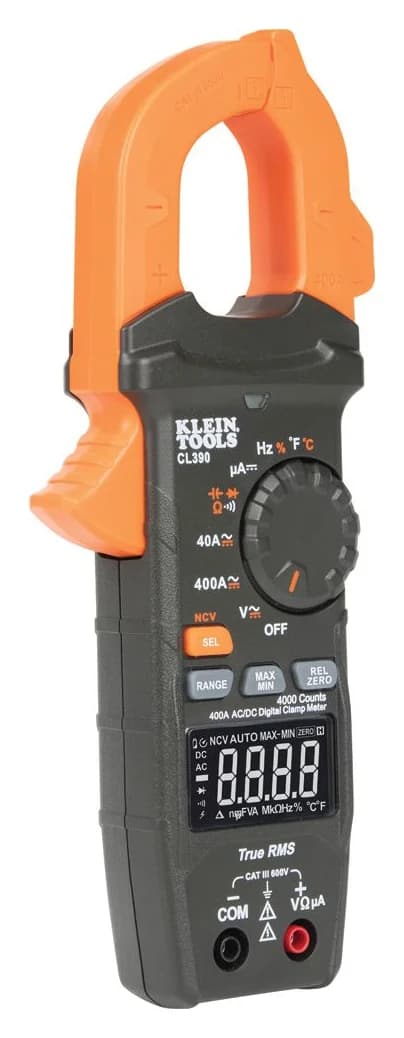
Choose for: Best for AC and DC clamp current
Check before buying: Rated CAT III 600V only: not for service-entrance (CAT IV) work
Choose the Fieldpiece SC440 for heating service when AC motor-start diagnosis matters: it has documented 100-millisecond inrush capture alongside DC microamps for flame-sensor work. Choose the Klein CL390 when you need DC current through the jaw as well as AC; Klein documents Max/Min, but no dedicated inrush capture mode. Both cover lead-based DC microamps, capacitance and temperature, so those feature names alone do not settle the purchase.
Quick picks: choose the missing function
- AC motor-start troubleshooting: SC440. Buy for its specified inrush function, rather than assuming ordinary peak retention will capture the same event.
- Mixed AC/DC current work: CL390. Its jaw handles both current types; the SC440 jaw is AC only.
- Flame-sensor checks without motor-start capture: either. Compare the microamp specification, probe arrangement and included accessories before choosing.
For a wider shortlist, see our HVAC multimeter guide. This comparison concerns these exact models and their documented standard packages.
CL390 vs SC440: the differences that change the purchase
All figures below are manufacturer specifications, not independent measurements. Sources: Klein's CL390 page, its linked instruction manual, and Fieldpiece's SC420/SC440 manual.
Current through jaw
- Klein CL390
- 400 A AC/DC; minimum measurable 0.3 A
- Fieldpiece SC440
- 400 A AC only
Motor-start capture
- Klein CL390
- Max/Min; no dedicated inrush mode documented
- Fieldpiece SC440
- 100-millisecond inrush; 50 A and 400 A ranges
DC current through leads
- Klein CL390
- 200 µA range; 0.1 µA resolution
- Fieldpiece SC440
- 500 µA range; 0.1 µA resolution
DC µA accuracy
- Klein CL390
- ±(1.0% + 5 digits)
- Fieldpiece SC440
- ±(1.0% + 2 counts); 1 V burden
Voltage ceiling
- Klein CL390
- 600 V AC/DC
- Fieldpiece SC440
- 600 V AC/DC
Capacitance ceiling
- Klein CL390
- 4,000 µF
- Fieldpiece SC440
- 5 mF
AC measurement
- Klein CL390
- True RMS
- Fieldpiece SC440
- True RMS
Display
- Klein CL390
- 4,000-count reverse-contrast LCD
- Fieldpiece SC440
- 5,000-count dual display with backlight
Marked safety rating
- Klein CL390
- CAT III 600V
- Fieldpiece SC440
- CAT III 600V
Full comparison table
Swipe to compare. Row labels stay visible.
| Decision point | Klein CL390 | Fieldpiece SC440 |
|---|---|---|
| Current through jaw | 400 A AC/DC; minimum measurable 0.3 A | 400 A AC only |
| Motor-start capture | Max/Min; no dedicated inrush mode documented | 100-millisecond inrush; 50 A and 400 A ranges |
| DC current through leads | 200 µA range; 0.1 µA resolution | 500 µA range; 0.1 µA resolution |
| DC µA accuracy | ±(1.0% + 5 digits) | ±(1.0% + 2 counts); 1 V burden |
| Voltage ceiling | 600 V AC/DC | 600 V AC/DC |
| Capacitance ceiling | 4,000 µF | 5 mF |
| AC measurement | True RMS | True RMS |
| Display | 4,000-count reverse-contrast LCD | 5,000-count dual display with backlight |
| Marked safety rating | CAT III 600V | CAT III 600V |
Scroll horizontally to see every column
| Decision point | Klein CL390 | Fieldpiece SC440 |
|---|---|---|
| Current through jaw | 400 A AC/DC; minimum measurable 0.3 A | 400 A AC only |
| Motor-start capture | Max/Min; no dedicated inrush mode documented | 100-millisecond inrush; 50 A and 400 A ranges |
| DC current through leads | 200 µA range; 0.1 µA resolution | 500 µA range; 0.1 µA resolution |
| DC µA accuracy | ±(1.0% + 5 digits) | ±(1.0% + 2 counts); 1 V burden |
| Voltage ceiling | 600 V AC/DC | 600 V AC/DC |
| Capacitance ceiling | 4,000 µF | 5 mF |
| AC measurement | True RMS | True RMS |
| Display | 4,000-count reverse-contrast LCD | 5,000-count dual display with backlight |
| Marked safety rating | CAT III 600V | CAT III 600V |
Neither wins every row. The SC440 supplies the documented motor-start function; the CL390 supplies DC jaw current. A higher display count or capacitance ceiling does not compensate for the missing measurement you actually need.
Best for AC motor-start diagnosis: Fieldpiece SC440
The SC440 is our first choice for an AC-focused heating-service kit. Its manual documents inrush, a DC microamp function specifically for flame-rectifier tests, and a direct Type-K thermocouple socket. The dual display can show voltage and AC current simultaneously; it is useful when those are the paired readings you need.
The practical extras are a magnetic strap, a test-lead holder, backlight and automatic jaw light. Fieldpiece's US package listing also names silicone leads and short alligator extensions. Those documented accessories make it the more complete starting package for our AC-service pick.
The trade-offs: no DC current through the jaw, and the inrush mode has minimum trigger inputs explained below. Its temperature socket also requires removing the electrical leads and moving the TEMP switch; it does not promise temperature alongside an electrical reading.
Check the SC440 package at Fieldpiece.
Best for AC and DC clamp current: Klein Tools CL390
The CL390 makes more sense when your purchase must include DC jaw current. Klein specifies AC and DC clamp ranges, plus a separate lead-based microamp function, temperature, capacitance and Max/Min recording. Its reverse-contrast display and side lead holder are other reasons to consider it if the required functions already fit.
Klein Tools
A 4,000-count True RMS clamp meter that measures AC and DC current to 400 A, voltage to 600 V and DC microamps, with non-contact voltage detection in the jaw and a thermocouple for temperature.
Check package and model options
- 600 V max
- 400 A max
- 4,000 counts
- CAT III 600V
There is a useful limitation behind the large current number: 0.3 A is Klein's minimum measurable jaw current, despite finer display steps on its lower range. That specification is separate from the microamp function. Do not buy a large-current jaw expecting it to replace a lead-based flame-sensor measurement.
A magnetic hanger is optional. More consequentially, Klein's manual says not to use DC clamp current with a magnetic hanger attached, because the magnet can cause inaccurate measurements. Account for that restriction if hanging the meter is part of your normal workflow.
Buying guide: separate flame current from motor current
DC microamps: both use leads
For flame-rectifier service, compare the lead-based range, not the jaw rating. The CL390 specifies 200 µA with 0.1 µA resolution and ±(1.0% + 5 digits). The SC440 specifies 500 µA with 0.1 µA resolution and ±(1.0% + 2 counts), plus 1 V burden. These are accuracy specifications with a percentage term and a least-significant-count term; resolution alone is not accuracy.
Fieldpiece explicitly directs the reader to compare a flame-sensor reading with the heating equipment manufacturer's specification. Use that equipment documentation to judge the result, rather than a universal pass/fail microamp value. Follow the instrument and equipment manuals for the measurement procedure.
Inrush: a defined capture mode beats an assumption
Fieldpiece specifies a 100-millisecond measurement period, with minimum input above 2 A on the 50 A range or above 20 A on the 400 A range. That makes the SC440 our pick when the motor-start task falls within those documented conditions. Do not assume that selecting the larger range improves capture of a smaller starting event.
Klein describes Max/Min as retaining maximum, minimum and their difference while continuing to sample. It does not give the CL390 an inrush capture specification. A retained maximum may be useful, but it is not evidence of equivalent starting-current capture.
- Yes: Choose SC440 when documented AC inrush capture is required.
- Yes: Choose CL390 when DC current through the jaw is required.
- Partly: Both provide DC microamps through leads; check the equipment's required signal.
Temperature: buy the probe arrangement, not the input ceiling
Each meter accepts a Type-K thermocouple, but the connections and supplied-probe limits differ. The CL390 manual, SC440 manual and ATB1 specifications establish these separate limits:
Meter input range
- CL390 standard package
- −40 to 1832°F / −40 to 1000°C
- SC440 standard package
- −30 to 932°F / −35 to 500°C
Display resolution
- CL390 standard package
- 1°F or 1°C
- SC440 standard package
- 0.1°F or 0.1°C
Included probe limit
- CL390 standard package
- Below 446°F / 230°C only
- SC440 standard package
- ATB1: up to 400°F / 204°C continuously
Connection
- CL390 standard package
- Thermocouple uses the meter's electrical input jacks
- SC440 standard package
- Direct Type-K socket behind the TEMP switch
Full comparison table
Swipe to compare. Row labels stay visible.
| Temperature detail | CL390 standard package | SC440 standard package |
|---|---|---|
| Meter input range | −40 to 1832°F / −40 to 1000°C | −30 to 932°F / −35 to 500°C |
| Display resolution | 1°F or 1°C | 0.1°F or 0.1°C |
| Included probe limit | Below 446°F / 230°C only | ATB1: up to 400°F / 204°C continuously |
| Connection | Thermocouple uses the meter's electrical input jacks | Direct Type-K socket behind the TEMP switch |
Scroll horizontally to see every column
| Temperature detail | CL390 standard package | SC440 standard package |
|---|---|---|
| Meter input range | −40 to 1832°F / −40 to 1000°C | −30 to 932°F / −35 to 500°C |
| Display resolution | 1°F or 1°C | 0.1°F or 0.1°C |
| Included probe limit | Below 446°F / 230°C only | ATB1: up to 400°F / 204°C continuously |
| Connection | Thermocouple uses the meter's electrical input jacks | Direct Type-K socket behind the TEMP switch |
The usable setup must stay within both meter and probe limits. The CL390's higher input ceiling does not give its included probe that range. Likewise, the SC440 input ceiling does not upgrade the ATB1. Fieldpiece's ATB1 manual describes using the supplied Velcro strap to secure the probe to a pipe, so a separate pipe clamp is not automatically necessary.
For repeated clip-on pipe measurements with the SC440, our optional accessory is the Fieldpiece TC24. Its own range is −50 to 257°F / −46 to 125°C, it fits 3/8″ to 1 3/8″ pipe diameters, and it uses a Type-K male mini plug. That is a lower upper limit than the included ATB1, despite the convenient clamp format; also respect the SC440's lower input boundary. Do not assume the mini plug directly fits the CL390's electrical jacks.
TC24 documentation caveat: its page lists ±0.5°C after calibration and settling under 30 seconds; the linked manual's specification table lists ±0.6°C and 30 seconds typical. Treat those details as unresolved.
Compare complete kits and the exact model label
The makers document these standard contents:
CL390
- Included accessories
- Case; test leads with CAT III/CAT IV safety caps; thermocouple; instructions; three AAA batteries
- Extra decision
- Magnetic hanger is optional and restricted during DC clamp measurements
SC440, US package
- Included accessories
- ADLS2 silicone leads with removable sheath and gold-plated tips; ASA2 short alligator extensions; ATB1 thermocouple; Velcro strap; magnetic strap; 9 V battery; ANC12 padded case
- Extra decision
- Try the included pipe-strapping arrangement before adding a pipe clamp
Full comparison table
Swipe to compare. Row labels stay visible.
| Package | Included accessories | Extra decision |
|---|---|---|
| CL390 | Case; test leads with CAT III/CAT IV safety caps; thermocouple; instructions; three AAA batteries | Magnetic hanger is optional and restricted during DC clamp measurements |
| SC440, US package | ADLS2 silicone leads with removable sheath and gold-plated tips; ASA2 short alligator extensions; ATB1 thermocouple; Velcro strap; magnetic strap; 9 V battery; ANC12 padded case | Try the included pipe-strapping arrangement before adding a pipe clamp |
Scroll horizontally to see every column
| Package | Included accessories | Extra decision |
|---|---|---|
| CL390 | Case; test leads with CAT III/CAT IV safety caps; thermocouple; instructions; three AAA batteries | Magnetic hanger is optional and restricted during DC clamp measurements |
| SC440, US package | ADLS2 silicone leads with removable sheath and gold-plated tips; ASA2 short alligator extensions; ATB1 thermocouple; Velcro strap; magnetic strap; 9 V battery; ANC12 padded case | Try the included pipe-strapping arrangement before adding a pipe clamp |
Sources: Klein package contents and Fieldpiece package contents. Compare a bundle against this inventory before paying for duplicate accessories. Check that an advertised pipe probe is included in that particular bundle, rather than assuming it comes with the meter.
SC420 is a different model. Although Fieldpiece shares a manual between SC420 and SC440, that manual labels True RMS, inrush, backlight, jaw light and the magnet as SC440-only features. Match the meter label and package inventory; do not transfer every feature in a shared manual to its other model.
Klein documentation conflict: the CL390 product page says auto power-off after 10 minutes, while its linked manual says approximately 5 minutes. Confirm the supplied manual revision; we would not make either delay a purchase reason.
Match the current path
Decide whether you need lead-based microamps, AC motor-start capture or DC jaw current.
Match the temperature setup
Check the connector, probe limit and whether simultaneous temperature readings are required.
Check the package
Compare included leads, clips, probe, case and hanging accessories before adding extras.
How we choose
We compared official product pages, the currently linked manuals, model-specific feature notes and accessory documentation, checked November 3, 2026. Recommendations reflect those documents; we have not physically evaluated these meters. We distinguish supplied-probe limits from meter ranges and leave the auto power-off conflict visible. Our selection method explains the research process.
Both instruments are marked CAT III 600V. Follow their manuals, inspect leads and use the required protective caps; an accessory does not upgrade the instrument's rating. Klein warns that no NCV indication can still mean voltage is present. Leave panel and service-equipment work to a licensed electrician.
For the broader instrument choice, read clamp meter vs multimeter. Keep a complementary handheld or thermometer when your job requires measurements that the chosen clamp cannot provide together. If your comparison is within Klein's family, use CL390 vs CL710.
Verdict
Buy the SC440 for an AC-focused heating-service kit when its documented inrush capture is the missing function. Buy the CL390 for AC/DC jaw current when Max/Min meets your needs. Both support lead-based DC microamps and temperature; choose the ranges, probe connection and complete package that match your work, and add the TC24 only when its pipe fit and separate temperature limit suit the job.
Frequently asked questions
Is the Klein CL390 suitable for HVAC work?
Yes, when the required jobs match its functions: AC/DC clamp current, lead-based DC microamps, capacitance and temperature. Its DC microamp range resolves 0.1 µA, while the jaw has a separate 0.3 A minimum measurable current. Choose the Fieldpiece SC440 instead when documented AC motor-start capture matters; Klein documents Max/Min for the CL390 rather than a dedicated inrush mode.
Does the Klein CL390 measure inrush current?
Klein documents Max/Min recording but does not specify a dedicated inrush function for the CL390. Do not treat that feature as equivalent to the SC440's documented 100-millisecond inrush capture. Fieldpiece also specifies minimum inputs for that mode: above 2 A on the 50 A range and above 20 A on the 400 A range. Buy for those documented conditions.
Can the Fieldpiece SC440 measure DC amps?
Its jaw measures AC current, not DC current. It does measure DC microamps through its test leads on a 500 µA range, which Fieldpiece identifies for flame-rectifier testing. Those are different measurement paths. Choose the CL390 if you need DC current through a jaw, and match its minimum measurable current and accuracy to the job.
Does the SC440 dual display give two temperature readings?
Fieldpiece describes simultaneous voltage and AC current on the dual display; the manual shows a single Type-K temperature connection. Do not buy it expecting simultaneous supply and return temperature readings. Its supplied ATB1 probe is limited to 400°F continuous use, regardless of the meter's higher temperature-input ceiling. Keep a second thermometer if simultaneous temperature readings are part of your workflow.
Related guides
Comparison · Clamp Meters
Milwaukee 2235 vs 2236 vs 2237: Which Clamp Meter Fits?
Choose a Milwaukee clamp multimeter: compare 2235-20, 2236-20 and 2237-20 for AC/DC jaw current, HVAC microamps, temperature, probe limits and package contents.
Comparison · Clamp Meters
Klein CL390 vs CL710: Which Klein Clamp Meter Should You Buy?
Choose the right Klein clamp meter: CL390 for HVAC microamps and temperature, CL710 for LoZ and higher ranges, with manual limits and buying traps explained.
Best picks · Clamp Meters
Best DC Clamp Meters for Cars, RVs and Battery Systems
Choose a DC clamp meter by its useful low-current range, accuracy and jaw size. Compare Fluke, Klein and Amprobe for car, RV and battery checks before buying.