

Comparison
Milwaukee 2235 vs 2236 vs 2237
Which Clamp Meter Fits?
Choose a Milwaukee clamp multimeter: compare 2235-20, 2236-20 and 2237-20 for AC/DC jaw current, HVAC microamps, temperature, probe limits and package contents.
By thisMETER EditorialUpdated November 3, 20268 min read
On this page · Quick picks: choose the measurement job
Choose the Milwaukee 2235-20 for basic AC load checks, the 2236-20 for HVAC work needing temperature and lead-based DC microamps, or the 2237-20 when you need DC current through the jaw. The crucial distinction when buying a Milwaukee clamp multimeter is that 2236-20 has DC microamps through leads, while 2237-20 has DC jaw current. The higher model number does not include every HVAC function: the shared manual assigns temperature and microamps to 2236-20 only.
Quick picks: choose the measurement job
Compare specifications and all conditions
AC current, voltage, resistance and continuity
- Choose
- 2235-20
- Main reason to stop and reconsider
- No DC jaw current, temperature, capacitance or microamp mode
AC current plus flame-sensor microamps and contact temperature
- Choose
- 2236-20
- Main reason to stop and reconsider
- Its jaw remains AC-only
DC current through the jaw, plus AC measurements and frequency
- Choose
- 2237-20
- Main reason to stop and reconsider
- No temperature or lead-based DC microamps
Full comparison table
Swipe to compare. Row labels stay visible.
| Your requirement | Choose | Main reason to stop and reconsider |
|---|---|---|
| AC current, voltage, resistance and continuity | 2235-20 | No DC jaw current, temperature, capacitance or microamp mode |
| AC current plus flame-sensor microamps and contact temperature | 2236-20 | Its jaw remains AC-only |
| DC current through the jaw, plus AC measurements and frequency | 2237-20 | No temperature or lead-based DC microamps |
Scroll horizontally to see every column
| Your requirement | Choose | Main reason to stop and reconsider |
|---|---|---|
| AC current, voltage, resistance and continuity | 2235-20 | No DC jaw current, temperature, capacitance or microamp mode |
| AC current plus flame-sensor microamps and contact temperature | 2236-20 | Its jaw remains AC-only |
| DC current through the jaw, plus AC measurements and frequency | 2237-20 | No temperature or lead-based DC microamps |
These are the exact US models on Milwaukee's 2235-20, 2236-20 and 2237-20 pages. For choices across brands, use our clamp-meter shortlist.
Milwaukee clamp multimeter comparison
All three are True RMS, measure 600 V AC/DC through leads, and are rated CAT III 600V. The 2235-20 manual and 2236-20/2237-20 manual separate the functions as follows:
AC jaw current
- 2235-20
- 400 A
- 2236-20 HVAC/R
- 600 A
- 2237-20
- 600 A
DC jaw current
- 2235-20
- No
- 2236-20 HVAC/R
- No
- 2237-20
- 600 A
DC microamps through leads
- 2235-20
- No
- 2236-20 HVAC/R
- 0–600.0 µA; 0.1 µA steps
- 2237-20
- No
Contact temperature input
- 2235-20
- No
- 2236-20 HVAC/R
- −40 to 400°C / −40 to 752°F
- 2237-20
- No
Capacitance
- 2235-20
- No
- 2236-20 HVAC/R
- 0.01 nF–4000 µF
- 2237-20
- 0.01 nF–4000 µF
Frequency
- 2235-20
- No
- 2236-20 HVAC/R
- No
- 2237-20
- Voltage: 1 Hz–10 kHz; jaw: 40–400 Hz
Resistance ceiling
- 2235-20
- 4000 Ω in manual; see conflict below
- 2236-20 HVAC/R
- 6 kΩ
- 2237-20
- 6 kΩ
Maximum conductor size
- 2235-20
- 1.0 in / 25.4 mm
- 2236-20 HVAC/R
- Approximately 1.3 in / 33 mm
- 2237-20
- Approximately 1.3 in / 33 mm
Built-in non-contact voltage detector
- 2235-20
- Not listed
- 2236-20 HVAC/R
- Yes
- 2237-20
- Yes
Full comparison table
Swipe to compare. Row labels stay visible.
| Function | 2235-20 | 2236-20 HVAC/R | 2237-20 |
|---|---|---|---|
| AC jaw current | 400 A | 600 A | 600 A |
| DC jaw current | No | No | 600 A |
| DC microamps through leads | No | 0–600.0 µA; 0.1 µA steps | No |
| Contact temperature input | No | −40 to 400°C / −40 to 752°F | No |
| Capacitance | No | 0.01 nF–4000 µF | 0.01 nF–4000 µF |
| Frequency | No | No | Voltage: 1 Hz–10 kHz; jaw: 40–400 Hz |
| Resistance ceiling | 4000 Ω in manual; see conflict below | 6 kΩ | 6 kΩ |
| Maximum conductor size | 1.0 in / 25.4 mm | Approximately 1.3 in / 33 mm | Approximately 1.3 in / 33 mm |
| Built-in non-contact voltage detector | Not listed | Yes | Yes |
Scroll horizontally to see every column
| Function | 2235-20 | 2236-20 HVAC/R | 2237-20 |
|---|---|---|---|
| AC jaw current | 400 A | 600 A | 600 A |
| DC jaw current | No | No | 600 A |
| DC microamps through leads | No | 0–600.0 µA; 0.1 µA steps | No |
| Contact temperature input | No | −40 to 400°C / −40 to 752°F | No |
| Capacitance | No | 0.01 nF–4000 µF | 0.01 nF–4000 µF |
| Frequency | No | No | Voltage: 1 Hz–10 kHz; jaw: 40–400 Hz |
| Resistance ceiling | 4000 Ω in manual; see conflict below | 6 kΩ | 6 kΩ |
| Maximum conductor size | 1.0 in / 25.4 mm | Approximately 1.3 in / 33 mm | Approximately 1.3 in / 33 mm |
| Built-in non-contact voltage detector | Not listed | Yes | Yes |
An official-source conflict: Milwaukee's embedded product-page specification for the 2235-20 says 400 Ω, while its manual's resistance row says 4000 Ω. We use the manual value above and flag the discrepancy so a resistance requirement does not get lost behind the headline amp rating.
- Yes: DC volts on the label establishes a voltage function through leads
- Yes: DC microamps on 2236-20 establishes a separate lead-based current function
- No: Neither marking establishes DC jaw current on 2235-20 or 2236-20
- Partly: Need DC jaw current and temperature together? Compare the Klein CL390 below
Best for basic AC work: Milwaukee 2235-20
Choose the 2235-20 when AC current, voltage, resistance and continuity cover the job. Milwaukee specifies a 400 A AC jaw, a backlit black-on-white display and an LED worklight. The product page describes a thin jaw profile; its 1.0-inch opening is smaller than the other two models' openings.
Its useful advantage is the 40.00 A lower current range, whose 0.01 A display step is finer than the larger meters' current step. That is a resolution specification, not proof of better accuracy at every reading; the limits below matter.
Skip it if you need capacitance, contact temperature, DC microamps or DC jaw current: none appears in its function table. Buying a different probe does not add a missing function.
See the exact 2235-20 package and buying options at Milwaukee.
Best for HVAC functions: Milwaukee 2236-20
The 2236-20 is our Milwaukee choice for the combination of AC load current, flame-rectification current, capacitance and contact temperature. Its jaw measures 600 A AC; the separate 600.0 µA DC range resolves 0.1 µA through the leads. Milwaukee specifically identifies flame rectification as a use for that microamp function.
The temperature input covers −40 to 400°C, and the package includes a dual-banana thermocouple. The manual calls for a K-type probe. However, the checked package list and manual do not separately establish the included probe's temperature limit: confirm the actual probe's rating before relying on the full instrument range. Match the probe to the surface or contact task as well as the temperature.
Choose a different meter if you need DC current through the jaw. The DC label on this model's microamp function does not change its AC-only clamp.
See the 2236-20 HVAC/R package at Milwaukee.
Best for DC jaw current: Milwaukee 2237-20
The 2237-20 measures 600 A AC/DC through the jaw. Choose it among these models for DC load-current work, after checking expected current and the circuit's voltage and category requirements. It also retains capacitance and adds frequency, but gives up the 2236-20's temperature and lead-based microamp functions.
Check the frequency input threshold. The manual specifies 1 Hz–10 kHz through the voltage input with a minimum of 70 Vrms, or 40–400 Hz through the jaw with at least 50 Arms. Those are frequency-function limits; they do not set the minimum ordinary current reading. Do not buy it for low-level control-signal frequency just because the dial has a Hz function.
See the 2237-20 package at Milwaukee.
Small-current limits and jaw access
A large amp ceiling says little about small loads. Read these manual specifications alongside the 2235-20's separate table:
- 2235-20: 40.00/400.0 A AC ranges, with 0.01/0.1 A steps. At 50/60 Hz, accuracy is ±(1.8% of reading + 5 digits). The manual specifies AC ranges only from 0.25% to 100% of range. Calculated from that percentage, the 40.00 A range's specified AC interval begins at 0.1 A; the digit allowance still matters there.
- 2236-20 and 2237-20: 0.1 A current steps. AC accuracy is ±(2.0% of reading + 5 digits) at 50/60 Hz, with another 3 digits added below 5 A. The percentage and digit allowance both matter at small readings.
- 2237-20 DC jaw: ±(1.5% of reading + 5 digits), with the same 0.1 A display step. Do not interpret that last digit as a guaranteed minimum accurately measurable current.
These figures are manufacturer specifications under the manuals' calibration and environmental conditions. For leakage or small automotive parasitic loads, choose an instrument with documented accuracy at the expected current; DC capability alone does not establish that fit.
Jaw size also needs context. The manuals describe maximum conductor diameter and require fully closed jaws. Their ordinary load-current instructions warn against enclosing multiple wires together. A larger opening does not make a whole appliance cord a suitable load-current measurement point. Our clamp meter vs multimeter guide explains the choice of measurement method.
Check the exact model, accessories and ratings
Treat 2235-20, 2236-20 and 2237-20 as different instruments, rather than bundles of the same meter. In particular, a thermocouple bundled with a 2237-20 would not give it the 2236-20's temperature mode. Milwaukee's US package lists document:
2235-20
- Included items besides the meter
- Electrical test lead set, two AAA batteries, manual
2236-20
- Included items besides the meter
- Dual-banana thermocouple, electrical test lead set, two AA batteries, manual
2237-20
- Included items besides the meter
- Test lead set, two AA batteries, manual
Full comparison table
Swipe to compare. Row labels stay visible.
The 2235-20 manual has inconsistent battery wording: a safety paragraph says 2-AA, while its specifications and battery-change section say two AAA, agreeing with the product page. Match the actual battery-compartment markings and the exact supplied manual. Have any case, extra clips or calibration certificate itemized separately before ordering a bundle.
Inspect the complete measurement setup. Both Milwaukee manuals require leads rated at least CAT III 600V. The 2235-20 manual additionally rates its test leads CAT IV 600V / CAT III 1000V with probe-tip sleeves on, but CAT II 1000V with them off; that does not upgrade the meter's CAT III 600V rating. Check the actual leads and accessories supplied with your package.
Match the instrument
Check the full model number and the current function your work requires.
Match the accessories
Confirm leads, their ratings and tip protection; verify the temperature probe's own limit where applicable.
Match the package
Ask for an itemized list of batteries, case, clips and any calibration paperwork.
When Klein or Fluke makes more sense
Need DC jaw current and HVAC functions together? The Klein CL390 combines an AC/DC jaw with lead-based DC microamps, capacitance and temperature. Its manual sets a 0.3 A minimum measurable jaw current; its microamp function has a different input. This combination is the reason to compare it before buying separate Milwaukee instruments.
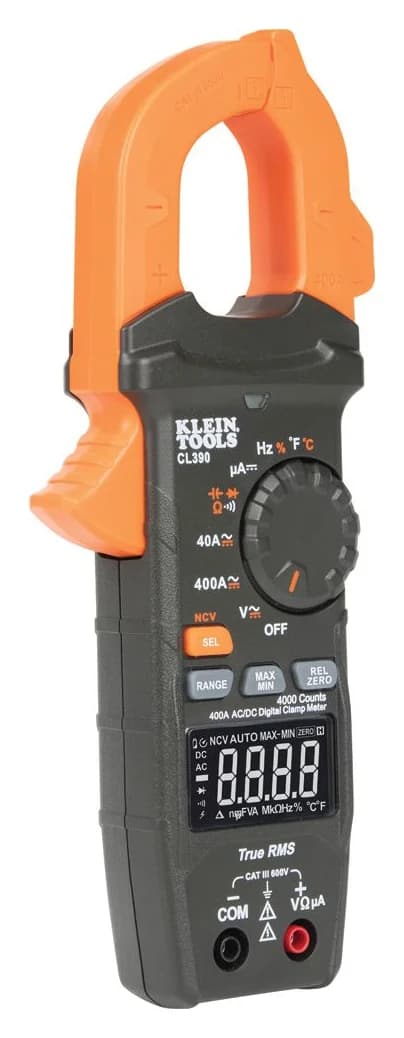
Klein Tools
A 4,000-count True RMS clamp meter that measures AC and DC current to 400 A, voltage to 600 V and DC microamps, with non-contact voltage detection in the jaw and a thermocouple for temperature.
Check package and model options
- 600 V max
- 400 A max
- 4,000 counts
- CAT III 600V
Need a higher category rating and LoZ? The Klein CL710 offers a 600 A AC/DC jaw, low-impedance voltage mode and CAT IV 600V / CAT III 1000V ratings. It is an alternative for those requirements; its specification table says no DC microamps and gives no temperature range. A thermocouple mentioned in a feature bullet conflicts with that table and the package list, so do not buy it for temperature.
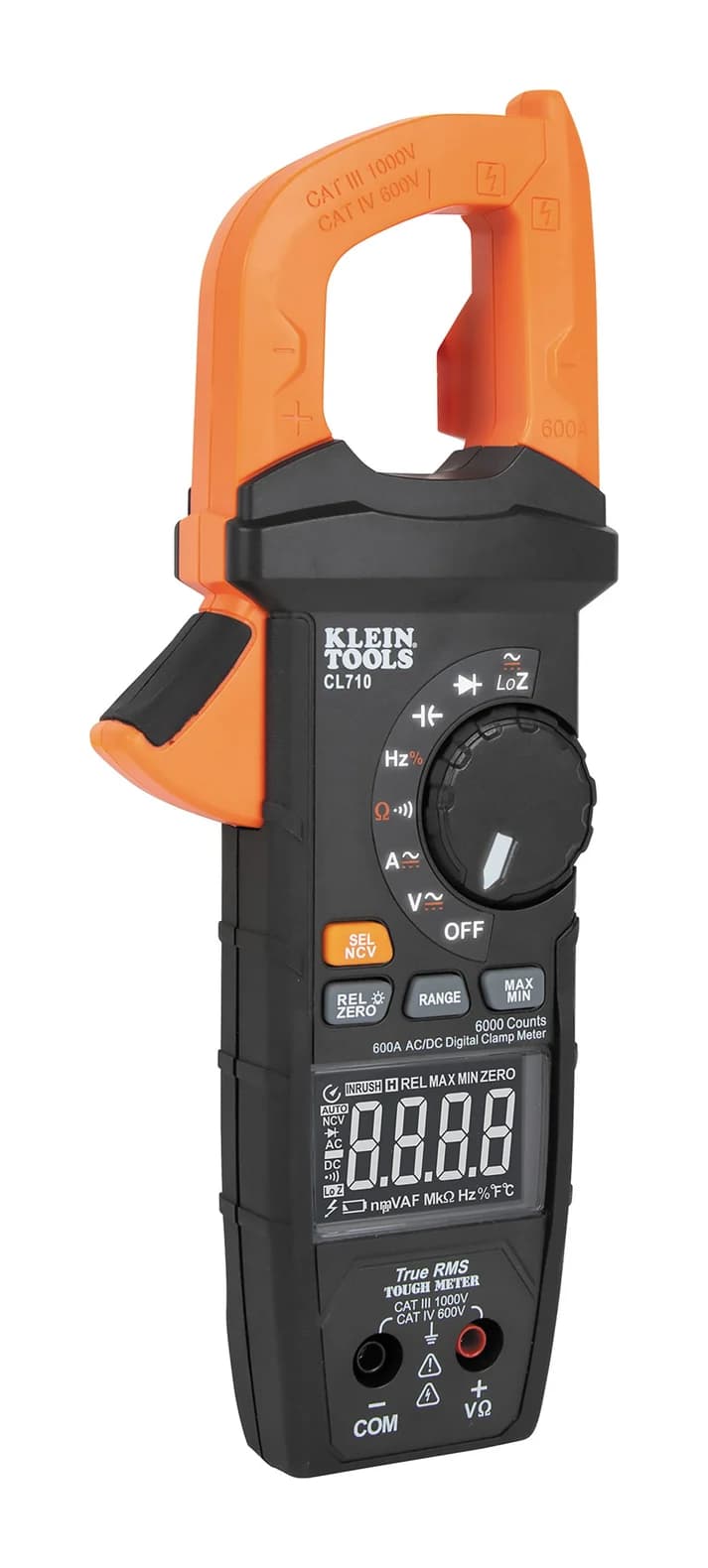
Klein Tools
A 6,000-count True RMS clamp meter that measures AC and DC current to 600 A and voltage to 1000 V, with a low-impedance mode and non-contact voltage detection in the jaw.
Check package and model options
- 1,000 V max
- 600 A max
- 6,000 counts
- CAT IV 600V, CAT III 1000V
Want another basic AC clamp? The Fluke 323 is a 400 A AC True RMS option with a soft case included. Its own specification table lists no DC current, capacitance or temperature. Compare the actual package rather than expecting it to replace the HVAC model's functions.
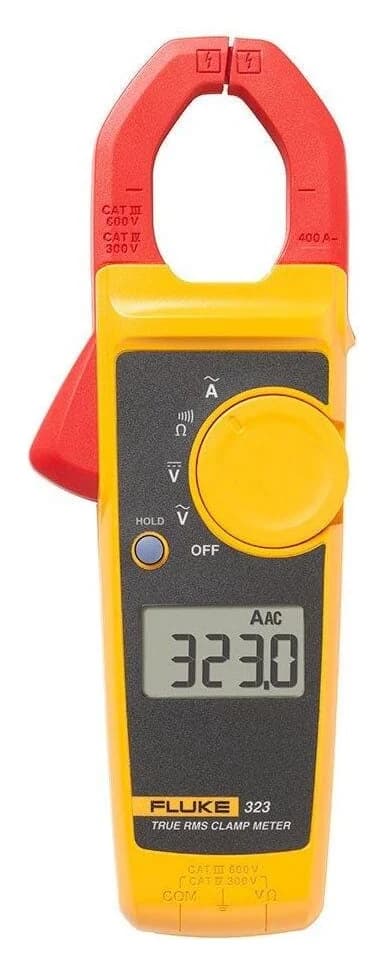
Fluke
A basic True RMS clamp meter rated CAT III 600V and CAT IV 300V that measures AC current to 400 A, AC and DC voltage to 600 V, resistance and continuity; it doesn't measure DC current.
Check package and model options
- 600 V max
- 400 A max
- CAT III 600V, CAT IV 300V
How we choose
We compared Milwaukee's US product pages, the separate 2235-20 manual and the shared 2236-20/2237-20 manual, checked November 2, 2026. We checked exact function rows, current resolution, accuracy conditions, probe information, ratings and package lists; the recommendations reflect those documents. No physical testing was performed. Conflicting maker information is identified above. Read our selection method and measurement policy for the research limits.
Verdict
Buy 2235-20 for basic AC measurements, 2236-20 for the HVAC combination of AC current, DC microamps and temperature, or 2237-20 for DC jaw current and frequency. If you need both DC clamping and HVAC functions in one instrument, compare the CL390 before choosing. Confirm the useful current range, probe limit and complete package before ordering.
Frequently asked questions
Does the Milwaukee 2235-20 measure DC amps?
No. Its jaw measures AC current up to 400 A; its DC capability is voltage measurement, up to 600 V through the leads. For DC current through the jaw, choose the 2237-20 among these Milwaukee models. The 2236-20 has a separate DC microamp function through leads, which does not give it a DC current clamp.
What is the difference between the Milwaukee 2236-20 and 2237-20?
Both have a 600 A AC jaw, capacitance and a CAT III 600V rating. Choose the 2236-20 for temperature and DC microamps through leads, including flame-rectification work. Choose the 2237-20 for DC jaw current and frequency. The 2237-20 does not combine all of the 2236-20's functions with DC clamping; its manual lists no temperature or DC microamp mode.
Can the Milwaukee 2237-20 measure temperature with an added probe?
The shared manual lists no temperature function for the 2237-20; the temperature instructions apply only to the 2236-20. Buy the 2236-20 if contact temperature is required. Its standard package includes a dual-banana thermocouple, but confirm the supplied probe's own limit before relying on the meter's full temperature input range.
What comes with the Milwaukee 2236-20?
Milwaukee's US package list includes the clamp meter, a dual-banana thermocouple, an electrical test lead set, two AA batteries and a manual. Check any additional case, clips or calibration paperwork separately with the exact package. The 2237-20 list includes leads, two AA batteries and a manual, with no thermocouple listed.
Will the Milwaukee 2237-20 measure frequency on low-voltage controls?
Check signal level first: the manual requires at least 70 Vrms for frequency through the voltage input or 50 Arms for frequency through the jaw. Those thresholds belong to the frequency function; they are not minimums for ordinary current or voltage readings. A frequency label alone therefore does not establish suitability for a low-level control signal.
Related guides
Comparison · Clamp Meters
Klein CL390 vs CL710: Which Klein Clamp Meter Should You Buy?
Choose the right Klein clamp meter: CL390 for HVAC microamps and temperature, CL710 for LoZ and higher ranges, with manual limits and buying traps explained.
Best picks · Clamp Meters
Best DC Clamp Meters for Cars, RVs and Battery Systems
Choose a DC clamp meter by its useful low-current range, accuracy and jaw size. Compare Fluke, Klein and Amprobe for car, RV and battery checks before buying.
Buying guide · Clamp Meters
How to Use a Clamp Meter: AC, DC Zeroing and Wrong Readings
Learn how to use a clamp meter for AC and DC current: choose jaws or leads, zero DC offset, use a line splitter, and troubleshoot zero or unstable readings.