

Best picks
Best DC Clamp Meters for Cars, RVs and Battery Systems
Choose a DC clamp meter by its useful low-current range, accuracy and jaw size. Compare Fluke, Klein and Amprobe for car, RV and battery checks before buying.
By thisMETER EditorialUpdated November 3, 20268 min read2 picks
On this page · Our picks at a glance
Our picks at a glance
- 1
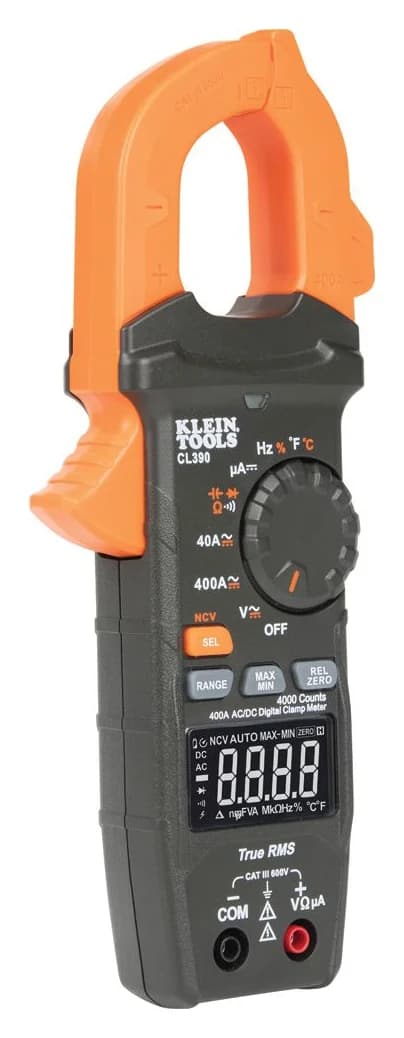
Choose for: More jaw clearance
Limit: Rated CAT III 600V only: not for service-entrance (CAT IV) work
- 2
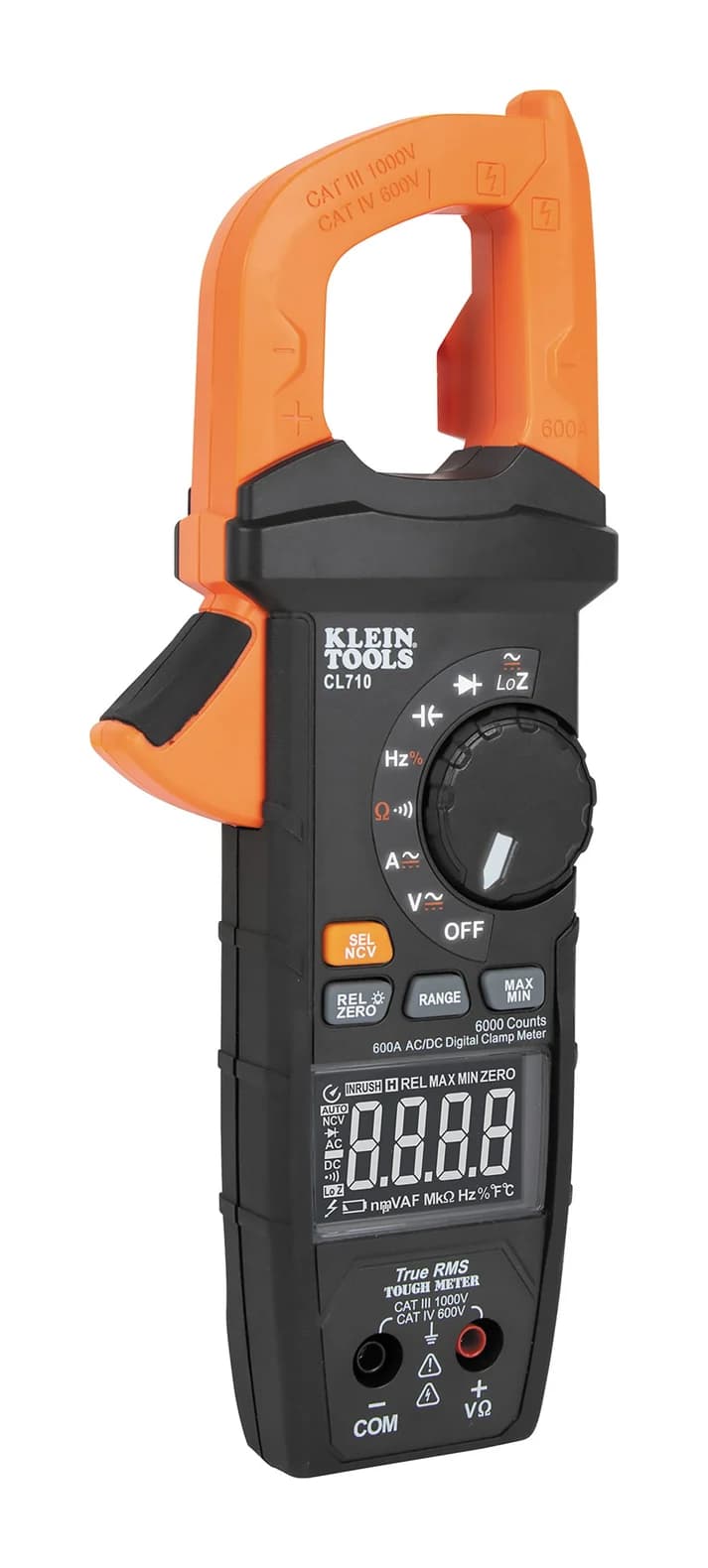
Choose for: Loads above the other full-size picks' range
Limit: No DC microamp range, so it can't read HVAC flame-sensor current
For ordinary car, RV and battery load checks, our default pick is the Fluke 325, with DC jaw current to 400 A and a tighter low-range accuracy specification than either Klein below. Choose the Amprobe LH41A for smaller currents, the Klein CL390 for its larger jaw, or the CL710 when the load exceeds 400 A. Treat tiny sleeping-vehicle draw and starter-current capture as separate buying decisions.
Quick picks: choose the DC range first
Compare specifications and all conditions
Fluke 325
- Choose it for
- Routine steady-load checks
- DC jaw ranges
- 40 / 400 A
- Smallest display step
- 10 mA
All specifications
- Access limit
- 30 mm conductor
Amprobe LH41A
- Choose it for
- Smaller currents; current-only tool
- DC jaw ranges
- 4 / 40 A
- Smallest display step
- 1 mA
All specifications
- Access limit
- 19 mm cable; 20 mm jaw opening
Klein CL390
- Choose it for
- More jaw clearance
- DC jaw ranges
- 40 / 400 A
- Smallest display step
- 10 mA
All specifications
- Access limit
- 4.1 cm jaw
Klein CL710
- Choose it for
- Loads above the other full-size picks' range
- DC jaw ranges
- 60 / 600 A
- Smallest display step
- 10 mA
All specifications
- Access limit
- 3.6 cm jaw
Full comparison table
Swipe to compare. Row labels stay visible.
| Meter | Choose it for | DC jaw ranges | Smallest display step | Access limit |
|---|---|---|---|---|
| Fluke 325 | Routine steady-load checks | 40 / 400 A | 10 mA | 30 mm conductor |
| Amprobe LH41A | Smaller currents; current-only tool | 4 / 40 A | 1 mA | 19 mm cable; 20 mm jaw opening |
| Klein CL390 | More jaw clearance | 40 / 400 A | 10 mA | 4.1 cm jaw |
| Klein CL710 | Loads above the other full-size picks' range | 60 / 600 A | 10 mA | 3.6 cm jaw |
Scroll horizontally to see every column
| Meter | Choose it for | DC jaw ranges | Smallest display step | Access limit |
|---|---|---|---|---|
| Fluke 325 | Routine steady-load checks | 40 / 400 A | 10 mA | 30 mm conductor |
| Amprobe LH41A | Smaller currents; current-only tool | 4 / 40 A | 1 mA | 19 mm cable; 20 mm jaw opening |
| Klein CL390 | More jaw clearance | 40 / 400 A | 10 mA | 4.1 cm jaw |
| Klein CL710 | Loads above the other full-size picks' range | 60 / 600 A | 10 mA | 3.6 cm jaw |
Ranges and resolution come from the Fluke manual, Amprobe manual and Klein CL390 and CL710 manuals. Access dimensions are the makers' stated limits, not a guarantee of clearance around a lug or inside a crowded battery compartment.
The important split is resolution versus usable measurement. The CL390 displays 0.01 A increments but explicitly specifies 0.3 A as its minimum measurable AC or DC current. Its separate 200 µA function uses test leads, not the jaw; it cannot turn the clamp into a microamp instrument.
Compare accuracy at the same DC load
At a displayed 1 A, the following are calculated allowances from the manuals, not measurements. Each uses the lowest DC range, where a digit means one display step:
Amprobe LH41A, 4 A
- Maker's DC current accuracy
- ±(1.3% of reading + 5 digits)
- Display step
- 1 mA
- Calculated allowance at 1 A
- ±18 mA
Fluke 325, 40 A
- Maker's DC current accuracy
- ±(2% of reading + 5 digits)
- Display step
- 10 mA
- Calculated allowance at 1 A
- ±70 mA
Klein CL710, 60 A
- Maker's DC current accuracy
- ±(2% of reading + 8 digits)
- Display step
- 10 mA
- Calculated allowance at 1 A
- ±100 mA
Klein CL390, 40 A
- Maker's DC current accuracy
- ±(2% of reading + 9 digits)
- Display step
- 10 mA
- Calculated allowance at 1 A
- ±110 mA
Full comparison table
Swipe to compare. Row labels stay visible.
| Meter and range | Maker's DC current accuracy | Display step | Calculated allowance at 1 A |
|---|---|---|---|
| Amprobe LH41A, 4 A | ±(1.3% of reading + 5 digits) | 1 mA | ±18 mA |
| Fluke 325, 40 A | ±(2% of reading + 5 digits) | 10 mA | ±70 mA |
| Klein CL710, 60 A | ±(2% of reading + 8 digits) | 10 mA | ±100 mA |
| Klein CL390, 40 A | ±(2% of reading + 9 digits) | 10 mA | ±110 mA |
Scroll horizontally to see every column
| Meter and range | Maker's DC current accuracy | Display step | Calculated allowance at 1 A |
|---|---|---|---|
| Amprobe LH41A, 4 A | ±(1.3% of reading + 5 digits) | 1 mA | ±18 mA |
| Fluke 325, 40 A | ±(2% of reading + 5 digits) | 10 mA | ±70 mA |
| Klein CL710, 60 A | ±(2% of reading + 8 digits) | 10 mA | ±100 mA |
| Klein CL390, 40 A | ±(2% of reading + 9 digits) | 10 mA | ±110 mA |
For example, the LH41A calculation is (1.3% × 1 A) + (5 × 1 mA) = 18 mA; the Fluke calculation is (2% × 1 A) + (5 × 10 mA) = 70 mA. The same formula produces the Klein results. Amprobe specifies its accuracy at 23°C ±1°C; Klein states 18–28°C, and Fluke requires temperature corrections outside 18–28°C. These comparisons exclude additional positioning, temperature and uncorrected zero effects.
Source: Calculations from the four manuals linked above, under their stated conditions; these are not measured errors.
The small range helps the Amprobe because its digits term is smaller. Even there, 5 digits at 1 mA means 5 mA before adding the percentage term. A changing last digit alone cannot establish a tiny parasitic fault.
Best for routine DC load checks: Fluke 325
The 325's own specification gives 40.00 / 400.0 A DC through the jaw, with ±(2% + 5 digits) accuracy. That is why we prefer it for ordinary ampere-level checks when its conductor limit fits. It also measures voltage to 600 V AC/DC, and provides Min/Max, capacitance, frequency and contact temperature.
Its trade-offs are the 30 mm maximum conductor diameter and a lowest current step of 10 mA. Buy it for load checks rather than assuming it can settle every battery-drain complaint.
Choose the package carefully. The standard US 325, part 5065866, includes TL75 leads, a K-type thermocouple, installed AAA batteries and a soft case. 325 CAL, part 5160474, adds a traceable calibration certificate with data; R-FLUKE-325 is reconditioned. The shared manual reserves DC jaw current for the 325: the 323 and 324 are not substitutes for that job. Also, Fluke's page advertises a temperature range to 400°C, while the manual limits the included thermocouple to 260°C.
View the standard package and variants at Fluke. For the sibling decision, see Fluke 323 vs 325.
Best for smaller DC currents: Amprobe LH41A
The LH41A is the specialist: 4 A and 40 A DC ranges, 1 mA resolution on 4 A, and ±(1.3% + 5 digits) basic accuracy. Its manual distinguishes a 20 mm jaw opening from a 19 mm cable capacity. Check the latter against the insulated cable you need to surround.
It is a current-only tool: Amprobe lists no voltage, resistance or continuity measurement. Its AC response is average responding, RMS calibrated, so choose another instrument when True RMS AC matters. That limitation does not remove its usefulness for DC current.
The 40 A measurement ceiling also makes it the wrong pick for heavier battery loads. The manual's 150 A overload capacity is not a measurement range. Its auto-zero addresses offset, but Amprobe explicitly warns that thermal shifts and environmental conditions can move the zero.
Why the UNI-T UT210E is not a pick here
The UT210E was our compact candidate. However, the global UT210 series page displays an out-of-stock notice, while the official US store search returned no matching product. This establishes a supply-verification gap, not discontinuation. We have not confirmed a current US package and supply route, so we recommend the documented Amprobe alternative instead. Do not transfer specifications or certification wording from another UT210 suffix to a particular meter.
Best for a larger jaw: Klein Tools CL390
The CL390 offers the widest stated jaw here, 4.1 cm, with 400 A AC/DC capacity. Choose it when cable access outweighs the Fluke's tighter stated current accuracy. Remember its 0.3 A minimum, regardless of the smaller increments on screen.
Klein Tools
A 4,000-count True RMS clamp meter that measures AC and DC current to 400 A, voltage to 600 V and DC microamps, with non-contact voltage detection in the jaw and a thermocouple for temperature.
Check package and model options
- 600 V max
- 400 A max
- 4,000 counts
- CAT III 600V
The standard package includes a case, test leads, thermocouple and batteries; the magnetic hanger is optional. Its temperature and lead-based DC microamp functions can be useful alongside clamp measurements, but neither improves low-current jaw accuracy. For those functions versus the CL710's electrical features, use our Klein CL390 vs CL710 comparison.
Best for loads above 400 A: Klein Tools CL710
Choose the CL710 for its 60 / 600 A DC ranges, not an expectation of finer small-current measurement. On the lower range it has 10 mA steps and ±(2% + 8 digits) accuracy. The jaw is 3.6 cm, smaller than the CL390's despite the higher current capacity.
Klein Tools
A 6,000-count True RMS clamp meter that measures AC and DC current to 600 A and voltage to 1000 V, with a low-impedance mode and non-contact voltage detection in the jaw.
Check package and model options
- 1,000 V max
- 600 A max
- 6,000 counts
- CAT IV 600V, CAT III 1000V
It adds LoZ voltage measurement for ghost-voltage troubleshooting. There is a documentation conflict: a product-page bullet includes a thermocouple, but that same page's specification table shows no temperature range, its included-items table omits the probe, and the manual provides no temperature function. We do not recommend it for temperature measurement. A bundle description cannot settle that discrepancy.
Buying advice: zero, access and capture matter
A stable zero comes before a small reading
Amprobe instructs users to zero the LH41A with the jaws closed and away from the current-carrying conductor; it notes that auto-zero can null the earth's magnetic field. Klein requires a new zero procedure on the CL710 if the DC current range changes. Follow the selected meter's manual, then check whether the unloaded baseline returns after a reading. If it moves by an amount comparable to the suspected draw, repeat the check before drawing a conclusion.
Klein also specifies a fully closed jaw with the conductor centered and perpendicular to it. Measure a single conductor: putting both outgoing and return conductors inside the jaw can cancel their fields. A larger current rating does not solve poor cable access. Our clamp meter guide covers technique in more detail.
Steady current is different from a starting-current event
The manuals establish ordinary current ranges; we found no dedicated DC starter-capture specification for these picks. Fluke's inrush application note explains why ordinary Min/Max or peak capture can miss an AC motor's starting event. Do not infer DC starter capture from an AC inrush label. Require the appropriate DC mode, range and timing specification before buying for cranking diagnostics.
- Yes: DC current explicitly specified through the jaw
- Yes: A useful lowest range and a documented zero procedure
- Partly: Min/Max: check capture timing and supported current mode
- No: AC/DC voltage alone as proof of DC jaw-current capability
- No: True RMS alone as proof of small-current DC accuracy
Match the marked ratings to the installation
Ratings are CAT III 600V / CAT IV 300V for the Fluke, CAT III 300V for the Amprobe, CAT III 600V for the CL390 and CAT IV 600V / CAT III 1000V for the CL710. These are the makers' markings, not our verification of safety. Match the meter and accessories to the actual installation; Fluke says the lowest-rated component governs.
When another tool makes more sense
For sleeping-vehicle drain, use vehicle service information for the acceptable draw and shutdown conditions. Pico's diagnostic guidance explains that operating a door handle or pulling and reinstalling a fuse can wake a network. A single spot reading may therefore describe the disturbance rather than the fault. Use a low-current recording setup or professional diagnosis for intermittent problems.
A suitable fused DMM in series is another option for small currents when its ratings and the circuit permit. Follow its manual: Fluke warns against connecting current-input probes in parallel with a circuit. See clamp meter vs multimeter before choosing the method.
For battery-bank monitoring over time, consider an installed shunt monitor instead. Victron's SmartShunt manual describes continuous current measurement, integration into amp-hours, and stored history. That answers a different question from a handheld load check.
How we choose
We compared official product pages and manuals, checked November 2, 2026. The shortlist prioritizes the lowest DC range, the full accuracy expression, zeroing instructions and cable access before maximum amperage. The worked example is arithmetic from published specifications; no readings are presented as our own. We distinguish manufacturer claims, calculated allowances and our recommendations, and flag conflicts instead of selecting the more attractive specification. See How we choose and How we measure.
Verdict
Get the Fluke 325 for routine DC load checks, the Amprobe LH41A when smaller currents dominate, the CL390 when jaw clearance decides, or the CL710 for higher-current loads. For sleep-current diagnosis or starter capture, choose the measurement method before the meter.
Frequently asked questions
Can a clamp meter measure DC current?
Yes, when its manual explicitly specifies DC current through the jaw. AC/DC voltage via test leads does not establish that capability: Fluke's shared manual specifies DC jaw current for the 325 alone, among the 323, 324 and 325. True RMS describes AC measurement and does not promise DC milliamp accuracy. Check the lowest DC range, resolution, accuracy and zeroing instructions before choosing.
Which DC clamp meter should I buy for parasitic draw?
The Amprobe LH41A is the most suitable specialist here for small DC currents: its 4 A range has 1 mA resolution and ±(1.3% + 5 digits) basic accuracy. Those display steps are not a promise of 1 mA accuracy. Pico warns that operating a door handle can wake a sleeping vehicle network. Follow vehicle service information, check the clamp's zero stability, and use recording diagnostics for intermittent drain.
Is the Fluke 325 better than the Klein CL390 for cars?
For steady DC loads, its stated allowance is tighter on the 40 A range: ±(2% + 5 digits), against the CL390's ±(2% + 9 digits). At a displayed 1 A, that calculates to ±70 mA versus ±110 mA under the makers' conditions. The CL390 has a larger 4.1 cm jaw, versus Fluke's 30 mm conductor limit. Choose access and the required measurement function as well as accuracy.
Does an inrush function measure DC starter current?
Do not assume it does. Require a documented DC capture mode, adequate current range and suitable capture timing. Fluke's AC motor application note explains why ordinary peak and min/max functions can differ from synchronized inrush measurement; that does not establish DC starter capability. These picks cover low-current or steady-load checks. For a starting-current waveform, choose an appropriate automotive probe and recording instrument, or professional diagnosis.
Related guides
Comparison · Clamp Meters
Klein CL390 vs CL710: Which Klein Clamp Meter Should You Buy?
Choose the right Klein clamp meter: CL390 for HVAC microamps and temperature, CL710 for LoZ and higher ranges, with manual limits and buying traps explained.
Comparison · Clamp Meters
Fluke 323 vs 325: When DC Current Justifies the Upgrade
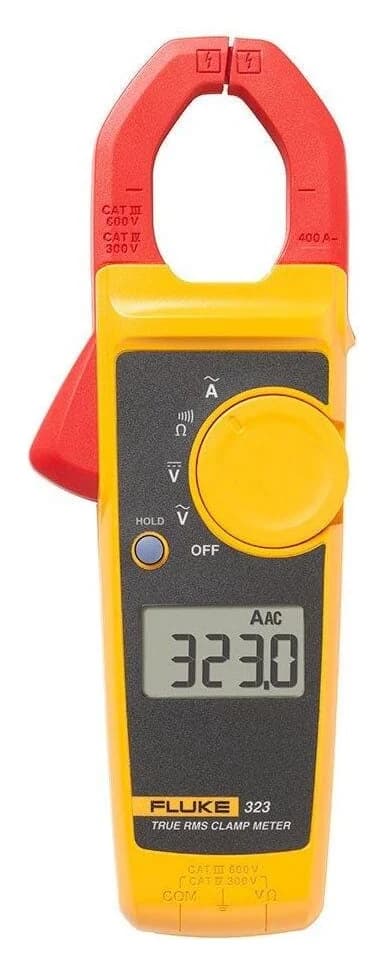
Choose the right Fluke clamp meter: AC versus DC current, accuracy at the same load, temperature-probe limits, and standard, CAL and reconditioned packages.
Buying guide · Clamp Meters
How to Use a Clamp Meter: AC, DC Zeroing and Wrong Readings
Learn how to use a clamp meter for AC and DC current: choose jaws or leads, zero DC offset, use a line splitter, and troubleshoot zero or unstable readings.