

Comparison
Klein NCVT3P vs NCVT1P
Which Voltage Tester Should You Buy?
Choose the right Klein voltage tester: compare NCVT3P and NCVT1P ranges, controls, flashlight, outlet restrictions, batteries and exact pen-versus-kit contents.
By thisMETER EditorialUpdated November 3, 20267 min read2 picks
Our recommendation: Klein Tools NCVT3P
Best for broader AC detection
Limit: You must check the active mode; extra sensitivity also responds more readily in electrically noisy surroundings
On this page · Our picks at a glance
Our picks at a glance
- 1
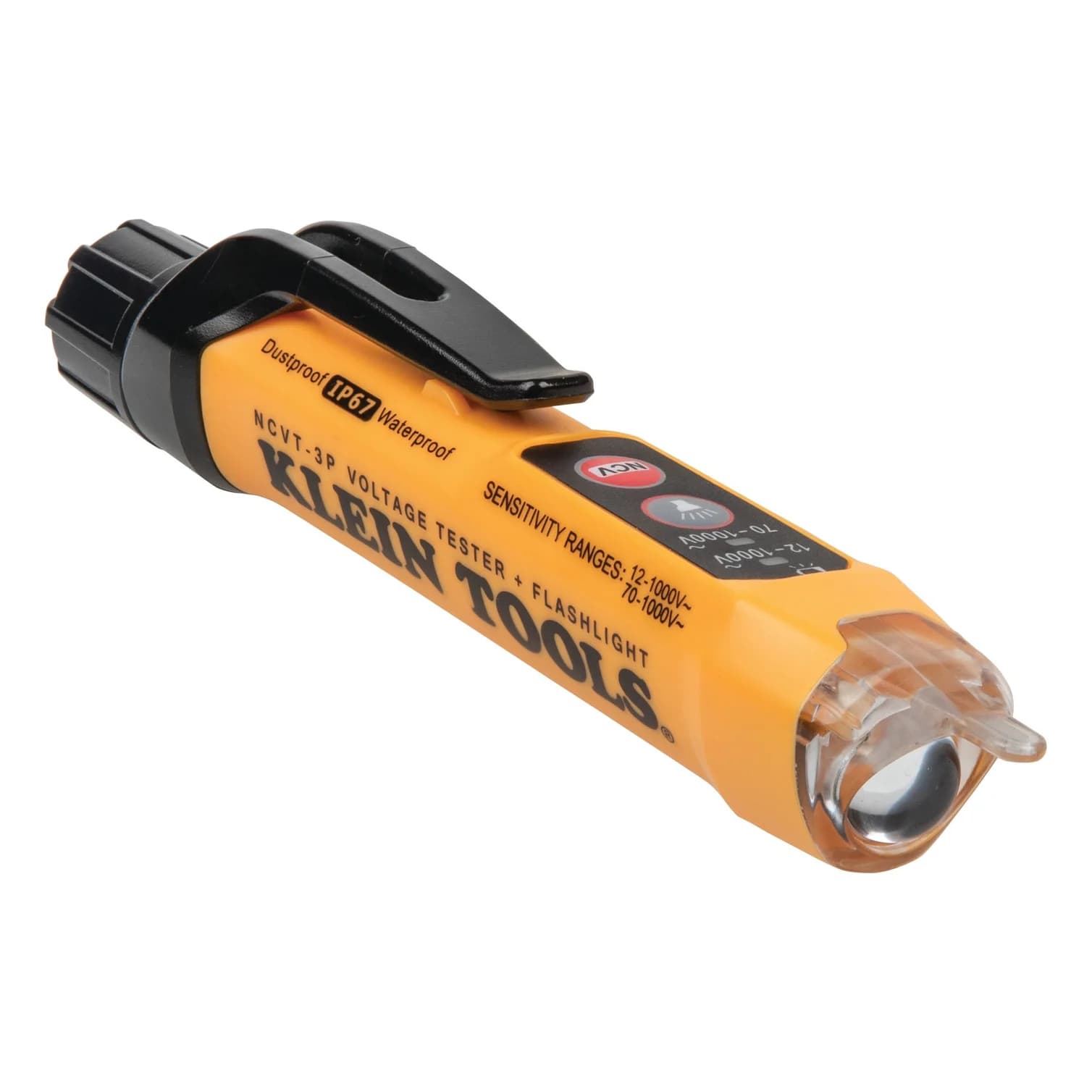
Choose for: Best for broader AC detection
Limit: You must check the active mode; extra sensitivity also responds more readily in electrically noisy surroundings
- 2
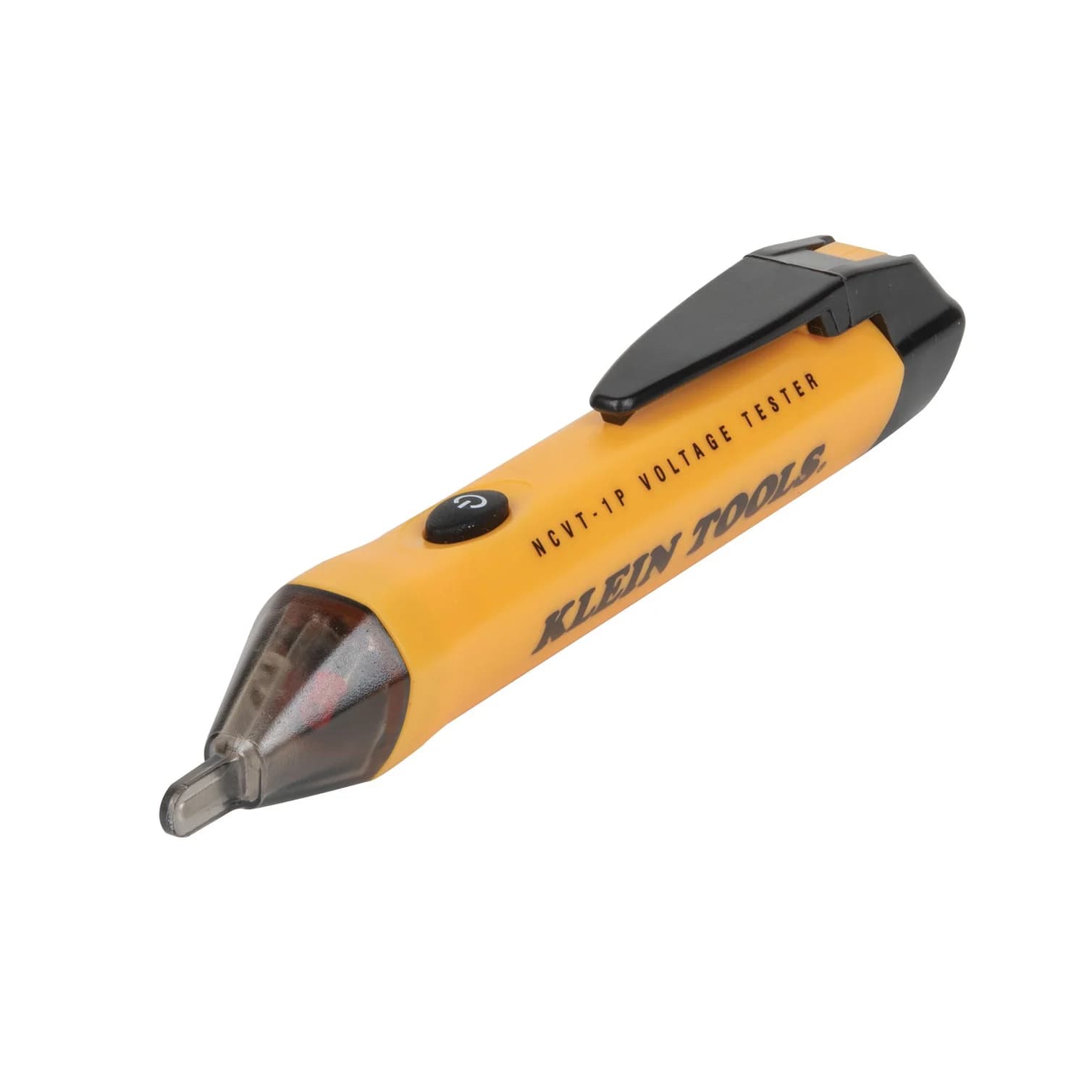
Choose for: Best for a fixed AC range
Limit: No low-voltage mode; Klein excludes tamper-resistant outlets from its recommended uses
For a Klein voltage tester, our pick is the NCVT3P if you want its sensitive 12–1000V AC mode and independent flashlight; choose NCVT1P for a fixed 50–1000V AC range without sensitivity selection. The important outlet distinction is explicit: Klein does not recommend NCVT1P for tamper-resistant receptacles and directs buyers toward NCVT3P in low-voltage mode. Neither pen establishes that a circuit is safe to touch.
Quick picks
Compare specifications and all conditions
NCVT3P — broader AC detection
- Buy it for
- Low-voltage AC applications, selectable sensitivity and a separate flashlight
- Main limitation
- You must check the active mode; extra sensitivity also responds more readily in electrically noisy surroundings
NCVT1P — fixed-range simplicity
- Buy it for
- Standard-voltage AC checks when you do not need mode selection
- Main limitation
- No low-voltage mode; Klein excludes tamper-resistant outlets from its recommended uses
Full comparison table
Swipe to compare. Row labels stay visible.
| Choose | Buy it for | Main limitation |
|---|---|---|
| NCVT3P — broader AC detection | Low-voltage AC applications, selectable sensitivity and a separate flashlight | You must check the active mode; extra sensitivity also responds more readily in electrically noisy surroundings |
| NCVT1P — fixed-range simplicity | Standard-voltage AC checks when you do not need mode selection | No low-voltage mode; Klein excludes tamper-resistant outlets from its recommended uses |
Scroll horizontally to see every column
| Choose | Buy it for | Main limitation |
|---|---|---|
| NCVT3P — broader AC detection | Low-voltage AC applications, selectable sensitivity and a separate flashlight | You must check the active mode; extra sensitivity also responds more readily in electrically noisy surroundings |
| NCVT1P — fixed-range simplicity | Standard-voltage AC checks when you do not need mode selection | No low-voltage mode; Klein excludes tamper-resistant outlets from its recommended uses |
- 12–1000V ACNCVT3P sensitive mode; its standard mode is separate
- 50–1000V ACNCVT1P fixed detection range
NCVT3P vs NCVT1P: specifications side by side
These are manufacturer specifications, not measurements by thisMETER. The sources are Klein's NCVT3P page, NCVT1P page and the manuals linked below.
Standard AC detection range
- NCVT3P
- Mode 1: 70–1000V AC
- NCVT1P
- Fixed: 50–1000V AC
More sensitive AC detection
- NCVT3P
- Mode 2: 12–1000V AC
- NCVT1P
- No selectable low-voltage mode
Mode selection
- NCVT3P
- NCV power button switches modes; remembers the last mode used
- NCVT1P
- Fixed range
Power/mode indication
- NCVT3P
- Red power-on lamp for Mode 1; blue for Mode 2
- NCVT1P
- Green power-on LED
Voltage indication
- NCVT3P
- Tip LEDs and audible beeps; silent operation available
- NCVT1P
- Red LED and audible tone
Separate flashlight
- NCVT3P
- Yes; works independently of detection
- NCVT1P
- No separate flashlight
Tamper-resistant outlets
- NCVT3P
- Klein directs buyers to low-voltage mode; compatibility caveat remains
- NCVT1P
- Not recommended by Klein
Frequency range
- NCVT3P
- 50–500 Hz
- NCVT1P
- 50–500 Hz
Safety marking
- NCVT3P
- CAT IV 1000V
- NCVT1P
- CAT IV 1000V
Ingress protection (selection guide)
- NCVT3P
- IP67
- NCVT1P
- IP40
Drop protection
- NCVT3P
- 2 m / 6.6 ft
- NCVT1P
- 2 m / 6.6 ft
Standalone package power
- NCVT3P
- Two AAA batteries, included
- NCVT1P
- Two AAA batteries, included
Automatic power-off
- NCVT3P
- Yes
- NCVT1P
- Yes
Full comparison table
Swipe to compare. Row labels stay visible.
| Buying question | NCVT3P | NCVT1P |
|---|---|---|
| Standard AC detection range | Mode 1: 70–1000V AC | Fixed: 50–1000V AC |
| More sensitive AC detection | Mode 2: 12–1000V AC | No selectable low-voltage mode |
| Mode selection | NCV power button switches modes; remembers the last mode used | Fixed range |
| Power/mode indication | Red power-on lamp for Mode 1; blue for Mode 2 | Green power-on LED |
| Voltage indication | Tip LEDs and audible beeps; silent operation available | Red LED and audible tone |
| Separate flashlight | Yes; works independently of detection | No separate flashlight |
| Tamper-resistant outlets | Klein directs buyers to low-voltage mode; compatibility caveat remains | Not recommended by Klein |
| Frequency range | 50–500 Hz | 50–500 Hz |
| Safety marking | CAT IV 1000V | CAT IV 1000V |
| Ingress protection (selection guide) | IP67 | IP40 |
| Drop protection | 2 m / 6.6 ft | 2 m / 6.6 ft |
| Standalone package power | Two AAA batteries, included | Two AAA batteries, included |
| Automatic power-off | Yes | Yes |
Scroll horizontally to see every column
| Buying question | NCVT3P | NCVT1P |
|---|---|---|
| Standard AC detection range | Mode 1: 70–1000V AC | Fixed: 50–1000V AC |
| More sensitive AC detection | Mode 2: 12–1000V AC | No selectable low-voltage mode |
| Mode selection | NCV power button switches modes; remembers the last mode used | Fixed range |
| Power/mode indication | Red power-on lamp for Mode 1; blue for Mode 2 | Green power-on LED |
| Voltage indication | Tip LEDs and audible beeps; silent operation available | Red LED and audible tone |
| Separate flashlight | Yes; works independently of detection | No separate flashlight |
| Tamper-resistant outlets | Klein directs buyers to low-voltage mode; compatibility caveat remains | Not recommended by Klein |
| Frequency range | 50–500 Hz | 50–500 Hz |
| Safety marking | CAT IV 1000V | CAT IV 1000V |
| Ingress protection (selection guide) | IP67 | IP40 |
| Drop protection | 2 m / 6.6 ft | 2 m / 6.6 ft |
| Standalone package power | Two AAA batteries, included | Two AAA batteries, included |
| Automatic power-off | Yes | Yes |
The standard ranges are different: NCVT3P's standard mode starts above NCVT1P's lower threshold. Its advantage is the additional sensitive mode, rather than a higher maximum voltage or a higher CAT marking.
There are small document conflicts: Klein's selection guide numbers its ranges in the reverse order from the manual's modes and prints 6.5 ft drop protection for both pens, whereas their product pages and manuals give 2 m / 6.6 ft. The operating mode labels above come from the NCVT3P manual.
Best for broader AC detection: Klein Tools NCVT3P
Klein Tools
A pen-style non-contact AC voltage detector with two sensitivity modes (12 to 1000 V AC and 70 to 1000 V AC), a built-in flashlight and a CAT IV 1000V rating.
Check package and model options
- 1,000 V max
- CAT IV 1000V
Choose NCVT3P when your intended jobs include low-voltage AC controls as well as standard-voltage wiring. Klein names doorbells, thermostats, low-voltage lighting and irrigation systems among its applications. Check that the circuit is AC: the application name alone is not enough, because the NCVT3P manual expressly excludes DC detection.
The controls deserve attention. Pressing the NCV button while the pen is on changes sensitivity, and it powers up in the last mode used. The red power-on lamp identifies standard mode; the blue lamp identifies sensitive mode. Read those mode lamps separately from the detection LEDs inside the tip. This makes NCVT3P the more flexible choice, provided you are willing to check its setting each time.
The flashlight has its own button and works independently of voltage detection. The manual also allows silent operation and says a low battery disables the flashlight to preserve battery function for detection. Read its battery warning before treating a missing flashlight as a separate fault.
One environmental caveat matters: Klein's product page calls the IP67 enclosure dustproof and waterproof, but the linked manual specifies indoor use and says not to expose it to moisture, rain or snow. Follow that operating restriction when deciding where to use it.
Best for a fixed AC range: Klein Tools NCVT1P
Klein Tools
A basic pen-style non-contact AC voltage detector with a 50 to 1000 V AC range, a red LED and tone alert, and a CAT IV 1000V rating.
Check package and model options
- 1,000 V max
- CAT IV 1000V
Choose NCVT1P when you want standard-voltage AC detection with a single range to understand. Klein specifies a green LED for power-on, changing to a red LED with an audible tone when voltage is detected. It has automatic power-off and the same published CAT marking and drop protection as NCVT3P.
The trade-off is application coverage. It lacks NCVT3P's selectable sensitive range and separate flashlight, and Klein explicitly excludes tamper-resistant outlets from its recommended applications. Those restrictions matter more than whether you consider yourself a beginner. A simpler pen is a sensible purchase only when its intended uses match yours.
Its instruction sheet is named NCVT1PKIT, but contains a section specifically labelled NCVT-1P as well as instructions for the bundled outlet tester. Use the pen's section; a kit filename does not mean the standalone purchase contains the other instrument.
How we choose
This comparison is based on manufacturer specifications and instructions; thisMETER has no original measurements for these pens. We compared detection ranges, controls, outlet restrictions, safety markings and package contents, and kept conflicting wording visible. Our picks express which documented feature set fits the stated use, without a claim about independently verified sensitivity or durability. Read our research method and measurement policy.
Buying guide: what extra sensitivity changes
The sensitive range continues into standard voltage. Klein's NCVT3P feature bullet describes low voltage as 12 to 70V AC, but its specification table and manual give Mode 2 as 12 to 1000V AC. That is a documentation wording mismatch to notice: the sensitive setting is not capped at the low-voltage band.
More sensitivity has a trade-off. The manual says Mode 2 is more sensitive to high-voltage sources and electrically noisy environments, and recommends Mode 1 when expected voltages are above 70V AC. Treat the extra setting as an application choice, not a reason to leave the pen permanently at maximum sensitivity. Neither setting supplies a numerical voltage reading.
Tamper-resistant outlets change the pick. Klein's NCVT1P page directs users toward NCVT3P or NCVT2P in low-voltage mode. However, the NCVT3P manual warns that socket design and insulation differences can prevent compatibility with some standard or tamper-resistant outlets. Our recommendation is conditional: NCVT3P is the appropriate choice between these pens for that application, with that warning intact.
Keep detection separate from a safety decision. Both manuals warn that voltage can still be present without an indication. Shielding, grounded metal conduit, distance from the source and the user's isolation can affect detection. The stated range is not a guarantee that every installation will produce an alert.
- Yes: Use the maker's stated AC detection applications and limitations
- Partly: Socket design, insulation and the user's isolation can prevent detection
- No: Neither pen detects DC
- No: An absent alert does not establish a de-energized circuit
Klein requires verification on a known working circuit within the instrument's rating before and after each use. Follow the full manual; do not use silence or a green light as permission to handle conductors. For the broader tool choice and operating limits, continue to our non-contact voltage tester guide.
Bare pen or kit: read the exact model
Both standalone pens include two AAA batteries. Choose the package according to the additional instrument you need; the KIT suffix alone does not identify it.
NCVT3P
- Instruments listed by Klein
- Dual-range pen with flashlight; batteries
- Choose it when…
- You need the pen and already have your other testers
NCVT1P
- Instruments listed by Klein
- Fixed-range pen; instructions and batteries
- Choose it when…
- The simpler pen covers your intended applications
NCVT3PKIT
- Instruments listed by Klein
- NCVT3P plus ET45 contact AC/DC voltage tester; instructions and required batteries
- Choose it when…
- You specifically want a separate contact voltage tester
RT250KIT
- Instruments listed by Klein
- NCVT3P plus RT250 LCD GFCI receptacle tester; manuals and storage pouch
- Choose it when…
- You want outlet wiring indications, displayed voltage and GFCI trip time
NCVT1PKIT
- Instruments listed by Klein
- NCVT1P plus RT205 GFCI receptacle tester; instructions and required batteries
- Choose it when…
- You want the fixed-range pen alongside an outlet tester
Full comparison table
Swipe to compare. Row labels stay visible.
| Package | Instruments listed by Klein | Choose it when… |
|---|---|---|
| NCVT3P | Dual-range pen with flashlight; batteries | You need the pen and already have your other testers |
| NCVT1P | Fixed-range pen; instructions and batteries | The simpler pen covers your intended applications |
| NCVT3PKIT | NCVT3P plus ET45 contact AC/DC voltage tester; instructions and required batteries | You specifically want a separate contact voltage tester |
| RT250KIT | NCVT3P plus RT250 LCD GFCI receptacle tester; manuals and storage pouch | You want outlet wiring indications, displayed voltage and GFCI trip time |
| NCVT1PKIT | NCVT1P plus RT205 GFCI receptacle tester; instructions and required batteries | You want the fixed-range pen alongside an outlet tester |
Scroll horizontally to see every column
| Package | Instruments listed by Klein | Choose it when… |
|---|---|---|
| NCVT3P | Dual-range pen with flashlight; batteries | You need the pen and already have your other testers |
| NCVT1P | Fixed-range pen; instructions and batteries | The simpler pen covers your intended applications |
| NCVT3PKIT | NCVT3P plus ET45 contact AC/DC voltage tester; instructions and required batteries | You specifically want a separate contact voltage tester |
| RT250KIT | NCVT3P plus RT250 LCD GFCI receptacle tester; manuals and storage pouch | You want outlet wiring indications, displayed voltage and GFCI trip time |
| NCVT1PKIT | NCVT1P plus RT205 GFCI receptacle tester; instructions and required batteries | You want the fixed-range pen alongside an outlet tester |
The NCVT3PKIT page specifies ET45 indicators at discrete voltage levels and says it needs no batteries. It retains its own CAT III 350V marking; it does not inherit the pen's CAT IV 1000V marking. The bundle adds DC checking through ET45, without changing NCVT3P into a DC detector.
The RT250KIT page restricts its outlet tester to North American three-wire 120V outlets. Its battery fields conflict: the Batteries row says four AAA, while Included says four AA. Confirm the kit's battery contents rather than transferring the standalone pen's list to the bundle. The NCVT1PKIT page separately identifies RT205 as its companion tester.
For a seasonal purchase, use our Klein kit checklist to compare exact contents. Choose the functions you need before deciding whether the bundle is useful.
Verdict
Buy NCVT3P for selectable sensitivity, low-voltage AC applications and the independent flashlight. Buy NCVT1P when its fixed AC range covers your work and you want fewer settings. For tamper-resistant outlets, follow Klein's direction toward NCVT3P in low-voltage mode and retain the manual's compatibility warning. Choose a kit only for its named extra tester, and treat a missing alert as a detection limit rather than proof of safety.
Frequently asked questions
Which Klein voltage tester should I buy: NCVT3P or NCVT1P?
Choose NCVT3P if you want low-voltage AC detection or a separate flashlight: it offers selectable sensitive and standard modes. Choose NCVT1P if a single standard-voltage AC range fits your work and you prefer fewer controls. Both have a CAT IV 1000V marking, so that rating alone does not decide between them. Neither pen establishes that a circuit is safe to touch.
Can the Klein NCVT1P test tamper-resistant outlets?
Klein does not recommend NCVT1P for tamper-resistant outlets and directs buyers to NCVT3P or NCVT2P in low-voltage mode. Of the pens compared here, choose NCVT3P for that application. Its manual still warns that socket design and insulation can prevent detection at some standard or tamper-resistant outlets. A quiet pen does not establish that an outlet is de-energized.
Does the NCVT3P detect DC or measure voltage?
No. NCVT3P is a non-contact AC detector, and its manual explicitly excludes DC detection. Its light and sound patterns indicate detection rather than a numerical voltage reading. NCVT1P also excludes DC. The separate ET45 contact tester in NCVT3PKIT adds AC/DC voltage indications; buying that kit does not change the pen's detection capabilities.
What is the difference between NCVT3P and NCVT3PKIT?
NCVT3P is the standalone dual-range pen with flashlight and batteries. NCVT3PKIT includes that pen, an ET45 contact AC/DC voltage tester, instructions and required batteries. ET45 is powered by the applied voltage and requires no batteries itself. If you want an LCD GFCI outlet tester alongside the pen, the relevant package is RT250KIT, which contains an RT250 instead.
Klein Tools NCVT3P
AmazonRelated guides
Best picks · Voltage & Outlet Testers
Best Circuit Breaker Finders: Outlet Kits and Wire Tracers
Find the right breaker finder for outlets, lighting or dead circuits. Compare Klein ET350, ET310 and ET450 with Fluke 2052, kit contents and safety limits.
Comparison · Voltage & Outlet Testers
Battery Load Tester vs Conductance Tester: Which Do You Need?
Choose a battery load tester or conductance tester with clear picks, chemistry support, CCA limits and cooling rules, plus when a free shop test makes sense.
Best picks · Voltage & Outlet Testers
AA Battery Testers: Alkaline, NiMH and 9 V Compatibility
Choose an AA battery tester by chemistry: compare ZTS alkaline, NiMH, lithium and 9 V support, case kits and when a multimeter gives you the answer you need.