Skip to content

ChargerLAB

ChargerLAB POWER-Z KM003C USB-C Tester and PD Analyzer

A USB-C power tester and USB PD protocol analyzer rated to 50 V and 6 A (240 W in PD) that reads cable e-markers, lists a charger's power profiles, detects and triggers fast-charge protocols, and logs to PC software.

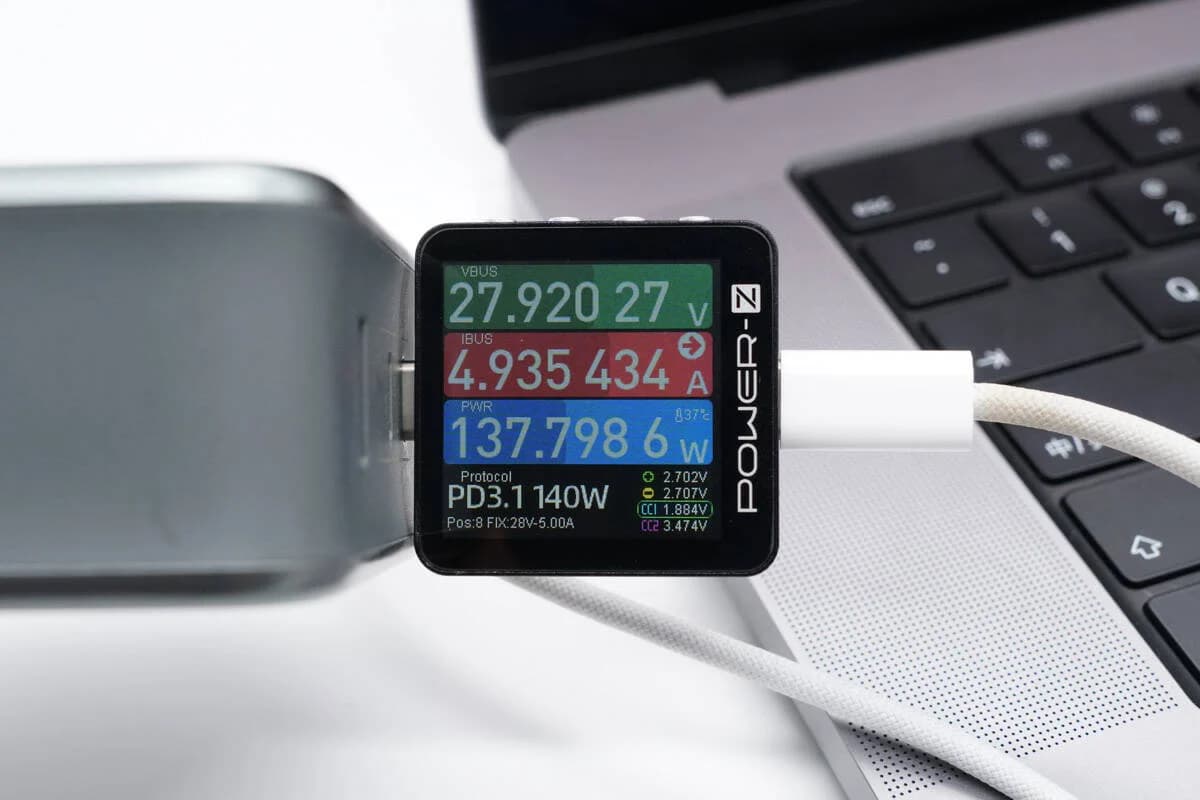
ChargerLAB POWER-Z KM003C showing live voltage, current and power while testing USB-C laptop charging.
1 / 5 · hero · hover to zoom

Photo: ChargerLAB

Key facts

Voltage and current
0 to 50 V and up to 6 A continuous (240 W in USB PD)
Measurement gain error (manual)
0.05% and 0.25% for voltage, and the same 0.05% and 0.25% for current (the manual doesn't label the two columns); temperature drift 5 and 20 ppm/°C
Voltage and current accuracy (manual)
0.00002 V and 0.000003 A, as the manual prints them
Measurement hardware
20-bit data acquisition; ARM Cortex-M4 processor
Ports
USB-C plug (input) and USB-C receptacle (output), each supporting USB4 Gen 3 (bidirectional), plus a separate USB-C HID port for a PC or power supply (driver-free per the manual)
Pin ratings
D+/D- and CC pins withstand 50 V; input impedance above 800 kΩ; 4 kV anti-surge
Reverse voltage
No reverse-voltage protection (manual)

Which version should you buy?

This page covers: POWER-Z KM003C tester alone, sold by ChargerLAB.

  • POWER-Z KM003C tester

    This page

    Model: KM003C

    What differs
    USB-C tester with PD 3.2 support, a rotating display and a 50 V, 6 A rating (240 W in PD).
    Best for
    USB-C charger and cable testing, with PC-based PD analysis.
  • POWER-Z KM002C tester

    Model: KM002C

    What differs
    Related model with a stated limit of 10 A. Current above 8 A cannot be tested continuously.
    Best for
    Bench users specifically needing the KM002C higher-current option.
  • POWER-Z KM002C Lite tester

    Model: KM002C Lite

    What differs
    Lite version with an 8.1 A limit and no ADC-chip temperature readout; current above 8 A is not continuous.
    Best for
    USB-C testing where the Lite current limit is sufficient and ADC-chip temperature is unnecessary.

Watch out

  • KM003C, KM002C and KM002C Lite are different models; their current limits differ.
  • Other-seller titles such as 'Latest Version', 'Metal' or 'Black' do not establish a separate KM003C model.
  • Check that the seller is ChargerLAB; its support page says it has not authorized other sellers.

Why people pick it

  • Reads a USB-C cable's e-marker and lists a charger's power profiles (PDOs)
  • Covers USB PD 3.1 EPR with a 50 V, 6 A rating (240 W in PD)
  • Full USB PD protocol analyzer and data capture with the PC software
  • Tiny: 16.5 g, with a screen that rotates with the meter

Know before you buy

  • No reverse-voltage protection, per ChargerLAB's manual
  • USB-C only: no USB-A port
  • Protocol analysis, long logs and firmware updates need the Windows PC software
  • Some USB 2.0 devices, such as mice and keyboards, may not work through the tester because of a hardware issue, per ChargerLAB

Full specifications

Voltage and current0 to 50 V and up to 6 A continuous (240 W in USB PD)
Measurement gain error (manual)0.05% and 0.25% for voltage, and the same 0.05% and 0.25% for current (the manual doesn't label the two columns); temperature drift 5 and 20 ppm/°C
Voltage and current accuracy (manual)0.00002 V and 0.000003 A, as the manual prints them
Measurement hardware20-bit data acquisition; ARM Cortex-M4 processor
PortsUSB-C plug (input) and USB-C receptacle (output), each supporting USB4 Gen 3 (bidirectional), plus a separate USB-C HID port for a PC or power supply (driver-free per the manual)
Pin ratingsD+/D- and CC pins withstand 50 V; input impedance above 800 kΩ; 4 kV anti-surge
Reverse voltageNo reverse-voltage protection (manual)
Operating temperature-10 to +65°C
USB PDSupports PD 3.2 (backward compatible), with SPR AVS added in a tester firmware update and PD 3.2 packet capture added in a PC software update; USB PD protocol analyzer with the PC software
TestsVoltage and current, capacity and energy, e-marker readout, PDO (power profile) list, fast-charge protocol detection and triggering
Protocols (ChargerLAB's list)PD 3.1 and 3.2, QC4+, QC5, AFC, FCP, SCP, PE, VFCP, SVOOC, UFCS and others
Current directionDetects current in either direction
Display1.54 in 240 × 240 IPS screen that rotates with the meter
Data captureThe PC software captures up to 10 million data points at a time; 4 MB on-board flash
LanguagesEnglish and Chinese
Size36.5 × 35.5 × 8.7 mm (1.44 × 1.4 × 0.34 in)
Weight16.5 g (0.58 oz)

From manufacturer documentation, checked November 2, 2026. Spotted an error? Tell us.

Featured in

Alternatives to consider