

Best picks
Best Analog Multimeters for Modern Use in 2026
Which analog multimeters you can still buy new, and when a needle earns its place: the Simpson 260-8P LED, 260-8P, Sanwa EM7000 and YX360TRF compared.
By thisMETER EditorialUpdated November 5, 20269 min read4 picks
On this page · Our picks at a glance
Our picks at a glance
- 1
Servicing, trend watching, dim spaces
Choose for: Servicing, trend watching, dim spaces
Check before buying: The manual states that the electronic overload system excludes the 1V, 10A, 50 μA, 250mV and 500/1000V AC and DC ranges, and that the 0-10A range is not fused.
- 2
Proven bench and field work
Choose for: Proven bench and field work
Check before buying: The 260-8P is the protected standard model the LED version builds on when you do not need the lighting.
- 3
Show all 4 picks
- 4
Learning, carry, general bench checks
Choose for: Learning, carry, general bench checks
Check before buying: DC voltage is 0.1/0.25/2.5/10/50 V at 20 kΩ/V input impedance, but 250/1000 V at only 9 kΩ/V — roughly half the Simpson's sensitivity on the upper ranges.
Analog multimeters you can buy new today are fewer than a decade ago, but the survivors are genuinely useful: for watching a trend move, spotting a null, or teaching what a measurement actually does to a circuit. For modern use, our pick is the Simpson 260-8P LED Lighted, the newest model in the 260 family — a resettable overload relay, audible continuity and a USB-rechargeable lighted dial in one current-production instrument. For low circuit loading, the Sanwa EM7000; for a compact carry and learning meter, the Sanwa YX360TRF; the proven Simpson 260-8P remains the standard protected workhorse. Recommendations are based on maker pages and manuals, checked November 5, 2026; this page is the modern-use companion to our full analog roundup.
- 36measurement ranges on the current Simpson 260-8P LED, per its sell sheet
- 20,000 Ω/VDC voltage sensitivity of both Simpson picks, per their manuals
- 500 hoursSanwa EM7000 6F22 meter-drive battery life, continuous with power on and inputs open, per its manual
Quick picks: match the needle to the job
Compare specifications and all conditions
Servicing, trend watching, dim spaces
- Our pick
- Simpson 260-8P LED
- What earns its place
- Lighted gasketed dial, relay protection, audible continuity
- What to check
- Relay protection excludes several ranges; the 10 A range is unfused
Proven bench and field work
- Our pick
- Simpson 260-8P
- What earns its place
- Resettable overload relay and audible continuity, classic phenolic case
- What to check
- Same relay range exclusions; 9 V battery must be installed and tested
Delicate high-resistance circuits
- Our pick
- Sanwa EM7000
- What earns its place
- FET input with approximately 2.5 MΩ–12 MΩ DC input resistance by range
- What to check
- Needs power and electrical zero adjustment for every measurement
Learning, carry, general bench checks
- Our pick
- Sanwa YX360TRF
- What earns its place
- Drop-shock-proof taut-band movement in a one-body case
- What to check
- 9 kΩ/V sensitivity on its upper DC ranges; AC accuracy is sine-wave based
Full comparison table
Swipe to compare. Row labels stay visible.
| Your job | Our pick | What earns its place | What to check |
|---|---|---|---|
| Servicing, trend watching, dim spaces | Simpson 260-8P LED | Lighted gasketed dial, relay protection, audible continuity | Relay protection excludes several ranges; the 10 A range is unfused |
| Proven bench and field work | Simpson 260-8P | Resettable overload relay and audible continuity, classic phenolic case | Same relay range exclusions; 9 V battery must be installed and tested |
| Delicate high-resistance circuits | Sanwa EM7000 | FET input with approximately 2.5 MΩ–12 MΩ DC input resistance by range | Needs power and electrical zero adjustment for every measurement |
| Learning, carry, general bench checks | Sanwa YX360TRF | Drop-shock-proof taut-band movement in a one-body case | 9 kΩ/V sensitivity on its upper DC ranges; AC accuracy is sine-wave based |
Scroll horizontally to see every column
| Your job | Our pick | What earns its place | What to check |
|---|---|---|---|
| Servicing, trend watching, dim spaces | Simpson 260-8P LED | Lighted gasketed dial, relay protection, audible continuity | Relay protection excludes several ranges; the 10 A range is unfused |
| Proven bench and field work | Simpson 260-8P | Resettable overload relay and audible continuity, classic phenolic case | Same relay range exclusions; 9 V battery must be installed and tested |
| Delicate high-resistance circuits | Sanwa EM7000 | FET input with approximately 2.5 MΩ–12 MΩ DC input resistance by range | Needs power and electrical zero adjustment for every measurement |
| Learning, carry, general bench checks | Sanwa YX360TRF | Drop-shock-proof taut-band movement in a one-body case | 9 kΩ/V sensitivity on its upper DC ranges; AC accuracy is sine-wave based |
For purely numerical checks, a digital meter is the better buy; see our best multimeters guide.
Best current analog multimeter: Simpson 260-8P LED
This is the newest instrument in the 260 family and the one we would buy for modern service work. Simpson's 260-8P LED page describes a lighted dial with a gasketed cover for particulate and moisture protection, a rechargeable USB lighting system, a battery charge indicator, an LED flashlight, and an LED-plus-sound continuity indicator — with 36 measurement ranges and the resettable overload relay carried over from the 260-8P.
The LED features answer the classic analog complaints. The manual's LED section explains that the dial light, a push-button flashlight on the back, and a continuity light below the glass all run from a USB rechargeable battery, with a front charge indicator that is on while charging and off when full. Replacing that internal battery is factory-only and voids the warranty if the owner services it.
The 260-8P LED adds its rechargeable lighting and continuity LED system to the 260-8P measurement circuits, while retaining the standard model's 1.5 V D and 9 V batteries. The sell sheet lists DC voltage ranges of 250mV, 1V, 2.5V, 10V, 25V, 50V, 250V, 500V, 1000V at 2% of full scale and 20KΩ per volt sensitivity; AC voltage at 3% of full scale and 5KΩ per volt; and the same fuses as the standard model — an F1 1A, 250V type 3AG quick-acting fuse and an F2 2A, 600V high-energy fuse. The manual states that the electronic overload system excludes the 1V, 10A, 50 μA, 250mV and 500/1000V AC and DC ranges, and that the 0-10A range is not fused.
See the Simpson 260-8P LED page.
Best proven workhorse: Simpson 260-8P
The 260-8P is the protected standard model the LED version builds on when you do not need the lighting. Its manual specifies the mirrored dial, 20,000 ohms per volt DC sensitivity, 5,000 ohms per volt AC sensitivity, and a 0-25V AC/DC range plus a continuity test alarm among its listed new features.
Its protection needs the same qualification as the LED model: the relay excludes the 1V, 10A, 50 μA, 250mV and 500/1000V ranges, and the 10 A range is unfused. The 9V battery runs both the R X 10,000 resistance range and the protection circuit, and the manual requires that battery to be installed and tested before the instrument is ready for use. Voltage and current measurements themselves do not draw meter power, but that installed and tested 9 V battery is required for the overload-protection circuit.
If you are comparing the standard 260-8 against the 260-8P, the letter P buys the relay and the audible continuity — not finer DC voltage accuracy, which is 2% of full scale across the family. Our full analog roundup covers that comparison in detail.
Best for low circuit loading: Sanwa EM7000
The EM7000 is the modern answer to the analog meter's oldest weakness: loading the circuit you measure. Sanwa's product page describes it as a high-sensitivity FET electronic tester with high input resistance of 2.5M–12MΩ for DCV, and its manual's range table gives the detail: approximately 2.5 MΩ on 0.3 V, 12 MΩ on 1.2 V, 11 MΩ on 3 V, and 10 MΩ on each of the 12/30/120/300/1000 V ranges — ordinary DC voltage accuracy is ±3% against full scale. It also measures a 0.12 µA DC current range, resistance from 0.2Ω to 200MΩ, and offers a zero-center NULL function for ± DC voltage.
The trade-offs are preparation and limits. The FET amplifier needs power — R6P or SUM-3 1.5 V batteries ×2 plus a 6F22 9 V cell — and an electrical zero adjustment before measuring. The manual rates the 6F22 meter-drive circuit for 500 hours of continuous operation with the power switch on and the input terminals open. Current from 3 to 6 A is limited to 30 seconds of continuous measurement because the shunt resistor overheats, and the manual forbids use on circuits exceeding 6 kVA or on lines connected to equipment generating induced or surge voltages. Its overload protection is by diode and fuse; for the Ω function the circuit is protected only at the input of positive polarity.
Best compact learning and carry meter: Sanwa YX360TRF
The YX360TRF is the practical choice when the needle is for learning, classroom use or a carry kit. Sanwa's product page highlights a case and instrument in one body, a drop-shock-proof taut-band design, a zero-center NULL meter, resistance to 200MΩ measured at low voltage, and capacitance, dB and Li (load current) measurement. The manual adds hFE transistor graduations and optional HV and hFE probes.
Read its input figures before buying. DC voltage is 0.1/0.25/2.5/10/50 V at 20 kΩ/V input impedance, but 250/1000 V at only 9 kΩ/V — roughly half the Simpson's sensitivity on the upper ranges. Accuracy is ±3% of full scale on the 0.25/2.5/10/50 V DC ranges and ±5% of full scale on the 0.1 V and NULL ranges; AC voltage is ±4% of full scale, and the AC specification is qualified for sine waves. The circuit is protected by fuse even when voltage of up to AC 230 V is impressed on each range for 5 seconds. Maker specifications list two 1.5 V R6 or UM-3 batteries and a mass of approximately 320 g; the instruction manual's accessory list includes a hand strap and instruction manual, with the body cover doubling as a stand.
Compare the current models
Simpson 260-8P LED
- DC input
- 20,000 Ω/V
- DC voltage accuracy
- 2% of full scale
- Protection
- Relay with range exclusions, fuses, diodes
All specifications
- Batteries
- 1.5 V D cell, 9 V, plus rechargeable lighting battery
Simpson 260-8P
- DC input
- 20,000 Ω/V
- DC voltage accuracy
- 2% of full scale
- Protection
- Relay with range exclusions, fuses, diodes
All specifications
- Batteries
- 1.5 V D cell, 9 V
Sanwa EM7000
- DC input
- Approx. 2.5 MΩ–12 MΩ, range dependent
- DC voltage accuracy
- ±3% against full scale
- Protection
- Diode and fuse; Ω input protected only at positive polarity
All specifications
- Batteries
- 1.5 V ×2, 9 V ×1
Sanwa YX360TRF
- DC input
- 20 kΩ/V lower DC ranges, 9 kΩ/V upper
- DC voltage accuracy
- ±3% / ±5% of full scale
- Protection
- Fuse protected to AC 230 V for 5 seconds
All specifications
- Batteries
- 1.5 V ×2
Full comparison table
Swipe to compare. Row labels stay visible.
| Model | DC input | DC voltage accuracy | Protection | Batteries |
|---|---|---|---|---|
| Simpson 260-8P LED | 20,000 Ω/V | 2% of full scale | Relay with range exclusions, fuses, diodes | 1.5 V D cell, 9 V, plus rechargeable lighting battery |
| Simpson 260-8P | 20,000 Ω/V | 2% of full scale | Relay with range exclusions, fuses, diodes | 1.5 V D cell, 9 V |
| Sanwa EM7000 | Approx. 2.5 MΩ–12 MΩ, range dependent | ±3% against full scale | Diode and fuse; Ω input protected only at positive polarity | 1.5 V ×2, 9 V ×1 |
| Sanwa YX360TRF | 20 kΩ/V lower DC ranges, 9 kΩ/V upper | ±3% / ±5% of full scale | Fuse protected to AC 230 V for 5 seconds | 1.5 V ×2 |
Scroll horizontally to see every column
| Model | DC input | DC voltage accuracy | Protection | Batteries |
|---|---|---|---|---|
| Simpson 260-8P LED | 20,000 Ω/V | 2% of full scale | Relay with range exclusions, fuses, diodes | 1.5 V D cell, 9 V, plus rechargeable lighting battery |
| Simpson 260-8P | 20,000 Ω/V | 2% of full scale | Relay with range exclusions, fuses, diodes | 1.5 V D cell, 9 V |
| Sanwa EM7000 | Approx. 2.5 MΩ–12 MΩ, range dependent | ±3% against full scale | Diode and fuse; Ω input protected only at positive polarity | 1.5 V ×2, 9 V ×1 |
| Sanwa YX360TRF | 20 kΩ/V lower DC ranges, 9 kΩ/V upper | ±3% / ±5% of full scale | Fuse protected to AC 230 V for 5 seconds | 1.5 V ×2 |
None of these meters carries a modern measurement category (CAT) rating in the documents we fetched; the Simpson's 1000V AC/DC rated circuit-to-ground voltage is a limit, not a category rating. For household mains work, prefer a CAT-rated digital meter — see our multimeter basics guide and best multimeters.
How we choose
This is a document-based shortlist: we compared maker product pages, exact-model manuals, sell sheets and spec tables, checked November 5, 2026, with no original instrument measurements. We favored models that are current production — Simpson lists the 260-8P LED as a NEW product and Sanwa lists both its picks on current product pages — and we flag every protection exclusion and battery requirement the manuals state. Hioki's 3030-10 page marks that long-popular analog tester Discontinued and lists the digital multimeter DT4256 alongside it, which is why it is absent here. Our selection method explains the broader approach.
Buying guide: what to verify before you buy a needle
Sensitivity is a range-scaled load. Ohms per volt is not a fixed impedance. Simpson's glossary explains that a 1000 ohms per volt meter has resistance of 150,000 ohms on its 150 volt range and 300,000 ohms on its 300 volt range. The same scaling applies to a 20,000 Ω/V meter: the selected range sets the load the meter places across the circuit, which is why the EM7000's FET input matters on high-resistance electronics. Sensitivity also varies within one meter — the YX360TRF's 250/1000 V ranges are 9 kΩ/V.
Full-scale accuracy punishes small readings. Simpson's manual works the example: 2% of full scale on the 10 volt range allows an error of ±0.20 V at any point on the dial. Readings near the top of the chosen range are the trustworthy ones; a small indication on a large range carries the same absolute allowance.
Plan the batteries and accessories with the meter. The Simpsons need their D cell and 9 V battery for resistance (and the relay), with the 9 V battery required and tested before use; the EM7000 needs power for everything and rates its 6F22 meter-drive circuit for 500 hours continuous with power on and inputs open. Sanwa's brochure lists a spare 0.5 A/250 V fuse, while the instruction manual's accessory specification also includes one, so confirm package contents before ordering. Replacement leads differ by maker: Simpson's included full-size leads have threaded probe tips and screw-on alligator clips (confirm the maker's current lead-set number before ordering), and Sanwa's TL-21a is specified for the EM7000 — buy the maker's specified type rather than a generic set.
Check current production
Confirm the model is listed on the maker's current pages, not a discontinued listing.
Check the input loading
Multiply sensitivity by the range you will use; or choose the FET-input EM7000 for high-resistance work.
Check the protection limits
Note which ranges the relay excludes, which current input is unfused, and what the fuse interrupt rating is.
Check batteries and leads
Order the specified battery types and the maker's lead set at the same time.
- Yes: Watching a trend, null or slow drift: a needle shows direction at a glance.
- Yes: Teaching measurement loading and scale reading: the YX360TRF is an inexpensive way in.
- Partly: High-resistance circuits: only if the input resistance per range is high enough, as on the EM7000.
- Partly: Mains and panel work: no fetched document here states a CAT rating; prefer a CAT-rated digital meter.
- No: Tight numerical accuracy: full-scale percentages cannot match a digital meter's percentage-of-reading spec.
Verdict
The Simpson 260-8P LED is the modern analog buy: current production, protected, audible, and usable in the dark. The 260-8P covers the same measurement ground for less, the Sanwa EM7000 is the pick when circuit loading is the problem, and the YX360TRF is the carry and classroom choice. For tight numerical accuracy, stay digital; use an analog needle for watching fluctuating trends and rates. For the full shortlist including the standard 260-8, read our best analog multimeters guide.
Frequently asked questions
Are analog multimeters still made?
Yes, but the field has narrowed. Simpson still builds 260-series VOMs in the USA, including the current 260-8P LED Lighted model. Sanwa currently lists analog multitesters including the YX360TRF and the FET-input EM7000. Hioki, by contrast, marks its 3030-10 analog tester discontinued and lists the digital multimeter DT4256 alongside it. Confirm the exact model and package with the seller before ordering.
What does 20,000 ohms per volt mean?
It is a sensitivity figure, not a fixed input resistance. Simpson's glossary explains that ohms per volt scales with the selected range: its example is a 1000 ohms per volt meter with 150,000 ohms on its 150 volt range and 300,000 ohms on its 300 volt range. Multiply the sensitivity by the range to get the resistance the meter places across the circuit. In high-resistance circuits that parallel load can pull the indicated voltage down.
Do analog multimeters need batteries?
For voltage and current, the passive Simpson models do not; their batteries power the resistance ranges, and on the 260-8P and 260-8P LED the 9 V battery also runs the overload relay circuit. The Sanwa EM7000 is different: it is an electronic tester whose FET amplifier needs power for all measurements, along with an electrical zero adjustment before use. Check the required battery types rather than assuming a meter works without them.
Is an analog multimeter more accurate than a digital one?
No. The Simpson manuals specify DC voltage as 2% of full scale; Simpson's own worked example shows that on the 10 volt range that allows an error of ±0.20 V at any point on the dial. Digital meters typically specify a percentage of reading. A moving needle buys trend visibility, not tighter accuracy, and readings near the top of the chosen range are the ones to trust.
Servicing, trend watching, dim spaces
Simpson 260-8P LED
Related guides
Buying guide · Multimeters
Professional Multimeter Buying Guide: Choose by Trade and Risk
Pick a professional multimeter by CAT category, working voltage, accuracy and calibration needs. Compare the Fluke 87V, 117, 289 and Fieldpiece SC640 by trade.
Buying guide · Multimeters
Fluke 87V Industrial Multimeter Buying: Which Version Should You Buy?
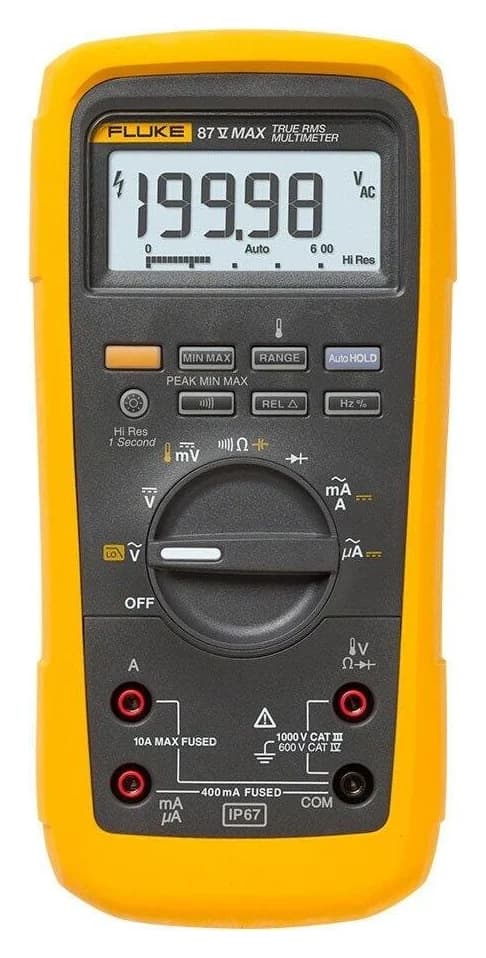
Pick the right Fluke 87V package for industrial work: standard, MAX, CAL, E2 kit or IMSK clamp kit. Compare IP ratings, CAT boundaries and box contents.
Best picks · Multimeters
Best Multimeters for Home Use and Electronics: Five Meters That Cover the Whole House
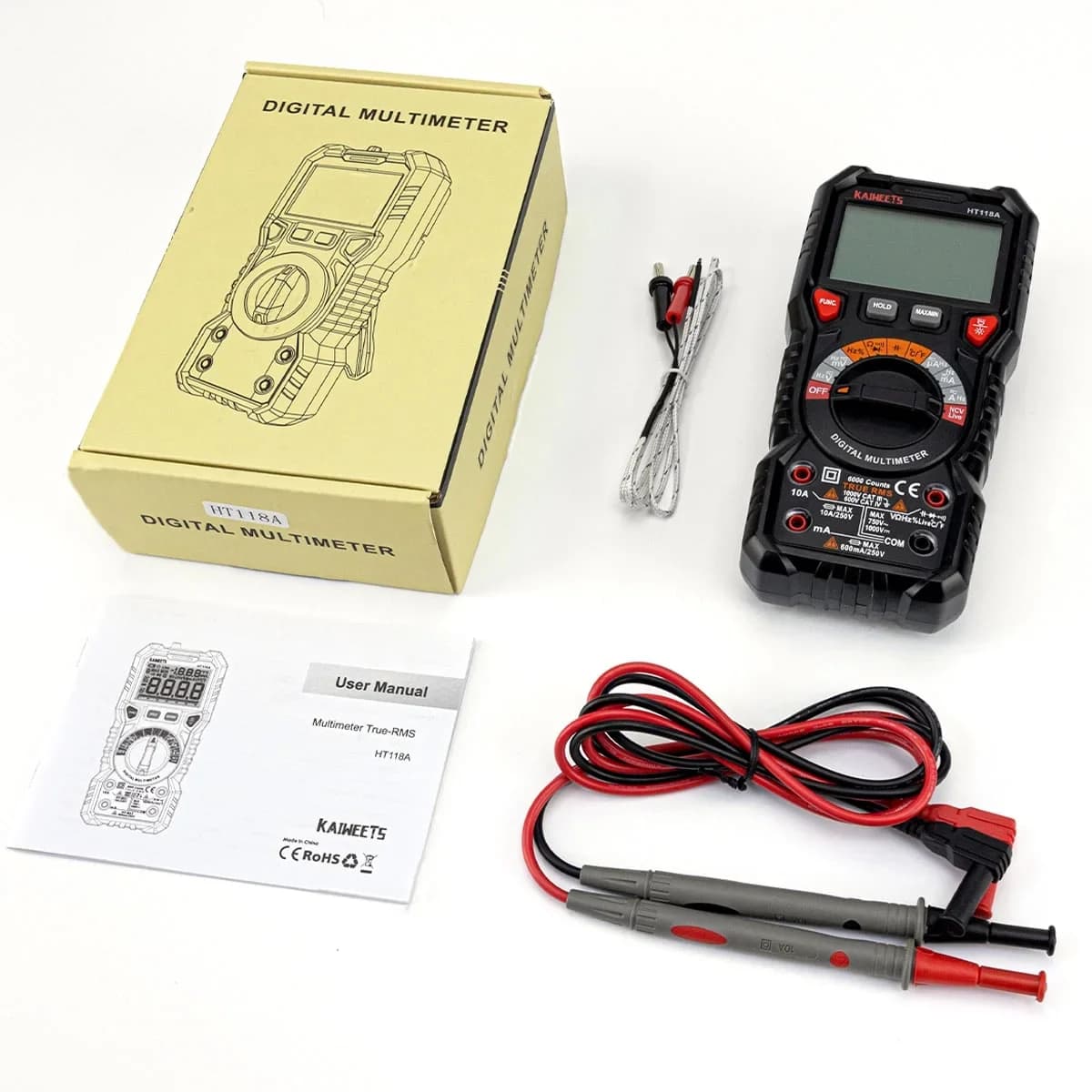
Pick a multimeter for home wiring and electronics work by safety rating, accuracy and fuse protection. Compare the KAIWEETS HT118A, Fluke 114, Brymen BM257s, Fluke 179 and Fluke 113.