

Best picks
Best Multimeters for Home Use and Electronics
Five Meters That Cover the Whole House
Pick a multimeter for home wiring and electronics work by safety rating, accuracy and fuse protection. Compare the KAIWEETS HT118A, Fluke 114, Brymen BM257s, Fluke 179 and Fluke 113.
By thisMETER EditorialUpdated November 5, 20268 min read5 picks
On this page · Our picks at a glance
Our picks at a glance
- 1
One meter for the whole house
1,000 V max · 10 A max
Choose for: One meter for the whole house
Check before buying: The official HT118A manual specifies 1000 V DC and 750 V AC; the 1000 V headline is not the AC measurement limit
- 2
Outlet, switch and breaker testing
Choose for: Outlet, switch and breaker testing
Check before buying: Most home electrical work is go/no-go: is this outlet live, is this switch closed, is that breaker leg dead.
- 3
Most documented features per dollar
Choose for: Most documented features per dollar
Check before buying: An access cover lets you replace the batteries and fuses without opening the case.
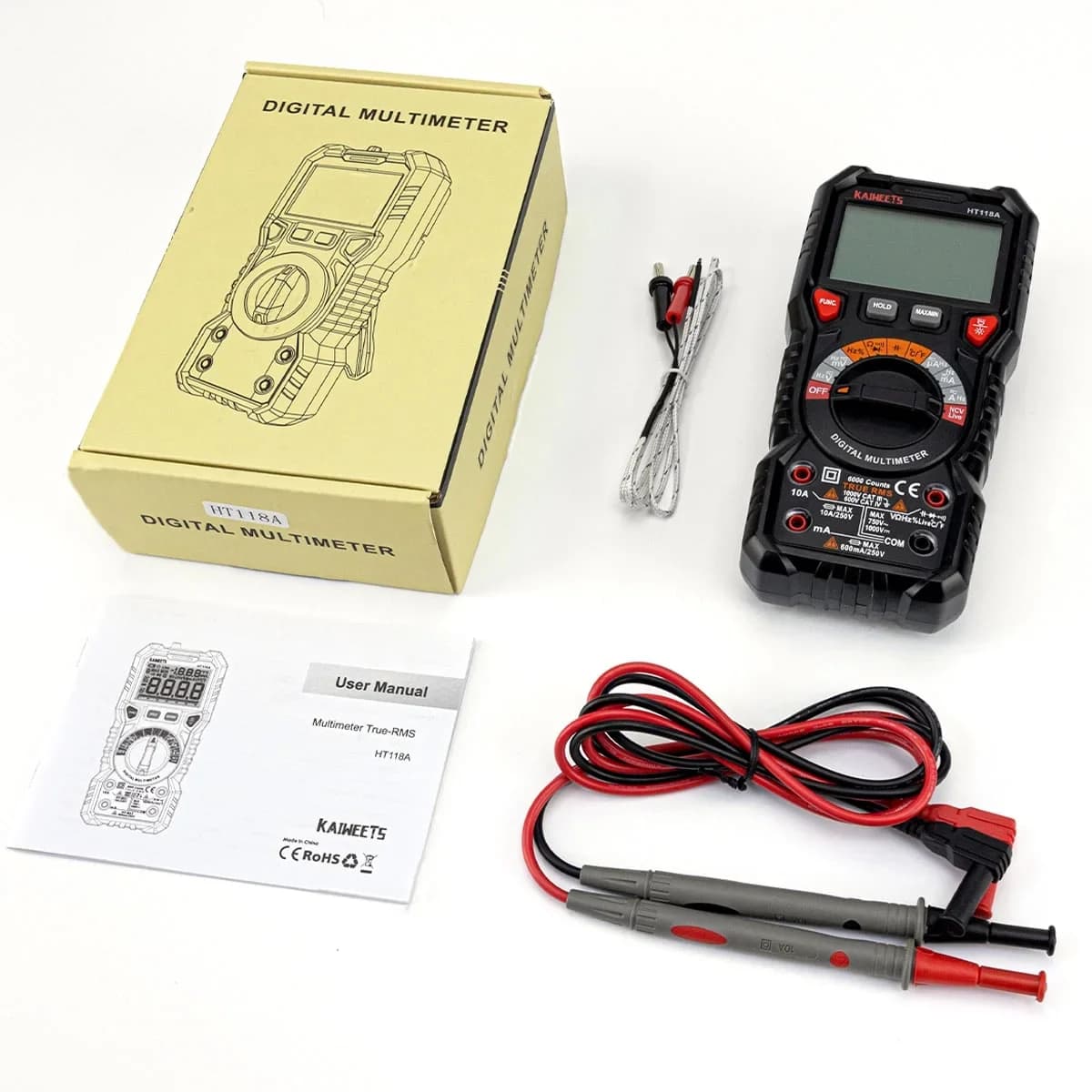
The KAIWEETS HT118A is the best multimeter for home use and electronics overall: it measures up to 600V AC/DC, 10A AC/DC current and 60 MOhms resistance, is rated CAT III 1000V and CAT IV 600V, has double ceramic fuse protection on its current inputs, and still tests temperature, capacitance, frequency and duty cycle. Choose the Fluke 114 if your work is almost entirely household electrical checks, the Brymen BM257s for the fullest documented feature set in a CAT III 600V meter, the Fluke 179 as the buy-it-once upgrade, and the Fluke 113 when voltage and continuity checks are all you need. Every specification here comes from the makers' own product pages and manuals.
Quick picks
Compare specifications and all conditions
One meter for the whole house
- Our choice
- KAIWEETS HT118A
- Why it wins
- CAT III 1000V / CAT IV 600V, fused current inputs, temperature and capacitance
Outlet, switch and breaker testing
- Our choice
- Fluke 114
- Why it wins
- AutoVolt plus LoZ kills ghost voltages; True-RMS 6000-count display
Most documented features per dollar
- Our choice
- Brymen BM257s
- Why it wins
- AutoCheck, LoZ, live-wire detection, PC logging, 1000V-rated fuses
The last meter you will buy
- Our choice
- Fluke 179
- Why it wins
- 1000V / 10A ranges, CAT III 1000V / CAT IV 600V, lifetime warranty
Voltage and continuity only
- Our choice
- Fluke 113
- Why it wins
- CAT IV 600V rating with VCHEK low-impedance voltage/continuity mode
Full comparison table
Swipe to compare. Row labels stay visible.
| Your priority | Our choice | Why it wins |
|---|---|---|
| One meter for the whole house | KAIWEETS HT118A | CAT III 1000V / CAT IV 600V, fused current inputs, temperature and capacitance |
| Outlet, switch and breaker testing | Fluke 114 | AutoVolt plus LoZ kills ghost voltages; True-RMS 6000-count display |
| Most documented features per dollar | Brymen BM257s | AutoCheck, LoZ, live-wire detection, PC logging, 1000V-rated fuses |
| The last meter you will buy | Fluke 179 | 1000V / 10A ranges, CAT III 1000V / CAT IV 600V, lifetime warranty |
| Voltage and continuity only | Fluke 113 | CAT IV 600V rating with VCHEK low-impedance voltage/continuity mode |
Scroll horizontally to see every column
| Your priority | Our choice | Why it wins |
|---|---|---|
| One meter for the whole house | KAIWEETS HT118A | CAT III 1000V / CAT IV 600V, fused current inputs, temperature and capacitance |
| Outlet, switch and breaker testing | Fluke 114 | AutoVolt plus LoZ kills ghost voltages; True-RMS 6000-count display |
| Most documented features per dollar | Brymen BM257s | AutoCheck, LoZ, live-wire detection, PC logging, 1000V-rated fuses |
| The last meter you will buy | Fluke 179 | 1000V / 10A ranges, CAT III 1000V / CAT IV 600V, lifetime warranty |
| Voltage and continuity only | Fluke 113 | CAT IV 600V rating with VCHEK low-impedance voltage/continuity mode |
New to all of this? Our beginner multimeter guide walks through the controls, and the main best-multimeters roundup covers specialist picks.
KAIWEETS HT118A: one meter for the whole house
The HT118A covers nearly every measurement a home asks for. It reads up to 600V AC/DC, 10A AC/DC and 60 MOhms, with a 6000-count, 2.9-inch backlit LCD and autoranging. For electronics, its voltage accuracy is ±(0.5%+3) and it measures frequency to 10MHz, capacitance and duty cycle. For the house, it tests temperature with the included K-type thermocouple and detects live wires without contact, with a sound-and-light alarm and a rear flashlight for panels and dim utility corners.
Safety is the reason it leads this list. It is IEC-rated CAT III 1000V and CAT IV 600V — the same category coverage as much costlier meters here — with double ceramic fuses, thermistor protection and high-voltage protection active on all ranges. The LED-lit jacks show where to plug the leads for each function, which prevents the most common beginner mistake.
KAIWEETS
A 6,000-count auto-ranging True RMS multimeter with non-contact voltage and live-wire detection, LED-lit input jacks, a flashlight and temperature measurement, rated CAT III 1000V and CAT IV 600V.
- 1,000 V max
- 10 A max
- 6,000 counts
- CAT III 1000V, CAT IV 600V
Fluke 114: the household electrical checker
Most home electrical work is go/no-go: is this outlet live, is this switch closed, is that breaker leg dead. The Fluke 114 is built for exactly that. Its AutoVolt function automatically switches between AC and DC voltage, and its LoZ low-impedance input drains ghost voltages — the stray readings induced in dead wires that run alongside live ones — so what you see is what is actually there. It displays True-RMS readings at 6000 counts and updates 4 per second, is CAT III 600V safety rated, and has a white LED backlight plus an easy-open battery door.
Its limits matter for electronics: it has no amps input and no capacitance or diode-test functions, though it does test frequency. Pair it with the electronics-focused picks if you also repair circuit boards.
Brymen BM257s: the documented feature-per-dollar pick
Brymen's BM257s is the sleeper on this list. The manual behind it documents everything a spec-conscious buyer wants: True RMS, a 6000-count display updating 5 per second, 0.2% basic DCV accuracy, current ranges from 600.0µA to 10.00A, capacitance to 3000µF, type-K temperature from -50°C to 1000°C, and a high-speed analog bar graph updating 40 times per second.
The BM257s separates itself with its safety engineering. Its µA/mA input is protected by a 0.4A/1000V fuse with a 30kA interrupt rating, its amps input by an 11A/1000V fuse with a 20kA interrupt rating, and the whole meter survives 6.5kV transient surges. The AutoCheck mode automatically selects LoZ DCV, LoZ ACV or ohms and warns you when a "resistance" measurement turns out to be a live circuit; EF detection finds live wiring both non-contact and with a single probe. An access cover lets you replace the batteries and fuses without opening the case.
Two cautions: its CAT IV rating is limited to 300V (CAT III covers 600V), so the Fluke 113, HT118A or 179 are better choices near the service entrance; and Brymen warns that the LoZ mode's roughly 2.1kΩ initial input impedance can load sensitive circuits, so use the high-impedance voltage modes for electronics. The BM251s, BM252s and BM255s siblings trade away features — only model 257 is True RMS.
Fluke 179: the buy-it-once upgrade
If you want the meter that HVAC techs and electricians have carried for decades, it is the Fluke 179. It measures 1000V AC/DC, 10A AC/DC, 50 MOhms resistance, capacitance to 10,000 µF, frequency to 100 kHz, and temperature from -40 °C to 400 °C with the included 80BK thermocouple. Its DC voltage accuracy of ±(0.09% + 2) is the tightest here, the display updates 4 times a second with a 33-segment bar graph, and it carries a lifetime warranty.
Its fuses match its rating ambitions: 0.44A, 1000V with a 10 kA interrupt rating for the mA input, and 11A, 1000V with a 17 kA interrupt rating for the amps input. Its input protection rating is CAT III 1000V and CAT IV 600V, enough for anything a house can present short of the utility side of the meter can. It lacks a LoZ ghost-voltage mode and non-contact detection, so a 114 or BM257s complements it rather than replaces it. Electricians should also see the best multimeters for electricians page.
Fluke 113: voltage, continuity, and the safest input rating
The Fluke 113 is deliberately not a do-everything meter. Its VCHEK LoZ function tests for AC or DC voltage or shows continuity from the same dial position, rejecting ghost voltages automatically, and Min/Max recording captures signal fluctuations. The display is 6000 counts updating 4 times a second.
What it buys you is the input rating: CAT IV 600V, and it is the simplest dial of the group to hand to a family member. The trade is absolute: it does not measure current, and Fluke notes the minimum measurable VCHEK input is 3 VDC, so low-voltage electronics work points elsewhere.
How to choose: safety, then accuracy, then features
Safety ratings come first
A home multimeter must survive the transient spikes that ride on household wiring, and that is what CAT ratings certify. Fluke's examples place single-phase receptacle-connected loads in CAT II and three-phase distribution, fixed-location equipment, feeders, short branch circuits, and appliance outlets with short connections to the service entrance in CAT III. Fluke's rule is to choose a tool rated for the highest category you could potentially use it in — a CAT III-1000V or CAT IV-600V rating also satisfies a CAT III-600V need.
- CAT III 600V, the home baseline, covers outlets, switches, panels and branch circuits
- CAT III 1000V / CAT IV 600V, held by the HT118A and Fluke 179, adds service-entrance margin
- 1000V-rated current fuses, in the BM257s and Fluke 179, protect the amps input path
- 6.5kV surge protection on the BM257s covers switching and lightning-induced transients
Accuracy and resolution at household voltages
At a 120V outlet, a meter's basic DC accuracy dominates the error budget, and every pick here is comfortably precise: the Fluke 179's ±(0.09% + 2) and the BM257s's 0.2% basic DCV accuracy are bench-adjacent, while the HT118A's ±(0.5%+3) is fine for every household decision. For battery and logic-level electronics work, a 6000-count display resolving 0.1 mV on low ranges — which all five picks have — is the practical sweet spot.
Why True RMS is not optional anymore
Homes are full of nonlinear loads: LED bulbs, computer power supplies, variable-speed furnace blowers. Fluke's engineering note is blunt — an averaging meter attempting to measure distorted waves can be up to 40% low or 10% high in its calculations. A True-RMS meter is the only kind that accurately measures both sinusoidal and non-sinusoidal AC waveforms, so it is a hard requirement on this page.
The accessory checklist
What ships in the box decides whether the meter is usable on day one.
- Fused current inputs with published ratings (all current-measuring picks here)
- Test leads rated to the meter's category (each maker specifies supplied leads)
- K-type thermocouple included: HT118A, BM257s and Fluke 179
- Batteries included and user-replaceable without opening the case
- Backlight for panels and dim spaces (all five picks)
How to match the meter to the job
List the measurements: outlet voltage, breaker continuity, battery tests, circuit-board diagnostics, appliance current draw
Rate the highest-energy point you will touch: outlet, panel, or service entrance
Pick the CAT rating for that point, then the tightest accuracy your budget allows
Confirm the current-input fuses are rated 1000V, and that the package includes leads and batteries
For appliance and whole-circuit current, remember the 10A limit of every direct-reading meter here and see clamp meter versus multimeter for the right tool. For tighter budgets, the budget multimeter guide covers safe low-cost options.
Gift and holiday buying: the exact-package checklist
The holiday-season difference between a great gift and a drawer ornament is the package. Before any gift or Black Friday purchase, verify the exact contents from the maker's listing, not the seller's blurb.
- KAIWEETS HT118A ships with test leads, a K-type thermocouple, AAA batteries and a user manual — complete out of the box.
- Fluke 179 ships with the 80BK temperature probe, an installed 9V battery, test leads and a quick reference guide.
- Brymen BM257s ships with a test lead pair, installed batteries, the user's manual and the BKP60 thermocouple; the USB PC-logging kit BRUA-20X is an optional purchase.
- Fluke 114 and 113 ship with test leads and an installed battery in their standard US packages.
- Watch for "bulk" or "bare meter" listings that drop the leads or thermocouple, and for seller-typed content that invents ranges the maker's manual does not list.
Verdict
For one meter that safely covers the house and the bench, buy the KAIWEETS HT118A. Spend on the Fluke 179 if this is a decades-long purchase; pick the Brymen BM257s if you want every feature documented and a PC-logging path; keep a Fluke 114 for outlet-and-switch work; choose the Fluke 113 for the simplest, highest-rated voltage checker. Whatever you choose, buy it by the maker's published CAT rating and fuse specifications — those two numbers are what keep a household meter safe.
Frequently asked questions
What safety rating should a home multimeter have?
Buy a meter rated for the highest category you could ever use it in. Fluke defines CAT II as single-phase receptacle-connected loads and CAT III as three-phase distribution and equipment in fixed locations; its examples also place feeders, short branch circuits, and appliance outlets with short connections to the service entrance in CAT III. Meters rated CAT III 1000V or CAT IV 600V, like the KAIWEETS HT118A and Fluke 179, add margin for higher-energy points.
Do I need True RMS for home measurements?
Yes, if the circuit feeds anything electronic. An averaging meter can read up to 40% low or 10% high on the distorted waveforms produced by computers, LED lighting and variable-speed drives. All five picks here, including the KAIWEETS HT118A, Fluke 114, Brymen BM257s and Fluke 179, specify True-RMS measurement.
Why do fuses matter in a multimeter?
Measuring current in the amps jack on an energized circuit is the classic way home users destroy a meter, because the amps input is nearly a short circuit. The fuse is what blows instead of the meter or the user. The Brymen BM257s uses a 0.4A/1000V fuse with a 30kA interrupt rating and an 11A/1000V fuse with a 20kA interrupt rating; the Fluke 179 specifies 0.44A and 11A fuses, both 1000V. Cheap meters with glass fuses or no published ratings are the ones to avoid.
Is 6000 counts enough resolution for electronics?
For household and most hobby electronics work, yes. A 6000-count display resolves to 0.001 V (1 mV) on a 6 V range — 0.1 mV on its 600 mV range — which is finer than most repair work requires. More counts matter for precision analog design, where a bench meter is the better tool anyway.
Can these meters measure household current draw?
Only the current-input meters (KAIWEETS HT118A, Brymen BM257s and Fluke 179) measure amps directly, and all three are limited to 10A continuous, with the BM257s allowing up to 20A for 30 seconds. For measuring an appliance or a whole circuit while it runs, use a clamp meter instead; see our clamp meter versus multimeter guide.
Which of these makes the best gift?
The KAIWEETS HT118A comes with test leads, a K-type thermocouple, batteries and a user manual, which makes it the most complete gift package on this page, and its non-contact voltage detection plus flashlight suit a first-time homeowner. The Fluke 179 is the gift for someone who will keep one meter for decades.

Related guides
Buying guide · Multimeters
Professional Multimeter Buying Guide: Choose by Trade and Risk
Pick a professional multimeter by CAT category, working voltage, accuracy and calibration needs. Compare the Fluke 87V, 117, 289 and Fieldpiece SC640 by trade.
Buying guide · Multimeters
Fluke 87V Industrial Multimeter Buying: Which Version Should You Buy?
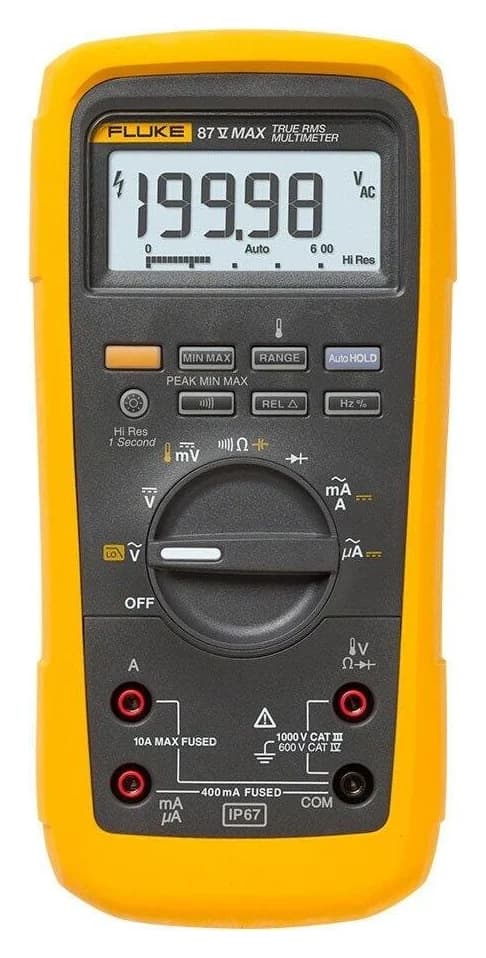
Pick the right Fluke 87V package for industrial work: standard, MAX, CAL, E2 kit or IMSK clamp kit. Compare IP ratings, CAT boundaries and box contents.
Buying guide · Multimeters
Good Multimeter Buying Guide: How to Recognize One Before You Buy
A good multimeter matches the highest-energy job you'll ever do with it. Accuracy, ranges, CAT rating, fuses, leads and repairability — explained before you buy.