

Buying guide
Professional Multimeter Buying Guide
Choose by Trade and Risk
Pick a professional multimeter by CAT category, working voltage, accuracy and calibration needs. Compare the Fluke 87V, 117, 289 and Fieldpiece SC640 by trade.
By thisMETER EditorialUpdated November 5, 202612 min read4 picks
On this page · Our picks at a glance
Our picks at a glance
- 1
CAT III 1000 V / CAT IV 600 V, low-pass filter, peak capture
Choose for: CAT III 1000 V / CAT IV 600 V, low-pass filter, peak capture
Limit: 6000 counts (19,999 in high-resolution mode); CAL version if you need the certificate
- 2
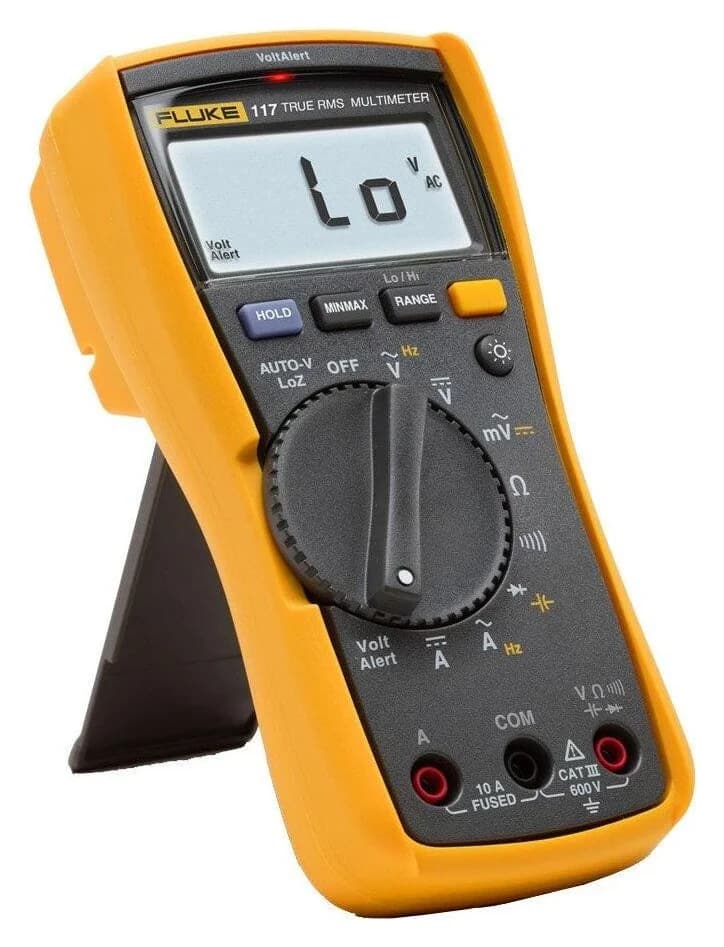
VoltAlert, AutoVolt, low-impedance mode; CAT III 600 V
600 V max · 10 A max
Choose for: Electrical troubleshooting with True RMS and a low-impedance mode for ghost voltage.
Limit: CAT III 600 V, not CAT IV; no mA/µA current ranges (the 6 A range resolves 1 mA).
- 3
Interval/event logging with time stamps and on-meter TrendCapture
Choose for: Interval/event logging with time stamps and on-meter TrendCapture
Limit: PC transfer needs the optional infrared interface and software
Show all 4 picks
- 4
400 A jaw, microamps DC, temperature, capacitance, inrush in one meter
Choose for: 400 A jaw, microamps DC, temperature, capacitance, inrush in one meter
Limit: AC-only jaw; PTC instead of a replaceable fuse
For professionals buying a meter for paid work, buy for the highest-energy job you actually perform, not the feature list: our industrial pick is the Fluke 87V (CAT III 1000 V / CAT IV 600 V), the Fluke 117 is the electrician's tool for branch-circuit troubleshooting, the Fluke 289 adds long unattended logging, and the Fieldpiece SC640 bundles the electrical and thermal ranges HVACR service needs in one clamp meter. Every rating and number below comes from the makers' own product pages and manuals, checked November 5, 2026; we have not tested these instruments.
- CAT IV 600VThe 87V's input rating, per Fluke, for service-entrance-adjacent energy levels
- ±(0.05% + 1)The 87V's DC-volt accuracy specification from Fluke's spec table
- 50,000 countsThe 289's display resolution, per Fluke
- 500 µA DCThe SC640's smallest current range, for flame-rectifier tests
Quick picks: match the meter to the job's energy and paperwork
Compare specifications and all conditions
Industrial, motor drives, feeders
- Our pick
- Fluke 87V
- Why it earns the job
- CAT III 1000 V / CAT IV 600 V, low-pass filter, peak capture
- Check before buying
- 6000 counts (19,999 in high-resolution mode); CAL version if you need the certificate
Electricians, commercial/residential
- Our pick
- Fluke 117
- Why it earns the job
- VoltAlert, AutoVolt, low-impedance mode; CAT III 600 V
- Check before buying
- 10 A fused input; no service-entrance rating
Predictive maintenance, unattended monitoring
- Our pick
- Fluke 289
- Why it earns the job
- Interval/event logging with time stamps and on-meter TrendCapture
- Check before buying
- PC transfer needs the optional infrared interface and software
HVACR field service
- Our pick
- Fieldpiece SC640
- Why it earns the job
- 400 A jaw, microamps DC, temperature, capacitance, inrush in one meter
- Check before buying
- AC-only jaw; PTC instead of a replaceable fuse
Full comparison table
Swipe to compare. Row labels stay visible.
| Your work | Our pick | Why it earns the job | Check before buying |
|---|---|---|---|
| Industrial, motor drives, feeders | Fluke 87V | CAT III 1000 V / CAT IV 600 V, low-pass filter, peak capture | 6000 counts (19,999 in high-resolution mode); CAL version if you need the certificate |
| Electricians, commercial/residential | Fluke 117 | VoltAlert, AutoVolt, low-impedance mode; CAT III 600 V | 10 A fused input; no service-entrance rating |
| Predictive maintenance, unattended monitoring | Fluke 289 | Interval/event logging with time stamps and on-meter TrendCapture | PC transfer needs the optional infrared interface and software |
| HVACR field service | Fieldpiece SC640 | 400 A jaw, microamps DC, temperature, capacitance, inrush in one meter | AC-only jaw; PTC instead of a replaceable fuse |
Scroll horizontally to see every column
| Your work | Our pick | Why it earns the job | Check before buying |
|---|---|---|---|
| Industrial, motor drives, feeders | Fluke 87V | CAT III 1000 V / CAT IV 600 V, low-pass filter, peak capture | 6000 counts (19,999 in high-resolution mode); CAL version if you need the certificate |
| Electricians, commercial/residential | Fluke 117 | VoltAlert, AutoVolt, low-impedance mode; CAT III 600 V | 10 A fused input; no service-entrance rating |
| Predictive maintenance, unattended monitoring | Fluke 289 | Interval/event logging with time stamps and on-meter TrendCapture | PC transfer needs the optional infrared interface and software |
| HVACR field service | Fieldpiece SC640 | 400 A jaw, microamps DC, temperature, capacitance, inrush in one meter | AC-only jaw; PTC instead of a replaceable fuse |
Trade-by-trade detail continues in our electricians, HVAC and industrial model guides.
Best industrial multimeter: Fluke 87V
The 87V is the industrial floor. Fluke's 87V page specifies inputs updated to the third edition of EN 61010-1 to CAT III 1000 V and CAT IV 600 V, designed to withstand spikes of more than 8000 V, and it supports accurate measurements on variable-frequency drives using a low-pass filter while capturing intermittents as fast as 250 µS with Peak Capture. Fluke states the 87V is designed and built in the U.S. and carries a lifetime warranty.
See the 87V on Fluke's site; the owner confirms purchase links separately.
- Accuracy and resolution: DC volts ±(0.05% + 1) with 10 µV maximum resolution; 6000 counts, updating 4 per second, with a 19,999-count high-resolution mode; a 32-segment analog bar graph updates 40 per second
- Ranges: 1000 V AC/DC, 10 A AC/DC (20 A for 30 seconds maximum), 50 MΩ resistance, 9999 µF capacitance, temperature from -200.0 °C to 1090 °C excluding probe
- Environment: -20 °C to + 55 °C operating, IP30, a 1 m drop test, 400 hours typical battery life without backlight
- Box contents: TL75 test leads (TL175 Eur), AC175 alligator clips, holster, 80BK temperature probe, installed 9 V battery
The trade-offs: IP30 is not a sealed case — the 87V MAX adds IP67 if your sites demand it, and our 87V vs 87V MAX comparison separates the two. The 87V CAL package adds a traceable certificate of calibration with data from Fluke; the standard box does not include one. There is also a documented conflict over the 87V's maximum VDC resolution between Fluke's website and its manual, which Fluke's own Q&A acknowledges; treat the manual as the governing document.
Best multimeter for electricians: Fluke 117
For day-in, day-out electrical troubleshooting, the 117 is the professional pick. Fluke's 117 page describes a compact CAT III 600 V True-RMS meter designed specifically for electricians, with VoltAlert non-contact detection, AutoVolt automatic AC/DC selection and a selectable low-impedance mode to prevent false readings from ghost voltage.
- Safety: IEC 61010-2-033 CAT III 600V; the A input's fuse is an 11 A, 1000 V FAST fuse (Fluke PN 803293)
- Accuracy: DC volts and millivolts ±(0.5% + 2); True RMS AC volts and millivolts ±(1.0% + 3) from DC and 45 Hz to 500 Hz, and ±(2.0% + 3) from 500 Hz to 1 kHz
- Display: 6000 counts updating 4 per second, plus a 33-segment bar graph updating 32 times per second
- Power: 9 V alkaline, 400 hours typical without backlight; operating range -10 °C to +50 °C
The trade-offs: the 10 A current range resolves to 1 milliamp — fine for load checks, wrong for electronics or flame-rectifier microamps. CAT III 600 V covers branch circuits and commercial lighting, not service entrances. The Fluke 115 shares most functions for field service; our 115 vs 117 breakdown and standard vs CAL vs combo-kit guide resolve the packages.
Best data-logging multimeter: Fluke 289
The 289 is the professional choice when the meter has to watch equipment while you do other jobs. Fluke's 289 page describes it as the next-generation high-performance industrial logging multimeter, with the ability to log data and graphically review up to 10,000 recorded events and logged readings with on-board TrendCapture, and a large 50,000 count, 1/4 VGA dot matrix display with white backlight. The page also states the meter stores up to 15,000 recorded events and has a logging memory of up to 15,000 readings; the specifications table's models section lists the standard package as part 2675778 with TL71 leads, AC175 alligator clips and six installed AA batteries.
See the 289 on Fluke's site; the owner confirms purchase links separately.
- Basic accuracies: 0.025% DC volts, 0.05% DC current and resistance, 0.4% True-RMS AC volts, 0.005% frequency
- Ranges: 1000 V AC/DC, 10 A AC/DC, 500.0 MΩ resistance, 100 mF capacitance, temperature -200.0 °C to 1350.0 °C excluding probe, 500.00 µA smallest current range
- Logging and clocks: interval/event logging with elapsed-time and time-of-day clocks, min/max/average, pulse width, dBV/dBm
- Endurance: 6 AA alkaline batteries, 100 hours minimum, 200 hours in logging mode; 870.9 g weight
The trade-offs: the 289 needs the optional Fluke ir3000 FC infrared connector for Fluke Connect communication, and the standard box lists TL71 leads, AC175 clips, six installed AA batteries and a quick reference guide — neither the connector, software nor temperature probe is included. Our 289 guide and kit comparison sorts the packages, and the 289 CAL variant adds a traceable certificate of calibration with data from Fluke. Battery consumption during long sessions is a known buyer consideration Fluke's own reviewers raise.
Best HVAC/service package: Fieldpiece SC640
One meter covers the electrical and thermal checks HVACR service actually performs. Fieldpiece's SC640 page lists a 400 A AC True RMS jaw, microamps DC, temperature, capacitance, inrush current, duty cycle and frequency through both leads and clamp, in a swivel-head body with a jaw light, dial backlight and magnetic strap. The specifications block gives a 5000-count dual display, a single 9 V battery with 100 hours typical alkaline life, and 600 VDC or 600 VAC rms overload protection; the page instructs using UL-listed test leads complying with UL61010-031 rated CAT III 600V or above, but does not state the meter body's own overvoltage category.
See the SC640 on Fieldpiece's site; the owner confirms purchase links separately.
- Small current: the shared SC420/SC440-series operator's manual specifies a 500 µA DC range with 0.1 µA resolution, ±(1.0% + 2) accuracy and a 1 V burden — the flame-rectifier diode test on a heater control
- Voltage and amps: DC volts ±(0.5% + 2) across 500 mV to 600 V; 400 A AC jaw with 0.01 A resolution
- In the box: ADLS2 deluxe silicone lead set with gold-plated tips and removable sheath, ATB1 wrap-tab Type-K thermocouple (rated -50 to 400°F, -46 to 204°C per its product page), ASA2 short alligator extensions, velcro strap, 9 V battery and ANC7 padded case
- Protection note: Fieldpiece's FAQ states the new meters no longer use a fuse; they use a PTC, which the maker describes as faster and safer for the technician
The trade-offs: the jaw measures AC only, so DC current work needs a different tool. The SC440 shares the core ranges without the swivel head and lights — our HVAC multimeter guide covers the wider Fieldpiece and Klein lineup for this trade.
Choose CAT category and working voltage first
Before features, set the safety floor. Fluke's multimeter safety guide advises always choosing a tool rated for the highest category you could potentially use it in, with a voltage rating to match or exceed those situations, and notes the ratings are usually located near the input jacks.
CAT IV
- Examples from Fluke's table
- Service entrance, electricity meters, outdoor conductors, service drop, run between meter and panel
- What it means for the purchase
- Needs a CAT IV-rated meter; only the 87V here is rated CAT IV 600 V
CAT III
- Examples from Fluke's table
- Feeders and short branch circuits, switchgear, polyphase motors, industrial bus, commercial lighting
- What it means for the purchase
- CAT III 600 V minimum for plant and panel work; CAT III 1000 V for higher-energy distribution
CAT II
- Examples from Fluke's table
- Appliances, portable tools, outlet and long branch circuits; outlets more than 10 meters from a CAT III source
- What it means for the purchase
- The 117's CAT III 600 V already exceeds receptacle work
Full comparison table
Swipe to compare. Row labels stay visible.
| Measurement category | Examples from Fluke's table | What it means for the purchase |
|---|---|---|
| CAT IV | Service entrance, electricity meters, outdoor conductors, service drop, run between meter and panel | Needs a CAT IV-rated meter; only the 87V here is rated CAT IV 600 V |
| CAT III | Feeders and short branch circuits, switchgear, polyphase motors, industrial bus, commercial lighting | CAT III 600 V minimum for plant and panel work; CAT III 1000 V for higher-energy distribution |
| CAT II | Appliances, portable tools, outlet and long branch circuits; outlets more than 10 meters from a CAT III source | The 117's CAT III 600 V already exceeds receptacle work |
Scroll horizontally to see every column
| Measurement category | Examples from Fluke's table | What it means for the purchase |
|---|---|---|
| CAT IV | Service entrance, electricity meters, outdoor conductors, service drop, run between meter and panel | Needs a CAT IV-rated meter; only the 87V here is rated CAT IV 600 V |
| CAT III | Feeders and short branch circuits, switchgear, polyphase motors, industrial bus, commercial lighting | CAT III 600 V minimum for plant and panel work; CAT III 1000 V for higher-energy distribution |
| CAT II | Appliances, portable tools, outlet and long branch circuits; outlets more than 10 meters from a CAT III source | The 117's CAT III 600 V already exceeds receptacle work |
The guide's worked example: to measure a 480-V electrical distribution feeder panel you need at least CAT III 600 V, meaning a CAT III 1000 V or CAT IV 600 V meter could also work. Leave service-entrance and panel work to the procedures a licensed electrician follows. The lowest-rated part limits the whole setup: a CAT II lead on a CAT IV meter does not make a CAT IV measurement, so check the lead rating before the meter's.
Fused inputs, lead ratings and probe access
Know the current-input protection design and its specification: Fluke's 117 documentation lists an 11 A, 1000 V FAST fuse with a 17 kA minimum interrupt rating (Fluke PN 803293) for the A input. Fluke's leads show how the rating chain works: the TL175 TwistGuard page rates the leads CAT II 1000 V, CAT III 1000 V, CAT IV 600 V at 10 A, with the correct category rating for the tip exposure always visible on the leads — twisting changes the exposed tip from 19 mm to 4 mm. Fieldpiece's SC640 instead uses a PTC rather than a replaceable fuse, per the maker's FAQ, and its manual instructs disconnecting and unplugging test leads before opening the case. For probe limits, the 87V's included 80BK probe is rated -40.0 °C to 260 °C while the meter's temperature input reaches -200.0 °C to 1090 °C excluding probe — the probe, not the meter, sets what you can actually measure.
Accuracy, resolution and calibration traceability
Compare accuracies as written, per range. On paper: the 289 specifies 0.025% basic DC-volts accuracy, the 87V ±(0.05% + 1) DC volts and ±(0.2% + 1) resistance, the 117 ±(0.5% + 2) DC volts, and the SC640 ±(0.5% + 2) DC volts and ±(2.0% + 10) on its jaw's amps. The digits term matters at low readings, and each maker states accuracy at a reference temperature — Fieldpiece, for example, states accuracy at 73°F ± 9°F (23 °C ± 5 °C) below 75% RH.
For calibration paperwork, Fluke sells CAL versions of the 87V and 289 that add a traceable certificate of calibration with data from Fluke to the standard package. That certificate is what most employers and quality systems mean by traceability; a standard-box meter can be sent for calibration later, but budget for the service and its turnaround rather than assuming the box includes paperwork it does not.
Source: each maker's specification table (linked in the product sections above)
Trade selectors: electrical, HVAC, industrial and electronics
- Electrical contractors: 117 for everyday branch-circuit troubleshooting; 87V when feeders and distribution are in scope. The depth pick list is our best multimeters for electricians guide.
- HVACR service: SC640, because microamps DC for flame rectifiers, temperature and a 400 A jaw in one body is the trade's daily shape; the HVAC guide covers more options.
- Industrial and maintenance: 87V for spot troubleshooting on drives and distribution; 289 when the job is unattended monitoring and the deliverable is a logged record.
- Electronics-adjacent work: the 289's 500.00 µA range and 50,000 counts, or the 87V's 0.01 µA DC resolution, beat the electrician-focused meters for low-current detail; our best multimeters for electronics guide covers the bench side.
Repairability, parts and long-term ownership
A professional meter is a multi-year asset, and the maker's own support posture is part of the purchase. Fluke lists the 87V with a lifetime warranty and the 289 with a limited lifetime warranty, operates repair services with service center locations, and sells the current-input fuse for the 117 (PN 803293) as a service part — meaning a blown fuse is a documented fix, not a replacement decision. The 289's battery/fuse access is listed as Yes/Yes in its general specifications. Fieldpiece's SC640, by contrast, has no user-replaceable current fuse (PTC protection), so an input overload means a service request; the maker's site carries a service-request process and user manuals. For software-dependent tools, check lifecycle before you buy: the 289's PC export path runs through optional infrared hardware and FlukeView Forms software, documented on Fluke's pages — confirm the current support status with Fluke before purchasing the meter specifically for export.
Compare the professional packages before ordering
Fluke 87V standard
- Documented box contents
- TL75 leads, AC175 clips, holster, 80BK probe, installed 9 V battery
- What to verify
- CAL certificate only in the 87V CAL package
Fluke 87V CAL
- Documented box contents
- Standard box plus a traceable certificate of calibration with data
- What to verify
- Confirm the certificate's data points cover your required ranges
Fluke 117
- Documented box contents
- 4 mm silicone test lead pair, 9 V battery
- What to verify
- Fuse is 11 A, 1000 V FAST, Fluke PN 803293 — buy the spare with the meter
Fluke 289 standard (2675778)
- Documented box contents
- TL71 leads, AC175 clips, six installed AA batteries, quick reference guide
- What to verify
- ir3000 FC connector, software, temperature probe and case are optional
Fieldpiece SC640
- Documented box contents
- ADLS2 gold-plated silicone leads, ATB1 thermocouple, ASA2 alligator extensions, velcro strap, 9 V battery, ANC7 case
- What to verify
- ATB1's 400°F limit versus the temperature the job reads
Full comparison table
Swipe to compare. Row labels stay visible.
| Package | Documented box contents | What to verify |
|---|---|---|
| Fluke 87V standard | TL75 leads, AC175 clips, holster, 80BK probe, installed 9 V battery | CAL certificate only in the 87V CAL package |
| Fluke 87V CAL | Standard box plus a traceable certificate of calibration with data | Confirm the certificate's data points cover your required ranges |
| Fluke 117 | 4 mm silicone test lead pair, 9 V battery | Fuse is 11 A, 1000 V FAST, Fluke PN 803293 — buy the spare with the meter |
| Fluke 289 standard (2675778) | TL71 leads, AC175 clips, six installed AA batteries, quick reference guide | ir3000 FC connector, software, temperature probe and case are optional |
| Fieldpiece SC640 | ADLS2 gold-plated silicone leads, ATB1 thermocouple, ASA2 alligator extensions, velcro strap, 9 V battery, ANC7 case | ATB1's 400°F limit versus the temperature the job reads |
Scroll horizontally to see every column
| Package | Documented box contents | What to verify |
|---|---|---|
| Fluke 87V standard | TL75 leads, AC175 clips, holster, 80BK probe, installed 9 V battery | CAL certificate only in the 87V CAL package |
| Fluke 87V CAL | Standard box plus a traceable certificate of calibration with data | Confirm the certificate's data points cover your required ranges |
| Fluke 117 | 4 mm silicone test lead pair, 9 V battery | Fuse is 11 A, 1000 V FAST, Fluke PN 803293 — buy the spare with the meter |
| Fluke 289 standard (2675778) | TL71 leads, AC175 clips, six installed AA batteries, quick reference guide | ir3000 FC connector, software, temperature probe and case are optional |
| Fieldpiece SC640 | ADLS2 gold-plated silicone leads, ATB1 thermocouple, ASA2 alligator extensions, velcro strap, 9 V battery, ANC7 case | ATB1's 400°F limit versus the temperature the job reads |
Set the safety floor
Pick the CAT category and voltage for the highest-energy location you actually work in, then the meter.
Set the accuracy floor
Match the spec-sheet accuracy and counts to the tolerance the job's readings require; add a CAL certificate if paperwork demands it.
Set the kit
Confirm the box contents, the lead ratings, the spare fuse or PTC service path, and any optional PC interface before ordering.
How we choose
We compared the makers' product pages, specification tables, package lists and support documentation, checked November 5, 2026, and cross-checked every safety rating against the maker's own text. These are research-based recommendations: we have not physically tested these meters, and every accuracy and rating figure above is the maker's specification. Where a maker's own pages conflict — such as the 87V's VDC resolution between website and manual — we name the conflict instead of picking one. Our selection method explains the process.
Verdict
Buy for the highest-energy job you actually perform, then let paperwork decide the package. The Fluke 87V is the professional default where CAT III 1000 V / CAT IV 600 V and a motor-drive filter matter. The Fluke 117 is the electrician's everyday meter. The 289 earns its price only when unattended logging and time-stamped records are the deliverable, and the Fieldpiece SC640 is the one-body answer for HVACR service. Choose the CAL variant the day a client's audit trail needs it, and match the leads to the meter before anything else touches a terminal.
Frequently asked questions
What is the best Fluke multimeter for electricians?
For everyday commercial and residential electrical work, the Fluke 117: Fluke itself describes it as designed specifically for electricians, with VoltAlert non-contact detection, AutoVolt AC/DC selection and a selectable low-impedance mode against ghost voltages, rated CAT III 600 V. When the work reaches feeders, switchgear or motor drives, the 87V's CAT III 1000 V / CAT IV 600 V ratings and low-pass filter are the reason to step up, and our electrician guide covers the trade's other options.
What CAT rating does a professional multimeter need?
Match the category to the location, not the meter's price. Fluke's safety guide places feeders and short branch circuits in CAT III and service entrances, electricity meters and outdoor conductors in CAT IV, and it advises choosing a tool rated for the highest category you could potentially use it in, with a voltage to match or exceed that situation. Branch-circuit and commercial work is CAT III 600 V territory; service-entrance work needs CAT IV and belongs with a licensed electrician following their own procedures.
Do professional multimeters need calibration certificates?
If your employer, client or a quality system requires documented accuracy, yes. Fluke sells CAL versions of its meters that add a traceable certificate of calibration with data to the standard package, which covers you from day one. A standard meter can be calibrated later, but factor that cost and turnaround into the purchase decision rather than assuming the box includes paperwork it does not.
Does more counts mean a better multimeter?
Counts describe display resolution, not accuracy. The 289 offers 50,000 counts, the 87V 6,000 with a 19,999 high-resolution mode, and the SC640 5,000, yet the number that decides whether a reading is trustworthy is the accuracy specification: the 289 specifies 0.025% basic DC volts accuracy and the 87V ±(0.05% + 1). Choose counts for the resolution the job reads, and accuracy for the tolerance the job needs.
Should the meter's fuse be replaceable?
For electrical and industrial work, know the current-input protection design and its specification: the 117's A input uses an 11 A, 1000 V FAST fuse with a 17 kA minimum interrupt rating. Fieldpiece's FAQ for the SC640 says the new meters no longer use a fuse; they use a PTC, which the maker describes as faster and safer for the technician, and there is no user-changeable fuse. Match the protection design to how your shop handles downtime.
CAT III 1000 V / CAT IV 600 V, low-pass filter, peak capture
Fluke 87V
Related guides
Buying guide · Multimeters
Fluke 87V Industrial Multimeter Buying: Which Version Should You Buy?
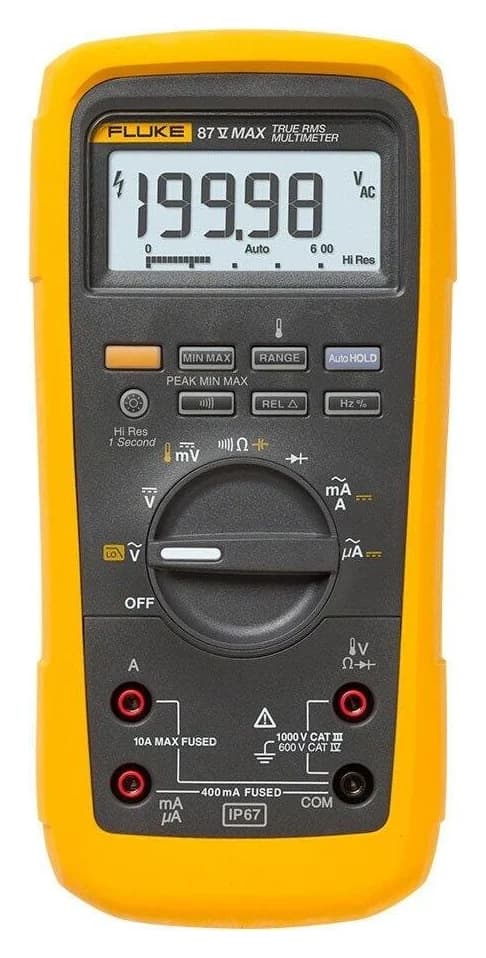
Pick the right Fluke 87V package for industrial work: standard, MAX, CAL, E2 kit or IMSK clamp kit. Compare IP ratings, CAT boundaries and box contents.
Best picks · Multimeters
Best Multimeters for Home Use and Electronics: Five Meters That Cover the Whole House
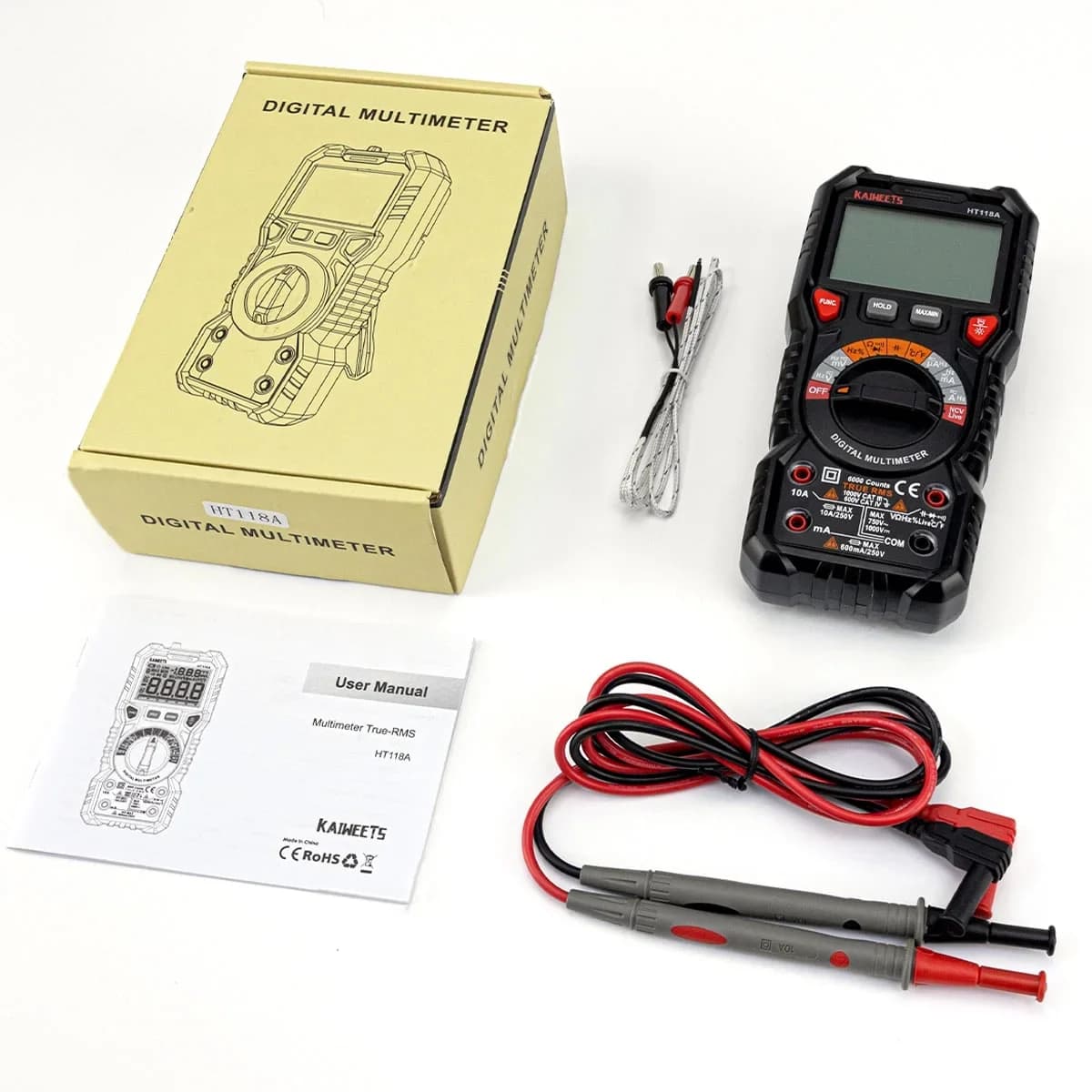
Pick a multimeter for home wiring and electronics work by safety rating, accuracy and fuse protection. Compare the KAIWEETS HT118A, Fluke 114, Brymen BM257s, Fluke 179 and Fluke 113.
Buying guide · Multimeters
Good Multimeter Buying Guide: How to Recognize One Before You Buy
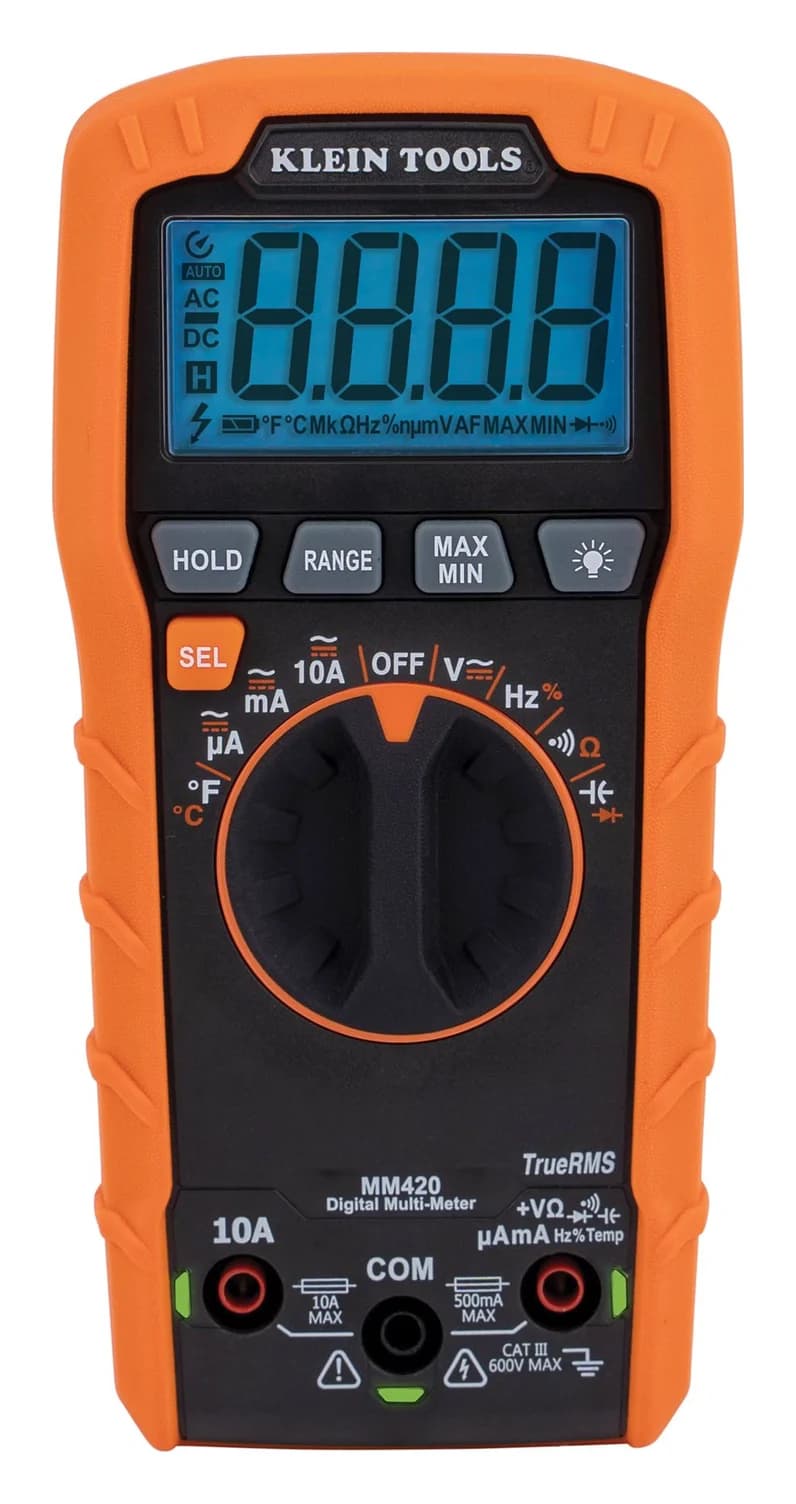
A good multimeter matches the highest-energy job you'll ever do with it. Accuracy, ranges, CAT rating, fuses, leads and repairability — explained before you buy.