

Comparison
Fluke 115 vs 117: Do You Need LoZ, AutoVolt and VoltAlert?
Choose between the Fluke 115 and 117 with a function table, matching-range accuracy example, current limits, and clear US package and calibration comparisons.
By thisMETER EditorialUpdated November 3, 20268 min read1 pick
Our recommendation: Fluke 117
Electrical troubleshooting with True RMS and a low-impedance mode for ghost voltage.
Limit: CAT III 600 V, not CAT IV; no mA/µA current ranges (the 6 A range resolves 1 mA).
On this page · Our picks at a glance
Our picks at a glance
- 1
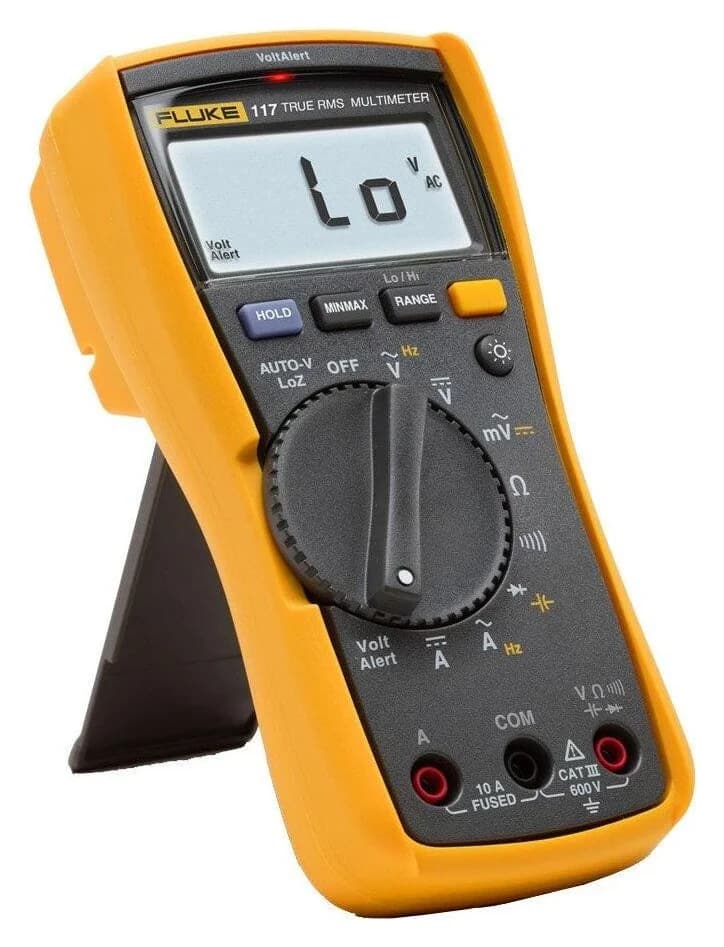
Choose for: Electrical troubleshooting with True RMS and a low-impedance mode for ghost voltage.
Limit: CAT III 600 V, not CAT IV; no mA/µA current ranges (the 6 A range resolves 1 mA).
Choose the Fluke 117 for electrical troubleshooting when LoZ, automatic AC/DC voltage selection and built-in VoltAlert are useful; choose the Fluke 115 for routine field service when you do not need those extras. Both have True RMS, a 6,000-count display and matching specified accuracy on their conventional voltage and current ranges. If you need temperature measurement or dedicated mA/µA ranges, choose neither.
Quick picks
Compare specifications and all conditions
Electrical troubleshooting with ghost-voltage checks
- Our pick
- Fluke 117
- Why
- AutoVolt/LoZ and integrated non-contact AC detection
Field service using conventional measurement functions
- Our pick
- Fluke 115
- Why
- Matching conventional voltage/current specifications without those extras
Temperature or very small-current work
- Our pick
- Neither
- Why
- No temperature function or dedicated mA/µA range
Full comparison table
Swipe to compare. Row labels stay visible.
| Your buying decision | Our pick | Why |
|---|---|---|
| Electrical troubleshooting with ghost-voltage checks | Fluke 117 | AutoVolt/LoZ and integrated non-contact AC detection |
| Field service using conventional measurement functions | Fluke 115 | Matching conventional voltage/current specifications without those extras |
| Temperature or very small-current work | Neither | No temperature function or dedicated mA/µA range |
Scroll horizontally to see every column
| Your buying decision | Our pick | Why |
|---|---|---|
| Electrical troubleshooting with ghost-voltage checks | Fluke 117 | AutoVolt/LoZ and integrated non-contact AC detection |
| Field service using conventional measurement functions | Fluke 115 | Matching conventional voltage/current specifications without those extras |
| Temperature or very small-current work | Neither | No temperature function or dedicated mA/µA range |
Both are specified for 600 V, with 6,000 display counts and CAT III 600V protection. These are manufacturer specifications, not independently verified performance.
- 600 VMaximum voltage between any terminal and earth ground, both models
- 6,000 countsDigital display, both models
- CAT III 600VSafety rating as specified by Fluke, both models
Best for electrical troubleshooting: Fluke 117
The 117 is our pick when its additional voltage functions belong on your work checklist. Fluke's model page identifies AutoVolt, VoltAlert and low-impedance voltage measurement as the differences from the 115. Those are useful reasons to select it; matching conventional-range specifications give no reason to expect more accurate ordinary DC readings.
Fluke
A compact 6,000-count True RMS multimeter for electricians, rated CAT III 600V, with built-in VoltAlert non-contact voltage detection, automatic AC/DC selection and a low-impedance mode.
Check package and model options
- 600 V max
- 10 A max
- 6,000 counts
- CAT III 600V
The limitation is shared with the 115: this is an amp-range meter without dedicated small-current ranges or temperature measurement. If those are essential, choose the appropriate functions before choosing between these models.
Best for routine field service: Fluke 115
The 115 fits a checklist built around voltage, amp-range current, resistance, continuity, diode testing, capacitance and frequency. It also has a backlight, Hold and Min/Max/Average recording. You keep autoranging: missing AutoVolt does not mean manually selecting every numerical range.

Choose it when the 117's additional functions would go unused. For sensitive electronics, remember that the 117 also retains conventional high-impedance voltage functions; the 115 is not uniquely suitable merely because it lacks AutoVolt/LoZ.
Check the Fluke 115 standard US package at Fluke.
Fluke 115 vs 117: the function table
Accuracy below means ±(% of reading + counts). The shared users manual identifies which models each function applies to.
True RMS AC voltage/current
- Fluke 115
- Yes
- Fluke 117
- Yes
AC/DC millivolt range
- Fluke 115
- 600.0 mV
- Fluke 117
- 600.0 mV
Conventional AC/DC voltage ranges
- Fluke 115
- 6.000 / 60.00 / 600.0 V
- Fluke 117
- Same
DC voltage accuracy
- Fluke 115
- ±(0.5% + 2)
- Fluke 117
- Same
AC voltage accuracy, 45–500 Hz
- Fluke 115
- ±(1.0% + 3)
- Fluke 117
- Same
Automatic AC/DC selection with LoZ voltage input
- Fluke 115
- No
- Fluke 117
- Yes: AutoVolt/LoZ
VoltAlert non-contact AC detection
- Fluke 115
- No
- Fluke 117
- Yes
AC/DC current ranges
- Fluke 115
- 6.000 A / 10.00 A
- Fluke 117
- Same
Current resolution on those ranges
- Fluke 115
- 0.001 A / 0.01 A
- Fluke 117
- Same
DC current accuracy
- Fluke 115
- ±(1.0% + 3)
- Fluke 117
- Same
AC current accuracy, 45–500 Hz
- Fluke 115
- ±(1.5% + 3)
- Fluke 117
- Same
Dedicated mA/µA ranges; temperature measurement
- Fluke 115
- Neither
- Fluke 117
- Neither
Resistance
- Fluke 115
- Up to 40 MΩ
- Fluke 117
- Same
Continuity, diode, capacitance, frequency
- Fluke 115
- Yes
- Fluke 117
- Yes
Low-impedance capacitance power-up option
- Fluke 115
- Yes
- Fluke 117
- Yes
Autoranging/manual range, Hold, backlight, Min/Max/Average
- Fluke 115
- Yes
- Fluke 117
- Yes
Full comparison table
Swipe to compare. Row labels stay visible.
| Function or specification | Fluke 115 | Fluke 117 |
|---|---|---|
| True RMS AC voltage/current | Yes | Yes |
| AC/DC millivolt range | 600.0 mV | 600.0 mV |
| Conventional AC/DC voltage ranges | 6.000 / 60.00 / 600.0 V | Same |
| DC voltage accuracy | ±(0.5% + 2) | Same |
| AC voltage accuracy, 45–500 Hz | ±(1.0% + 3) | Same |
| Automatic AC/DC selection with LoZ voltage input | No | Yes: AutoVolt/LoZ |
| VoltAlert non-contact AC detection | No | Yes |
| AC/DC current ranges | 6.000 A / 10.00 A | Same |
| Current resolution on those ranges | 0.001 A / 0.01 A | Same |
| DC current accuracy | ±(1.0% + 3) | Same |
| AC current accuracy, 45–500 Hz | ±(1.5% + 3) | Same |
| Dedicated mA/µA ranges; temperature measurement | Neither | Neither |
| Resistance | Up to 40 MΩ | Same |
| Continuity, diode, capacitance, frequency | Yes | Yes |
| Low-impedance capacitance power-up option | Yes | Yes |
| Autoranging/manual range, Hold, backlight, Min/Max/Average | Yes | Yes |
Scroll horizontally to see every column
| Function or specification | Fluke 115 | Fluke 117 |
|---|---|---|
| True RMS AC voltage/current | Yes | Yes |
| AC/DC millivolt range | 600.0 mV | 600.0 mV |
| Conventional AC/DC voltage ranges | 6.000 / 60.00 / 600.0 V | Same |
| DC voltage accuracy | ±(0.5% + 2) | Same |
| AC voltage accuracy, 45–500 Hz | ±(1.0% + 3) | Same |
| Automatic AC/DC selection with LoZ voltage input | No | Yes: AutoVolt/LoZ |
| VoltAlert non-contact AC detection | No | Yes |
| AC/DC current ranges | 6.000 A / 10.00 A | Same |
| Current resolution on those ranges | 0.001 A / 0.01 A | Same |
| DC current accuracy | ±(1.0% + 3) | Same |
| AC current accuracy, 45–500 Hz | ±(1.5% + 3) | Same |
| Dedicated mA/µA ranges; temperature measurement | Neither | Neither |
| Resistance | Up to 40 MΩ | Same |
| Continuity, diode, capacitance, frequency | Yes | Yes |
| Low-impedance capacitance power-up option | Yes | Yes |
| Autoranging/manual range, Hold, backlight, Min/Max/Average | Yes | Yes |
Frequency limit conflict: the US product-page tables and extended specification sheet specify voltage-input frequency to 50 kHz. The 115 page also retains an inconsistent 30 kHz footnote. The shared manual instead specifies 99.99 kHz, with extra input-sensitivity qualifications above 50 kHz; all agree on 45 Hz–5 kHz for current-input frequency. If your purchase depends on voltage-frequency measurement above 30 kHz, get clarification from Fluke rather than treating the higher figures as settled.
What LoZ, AutoVolt and VoltAlert actually add
AutoVolt and autoranging solve different problems. Autoranging selects a range within a function on both meters. The 117's AutoVolt selects AC or DC voltage and simultaneously uses an input impedance of approximately 3 kΩ, according to the manual. It is the same dial function that provides LoZ voltage measurement.
LoZ helps with ghost voltage, but loads the circuit. Fluke's stray-voltage application note explains how capacitive coupling can create confusing readings on adjacent unconnected wiring. A low-impedance input loads that weakly coupled source. Fluke also warns that low-impedance instruments can affect sensitive control and electronic circuits. The conventional DC voltage input on both meters is specified above 10 MΩ; select a function appropriate to the circuit and the manual.
The 115's Lo-Z capacitance option is different. The shared manual explicitly includes a low-impedance capacitance power-up option for both models. That does not give the 115 the 117's AutoVolt/LoZ voltage function. A bare claim that the 115 has “no LoZ” misses this distinction.
VoltAlert detects AC presence without contact. It adds audible and visual indication on the 117. Fluke warns that voltage can still be present without an indication and that shielded wire can defeat detection. Treat it as a presence indicator, not proof that equipment is safe to touch; our non-contact voltage tester guide covers the buying decision separately.
- Yes: Choose the 117 when you need built-in LoZ voltage measurement.
- Yes: Choose the 117 when automatic AC/DC selection is useful.
- Yes: Choose the 117 when integrated non-contact AC detection belongs in your kit.
- Partly: Choose the 115 when the shared conventional functions cover your work.
Accuracy and current: compare the same range
On the 600.0 V DC range, both meters resolve 0.1 V and specify ±(0.5% + 2 counts). For a hypothetical 100 V reading, the calculation is ±[(0.5% × 100 V) + (2 × 0.1 V)] = ±0.7 V for either meter. This is a calculated specification allowance, not a measurement we made. The 117's additional voltage modes do not improve this result.
The 117's AutoVolt/LoZ mode has its own 600.0 V range, 0.1 V resolution and ±(2.0% + 3) DC accuracy. Compare the ordinary DC functions when judging precision; AutoVolt/LoZ serves a different purpose. Fluke specifies accuracy for one year after calibration, at 18–28 °C and 0–90% relative humidity.
Display count also differs from accuracy. Both digital displays update four times per second, and both have a 33-segment bar graph updating 32 times per second, per Fluke's specifications. Neither provides a display-count advantage here.
For current, the 6 A range resolves 0.001 A, equivalent to 1 mA; the 10 A range resolves 0.01 A. Neither offers a dedicated milliamp or microamp range. Do not mistake that first resolution figure for suitability for every small-current task.
Nor is either a continuous 20 A meter. The manual marks accuracy above 10 A unspecified and limits above 10 A through 20 A to 30 seconds on, 10 minutes off. For other current-measurement needs, use our clamp meter vs multimeter comparison to choose the instrument type.
How we choose
This comparison is document research, with no physical testing. We compared Fluke's US product pages, the shared users manual, the extended specifications and the maker's explanation of stray voltage. Recommendations reflect function fit, matching-range accuracy and package contents. Where Fluke's own documents disagree, we identify the conflict rather than silently choosing a figure. See How we choose and How we measure.
Buying guide: check the exact US package
Included leads, holster and paperwork
For the standard US Fluke 115, part 2538790, Fluke lists the meter, holster, installed 9 V battery and 4 mm PVC-insulated test leads. Its box-content section names a Quick Reference Guide; its model inventory names a user manual. Confirm the supplied paperwork rather than assuming both documents are included.
For the standard US Fluke 117, part 2538815, the model inventory lists 4 mm silicone test leads, holster and user manual. Both models specify a 9 V alkaline battery, approximately 400 hours without the backlight, and a three-year warranty.
Lead descriptions conflict across regions: Fluke's UK 115 page lists silicone leads in one section and PVC-insulated leads elsewhere. Use the US part number and its stated contents for a US purchase; ask for confirmation if a listing promises a different lead set. A compatible-accessories list does not establish what comes in the box.
CAL and factory-reconditioned versions
Fluke 115 CAL
- Part number
- 5160536
- What changes
- Adds a traceable calibration certificate with data from Fluke
Fluke 117 CAL
- Part number
- 5160508
- What changes
- Adds a traceable calibration certificate with data from Fluke
R-FLUKE-115
- Part number
- 4373456
- What changes
- Factory-reconditioned 115; Fluke states a three-year product warranty
R-FLUKE-117
- Part number
- 4373474
- What changes
- Factory-reconditioned 117; Fluke states a three-year product warranty
Full comparison table
Swipe to compare. Row labels stay visible.
| Version on Fluke's US model pages | Part number | What changes |
|---|---|---|
| Fluke 115 CAL | 5160536 | Adds a traceable calibration certificate with data from Fluke |
| Fluke 117 CAL | 5160508 | Adds a traceable calibration certificate with data from Fluke |
| R-FLUKE-115 | 4373456 | Factory-reconditioned 115; Fluke states a three-year product warranty |
| R-FLUKE-117 | 4373474 | Factory-reconditioned 117; Fluke states a three-year product warranty |
Scroll horizontally to see every column
| Version on Fluke's US model pages | Part number | What changes |
|---|---|---|
| Fluke 115 CAL | 5160536 | Adds a traceable calibration certificate with data from Fluke |
| Fluke 117 CAL | 5160508 | Adds a traceable calibration certificate with data from Fluke |
| R-FLUKE-115 | 4373456 | Factory-reconditioned 115; Fluke states a three-year product warranty |
| R-FLUKE-117 | 4373474 | Factory-reconditioned 117; Fluke states a three-year product warranty |
Choose CAL for the supplied documentation your workplace requires. Fluke describes the reconditioned versions as restored to original factory specifications, but does not enumerate their accessories in those model entries; confirm the inventory. Neither label turns a 115 into a 117.
Before Black Friday or Cyber Monday, compare the exact packages using this order. Keep this comparison focused on the model decision; our broader Fluke vs Klein guide covers cross-brand alternatives.
Match the model
Confirm the meter has the functions your work requires.
Match the documentation
Decide whether supplied calibration data is required.
Match the accessories
Compare the stated lead set, holster and paperwork.
Match the condition
Compare new packages with new packages, or deliberately choose factory reconditioned.
Verdict
Buy the Fluke 117 when you need its LoZ voltage input, AutoVolt or integrated VoltAlert. Buy the Fluke 115 when their shared conventional measurement functions meet your needs. Choose outside this pair for temperature or dedicated small-current ranges, and compare the exact package before treating an offer as equivalent.
Frequently asked questions
What is the difference between the Fluke 115 and 117?
The 117 adds automatic AC/DC voltage selection, low-impedance voltage measurement to reduce ghost-voltage readings, and VoltAlert non-contact AC detection. Both have True RMS, autoranging, a backlight and a 6,000-count display. Their conventional voltage and current ranges have matching specified accuracy. Choose the 117 for those voltage extras; choose the 115 when your work does not require them.
Is the Fluke 115 auto ranging?
Yes. The shared manual says the meters default to autoranging and also offer manual range selection. Autoranging chooses the numerical range within a measurement function. AutoVolt chooses between AC and DC voltage and uses a low-impedance input. The 115 has autoranging, but the 117 is the model in this pair with AutoVolt.
Can the Fluke 117 read milliamps or microamps?
It can resolve current in 1 mA increments on its 6 A range, as can the 115, but neither has a dedicated mA or microamp range. That distinction matters: displaying an amp reading with milliamps of resolution does not make a meter suitable for very small currents. Choose a meter with an explicitly specified small-current range when that is your job.
Do the Fluke 115 and 117 measure temperature?
Neither has a temperature measurement function in the shared model-specific manual. Fluke's product-page comparison widgets and temperature footnotes are misleading here; the extended specification sheet assigns thermocouple temperature measurement to the 116. An operating-temperature specification describes the meter's environment, not a probe function. Do not buy either model expecting temperature measurement.
What does CAL mean on a Fluke 115 or 117?
Fluke describes the CAL packages as including a traceable certificate of calibration with data from Fluke. Choose that package when you need the supplied calibration documentation. Check the exact model and part number as well: a 115 CAL remains a 115, and the certificate does not add the 117's AutoVolt, LoZ voltage or VoltAlert functions.
Fluke 117
AmazonRelated guides
Best picks · Multimeters
Best Multimeters for Beginners: Choose a First Meter You Can Learn On
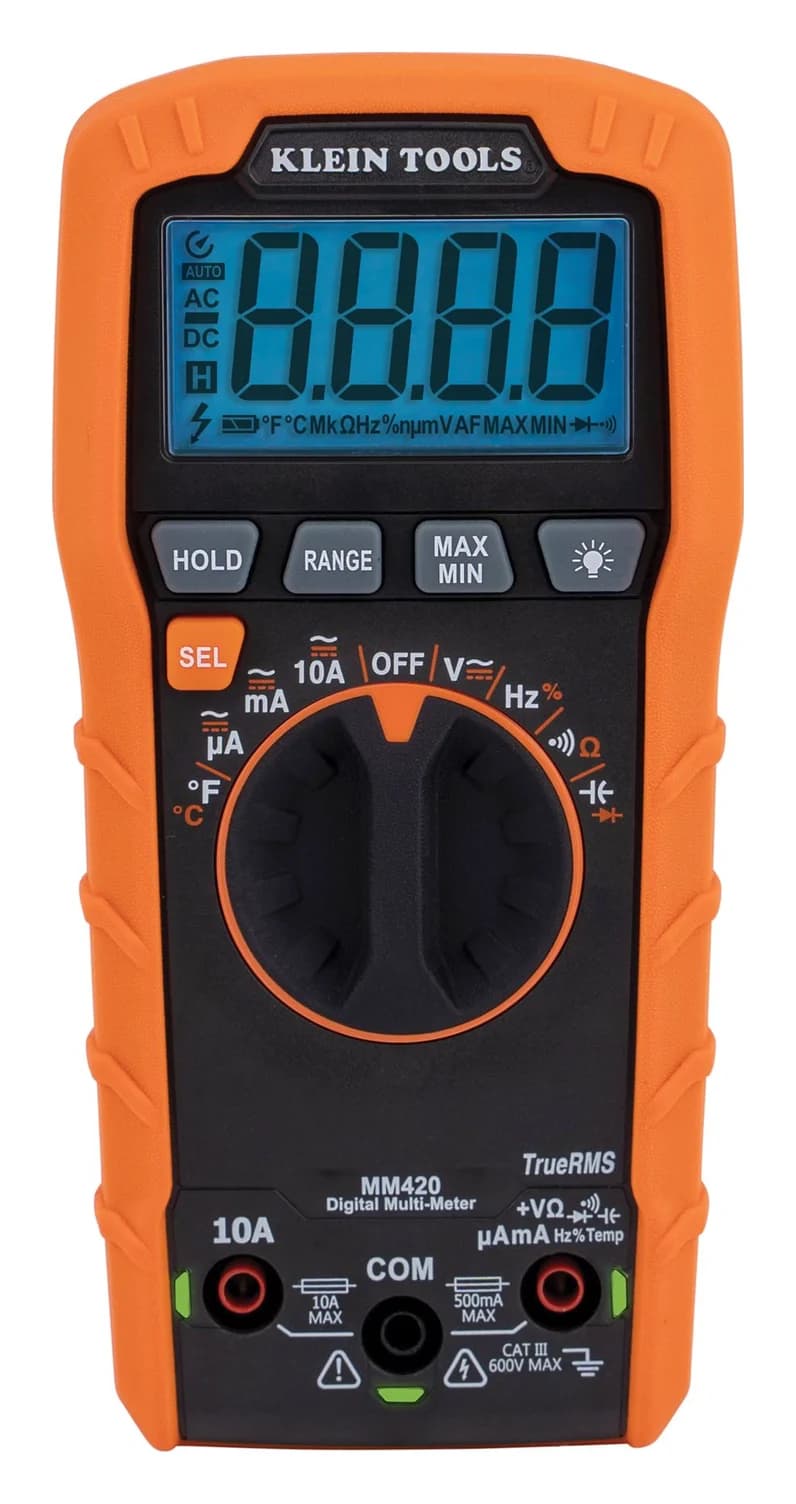
Choose a first multimeter by its controls, current ranges, jack reminders and included leads. Compare Klein MM420, MM325 and Fluke 107 for learning and gifts.
Best picks · Multimeters
Best Multimeters for HVAC: Microamps, Temperature and Complete Kits
Choose an HVAC multimeter by job: compare Fluke 116, Fieldpiece SC260 and Klein alternatives for flame sensors, clamp current, probe limits and kit contents.
Comparison · Multimeters
Fluke 101 vs 107: Current Ranges, Backlight and Regional Support
Compare the Fluke 101 and 107 by current inputs, backlight, accuracy and kit contents, with manual references and regional warranty checks before you buy.