

Best picks
Best Multimeters for Electronics
Small Currents and Bench Work
Choose an electronics multimeter by current resolution, burden voltage, diode limits and logging, with clear picks and a worked low-current accuracy comparison.
By thisMETER EditorialUpdated November 3, 20268 min read2 picks
On this page · Our picks at a glance
Our picks at a glance
- 1
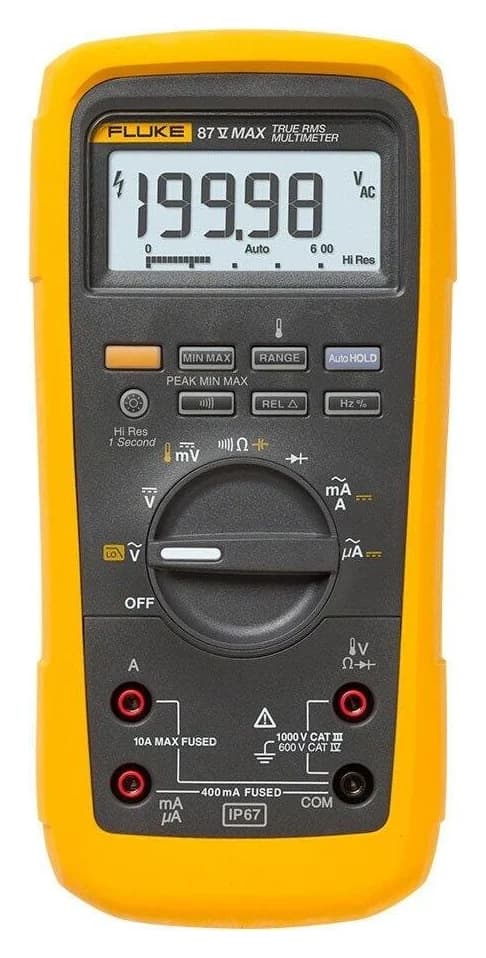
Choose for: Best for industrial electronics
Check before buying: Heavy for a handheld: 698.5 g with the holster and Flex-Stand
- 2
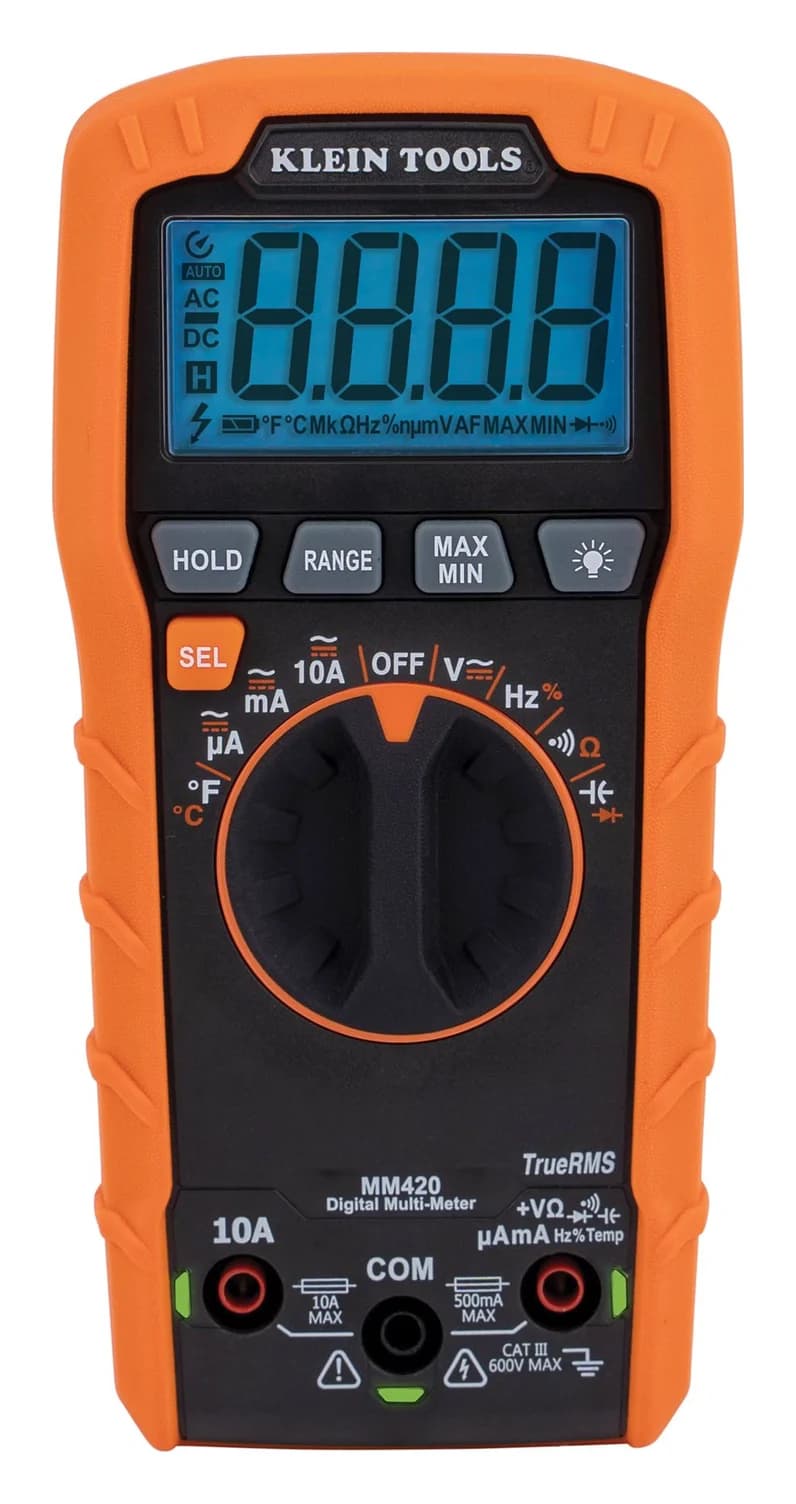
Choose for: Best starter for mixed work
Check before buying: Rated CAT III 600V: not for service-entrance (CAT IV) work
For a low-voltage electronics bench, our best multimeter for component work is the Brymen BM235, with audible and visible continuity indication and documented microamp burden voltage. Choose the UNI-T UT61E+ for finer current resolution and USB recording if regional supply is confirmed; choose the Fluke 87V MAX for industrial electronics or the Klein MM420 as a starter. These picks come from manufacturer specifications, with the buying traps below taken from their linked manuals.
Quick picks and comparison
- Component sorting, switches and board repair: BM235, for BeepLit continuity and relative zero.
- Steady small currents and computer recording: UT61E+, subject to availability and a burden-voltage check for sensitive circuits.
- Industrial troubleshooting and documented current accuracy: 87V MAX.
- First meter for electronics and household checks: MM420, with illuminated jack guidance.
Compare specifications and all conditions
Brymen BM235 manual
- Display counts
- 6,000
- Lowest DC current range / step
- 600.0 µA / 0.1 µA
- Highest resistance range
- 60.00 MΩ
All specifications
- Highest capacitance range
- 10.00 mF
UNI-T UT61E+ manual
- Display counts
- 22,000
- Lowest DC current range / step
- 220.00 µA / 0.01 µA
- Highest resistance range
- 220.00 MΩ
All specifications
- Highest capacitance range
- 220.00 mF
Fluke 87V MAX manual
- Display counts
- 6,000; 19,999 high-resolution mode
- Lowest DC current range / step
- 600.0 µA / 0.1 µA, standard mode
- Highest resistance range
- 50.00 MΩ
All specifications
- Highest capacitance range
- 9,999 µF
Klein MM420 manual
- Display counts
- 4,000
- Lowest DC current range / step
- 400.0 µA / 0.1 µA
- Highest resistance range
- 50.0 MΩ
All specifications
- Highest capacitance range
- 400.0 µF
Full comparison table
Swipe to compare. Row labels stay visible.
| Meter | Display counts | Lowest DC current range / step | Highest resistance range | Highest capacitance range |
|---|---|---|---|---|
| Brymen BM235 manual | 6,000 | 600.0 µA / 0.1 µA | 60.00 MΩ | 10.00 mF |
| UNI-T UT61E+ manual | 22,000 | 220.00 µA / 0.01 µA | 220.00 MΩ | 220.00 mF |
| Fluke 87V MAX manual | 6,000; 19,999 high-resolution mode | 600.0 µA / 0.1 µA, standard mode | 50.00 MΩ | 9,999 µF |
| Klein MM420 manual | 4,000 | 400.0 µA / 0.1 µA | 50.0 MΩ | 400.0 µF |
Scroll horizontally to see every column
| Meter | Display counts | Lowest DC current range / step | Highest resistance range | Highest capacitance range |
|---|---|---|---|---|
| Brymen BM235 manual | 6,000 | 600.0 µA / 0.1 µA | 60.00 MΩ | 10.00 mF |
| UNI-T UT61E+ manual | 22,000 | 220.00 µA / 0.01 µA | 220.00 MΩ | 220.00 mF |
| Fluke 87V MAX manual | 6,000; 19,999 high-resolution mode | 600.0 µA / 0.1 µA, standard mode | 50.00 MΩ | 9,999 µF |
| Klein MM420 manual | 4,000 | 400.0 µA / 0.1 µA | 50.0 MΩ | 400.0 µF |
These are range ceilings, not equal-accuracy promises. The linked manuals supply the table; notably, the UT61E+ manual specifies ±(20% + 5 digits) at its largest capacitance range, despite the series page summarizing capacitance as ±(3% + 5).
Best for component work: Brymen BM235
The BM235 earns this recommendation through useful bench functions: relative zero, Min/Max/Average and BeepLit continuity. Its manual specifies a continuity-on response below 15 ms, with both sound and backlight indication. That is a more useful buying detail for checking intermittent connections than display counts alone.
Its DC voltage specification is ±(0.3% + 2 digits) on the 60.00 mV, 600.0 mV and 6.000 V ranges. The diode function has a 3.000 V reading range, 0.3 mA typical test current and below 3.2VDC typical open-circuit voltage. Use those limits when choosing it for particular components.
Buying trap: Brymen's product page advertises 1000 V AC/DC capability and CAT II 1kV / CAT III 600V. Its linked manual instead specifies DC voltage ranges through 600.0 V and CAT III 600V / CAT IV 300V. We use the linked manual's low-voltage specifications here; have the maker confirm the supplied revision before buying for higher-voltage work. For regional supply, ask Brymen to identify an authorized agent; its warranty directs owners to their nearest one.
See the BM235 and its official downloads
Best for USB recording, subject to supply: UNI-T UT61E+
The plus suffix matters. The UT61+ page specifies USB communication and supplies separate UT61E+ software downloads. Its manual gives the finer microamp step shown above, but does not publish a burden-voltage figure. Diode-test open-circuit voltage is about 3 V, and continuity beeps below 50 Ω. For a supply-sensitive circuit, the missing burden specification is a reason to verify loading before relying on the reading.
Availability is unresolved: the page's visible text says the series is out of stock and unavailable, while its page metadata says in stock. Treat this as a conditional shortlist choice; confirm regional stock and warranty through UNI-T. The global package lists a USB cable and a multipurpose socket for UT61E+; its temperature probe belongs to UT61D+. Bluetooth/app is optional, not a promised inclusion.
UNI-T's discontinued list names UT61E+ as UT61E's replacement, although the older series page still presents UT61E. Its UT161 series is described as suitable for Europe and has separate downloads. Match model, manual and software; do not assume interchangeability.
Check the exact model and downloads with UNI-T
Best for industrial electronics: Fluke 87V MAX
The 87V MAX combines an IP67 enclosure with well-documented microamp accuracy and burden voltage. Its manual also specifies detection of intermittent opens and shorts lasting 1 ms. Those are reasons to choose it for industrial troubleshooting; its enclosure alone does not improve the accuracy of a bench reading.
Fluke
A rugged industrial True RMS multimeter rated CAT IV 600V and CAT III 1000V, with an IP67 case, a 4 m drop rating, a low-pass filter for motor-drive readings and temperature measurement.
Check package and model options
- 1,000 V max
- 10 A max
- 6,000 counts
- CAT IV 600V, CAT III 1000V
For ordinary DC voltage ranges from 6.000 V through 1000 V, its specification is ±(0.05% + 1 digit); the 600.0 mV range is ±(0.1% + 1). High-resolution mode adds digits, but the manual says to multiply the digits term by 10 in that mode. Do not read the extra display digit as a corresponding improvement in guaranteed accuracy.
Check the exact 87V MAX label and package. Fluke lists the standard box with TL175 leads, AC175 clips and an 80BK-A temperature probe. Also read its EMC caveat: the manual says the equipment is not intended for residential environments. That limits its appeal as a home-bench upgrade.
Best starter for mixed work: Klein Tools MM420
The MM420 pairs its microamp range with Lead Alert illumination for lead placement. It is worth considering when you want one meter for circuit basics and household checks, particularly if remembering the correct jack is still part of learning.
Klein Tools
A 4,000-count auto-ranging True RMS multimeter rated CAT III 600V that measures up to 600 V and 10 A, plus temperature, capacitance, frequency and duty cycle.
Check package and model options
- 600 V max
- 10 A max
- 4,000 counts
- CAT III 600V
Its manual specifies a diode-test open-circuit voltage of 3.9 V DC, at 1.8 mA maximum, and an audible continuity threshold below 50 Ω. It does not specify a continuity response time or current burden voltage. The capacitance ceiling in the comparison is also much lower than the other picks'. Keep an existing MM420 for basic work; upgrade when a particular range, error limit or recording need rules it out.
Counts, digits and accuracy: compare the same reading
Fluke's explanation distinguishes the smallest displayed increment from the allowed measurement error. For a specification written ±(% of reading + digits), calculate:
Basic error limit = reading × percentage ÷ 100 + digits × range resolution.
Here is a calculated example at a steady 100 µA, using the lowest DC current ranges in the manuals above and standard display mode. These are specification calculations, not measurements of the meters.
BM235
- DC current specification on that range
- ±(1.0% + 3)
- Digits contribution
- 3 × 0.1 µA
- Calculated basic error at 100 µA
- ±1.3 µA
UT61E+
- DC current specification on that range
- ±(0.5% + 10)
- Digits contribution
- 10 × 0.01 µA
- Calculated basic error at 100 µA
- ±0.6 µA
87V MAX
- DC current specification on that range
- ±(0.2% + 4)
- Digits contribution
- 4 × 0.1 µA
- Calculated basic error at 100 µA
- ±0.6 µA
MM420
- DC current specification on that range
- ±(1.0% + 5)
- Digits contribution
- 5 × 0.1 µA
- Calculated basic error at 100 µA
- ±1.5 µA
Full comparison table
Swipe to compare. Row labels stay visible.
| Meter | DC current specification on that range | Digits contribution | Calculated basic error at 100 µA |
|---|---|---|---|
| BM235 | ±(1.0% + 3) | 3 × 0.1 µA | ±1.3 µA |
| UT61E+ | ±(0.5% + 10) | 10 × 0.01 µA | ±0.6 µA |
| 87V MAX | ±(0.2% + 4) | 4 × 0.1 µA | ±0.6 µA |
| MM420 | ±(1.0% + 5) | 5 × 0.1 µA | ±1.5 µA |
Scroll horizontally to see every column
| Meter | DC current specification on that range | Digits contribution | Calculated basic error at 100 µA |
|---|---|---|---|
| BM235 | ±(1.0% + 3) | 3 × 0.1 µA | ±1.3 µA |
| UT61E+ | ±(0.5% + 10) | 10 × 0.01 µA | ±0.6 µA |
| 87V MAX | ±(0.2% + 4) | 4 × 0.1 µA | ±0.6 µA |
| MM420 | ±(1.0% + 5) | 5 × 0.1 µA | ±1.5 µA |
The UT61E+ displays a smaller step, yet matches the Fluke's basic error limit at this reading. Check conditions before applying the figures: the makers specify reference temperatures and calibration periods, and Fluke lists additional error in an RF field. A tiny displayed change is not automatically a change you can trust to that size.
Microamps, burden voltage and fuse limits
Burden is the voltage drop introduced by the meter during current measurement. Brymen specifies 0.1 mV/µA on its microamp ranges; Fluke specifies the equivalent 100 µV/µA. Calculated from those figures, either introduces 10 mV at 100 µA, or 100 mV at 1 mA on the higher microamp range. Consider whether that drop could change your circuit's behavior before interpreting the current.
The Fluke manual warns that the meter's voltage drop can affect circuit operation. We found no burden specification in the linked MM420 or UT61E+ manuals; neither earns a low-burden claim here.
A range ceiling is not a fuse rating. The manuals specify microamp/milliamp input fuses of 0.4 A/1000 V for BM235, 0.44 A/1000 V for 87V MAX, 500 mA/600 V for MM420 and 1 A/240 V for UT61E+. In particular, the UT61E+ table's 20 A range is not a continuous-current allowance: its manual limits measurements above 5 A to 10 seconds, with at least 15 minutes between them. Follow the exact jack limit and specified replacement fuse.
Use this selection worksheet before buying or recording a small-current result:
Define the task
Record supply voltage, expected steady current, possible wake current and the smallest change that matters.
Choose the exact range
Copy its resolution, percentage error, digits term and calibration conditions from the matching manual; calculate the error at your expected reading.
Budget the voltage drop
Multiply documented burden per unit current by expected current; leave an unknown burden marked unknown.
Plan the record
Note model, range, supply at the load, firmware state and whether you need a steady value or a time-varying current profile.
Component checks: what the function name leaves out
Open-circuit diode voltage and the readable forward-voltage range are different specifications. For example, the 87V MAX manual gives a 2.000 V diode reading range despite an open-circuit test voltage below 2.8 V. Do not treat the Klein's higher open-circuit figure as proof that every LED can be measured. Match the component's required forward voltage and test current to the meter's documented limits.
A continuity beep also does not certify a low-resistance connection. Brymen specifies a threshold between 30 Ω and 480 Ω, while Klein beeps below 50 Ω. Read resistance when the distinction matters. Brymen notes that parallel circuit paths can require disconnecting a suspected component to obtain an accurate resistance reading.
- Yes: Power removed and capacitors discharged as the manual requires
- Yes: Diode test current and voltage limits checked for the component
- Yes: Resistance reading checked when a beep is not enough
- Partly: In-circuit resistance: other paths can change the result
Logging and the next bench instrument
USB communication is a specific reason to choose UT61E+. Its maker lists V2.02 EXE and ZIP software; verify compatibility with your computer before ordering. The BM235's Min/Max/Average, MM420's Min/Max and 87V MAX's Min/Max/Average functions summarize readings; they are not a promise of a timestamped computer log.
For changing current over an application's operating cycle, consider a power profiler: Nordic's official Power Profiler documentation describes real-time current profiling. For rail noise or transient waveforms, Fluke explains why an oscilloscope reveals information a numeric multimeter reading cannot. A bench DMM is the next category to investigate when stationary precision measurement is the priority. Choose the next instrument around the missing measurement.
How we choose
These recommendations are based on manufacturer documents. We read each maker's range tables and manuals, distinguish typical figures from specified limits, and expose conflicts between documents. The calculated example compares the same current and includes the digits term. BM235 and UT61E+ link to their makers for model and regional supply checks. For broader job choices, see our general multimeter guide; our methodology explains the evidence standard.
Verdict
Choose BM235 for component work after confirming the supplied revision, UT61E+ for USB recording if regional supply is confirmed, 87V MAX for industrial electronics, or MM420 for a first meter shared with household tasks. Let the required current range, calculated error and circuit loading decide the purchase before display counts.
Frequently asked questions
What is the best multimeter for electronics?
Our component-work pick is the Brymen BM235 for its audible and visible continuity indication, documented response time and microamp ranges. Choose the UNI-T UT61E+ for finer current resolution and USB recording, subject to local availability. The Fluke 87V MAX suits industrial electronics, while the Klein MM420 suits a first meter used for both household and circuit checks. These are recommendations based on manufacturer documents.
Is a 22,000-count multimeter more accurate than a 6,000-count meter?
Counts describe display resolution, while accuracy depends on the selected function and range. At a hypothetical steady 100 µA, the UT61E+ and the 87V MAX in standard mode each calculate to a basic specified error limit of ±0.6 µA, despite their different display counts. Use the per-range percentage, digits term and resolution together, then check the maker's temperature, calibration and interference conditions.
Can I measure a microcontroller's sleep current with these meters?
For a steady reading, compare the microamp range, its resolution and specified accuracy. Also check burden voltage: both the BM235 and 87V MAX specify the equivalent of 0.1 mV per µA on their microamp ranges. That is a calculated 10 mV at 100 µA. For an entire sleep-and-wake current profile, consider a dedicated power profiler rather than treating a handheld reading as a waveform.
Are the UNI-T UT61E, UT61E+ and UT161E the same meter?
Keep the exact model names separate. UNI-T's discontinued-product list identifies UT61E+ as the replacement for UT61E, although its older UT61 series page still presents UT61E specifications. UNI-T describes UT161 as suitable for the European market and provides its own manuals and software. Match the label, regional documentation and included interface to the version being purchased; do not transfer specifications or software between names.
Related guides
Best picks · Multimeters
Best Multimeters for Electricians: LoZ, CAT Ratings and Job Fit
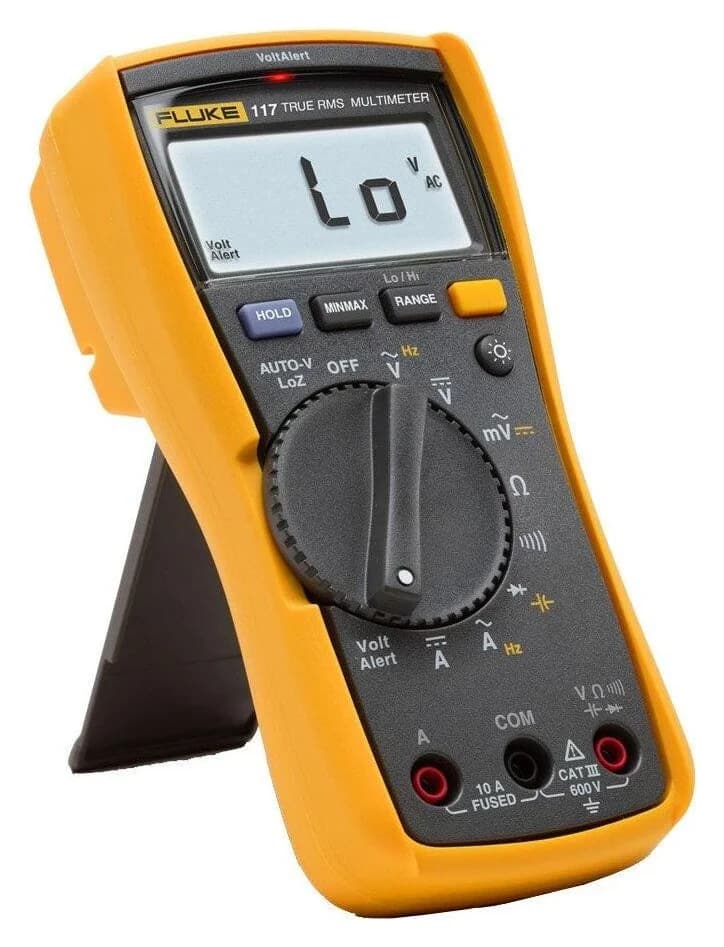
Choose an electrician's multimeter by job: Fluke 117 for branch circuits, 87V MAX for industry, Klein MM420 for extra functions, or the narrower Fluke 113.
Best picks · Multimeters
Best Multimeters for Automotive Work: Batteries, Sensors and RPM
Choose an automotive multimeter for voltage drop, sensors, RPM and small currents. Compare Klein, Innova and Fluke, kit contents and DC clamp limitations too.
Comparison · Multimeters
AstroAI DM6000AR vs KAIWEETS HT118A: Which Budget Multimeter?
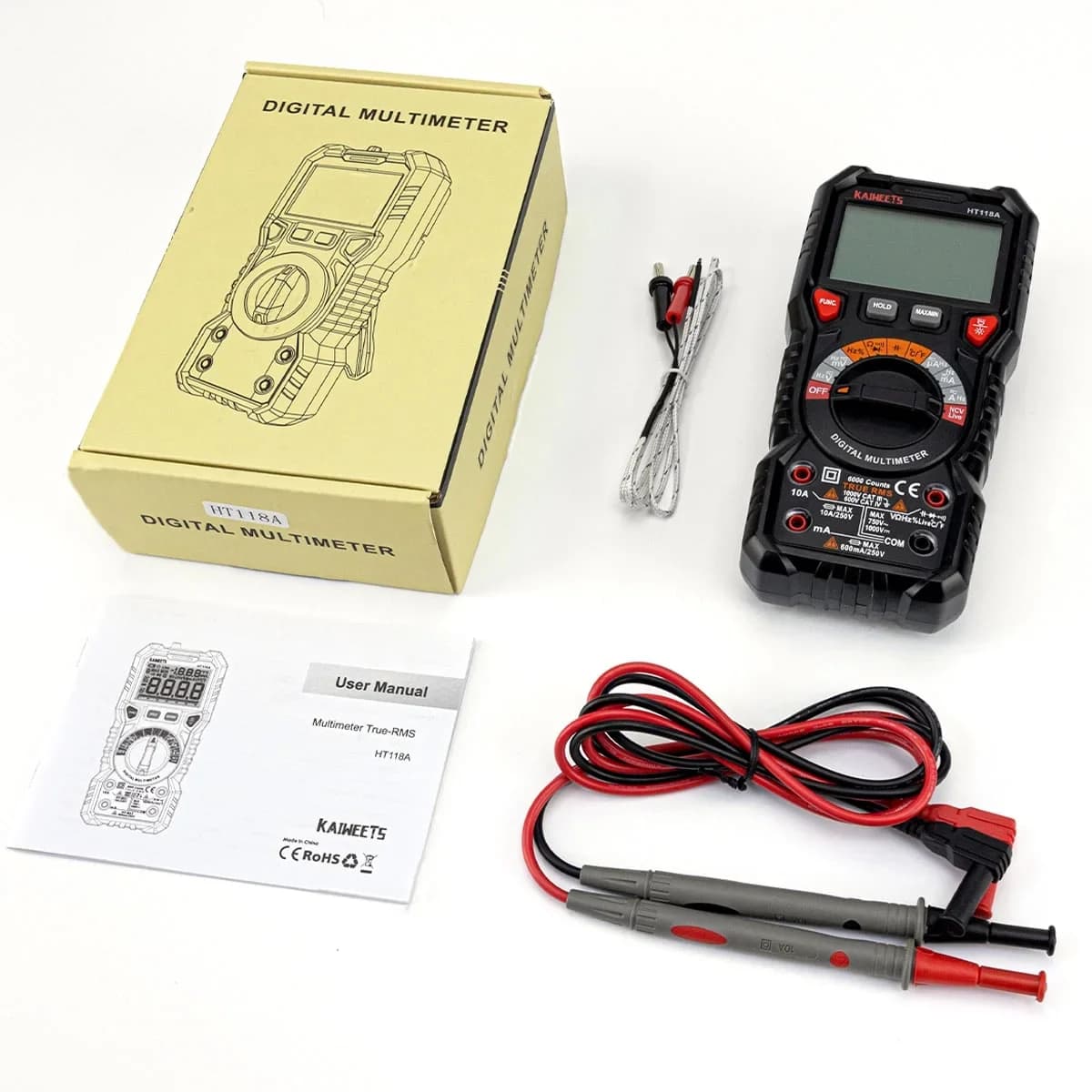
Choose an AstroAI DM6000AR or KAIWEETS HT118A for your first meter: compare controls, voltage claims, fuses, accessories and safe low-voltage starter tasks.