

Buying guide
Good Multimeter Buying Guide
How to Recognize One Before You Buy
A good multimeter matches the highest-energy job you'll ever do with it. Accuracy, ranges, CAT rating, fuses, leads and repairability — explained before you buy.
By thisMETER EditorialUpdated November 5, 20268 min read2 picks
On this page · Our picks at a glance
Our picks at a glance
- 1
what "good" looks like at each level
600 V max · 10 A max
Choose for: what "good" looks like at each level
Check before buying: Rated CAT III 600V: not for service-entrance (CAT IV) work
- 2
what "good" looks like at each level
1,000 V max · 10 A max
Choose for: what "good" looks like at each level
Check before buying: The official HT118A manual specifies 1000 V DC and 750 V AC; the 1000 V headline is not the AC measurement limit
A good multimeter is not the one with the most modes — it is the one whose safety rating, accuracy and ranges match the highest-energy job you will ever ask it to do. For most households that sweet spot is an auto-ranging True RMS meter such as the Klein Tools MM420; the checklist below shows you how to verify that claim — or any other — before you pay.
- 40%How far low an averaging meter can read on distorted AC waveforms, per Fluke
- CAT III 600VThe minimum meter rating Fluke gives for measuring a 480-V feeder panel
- 30%Electricians who admitted to using test tools not accurately rated for their environment
Start with the highest-energy measurement you will ever make
Every "is this multimeter good?" question is really a where question. A meter that is excellent on a 9 V battery can be the wrong tool at a breaker panel, because the difference is not voltage — it is the energy available behind the measurement point. That is what measurement categories describe.
Tap a label to explore. You can also hover or use your keyboard.
CAT IIPlug-in appliances & tools
Receptacle-connected loads, such as household appliances and portable tools. The category describes the measurement environment; it does not give permission to work on live equipment.
Sources: 1: CAT II includes household appliances, portable tools and other receptacle-connected loads.CAT IIIFixed wiring & distribution
The distribution part of the building installation, including distribution-panel devices and fixed-installation equipment. This is a different environment from a plug-in appliance.
Sources: 2: CAT III includes equipment in fixed installations and distribution-panel devices.CAT IVUtility meter & service entry
The origin of the low-voltage installation, including electricity meters and the service entrance. Fluke also identifies the run between the meter and panel as CAT IV.
Sources: 3: CAT IV includes electricity meters, the service entrance and the run between meter and panel.Illustrative locations, not a testing procedure. Match both the measurement category and voltage rating to the job. The lowest-rated meter, lead, probe or accessory limits the setup.
Source notes5 references
CAT II includes household appliances, portable tools and other receptacle-connected loads.
media.fluke.com — source for CAT II includes household appliances, portable tools and other receptacle-connected loads.Appliance, portable tools, and other household and similar
CAT III includes equipment in fixed installations and distribution-panel devices.
media.fluke.com — source for CAT III includes equipment in fixed installations and distribution-panel devices.distribution panel devices
CAT IV includes electricity meters, the service entrance and the run between meter and panel.
media.fluke.com — source for CAT IV includes electricity meters, the service entrance and the run between meter and panel.Electricity meters, primary overcurrent protection equipment
Probes, test leads and adapters need the correct measurement category, voltage and amperage ratings.
assets.fluke.com — source for Probes, test leads and adapters need the correct measurement category, voltage and amperage ratings.Use only correct measurement category (CAT), voltage, and amperage
The lowest-rated component limits the measurement-category rating of the setup.
assets.fluke.com — source for The lowest-rated component limits the measurement-category rating of the setup.Do not exceed the Measurement Category (CAT) rating of the lowest
Fluke's breakdown, in short: CAT IV covers the origin of the installation — service entrance, electricity meters, outdoor conductors. CAT III covers three-phase distribution, including fixed commercial lighting, switchgear and polyphase motors. CAT II covers single-phase receptacle-connected loads — appliances, portable tools, and other household and similar loads. Fluke's worked example: measuring a 480-V electrical distribution feeder panel needs at least a CAT III-600 V rated meter, and a CAT III-1000 V or CAT IV-600 V meter also works.
The ratings are usually located near the input jacks, and Fluke's advice is to always choose a tool rated for the highest category you could potentially use it in, with a voltage rating to match or exceed those situations. This is the single most skipped check in budget buying — Fluke reports that more than 30% of electricians admitted to not using test tools accurately rated for their work environment.
Accuracy, resolution and ranges: read the real numbers
Three different specs get blurred together in listings. Accuracy is written as a percentage of reading plus a count of digits, such as ±(0.5% + 5). Counts describe resolution — a 4,000-count meter displays finer steps than a 2,000-count one — not accuracy. Ranges are the ceilings: the Klein MM420 measures up to 600V AC/DC voltage and 10A AC/DC current, while the KAIWEETS HT118A's voltage range table reaches 1000V DC and 750V AC. A bigger number is only useful if the accuracy and the CAT rating behind it are good.
For AC work, check for True RMS. An average-responding meter is accurate on pure sinusoidal waves but reads with uncertain accuracy on anything else — Fluke puts the error at up to 40% low or 10% high on distorted waves, which nonlinear loads such as variable speed drives or computers produce. For pure DC checks, True RMS changes nothing.
Find the exact model
The full model name, not just the brand and series — functions differ within one storefront.
Read the CAT marking
Category and voltage printed near the input jacks must meet or exceed your highest-energy job.
Check the fuses
Current inputs should be fused, and you should be able to buy the exact replacement fuse.
Confirm True RMS
Required for distorted AC waveforms; irrelevant for pure DC battery work.
Count the kit
Leads with ratings, batteries, thermocouple, case, manual — price the exact package, not the hero photo.
The picks: what "good" looks like at each level
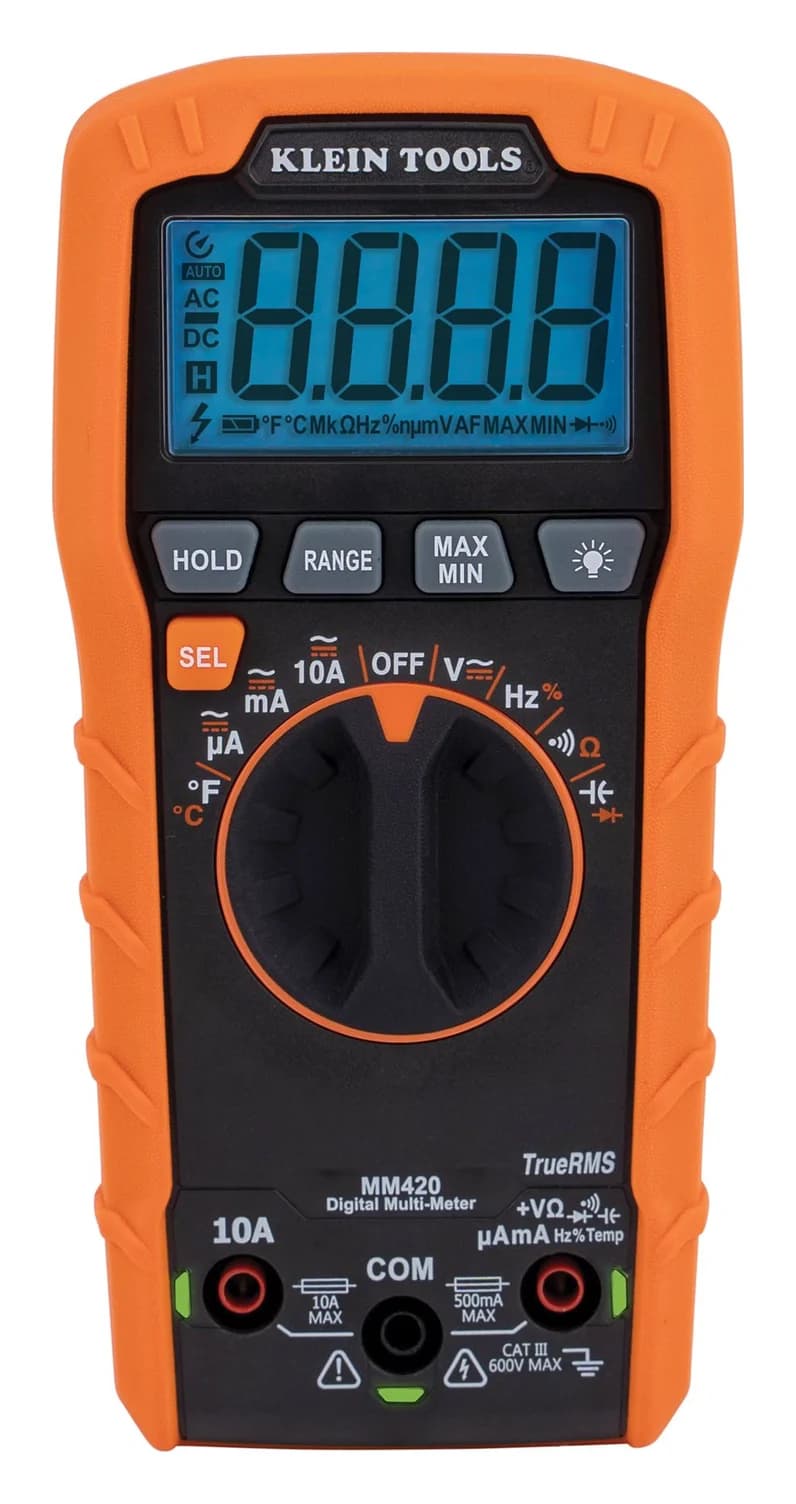
Good for most homes: Klein Tools MM420
Klein Tools
A 4,000-count auto-ranging True RMS multimeter rated CAT III 600V that measures up to 600 V and 10 A, plus temperature, capacitance, frequency and duty cycle.
Check package and model options
- 600 V max
- 10 A max
- 4,000 counts
- CAT III 600V
The MM420 is our reference for "good" at household level. Klein's page describes it as an auto-ranging, true root mean square (TRMS) multimeter measuring AC/DC voltage, AC/DC current and resistance, plus temperature, capacitance, frequency, duty-cycle, diodes and continuity — the full homeowner set. Its headline figures: up to 600V AC/DC, 10A AC/DC and 50 MΩ resistance on a 4000-count display, with a CAT III 600V safety rating for residential, business and light-industrial locations.
Two design details mark it out as a good first serious meter. Lead-Alert protection lights the correct input jacks with LED illumination for lead placement, and the battery and fuse compartment is easily accessible — the two things beginners actually get wrong. The package includes test leads, a thermocouple, instructions and two AAA batteries, so there is nothing extra to source on day one.
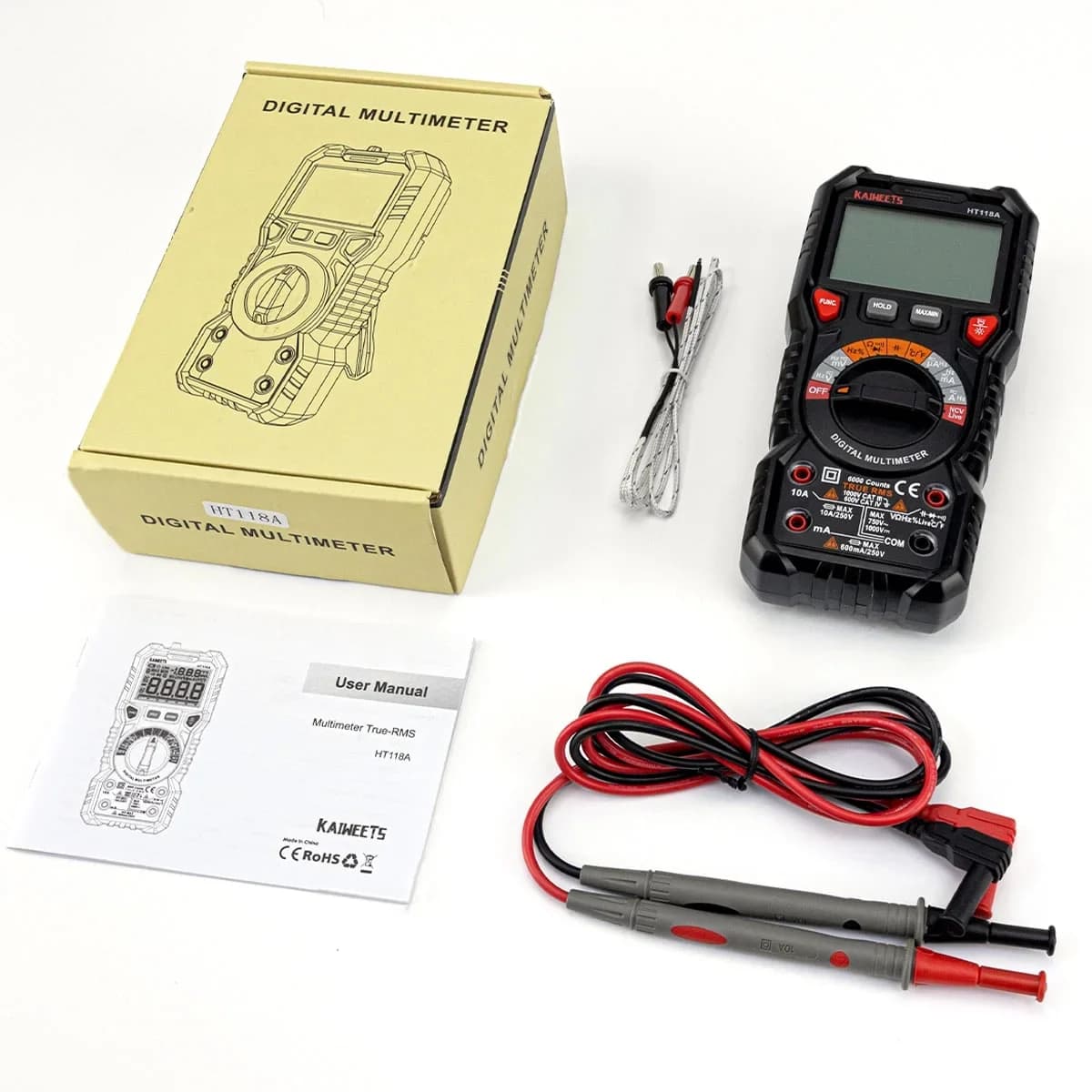
Good budget meter with a bigger safety margin: KAIWEETS HT118A
KAIWEETS
A 6,000-count auto-ranging True RMS multimeter with non-contact voltage and live-wire detection, LED-lit input jacks, a flashlight and temperature measurement, rated CAT III 1000V and CAT IV 600V.
- 1,000 V max
- 10 A max
- 6,000 counts
- CAT III 1000V, CAT IV 600V
The HT118A is the budget pick that still documents its protection. KAIWEETS rates it CAT III 1000V and CAT IV 600V, with double ceramic fuse and thermistor protection, high-voltage protection active on all ranges, and a double-insulated unit. The display is a backlit 6000-count LCD, and autoranging removes the need to know the range in advance; like the MM420 it illuminates the appropriate jacks when you select a function.
The repairability argument is what makes it a genuinely good cheap multimeter rather than a disposable one: KAIWEETS sells replacement ceramic fuses and lists compatible fuse values by model — for the HT118A, 10A/250V, 10A/600V, 600mA/250V and 800mA/1000V in Φ6*32mm format, with the advice to check the model number and choose the correct fuse. A meter you can re-fuse from the maker's own shelf is a better buy than a cheaper sealed one. One caution: KAIWEETS' marketing bullet says "measures up to 600V AC/DC voltage," while its spec-table ranges reach 1000V DC and 750V AC, so treat the table figures as function ceilings, check the delivered meter and keep the CAT ratings as the safety story.
Good for panel and service work: Fluke 113
The Fluke 113 is what "good" means when the job is the panel itself: a CAT IV 600 V safety rating under IEC 61010-2-033, the highest category in this guide. Its VCHEK LoZ low-impedance function tests for AC or DC voltage from one dial position, or shows continuity if voltage is not detected. The display runs 6000 counts, the integrated holster holds the probes on the back, and it ships with Fluke TL75 test leads and a 9 V battery installed.
This is the meter the first two picks are not. If your highest-energy measurement involves feeders, distribution panels or anything upstream of a receptacle, the CAT III budget meters are the wrong tool no matter how good their feature lists look. We have not verified a current Amazon listing for the 113, so we link the maker instead of a marketplace.
See the Fluke 113 specifications at Fluke
Good cheap first meter for electronics and batteries: AstroAI DM130B
For pure low-voltage learning — batteries, hobby circuits, continuity, disconnected components — AstroAI's own beginner guide names the DM130B its most balanced starting point: a 4000-count display, automatic and manual ranging, core electrical measurements, capacitance, NCV screening and dedicated 1.5V/9V/12V battery test positions. The dedicated battery positions are unusually practical for a first meter, and AstroAI notes that users who need frequency or temperature should look further up its range.
Respect the boundary: AstroAI's guidance is to start with low-voltage batteries and de-energized circuits, and its own safety note says NCV is a preliminary screening function, not proof that a circuit is de-energized. The DM130B page prints no CAT rating, so it is a learning and electronics meter, not an outlet-and-panel meter — that is exactly the job-matching this guide is about.
How we choose
We have not lab-tested these meters. This guide is built from manufacturer spec sheets, manuals and safety documentation — Klein Tools, KAIWEETS, Fluke and AstroAI — cross-checked against the measurement-category framework Fluke publishes. Where a maker's own pages conflict (KAIWEETS' HT118A bullet and spec table disagree on maximum voltage), we say so instead of picking the convenient number. Picks are name-brand, currently sold models with documented ratings; verified Amazon links appear only where the ASIN is confirmed.
Match the meter to the job
"Good" is a property of a pairing, not a product. Use this routing table, then read the dedicated guide for your job:
Batteries, hobby circuits, continuity
- Minimum to look for
- Auto/manual ranging, fused inputs, battery test modes
- Where to go next
- Best multimeters for beginners
Outlets and household wiring
- Minimum to look for
- CAT III 600V, True RMS, fused 10A input
- Where to go next
- Best multimeters
Service panels, feeders, meter base
- Minimum to look for
- CAT IV 600V or CAT III 1000V, from a documented brand
- Where to go next
- Best multimeters for electricians
Vehicle electrical and charging systems
- Minimum to look for
- DC accuracy, 10A fused current, duty cycle
- Where to go next
- Best multimeters for automotive
HVAC and motor drives
- Minimum to look for
- True RMS, capacitance, temperature, µA
- Where to go next
- Best multimeters for HVAC
Full comparison table
Swipe to compare. Row labels stay visible.
| Your highest-energy job | Minimum to look for | Where to go next |
|---|---|---|
| Batteries, hobby circuits, continuity | Auto/manual ranging, fused inputs, battery test modes | Best multimeters for beginners |
| Outlets and household wiring | CAT III 600V, True RMS, fused 10A input | Best multimeters |
| Service panels, feeders, meter base | CAT IV 600V or CAT III 1000V, from a documented brand | Best multimeters for electricians |
| Vehicle electrical and charging systems | DC accuracy, 10A fused current, duty cycle | Best multimeters for automotive |
| HVAC and motor drives | True RMS, capacitance, temperature, µA | Best multimeters for HVAC |
Scroll horizontally to see every column
| Your highest-energy job | Minimum to look for | Where to go next |
|---|---|---|
| Batteries, hobby circuits, continuity | Auto/manual ranging, fused inputs, battery test modes | Best multimeters for beginners |
| Outlets and household wiring | CAT III 600V, True RMS, fused 10A input | Best multimeters |
| Service panels, feeders, meter base | CAT IV 600V or CAT III 1000V, from a documented brand | Best multimeters for electricians |
| Vehicle electrical and charging systems | DC accuracy, 10A fused current, duty cycle | Best multimeters for automotive |
| HVAC and motor drives | True RMS, capacitance, temperature, µA | Best multimeters for HVAC |
On a strict budget, our best budget multimeters roundup applies the same fuse-and-rating checks to the cheaper shelf. And if a listing claims numbers you cannot verify, our how to read a multimeter explainer covers what counts, resolution and accuracy actually mean on a display.
Black Friday and Cyber Monday: the exact-package checklist
Sale season is when bad meters look good — the discount is real and the spec sheet is vague. Run this list before any checkout:
- Yes: Exact model number printed in the listing, matching the maker's own page
- Yes: CAT rating and voltage visible in the specs, not just "safe" in the title
- Yes: Fused current inputs, with the replacement fuse value published
- Yes: True RMS stated explicitly if you will measure AC
- Yes: Test leads included, with their own rating
- Yes: Batteries in the box, so the "deal" does not need a second trip
- No: A count number marketed as accuracy ("6000 counts" is resolution)
- No: A CAT claim with no matching marking in the manual or on the jacks
- No: A bundle where the case or thermocouple vanishes at checkout
A discounted meter that fails the fuse or CAT line is not a deal at any price; a full-price meter that passes all of them usually is.
Verdict
A good multimeter is matched, documented and repairable: matched to the highest-energy measurement you will ever make, documented with a CAT rating and accuracy you can read before buying, and repairable through fuses and leads you can actually replace. For most homes that is the Klein MM420; on a tight budget the KAIWEETS HT118A adds a bigger published safety margin and maker-sold replacement fuses; for panel work step up to the Fluke 113; and for batteries and electronics the AstroAI DM130B is the sensible low-voltage start. Pick the job first — the meter follows.
Frequently asked questions
What makes a multimeter good?
A good multimeter is accurate enough for your measurements and rated for the highest-energy circuit you will ever touch. In practice that means a specified DC accuracy, a CAT rating with a voltage that matches the work, fused current inputs, rated test leads, and ranges that cover your actual jobs. Extra modes, Bluetooth and big count numbers do not make up for a mismatch on those basics.
Is a good cheap multimeter worth buying?
Yes for low-voltage learning: batteries, hobby circuits, continuity and disconnected components. Budget meters such as the AstroAI DM130B and KAIWEETS HT118A cover those jobs on paper. The trap is treating a low price as permission for panel work. Fluke reports that more than 30% of electricians admitted to not using test tools accurately rated for their work environment — do not repeat that with a bargain meter.
What CAT rating do I need for home electrical work?
Match the measurement category to the location. CAT II covers single-phase receptacle-connected loads; CAT III covers distribution-level circuits. Fluke's example: measuring a 480-V distribution feeder panel calls for at least a CAT III-600 V rated meter, and a CAT III-1000 V or CAT IV-600 V meter also works. Check the rating printed near the input jacks of the exact meter, not just the box.
Do I need True RMS in a multimeter?
Need it if you will measure AC circuits with non-sinusoidal waveforms. Fluke explains that an averaging meter attempting to measure distorted waves can be up to 40% low or 10% high in its calculations, and waveforms can be distorted by nonlinear loads such as variable speed drives or computers. For pure DC work — batteries and automotive circuits — True RMS changes nothing.
Which is the best cheap multimeter brand?
Judge the model, not the logo. A good cheap meter publishes its CAT rating and accuracy, fuses its current inputs, and has an available source of exact replacement fuses. KAIWEETS sells replacement ceramic fuses by model, which is the kind of support detail worth checking before checkout. Whichever brand you pick, verify the exact model number against the manual and the ratings on the delivered unit.
Related guides
Buying guide · Multimeters
Professional Multimeter Buying Guide: Choose by Trade and Risk
Pick a professional multimeter by CAT category, working voltage, accuracy and calibration needs. Compare the Fluke 87V, 117, 289 and Fieldpiece SC640 by trade.
Buying guide · Multimeters
Fluke 87V Industrial Multimeter Buying: Which Version Should You Buy?
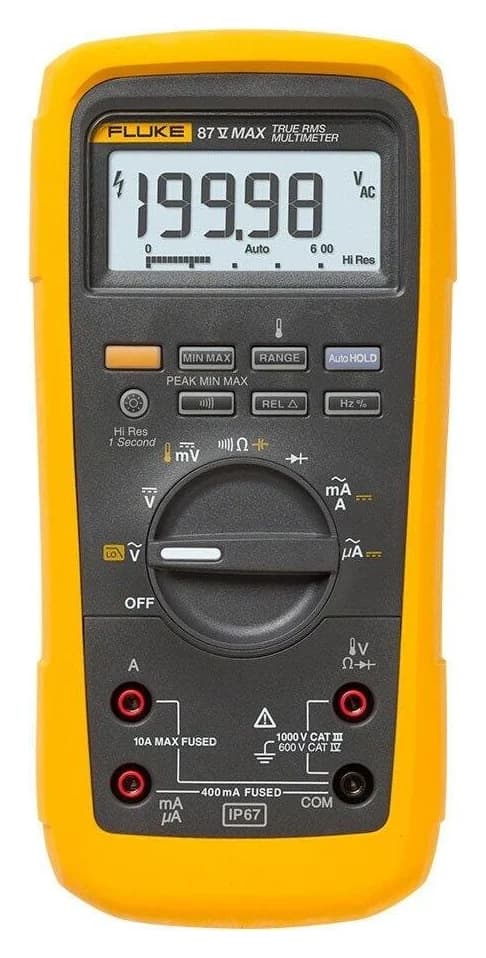
Pick the right Fluke 87V package for industrial work: standard, MAX, CAL, E2 kit or IMSK clamp kit. Compare IP ratings, CAT boundaries and box contents.
Best picks · Multimeters
Best Multimeters for Home Use and Electronics: Five Meters That Cover the Whole House
Pick a multimeter for home wiring and electronics work by safety rating, accuracy and fuse protection. Compare the KAIWEETS HT118A, Fluke 114, Brymen BM257s, Fluke 179 and Fluke 113.