

Best picks
Best Insulation Resistance Testers
Dedicated or Multimeter?
Choose an insulation tester by test voltage, range, timing modes and leads. Compare Fluke and Megger kits, app requirements and when a multimeter suffices.
By thisMETER EditorialUpdated November 3, 20267 min read
On this page · Quick picks: compare the job, then the instrument
For qualified users who already own a suitable multimeter, the Fluke 1507 is our best dedicated insulation resistance tester: five test voltages, automatic PI/DAR and a compare function. Choose the Fluke 1587 FC for combined multimeter work, or the Megger MIT420/2 for local result recall and a higher resistance ceiling, subject to the documentation caveats below. If the job only requires ordinary resistance or continuity checks, keep your suitable multimeter and skip the specialist purchase.
Quick picks: compare the job, then the instrument
Compare specifications and all conditions
Fluke 1507
- Instrument CAT rating
- CAT IV 600 V
- Best fit
- Dedicated testing alongside your DMM
- Important limit
- Match category and voltage; the lowest-rated lead or accessory limits the assembly.
All specifications
- Fixed DC test voltages
- 50, 100, 250, 500, 1000 V
- Advertised insulation range/ceiling
- 0.01 MΩ–10 GΩ
- Timing and records
- Automatic PI/DAR; compare/pass-fail
Fluke 1587 FC
- Instrument CAT rating
- CAT III 1000 V / CAT IV 600 V
- Best fit
- Insulation testing plus multimeter functions
- Important limit
- Match category and voltage; the lowest-rated lead or accessory limits the assembly.
All specifications
- Fixed DC test voltages
- 50, 100, 250, 500, 1000 V
- Advertised insulation range/ceiling
- 0.01 MΩ–2 GΩ
- Timing and records
- PI/DAR; Fluke Connect for graphs/storage
Megger MIT420/2
- Instrument CAT rating
- CAT IV 600 V
- Best fit
- Local storage and recall
- Important limit
- Match category and voltage; the lowest-rated lead or accessory limits the assembly.
All specifications
- Fixed DC test voltages
- 50, 100, 250, 500, 1000 V
- Advertised insulation range/ceiling
- Up to 200 GΩ
- Timing and records
- PI/DAR, timed tests, onboard recall; no Bluetooth download
Full comparison table
Swipe to compare. Row labels stay visible.
| Pick | Best fit | Fixed DC test voltages | Advertised insulation range/ceiling | Timing and records | Instrument CAT rating |
|---|---|---|---|---|---|
| Fluke 1507 | Dedicated testing alongside your DMM | 50, 100, 250, 500, 1000 V | 0.01 MΩ–10 GΩ | Automatic PI/DAR; compare/pass-fail | CAT IV 600 V |
| Fluke 1587 FC | Insulation testing plus multimeter functions | 50, 100, 250, 500, 1000 V | 0.01 MΩ–2 GΩ | PI/DAR; Fluke Connect for graphs/storage | CAT III 1000 V / CAT IV 600 V |
| Megger MIT420/2 | Local storage and recall | 50, 100, 250, 500, 1000 V | Up to 200 GΩ | PI/DAR, timed tests, onboard recall; no Bluetooth download | CAT IV 600 V |
Scroll horizontally to see every column
| Pick | Best fit | Fixed DC test voltages | Advertised insulation range/ceiling | Timing and records | Instrument CAT rating |
|---|---|---|---|---|---|
| Fluke 1507 | Dedicated testing alongside your DMM | 50, 100, 250, 500, 1000 V | 0.01 MΩ–10 GΩ | Automatic PI/DAR; compare/pass-fail | CAT IV 600 V |
| Fluke 1587 FC | Insulation testing plus multimeter functions | 50, 100, 250, 500, 1000 V | 0.01 MΩ–2 GΩ | PI/DAR; Fluke Connect for graphs/storage | CAT III 1000 V / CAT IV 600 V |
| Megger MIT420/2 | Local storage and recall | 50, 100, 250, 500, 1000 V | Up to 200 GΩ | PI/DAR, timed tests, onboard recall; no Bluetooth download | CAT IV 600 V |
Sources: Fluke's 1507 specifications, 1587 FC datasheet and Megger's US datasheet. These are manufacturer specifications. The maximum insulation ranges are not available at every test voltage; CAT ratings here describe the instruments, with probe limits discussed below.
Best dedicated tester: Fluke 1507
Buy the 1507 when the missing tool is an insulation tester and your existing DMM already meets your other needs. Its US package, part 5066006, includes TL224 leads, TP74 probes, alligator clips, a holster and a remote test probe. Fluke positions the remote probe for repetitive or hard-to-reach tests.
The appeal is standalone operation: automatic polarization index (PI) and dielectric absorption ratio (DAR), plus compare/pass-fail for repeated checks. The 1507 manual defines PI as the ten-minute resistance divided by the one-minute resistance, and DAR as the one-minute resistance divided by the thirty-second resistance. Record the timing convention with the result.
The trade-off is limited general measurement capability: AC/DC voltage to 600 V and earth-bond resistance to 20.00 kΩ, rather than the 1587 FC's current, capacitance and temperature functions. The advertised 10 GΩ ceiling applies at 1000 V; the manual gives 50 MΩ at 50 V and 500 MΩ at 500 V. Buy for the range at your required voltage.
Variant trap: the 1503 offers only 500 V and 1000 V insulation settings in the shared manual. It is not the same five-voltage tester.
Check the standard US package with Fluke
Best combined instrument: Fluke 1587 FC
Choose the FLK-1587-FC, part 4691215, if consolidating instruments matters more than the 1507's higher insulation ceiling. Fluke specifies a 6,000-count True RMS multimeter, AC/DC voltage to 1000 V, AC/DC current ranges to 400 mA, capacitance, temperature, frequency, diode test and a VFD low-pass filter. Its lead-current input is not a high-current clamp; consider our clamp-meter guide for that separate purchase.
The insulation ceiling is 2 GΩ at 1000 V; at 500 V it is 500 MΩ, and at 50 V it is 50 MΩ. The manual describes on-meter PI/DAR. The datasheet places graphs, memory storage and temperature compensation in the Fluke Connect Measurements app workflow. Check the app on your intended phone before buying for reporting. Fluke separately identifies Fluke Connect Assets as sold separately.
Case conflict: the US page lists a soft case in its box/model sections, but says hard case in its overview; the datasheet also says hard case. Confirm the supplied case. The manual's unpack list names TL224 leads, TP74 probes, AC285 clips, a holster, thermocouple and remote probe, with a soft case.
Variant trap: the standard instrument is different from the Advanced Electrical Troubleshooting Kit, which adds an i400 clamp and 62 MAX+ infrared thermometer. The 1577 has only 500/1000 V insulation settings; do not transfer the FC's features to it.
Check the standard US package with Fluke
Best for local result recall: Megger MIT420/2
Choose MIT420/2, US order code 1004-739, when onboard storage and recall fit your maintenance records. Megger's US datasheet documents that order code and includes 1002-001 red/black silicone leads with probes and clips, an SP5 remote switch probe, six AA alkaline batteries, a carry case and calibration certificate. This establishes the US ordering package; it does not establish a particular seller's stock.
Its resistance ceilings are 10 GΩ at 50 V, 100 GΩ at 500 V and 200 GΩ at 1000 V. The insulation-accuracy specification includes a resistance-dependent term, so the largest displayable value is not a promise of equal precision across the range. PI/DAR and timed tests are documented; Bluetooth downloading belongs to MIT430/2, whereas the 420/2 provides local storage/recall.
Resolve the revision before ordering for variable voltage. The US datasheet describes 10–1000 V in 1 V steps. The linked user guide lists 50–1000 V in its setup table and 1 V increments to 100 V, then 10 V increments in its variable-voltage section. Confirm the delivered instrument's lower limit and steps with Megger. Those documents also print PI/DAR ratios in opposite orders; resolve the reporting convention before comparing historical ratios.
This is our conditional specialist pick for its local memory and range. If the unresolved voltage revision is central to your job, defer purchase until Megger confirms it.
Check the US configuration with Megger
How we choose
We compare official specifications, model-specific manual tables, documented accessories and US ordering information. Recommendations reflect those documents, without physical product testing or claims of verified accuracy. We separate shared-family features from the selected model and flag conflicting descriptions. ASINs await owner verification, so purchase routes here lead to the manufacturers. See how we choose and how we measure.
Buying guide: insulation tester vs multimeter
An insulation tester applies a specified DC test voltage to evaluate insulation; an ordinary resistance check answers a different question. Fluke's selection guide explains why the test voltage, charging/absorption currents and test duration matter. A continuity result alone cannot substitute for a required insulation test.
- Yes: Choose an insulation tester when the equipment procedure specifies a DC insulation-test voltage.
- Partly: Choose a combined insulation multimeter when its additional functions replace tools you need to carry.
- No: Skip the specialist purchase when ordinary resistance or continuity is the entire job.
For ordinary electrical troubleshooting, use our multimeter shortlist; start with the multimeter beginner guide if you are still choosing functions. A professional multimeter label is less useful than the exact function and ratings your job requires.
Match voltage, range and timing together
Fluke says to base the output test voltage on the equipment manufacturer's recommended DC insulation-test voltage. Do not use a higher setting as an automatic upgrade. If your procedure requires an output beyond 1000 V, this shortlist does not cover it.
Next check resistance range at that voltage, the applicable accuracy conditions, and the required timing mode. A large maximum range cannot replace the right voltage. For trending, use the same documented test conditions and timing convention; Fluke explains that capacitive charging and absorption currents settle differently over time. Use the equipment's acceptance procedure, rather than treating a tester's configurable pass/fail setting as a universal insulation standard.
Compare discharge provisions and indications
Both Flukes specify automatic discharge in less than 0.5 second for 1 µF or less, with a 1 µF maximum operable capacitive load and test inhibition when terminal voltage is greater than 30 V before starting. Those are bounded specifications, not promises for every cable or connected load. Megger documents automatic discharge and a configurable live-circuit inhibit, default 50 V; the cited manual does not provide the same numeric discharge-time specification.
Buy the complete, correctly rated kit
The two Fluke unpack lists name TL224 leads and TP74 probes. Fluke rates the TL224 CAT III 1000 V / CAT IV 600 V, but its TP74 page states CAT II 1000 V, with CAT III 1000 V only with the protective cap. Do not assume the instrument's CAT IV rating applies through every supplied probe configuration. Check the markings and caps on the actual leads, remote probe and clips.
For Megger, match the listed lead set and SP5 to the exact kit; the instrument's CAT rating alone does not verify each accessory's rating. Its manual calls for Megger-approved leads. Confirm the calibration paperwork your employer requires rather than treating a bundle name as proof of its scope.
Write down the requirement
Equipment-specified test voltage, resistance range and timing mode come first.
Choose the record workflow
Compare standalone timed results, local recall and the Fluke Connect app workflow.
Confirm the supplied kit
Match the model and order code, probe markings, protective caps, case and calibration paperwork.
Verdict
Choose Fluke 1507 to add dedicated insulation testing to an existing DMM kit, 1587 FC to combine functions with Fluke Connect reporting, or MIT420/2 for local recall and a higher resistance ceiling after resolving its documentation conflicts. Buy the required voltage, usable range and complete probe configuration together. If ordinary resistance is all you need, keep the suitable meter you already own.
Frequently asked questions
Can a multimeter replace an insulation resistance tester?
Only for ordinary resistance and continuity questions. An insulation tester applies a specified DC test voltage; a standard multimeter resistance reading does not establish insulation performance at that voltage. If the equipment procedure calls for an insulation test, buy the required function. If you only need ordinary resistance checks, keep your existing suitable multimeter and skip this purchase. The 1587 FC combines both instrument types.
Should I buy the Fluke 1507 or 1587 FC?
Choose the 1507 if you already have a suitable multimeter and want automatic PI/DAR on the tester. Choose the 1587 FC to combine insulation testing, True RMS voltage, milliamp current, capacitance and temperature in one instrument. Its manual describes on-meter PI/DAR; the graphs and storage workflow uses Fluke Connect. The 1507's advertised insulation ceiling is 10 GΩ; the 1587 FC's is 2 GΩ, and both ceilings depend on test voltage.
Which insulation test voltage should I choose?
Use the equipment manufacturer's specified DC insulation-test voltage and procedure. Fluke's selection guidance explicitly puts that requirement first. Choose a tester that supplies that voltage and the required resistance range; do not select the highest voltage simply because it is available. The three picks offer fixed settings from 50 V through 1000 V, but their resistance ceilings vary with the selected voltage.
Does the Megger MIT420/2 have Bluetooth?
The MIT420/2 has local result storage and recall. Megger assigns Bluetooth downloading to the MIT430/2, so the family page's wireless features should not be attributed to every model. Buy the 420/2 for local records; investigate the 430/2 if downloading is essential. Also confirm the variable-voltage revision: the current US datasheet and linked user guide describe different lower limits and adjustment steps.
Related guides
Best picks · Multimeters
Best Multimeters for Beginners: Choose a First Meter You Can Learn On
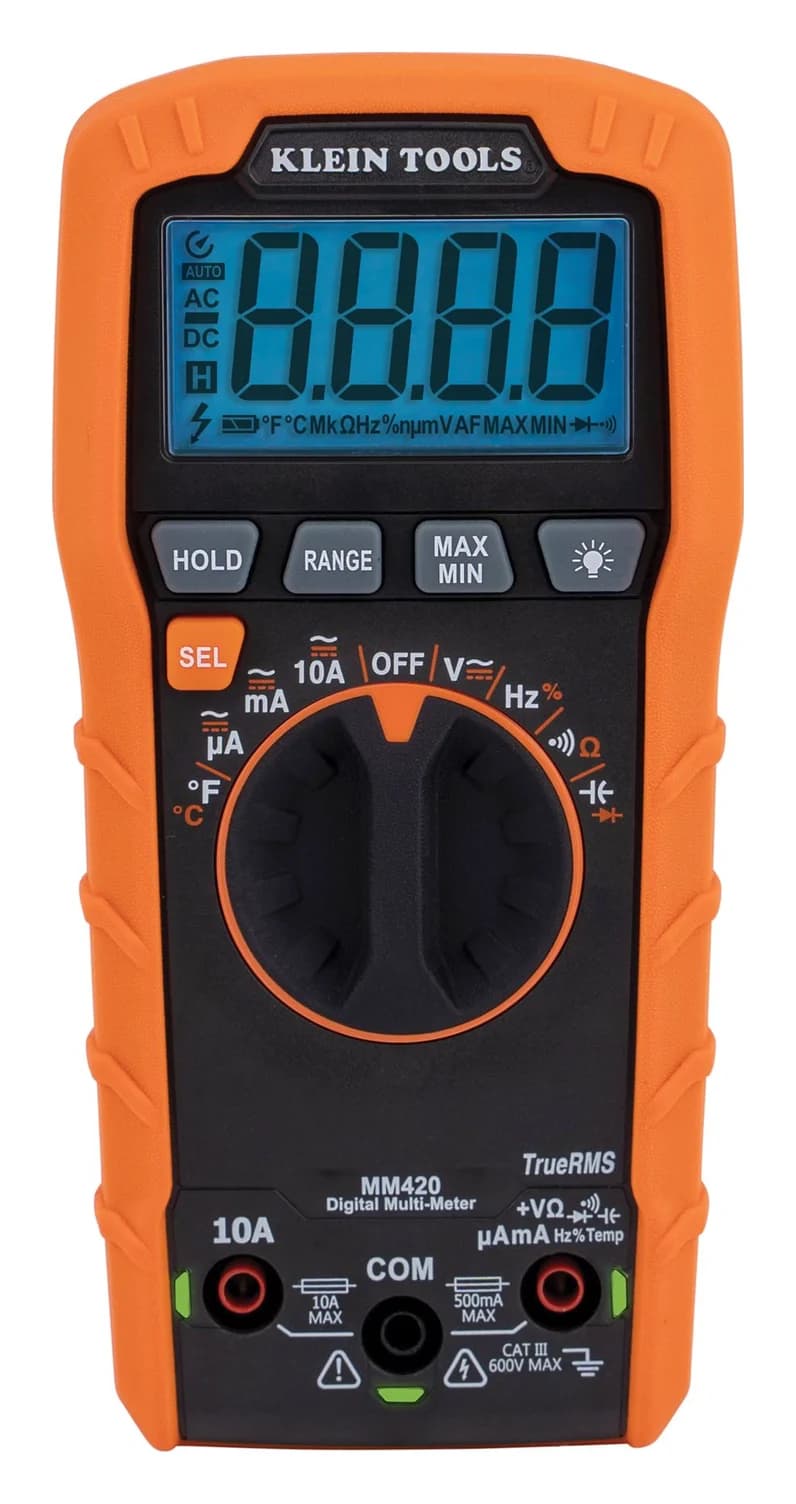
Choose a first multimeter by its controls, current ranges, jack reminders and included leads. Compare Klein MM420, MM325 and Fluke 107 for learning and gifts.
Best picks · Multimeters
Best Multimeters for HVAC: Microamps, Temperature and Complete Kits
Choose an HVAC multimeter by job: compare Fluke 116, Fieldpiece SC260 and Klein alternatives for flame sensors, clamp current, probe limits and kit contents.
Comparison · Multimeters
Fluke 101 vs 107: Current Ranges, Backlight and Regional Support
Compare the Fluke 101 and 107 by current inputs, backlight, accuracy and kit contents, with manual references and regional warranty checks before you buy.