

Best picks
Best Pocket Multimeters
Small Meters, Leads and Current Limits
Compare the Fluke 107, Amprobe PM55A and Hioki 3244-60 for pocket carry, stored leads, current ranges and display features, with the important limits explained.
By thisMETER EditorialUpdated November 3, 20268 min read1 pick
Our recommendation: Fluke 107
General checks, replaceable leads, backlight
Limit: Not True RMS: Fluke positions it for jobs where True RMS accuracy isn't needed
On this page · Our picks at a glance
Our picks at a glance
- 1
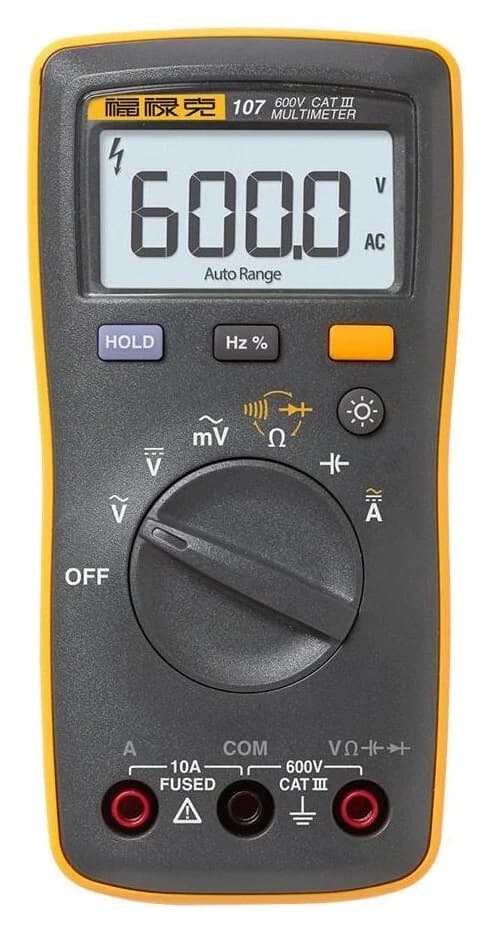
Choose for: General checks, replaceable leads, backlight
Check before buying: Not True RMS: Fluke positions it for jobs where True RMS accuracy isn't needed
The Fluke 107 is our best pocket multimeter for general checks when you need an amp input: it combines replaceable leads, a backlight and AC/DC current measurement to 10 A. Choose the Amprobe PM55A for microamp measurements in a thinner body, or the Hioki 3244-60 for basic voltage and continuity checks with tidy, documented lead storage. The crucial choice is current capability and the size of the complete carried package.
Quick picks
Compare specifications and all conditions
Fluke 107 — best with an amp input
- Choose it for
- General checks, replaceable leads, backlight
- Main compromise
- Thickest body here; no dedicated microamp range
Amprobe PM55A — best for microamps
- Choose it for
- AC/DC microamps, capacitance, automatic function selection
- Main compromise
- Permanently attached leads; conflicting upper-range specifications
Hioki 3244-60 — best for simple checks and stored leads
- Choose it for
- Voltage, resistance, continuity; included hard case
- Main compromise
- No current, capacitance or diode test
Full comparison table
Swipe to compare. Row labels stay visible.
| Pick | Choose it for | Main compromise |
|---|---|---|
| Fluke 107 — best with an amp input | General checks, replaceable leads, backlight | Thickest body here; no dedicated microamp range |
| Amprobe PM55A — best for microamps | AC/DC microamps, capacitance, automatic function selection | Permanently attached leads; conflicting upper-range specifications |
| Hioki 3244-60 — best for simple checks and stored leads | Voltage, resistance, continuity; included hard case | No current, capacitance or diode test |
Scroll horizontally to see every column
| Pick | Choose it for | Main compromise |
|---|---|---|
| Fluke 107 — best with an amp input | General checks, replaceable leads, backlight | Thickest body here; no dedicated microamp range |
| Amprobe PM55A — best for microamps | AC/DC microamps, capacitance, automatic function selection | Permanently attached leads; conflicting upper-range specifications |
| Hioki 3244-60 — best for simple checks and stored leads | Voltage, resistance, continuity; included hard case | No current, capacitance or diode test |
These are research-based picks from the makers' product pages and manuals. None is a True RMS meter; see the AC limitation below.
Compare size, storage and functions
Dimensions below are normalized to height × width × depth. Body measurements exclude any unreported increase from packed leads or a carrying case; weights are the makers' instrument figures, not complete travel-kit weights.
Fluke 107
- AC/DC current ranges
- 4.000 A / 10.00 A
- Body, H × W × D
- 142 × 69 × 28 mm
- Lead storage / packed dimensions
- Separate TL75 lead set; packed dimensions not stated
All specifications
- Instrument weight
- 200 g
- Display
- 6,000 counts; backlight and hold
- Extra functions
- Capacitance, diode, frequency, duty cycle
- Rating as documented
- CAT III 600 V
- Battery
- Two AAA
Amprobe PM55A
- AC/DC current ranges
- 400.0 µA / 2000 µA
- Body, H × W × D
- 113 × 53 × 10.2 mm
- Lead storage / packed dimensions
- Carrying case included; packed dimensions not stated
All specifications
- Instrument weight
- Approximately 78 g
- Display
- 6,000 counts; oversized display
- Extra functions
- Capacitance, diode, frequency, VolTect detection
- Rating as documented
- CAT III 300 V / CAT II 600 V
- Battery
- One CR2032
Hioki 3244-60
- AC/DC current ranges
- No current function
- Body, H × W × D
- 109 × 55 × 9.5 mm
- Lead storage / packed dimensions
- Included hard case with lead storage: approximately 116 (H) × 80 (W) × 17 (D) mm
All specifications
- Instrument weight
- 60 g
- Display
- Up to 4,199 counts, except the 500 V range
- Extra functions
- Resistance and continuity; no diode test
- Rating as documented
- CAT III 300 V / CAT II 600 V; sleeve-dependent
- Battery
- One CR2032
Full comparison table
Swipe to compare. Row labels stay visible.
| Specification | Fluke 107 | Amprobe PM55A | Hioki 3244-60 |
|---|---|---|---|
| Body, H × W × D | 142 × 69 × 28 mm | 113 × 53 × 10.2 mm | 109 × 55 × 9.5 mm |
| Lead storage / packed dimensions | Separate TL75 lead set; packed dimensions not stated | Carrying case included; packed dimensions not stated | Included hard case with lead storage: approximately 116 (H) × 80 (W) × 17 (D) mm |
| Instrument weight | 200 g | Approximately 78 g | 60 g |
| AC/DC current ranges | 4.000 A / 10.00 A | 400.0 µA / 2000 µA | No current function |
| Display | 6,000 counts; backlight and hold | 6,000 counts; oversized display | Up to 4,199 counts, except the 500 V range |
| Extra functions | Capacitance, diode, frequency, duty cycle | Capacitance, diode, frequency, VolTect detection | Resistance and continuity; no diode test |
| Rating as documented | CAT III 600 V | CAT III 300 V / CAT II 600 V | CAT III 300 V / CAT II 600 V; sleeve-dependent |
| Battery | Two AAA | One CR2032 | One CR2032 |
Scroll horizontally to see every column
| Specification | Fluke 107 | Amprobe PM55A | Hioki 3244-60 |
|---|---|---|---|
| Body, H × W × D | 142 × 69 × 28 mm | 113 × 53 × 10.2 mm | 109 × 55 × 9.5 mm |
| Lead storage / packed dimensions | Separate TL75 lead set; packed dimensions not stated | Carrying case included; packed dimensions not stated | Included hard case with lead storage: approximately 116 (H) × 80 (W) × 17 (D) mm |
| Instrument weight | 200 g | Approximately 78 g | 60 g |
| AC/DC current ranges | 4.000 A / 10.00 A | 400.0 µA / 2000 µA | No current function |
| Display | 6,000 counts; backlight and hold | 6,000 counts; oversized display | Up to 4,199 counts, except the 500 V range |
| Extra functions | Capacitance, diode, frequency, duty cycle | Capacitance, diode, frequency, VolTect detection | Resistance and continuity; no diode test |
| Rating as documented | CAT III 600 V | CAT III 300 V / CAT II 600 V | CAT III 300 V / CAT II 600 V; sleeve-dependent |
| Battery | Two AAA | One CR2032 | One CR2032 |
Sources: Fluke specifications, Amprobe specifications and manual, and Hioki specifications and manual. Amprobe's disputed upper ranges are deliberately explained below rather than presented as settled specifications.
The body depths are 28 mm for Fluke, 10.2 mm for Amprobe and 9.5 mm for Hioki. This chart compares bodies only; Hioki's stored package is 17 millimeters deep.
Source: Manufacturer specifications and Amprobe's manual, linked above; not packed-kit dimensions
The useful pocket-size winner is the Hioki package, because its maker documents the hard case with the leads stowed. For Fluke and Amprobe, do not mistake a body-only dimension for a guaranteed pocket fit: request the closed-case dimensions if your pocket is tight. We cannot rank their complete packed sizes from the available documents.
Best pocket meter with an amp input: Fluke 107
Fluke
A palm-size 6,000-count multimeter rated CAT III 600V that measures AC and DC voltage and current to 600 V and 10 A, plus resistance, capacitance, frequency and duty cycle; it is not True RMS.
Check package and model options
- 600 V max
- 10 A max
- 6,000 counts
- CAT III 600V
The 107 is our general-checks pick when you want a small meter that still measures amps. Its manual specifies 4.000 A and 10.00 A AC/DC ranges; the lower range resolves 0.001 A. That is not a dedicated microamp range: choose the PM55A if tiny currents are your actual buying reason.
The 6,000-count backlit display, manual hold and supplied SmartStrap magnetic lanyard make the Fluke the most appealing option here for supporting the meter where you can see it. The standard US package is part 4367953, with TL75 leads, two installed AAA batteries and SmartStrap. The leads have shrouded banana plugs; unlike the PM55A's permanently attached leads, they can be unplugged and replaced.
There are important limits. Fluke specifies a 10 A duty cycle of less than 7 minutes on, then 20 minutes off at 25–40 °C: the highest current range is not permission for continuous monitoring. The current input uses an 11 A, 1000 V fuse; use only the replacement specified in the manual. Its hold button freezes the present reading, so it does not solve every awkward viewing position.
Buy this exact package: the 107 with TL75 and SmartStrap. The shared manual also covers the 106, but identifies diode, frequency and duty-cycle functions as 107-only; do not transfer those features to its sibling. For the regional Fluke 101 versus 107 decision, use our dedicated model guide.
Best pocket multimeter for microamps: Amprobe PM55A
The PM55A earns its place for a function the Fluke lacks: 400.0 µA and 2000 µA AC/DC ranges. Its manual also specifies 6 mV/µA burden voltage on those ranges. That burden is a reason to check the circuit's tolerance before choosing it for low-voltage electronics; a microamp label alone does not establish suitability.
Amprobe specifies a 6,000-count display, a 113 × 53 × 10.2 mm body and approximately 78 g weight. Its permanently attached leads avoid a separate plug-in lead set, but cable damage becomes a servicing issue; the manual reserves repairs for qualified personnel. AutoTect selects AC voltage, DC voltage or resistance automatically, and VolTect adds AC non-contact detection.
AutoTect's low input impedance also matters: Amprobe tells users to select the separate Hi-Z voltage function for circuits sensitive to input loading. Do not assume automatic function selection is the right mode for every electronic circuit. The rotary selector and SELECT button share functions; compare that control scheme with Hioki's simpler function dial before buying a gift.
Resolve these document conflicts before buying for the upper ranges. The current product page advertises 600 V AC/DC and capacitance to 2000 µF, but the English manual linked from Amprobe's manual index lists a highest DC-voltage table entry of 450.0 V and capacitance entries only through 100.0 µF. These are conflicting maker documents, not evidence of a verified new generation; ask Amprobe to confirm the supplied instrument's limits if they matter to your work.
Package check: the current page lists the meter, carrying case and installed battery. The manual names an H-PM holster and VC3 pouch as accessories. Treat the named holster/pouch bundle as unconfirmed, and request the exact contents before ordering. The separate PM51A column in Amprobe's comparison table is not the PM55A specification.
See the PM55A and package details at Amprobe.
Best for simple checks and stored leads: Hioki 3244-60
Choose this one if you mainly need voltage, resistance and continuity and want the leads to travel with the meter. Hioki lists a 109 × 55 × 9.5 mm, 60 g instrument and an included hard case approximately 116 (H) × 80 (W) × 17 (D) mm with room to wind and store the leads. That is the most complete carry-size specification in this shortlist.
The limitations are straightforward: no current function, capacitance or diode test. Hioki specifies a display of up to 4,199 counts, with an exception for the 500 V range. It automatically selects ranges, but its manual says manual range selection is unavailable. A simple function dial may be preferable to the PM55A's button-driven secondary functions; that is a buying preference, not a measured usability result.
The leads are integrated into the instrument in Hioki's manual illustration, rather than a plug-in lead set. Its cable-inspection warning directs damaged-lead repairs to a dealer or Hioki representative. The CR2032 battery is replaceable, and the official package includes the case, instruction manual, trial battery and red/black sleeves. Check for the complete 3244-60 package, not a C0204 case-only accessory.
Read the voltage limits carefully. The maker states CAT III 300 V / CAT II 600 V, with the category depending on the probe sleeves, while the measurement range ends at 500 V. The manual also warns against exceeding 450 V to ground. Do not interpret the CAT II marking as a 600 V measurement range; obtain maker clarification for work near these conflicting upper limits.
Hioki lists the model on its Americas site and provides US contact coverage and calibration/repair support. Those are support routes, not a promise of local stock or universal coverage for an imported unit.
See the 3244-60 and included accessories at Hioki.
Buying advice: choose the missing function first
Current divides these meters into different tools. Choose the Fluke for amp measurements, the Amprobe for microamps, and the Hioki when you do not need current at all. Neither current-capable pick covers both of those jobs with the ranges documented here.
- Yes: Fluke 107: amp ranges and replaceable leads
- Yes: Amprobe PM55A: microamp ranges
- Yes: Hioki 3244-60: voltage, resistance and continuity with case storage
- No: None of these picks combines the Fluke's amp ranges with dedicated microamp ranges
For distorted AC, look beyond this shortlist. Fluke explicitly identifies the 107 as non-True-RMS; Amprobe specifies average sensing and Hioki average rectification. Fluke's True RMS explanation says average-responding meters have uncertain accuracy on non-sinusoidal waveforms. Use our broader multimeter picks when True RMS or a different range mix matters more than pocket carry.
Readability needs more than a count figure. Fluke documents backlighting; Amprobe describes oversized digits; Hioki describes a simple display with large text. Those are maker descriptions, not verified viewing-angle or sunlight results. Prefer the Fluke if a documented backlight is essential, and check the manual's button layout for the intended recipient.
Repairability favors removable leads. All three specify replaceable batteries, but the Fluke separates its lead set from the meter. For either integrated-lead model, factor the maker's service route into ownership. Never use damaged cables, and follow the manual before opening a battery compartment.
For low-voltage learning, start with our multimeter basics guide. For a present, check these purchase details before choosing the smallest box:
Choose the current function
Fluke for amps, Amprobe for microamps, Hioki for voltage and continuity.
Check the complete package
Fluke's TL75 and SmartStrap; Amprobe's carrying case; Hioki's case and sleeves.
Check storage and service
Use the closed-case size; decide whether integrated leads suit the recipient.
How we choose
We compared official product pages, model-specific manual tables, package lists and service pages. The shortlist deliberately includes a plug-in-lead meter and two thinner integrated-lead formats. We have not performed physical testing, timed continuity response or verified pocket fit, display readability or accuracy. Ratings and dimensions are manufacturer specifications; missing packed dimensions and document disagreements remain explicit. See How we choose for the site's research policy.
Verdict
Get the Fluke 107 for general checks that need an amp input and removable leads. Choose the Amprobe PM55A specifically for its microamp capability, after checking its loading and specification caveats. Choose the Hioki 3244-60 for basic checks and an included case with documented lead storage; accept its deliberately limited function set.
Frequently asked questions
What is the best pocket multimeter?
Choose the Fluke 107 if you want a compact general-purpose meter with a backlight, replaceable leads and an amp input. Choose the Amprobe PM55A for its microamp ranges, or the Hioki 3244-60 for basic voltage, resistance and continuity checks with leads stored in an included hard case. These recommendations compare manufacturer documents; we have not performed physical testing.
Can a pocket multimeter measure current?
It depends on the model. The Fluke 107 has AC/DC ranges of 4.000 A and 10.00 A, with 0.001 A resolution on its lower range. The Amprobe PM55A instead has 400.0 µA and 2000 µA AC/DC ranges. The Hioki 3244-60 has no current function. Choose for both the current ceiling and the smallest change you need to see.
Is the Hioki 3244-60 really only 9.5 mm thick?
That is Hioki's body-depth specification. The included hard case, which stores the meter and its leads, is approximately 80 (W) × 116 (H) × 17 (D) mm. Use the case dimensions when deciding whether the complete package fits your pocket. The advertised body weight is 60 g; Hioki does not give a complete packed weight on that page.
Are these pocket multimeters True RMS?
No. Fluke explicitly says the 107 is not True RMS, Amprobe specifies average sensing for the PM55A, and Hioki specifies average-rectified AC measurement for the 3244-60. Fluke explains that average-responding meters have uncertain accuracy on non-sinusoidal waveforms. If distorted AC is part of your work, choose a suitable True RMS meter instead of choosing solely by pocket size.
Fluke 107
AmazonRelated guides
Best picks · Multimeters
Best Multimeters for Beginners: Choose a First Meter You Can Learn On
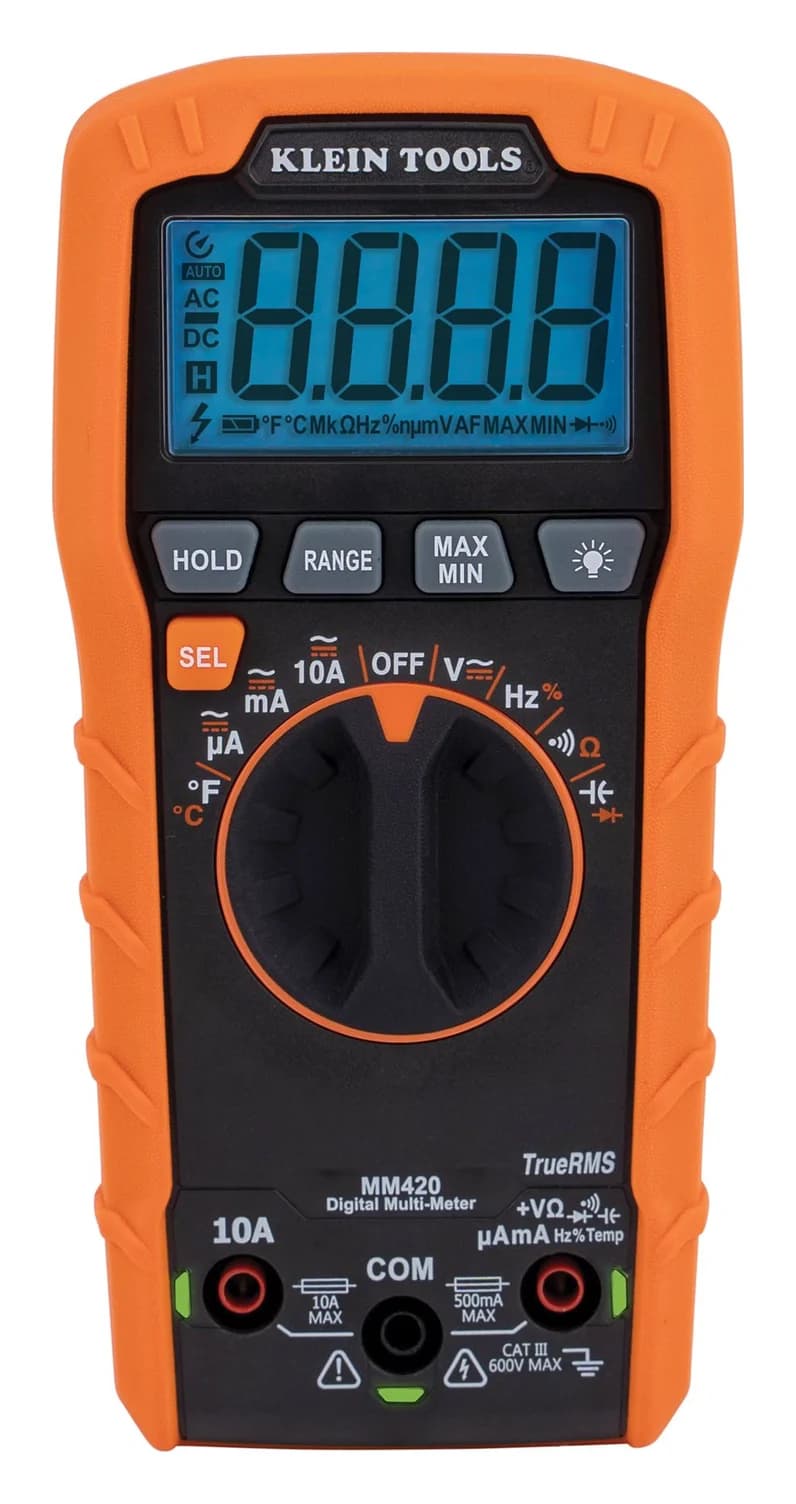
Choose a first multimeter by its controls, current ranges, jack reminders and included leads. Compare Klein MM420, MM325 and Fluke 107 for learning and gifts.
Best picks · Multimeters
Best Multimeters for HVAC: Microamps, Temperature and Complete Kits
Choose an HVAC multimeter by job: compare Fluke 116, Fieldpiece SC260 and Klein alternatives for flame sensors, clamp current, probe limits and kit contents.
Comparison · Multimeters
Fluke 101 vs 107: Current Ranges, Backlight and Regional Support
Compare the Fluke 101 and 107 by current inputs, backlight, accuracy and kit contents, with manual references and regional warranty checks before you buy.