

Comparison
Fluke i410 vs i1010: Which Current Clamp Fits Your Multimeter?
Choose the Fluke i410 or i1010 for your existing multimeter. Compare useful current ranges, voltage inputs, accuracy, jaw clearance and complete kit contents.
By thisMETER EditorialUpdated November 3, 20269 min read
On this page · Quick picks: which setup should you buy?
Choose the Fluke i410 to reuse a compatible multimeter for current within 400 A AC/DC; choose the i1010 when you need 600 A AC or 1000 A DC, according to Fluke's instruction sheet. Both send 1 mV/A to the DMM's voltage input; with a Fluke 117, deriving 1% of its 600.0 mV range gives a 6 mV, or 6 A, AC input threshold. If you also need to buy a DMM, compare an integrated clamp multimeter before committing to a separate probe and display.
- 1 mV/ABoth accessories send voltage to the DMM
- 400 Ai410 maximum for AC and DC
- 6 ADerived AC input threshold when paired with a Fluke 117
Quick picks: which setup should you buy?
Compare specifications and all conditions
Existing suitable DMM; current stays within 400 A
- Our choice
- i410
- Buying condition
- Accept its accuracy and check the DMM's low end
DC above 400 A through 1000 A, or AC above 400 A through 600 A
- Our choice
- i1010
- Buying condition
- Match the output voltage range, not the DMM's direct-current jack rating
A wider jaw
- Our choice
- Neither wins on the documented specification
- Buying condition
- The sheet gives 30 mm for one conductor and 2 × 25 mm for two
Small parasitic drain or leakage
- Our choice
- Choose a purpose-specific instrument
- Buying condition
- Neither clamp's small-current accuracy makes it our default here
No DMM already, or preference for one instrument
- Our choice
- Compare integrated clamps
- Buying condition
- Start with clamp meter vs multimeter
Full comparison table
Swipe to compare. Row labels stay visible.
| Your requirement | Our choice | Buying condition |
|---|---|---|
| Existing suitable DMM; current stays within 400 A | i410 | Accept its accuracy and check the DMM's low end |
| DC above 400 A through 1000 A, or AC above 400 A through 600 A | i1010 | Match the output voltage range, not the DMM's direct-current jack rating |
| A wider jaw | Neither wins on the documented specification | The sheet gives 30 mm for one conductor and 2 × 25 mm for two |
| Small parasitic drain or leakage | Choose a purpose-specific instrument | Neither clamp's small-current accuracy makes it our default here |
| No DMM already, or preference for one instrument | Compare integrated clamps | Start with clamp meter vs multimeter |
Scroll horizontally to see every column
| Your requirement | Our choice | Buying condition |
|---|---|---|
| Existing suitable DMM; current stays within 400 A | i410 | Accept its accuracy and check the DMM's low end |
| DC above 400 A through 1000 A, or AC above 400 A through 600 A | i1010 | Match the output voltage range, not the DMM's direct-current jack rating |
| A wider jaw | Neither wins on the documented specification | The sheet gives 30 mm for one conductor and 2 × 25 mm for two |
| Small parasitic drain or leakage | Choose a purpose-specific instrument | Neither clamp's small-current accuracy makes it our default here |
| No DMM already, or preference for one instrument | Compare integrated clamps | Start with clamp meter vs multimeter |
i410 vs i1010: the comparison that matters
Fluke i410
- Specified DC current range
- 1–400 A
- Specified AC current range
- 1–400 A rms
- DMM input / output scale
- AC/DC voltage at V/COM; 1 mV/A
All specifications
- DC accuracy, zero adjusted and conductor centered
- ±(3.5% of reading + 0.5 A)
- AC accuracy, 45–400 Hz, crest factor ≤3
- ±(3.5% of reading + 0.5 A)
- Useable frequency; distinct from the accuracy band
- 3 kHz
- Conductor diameter in instruction sheet
- 30 mm (headline conflict below); 2 × 25 mm
- Output connection and cable
- Shrouded banana plugs; 1.6 m
- Clamp battery and typical continuous life
- 9 V alkaline; 60 hr
- Marked measurement category
- CAT III 600 V
Fluke i1010
- Specified DC current range
- 1–1000 A
- Specified AC current range
- 1–600 A rms
- DMM input / output scale
- AC/DC voltage at V/COM; 1 mV/A
All specifications
- DC accuracy, zero adjusted and conductor centered
- ±(2.0% of reading + 0.5 A)
- AC accuracy, 45–400 Hz, crest factor ≤3
- ±(2.0% of reading + 0.5 A)
- Useable frequency; distinct from the accuracy band
- 10 kHz
- Conductor diameter in instruction sheet
- 30 mm; 2 × 25 mm
- Output connection and cable
- Shrouded banana plugs; 1.6 m
- Clamp battery and typical continuous life
- 9 V alkaline; 60 hr
- Marked measurement category
- CAT III 600 V
Full comparison table
Swipe to compare. Row labels stay visible.
| Specification | Fluke i410 | Fluke i1010 |
|---|---|---|
| DMM input / output scale | AC/DC voltage at V/COM; 1 mV/A | AC/DC voltage at V/COM; 1 mV/A |
| Specified DC current range | 1–400 A | 1–1000 A |
| Specified AC current range | 1–400 A rms | 1–600 A rms |
| DC accuracy, zero adjusted and conductor centered | ±(3.5% of reading + 0.5 A) | ±(2.0% of reading + 0.5 A) |
| AC accuracy, 45–400 Hz, crest factor ≤3 | ±(3.5% of reading + 0.5 A) | ±(2.0% of reading + 0.5 A) |
| Useable frequency; distinct from the accuracy band | 3 kHz | 10 kHz |
| Conductor diameter in instruction sheet | 30 mm (headline conflict below); 2 × 25 mm | 30 mm; 2 × 25 mm |
| Output connection and cable | Shrouded banana plugs; 1.6 m | Shrouded banana plugs; 1.6 m |
| Clamp battery and typical continuous life | 9 V alkaline; 60 hr | 9 V alkaline; 60 hr |
| Marked measurement category | CAT III 600 V | CAT III 600 V |
Scroll horizontally to see every column
| Specification | Fluke i410 | Fluke i1010 |
|---|---|---|
| DMM input / output scale | AC/DC voltage at V/COM; 1 mV/A | AC/DC voltage at V/COM; 1 mV/A |
| Specified DC current range | 1–400 A | 1–1000 A |
| Specified AC current range | 1–400 A rms | 1–600 A rms |
| DC accuracy, zero adjusted and conductor centered | ±(3.5% of reading + 0.5 A) | ±(2.0% of reading + 0.5 A) |
| AC accuracy, 45–400 Hz, crest factor ≤3 | ±(3.5% of reading + 0.5 A) | ±(2.0% of reading + 0.5 A) |
| Useable frequency; distinct from the accuracy band | 3 kHz | 10 kHz |
| Conductor diameter in instruction sheet | 30 mm (headline conflict below); 2 × 25 mm | 30 mm; 2 × 25 mm |
| Output connection and cable | Shrouded banana plugs; 1.6 m | Shrouded banana plugs; 1.6 m |
| Clamp battery and typical continuous life | 9 V alkaline; 60 hr | 9 V alkaline; 60 hr |
| Marked measurement category | CAT III 600 V | CAT III 600 V |
Sources: shared instruction sheet, i410 specifications and i1010 specifications. These are manufacturer specifications, not readings from thisMETER.
Best when 400 A covers the job: Fluke i410
The i410 is our starting accessory when you already own a suitable DMM and its current ceiling covers your work. Fluke identifies the standalone US model as i410, part 617727. Its Hall-effect design measures AC and DC; the meter reads the clamp's voltage output rather than carrying the measured current through its own current input. Fluke's accessory explanation distinguishes this from AC-only current-output clamps.
The trade-off is its looser percentage accuracy relative to i1010. Do not choose it for fine drain measurements simply because Fluke's product page lists a lowest measurable current below its specified range; the accuracy floor still applies.
Jaw conflict: the i410 page's headline says 32 mm, while its specification table and the shared instruction sheet say 30 mm for one conductor. Treat clearance near that boundary as unresolved and obtain confirmation for your exact cable; we would not buy it assuming the headline wins.
Check the standalone i410 at Fluke.
Best for higher current: Fluke i1010
Choose the i1010, part 617735, for its higher current ceilings or tighter percentage accuracy. Its headline maximum applies to DC: 1000 A DC does not mean 1000 A AC. The instruction sheet caps AC at 600 A rms. Fluke's US i1010 page confirms the separate ranges.
It does not buy a larger documented jaw: both models share the instruction sheet's conductor dimensions. Nor does its wider bandwidth guarantee its headline accuracy at every frequency. If your reason for upgrading is conductor clearance or a particular waveform, resolve that requirement separately from the maximum-current number.
Match the output to your DMM before ordering
The instruction sheet requires a voltmeter accepting safety-shrouded banana plugs, able to display 1 mV, preferably 0.1 mV, with accuracy ≥0.75%, a load impedance of 1 MΩ, ≤100 pF. For AC current, select mV AC or V AC; for DC current, select mV DC. Check the chosen voltage function's accuracy as well as its resolution, and use the matching mode.
At 1 mV/A, a hypothetical 20 A gives 20 mV. A display step of 0.1 mV corresponds to 0.1 A; it does not establish that accuracy. The i1010's 1000 A DC ceiling corresponds to 1000 mV, exceeding a 600 mV range. These conversions follow the documented output scale.
Fluke specifies the DMM's voltage and COM inputs for these accessories: connect the black output lead to COM and the red output lead to V. For the most accurate DC readings, zero the display with the jaws closed before clamping one conductor. Its similarly named i400 instead produces an AC current output and needs the appropriate milliamp input. A shared brand, banana connection or clamp shape is insufficient compatibility evidence. Source: Fluke's connection guide.
- Yes: Voltage-output clamp plus matching AC/DC voltage function is the required pairing
- No: A current-input jack alone does not establish compatibility with i410 or i1010
- Partly: Another DMM needs its connector, impedance, range and accuracy checked individually
Compatible DMM example to reuse: Fluke 117
The existing Fluke 117 record is a useful host example, not a requirement to buy another meter. Its manual explicitly permits mV/A current probes. A shared input-characteristics table for models 110, 114, 115 and 117 lists nominal voltage-input impedances above 5 MΩ AC and 10 MΩ DC, each below 100 pF; this article infers that those documented inputs fit the clamp load requirement. Fluke also confirms i1010/117 compatibility in the i1010 page's manufacturer Q&A, while the instruction sheet says minimum AC current is limited to the low end of the specified mV AC range.
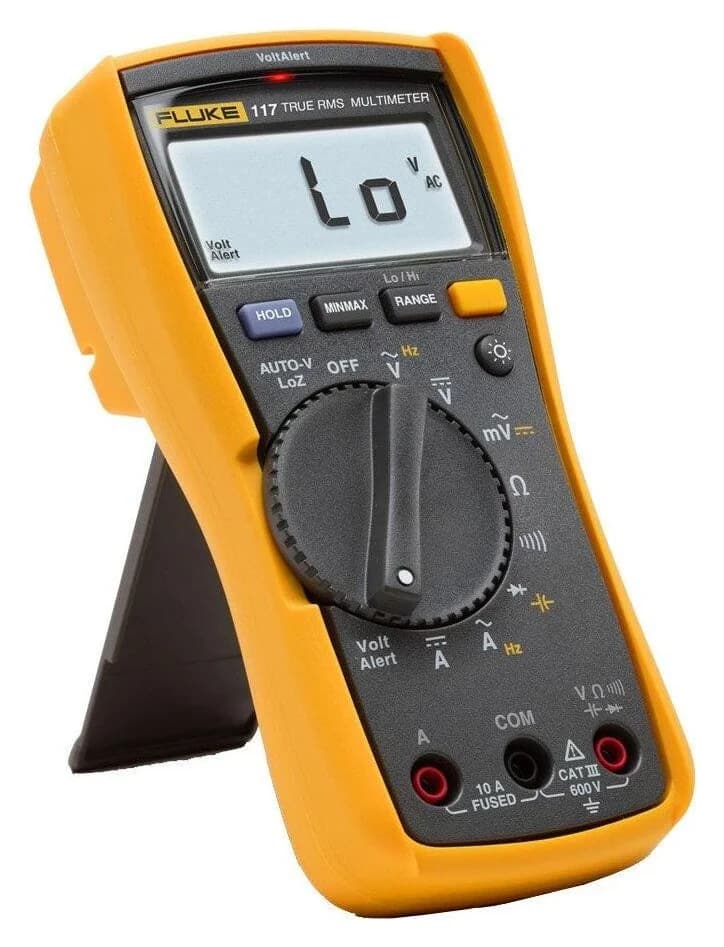
Fluke
A compact 6,000-count True RMS multimeter for electricians, rated CAT III 600V, with built-in VoltAlert non-contact voltage detection, automatic AC/DC selection and a low-impedance mode.
Check package and model options
- 600 V max
- 10 A max
- 6,000 counts
- CAT III 600V
DC: 600.0 mV range, 0.1 mV resolution; accuracy 0.5% + 2 counts
- What the clamp combination gains
- 0.1 A display steps; electrically suitable for either clamp
- What still limits it
- Clamp error plus DMM error; higher i1010 DC signals need another range
AC: 600.0 mV range, 0.1 mV resolution; accuracy 1.0% + 3 counts
- What the clamp combination gains
- True RMS voltage reading, equivalent 0.1 A steps
- What still limits it
- Derived specified input threshold: 6 mV, equivalent to 6 A
DC: 6.000 V range, 0.001 V resolution
- What the clamp combination gains
- Accommodates the i1010's full-scale DC output
- What still limits it
- Equivalent 1 A display steps
Auto-V LoZ
- What the clamp combination gains
- Use the ordinary voltage functions instead
- What still limits it
- Approximately 3 kΩ input and up to 500 pF fail the clamp's ≥1 MΩ, ≤100 pF load requirement
Full comparison table
Swipe to compare. Row labels stay visible.
| Fluke 117 voltage function | What the clamp combination gains | What still limits it |
|---|---|---|
| DC: 600.0 mV range, 0.1 mV resolution; accuracy 0.5% + 2 counts | 0.1 A display steps; electrically suitable for either clamp | Clamp error plus DMM error; higher i1010 DC signals need another range |
| AC: 600.0 mV range, 0.1 mV resolution; accuracy 1.0% + 3 counts | True RMS voltage reading, equivalent 0.1 A steps | Derived specified input threshold: 6 mV, equivalent to 6 A |
| DC: 6.000 V range, 0.001 V resolution | Accommodates the i1010's full-scale DC output | Equivalent 1 A display steps |
| Auto-V LoZ | Use the ordinary voltage functions instead | Approximately 3 kΩ input and up to 500 pF fail the clamp's ≥1 MΩ, ≤100 pF load requirement |
Scroll horizontally to see every column
| Fluke 117 voltage function | What the clamp combination gains | What still limits it |
|---|---|---|
| DC: 600.0 mV range, 0.1 mV resolution; accuracy 0.5% + 2 counts | 0.1 A display steps; electrically suitable for either clamp | Clamp error plus DMM error; higher i1010 DC signals need another range |
| AC: 600.0 mV range, 0.1 mV resolution; accuracy 1.0% + 3 counts | True RMS voltage reading, equivalent 0.1 A steps | Derived specified input threshold: 6 mV, equivalent to 6 A |
| DC: 6.000 V range, 0.001 V resolution | Accommodates the i1010's full-scale DC output | Equivalent 1 A display steps |
| Auto-V LoZ | Use the ordinary voltage functions instead | Approximately 3 kΩ input and up to 500 pF fail the clamp's ≥1 MΩ, ≤100 pF load requirement |
The 6 A AC threshold is this article's calculation from the manual's 1% of range specified-input note on 600.0 mV, not a Fluke statement in amps. Thus the clamp's 1 A specified lower end does not make a 117 combination specified down to that current. Also note that the 117's AC millivolt function is DC-coupled. Its AC accuracy table covers 45–500 Hz and 500 Hz–1 kHz; intersect the meter's conditions with the clamp's conditions rather than adopting whichever specification looks broader. 117 accuracy tables and notes.
Check the useful low end and the combined accuracy
Fluke separates specified ranges starting at 1 A from usable ranges of 0.5 A to 400 A (i410) and 0.5 A to 1000 A DC (i1010); with a true-rms voltmeter, minimum AC current is limited to the low end of the specified mV AC range. Both clamps retain a 0.5 A fixed accuracy term, so neither is our default for small parasitic drain or leakage. More display digits cannot remove clamp error. For DC, the published accuracy requires zero adjustment and a centered conductor; follow the manual's procedure.
For an illustrative 20 A DC signal, the 117's 20 mV reading has a meter allowance of ±(0.5% of reading + 2 counts), with 0.1 mV per count. Add that contribution, converted to amps, to the clamp's ±(3.5% + 0.5 A) or ±(2.0% + 0.5 A). A first-order worst-case sum is approximately ±1.5 A with i410, or ±1.2 A with i1010. This is calculated from the clamp specifications and 117 DC millivolt table, before additional environmental allowances, not a calibration result.
Frequency, voltage and environment still apply
The current instruction sheet gives the quoted AC accuracy over 45–400 Hz, with crest factor ≤3. Its separate 3 kHz/10 kHz bandwidth figures are not the same promise. The linked older service document additionally lists an i1010 sine-wave accuracy band above that interval; the current instruction sheet omits it. Confirm the applicable specification with Fluke before buying for higher-frequency accuracy.
Both clamps have a current × frequency limit of 240,000 A·Hz, so maximum current and maximum bandwidth cannot be assumed simultaneously. Their operating temperature is −10 to 50°C, storage temperature is −20 to 60°C, permitted humidity falls from 0–90% to 0–45% as temperature rises, and the operating altitude is 2000 m. The instructions prohibit damp or wet use. Check those limits for the actual location. Instruction-sheet limits.
Buying guide: variants and the complete order
i410, part 617727
- Documented package distinction
- Standalone current-clamp accessory
- What you must supply or confirm
- Suitable DMM, clamp battery contents and carrying provision
i410-KIT, part 2097005
- Documented package distinction
- i410 plus zippered vinyl case with movable divider
- What you must supply or confirm
- DMM remains separate; this is not a higher-range clamp
i1010, part 617735
- Documented package distinction
- Higher-range current-clamp accessory
- What you must supply or confirm
- Suitable DMM and battery contents; do not assume the i410-KIT case is included
Full comparison table
Swipe to compare. Row labels stay visible.
| Exact order | Documented package distinction | What you must supply or confirm |
|---|---|---|
| i410, part 617727 | Standalone current-clamp accessory | Suitable DMM, clamp battery contents and carrying provision |
| i410-KIT, part 2097005 | i410 plus zippered vinyl case with movable divider | DMM remains separate; this is not a higher-range clamp |
| i1010, part 617735 | Higher-range current-clamp accessory | Suitable DMM and battery contents; do not assume the i410-KIT case is included |
Scroll horizontally to see every column
| Exact order | Documented package distinction | What you must supply or confirm |
|---|---|---|
| i410, part 617727 | Standalone current-clamp accessory | Suitable DMM, clamp battery contents and carrying provision |
| i410-KIT, part 2097005 | i410 plus zippered vinyl case with movable divider | DMM remains separate; this is not a higher-range clamp |
| i1010, part 617735 | Higher-range current-clamp accessory | Suitable DMM and battery contents; do not assume the i410-KIT case is included |
The kit's own contents list names the same i410 1-400A AC rms, 1-400A DC clamp and case, not a DMM or a higher range. Both standalone product pages list 1.6 m output cables with shrouded banana plugs, so the documented 117 pairing needs no connector adapter. We recommend no unverified adapter for a different host. Both clamps specify a 9 V alkaline battery and 60 hr typical continuous life; remove the battery during non-use over 60 days or storage above 50°C. Inventory the clamp and meter batteries separately, and confirm what ships.
Match the measurement
Check AC versus DC, useful current range, waveform and conductor clearance.
Match the host
Read the DMM's voltage-input, impedance, resolution and accuracy tables.
Match the package
Confirm standalone versus case kit, batteries and an approved connection for the exact host.
Only one conductor carrying the target current should pass through the jaw: Fluke explains that enclosing line and neutral together cancels the reading. Do not alter a mains cord to gain access. Use the maker's procedure and suitable equipment for the job. Replacement leads and accessories are covered separately in best multimeter test leads.
How we choose
We compared Fluke's US product pages, instruction sheet, service specifications and the 117 manual, checked November 3, 2026. Recommendations follow documented range, compatibility, accuracy, safety limits and package contents; we have not physically tested these accessories. Conflicting maker claims remain identified. See how we choose for our research method.
Verdict
Get i410 when your existing DMM and required current range fit. Pay for i1010 when its higher ceiling or tighter percentage accuracy solves a defined need. Check the DMM's low end before either purchase; if you are starting from scratch, compare our integrated clamp-meter picks first.
Frequently asked questions
Is an i410 or i1010 the same as a clamp multimeter?
These are current-clamp accessories that send a voltage signal to a separate multimeter. Both output 1 mV per amp, so the multimeter supplies the display and its own accuracy limits. Choose i410 for current within 400 A AC/DC, or i1010 for up to 600 A AC or 1000 A DC. If you need to buy the display too, compare an integrated clamp meter before ordering.
Will the Fluke i1010 work with a Fluke 117?
Fluke explicitly confirms this pairing, and the 117 manual documents compatible voltage functions. Its 600.0 mV range resolves 0.1 mV, equivalent to a 0.1 A display step at the clamp's scale. However, the manual specifies AC ranges from 1% to 100% of range, so the 6 mV, or 6 A, figure is a derived input threshold, while the AC-millivolts accuracy is 1.0% + 3 counts. Above 600 A DC, the signal exceeds the millivolt range and requires a voltage range. Compatibility does not promise the same resolution or accuracy everywhere.
Can these clamps measure automotive parasitic drain or leakage current?
Neither is our default choice for small drain or leakage measurements. Fluke specifies current ranges starting at 1 A, separately lists usable ranges from 0.5 A to 400 A for i410 and 0.5 A to 1000 A DC for i1010, and includes a fixed 0.5 A term in the accuracy specification. With a true-rms voltmeter, minimum AC current is limited to the low end of the specified mV AC range. A finer multimeter display cannot remove the fixed accuracy term. Choose an instrument whose specified range, accuracy and AC or DC capability match the small current you actually need to resolve.
What does the Fluke i410-KIT add?
Fluke lists an i410 1-400A AC rms, 1-400A DC current clamp and a zippered vinyl carrying case with a movable divider. It is a package choice, not an increase in current range, and the listed contents do not include a multimeter. The standalone i410 is part 617727; i410-KIT is part 2097005. Confirm the exact package and battery contents before ordering, especially if you already have a suitable case.
Related guides
Comparison · Clamp Meters
Fluke 368 FC vs Hioki CM4001: Best Clamp for Small AC Leakage?
Choose between Fluke 368 FC and Hioki CM4001 for AC leakage. Compare useful low-current ranges, filters, jaw access and the complete wireless recording setup.
Comparison · Clamp Meters
Starter-Current Testing: Peak Clamp Meter vs Scope Probe
Choose a clamp meter for a DC starter-current peak or a Pico probe and scope for a saved waveform. Compare timing, ranges, jaw access and complete-kit needs.
Comparison · Clamp Meters
Klein CL390 vs Fieldpiece SC440: Which HVAC Clamp Meter?
Compare Klein CL390 and Fieldpiece SC440 for heating service: inrush, DC clamp current, flame-sensor microamps, temperature probes and complete kit choices.