

Buying guide
SWR Meters: The Right Pick for HF, VHF/UHF and CB in 2026
Choose an SWR meter for antenna tuning across HF, VHF and UHF. Compare Diamond, Surecom and Bird on band coverage, power range, connectors and reading style.
By thisMETER EditorialUpdated November 6, 20268 min read5 picks
On this page · Our picks at a glance
Our picks at a glance
- 1
Best HF SWR meter
Choose for: Best HF SWR meter
Limit: No peak hold; sweep-needle style, not cross-needle
- 2
- 3
Best CB SWR meter
Choose for: Best CB SWR meter
Limit: Dual-window analog style; no digital display
Show all 5 picks
- 4
Best budget pocket SWR meter
Choose for: Best budget pocket SWR meter
Limit: SMA needs adapters for common coax
- 5
Best professional wattmeter
Choose for: Best professional wattmeter
Limit: Elements are bought separately for each band and power
For most ham and CB stations, the Diamond SX-200 is the SWR meter to buy: Diamond's own specifications cover 1.8-200 MHz with 5/20/200 W ranges, peak power readout for SSB and a standard SO-239 connector. VHF/UHF operators should get the Diamond SX-400 (140-525 MHz), CB operators the Surecom SW-114 (27-30 MHz), and anyone wanting a small digital meter the Surecom SW-33 Plus. For bench-grade power measurement across 2 MHz to 1.2 GHz, the Bird Model 43 remains the professional standard. Specifications checked against the makers' pages and manuals, November 5, 2026; we have not physically tested these meters.
- 1.8–200 MHzHF coverage of the Diamond SX-200, per Diamond's specifications
- 2 MHz to 1.2 GHzFrequency span of the Bird 43 through its plug-in elements
- 5,000 WTop power of a Bird 43 element, per the maker's table
- ± 5% of full scaleBird 43 CW accuracy, as specified in its manual
Quick picks: buy for the band first
Compare specifications and all conditions
HF, 160–10 meters
- Our pick
- Diamond SX-200
- What the maker's documents establish
- 1.8-200 MHz, 5/20/200 W, peak readout, SO-239
- Check before ordering
- No peak hold; sweep-needle style, not cross-needle
VHF/UHF, two meters and seventy centimeters
- Our pick
- Diamond SX-400
- What the maker's documents establish
- 140-525 MHz, 5/20/200 W, peak readout, SO-239
- Check before ordering
- Same trade-offs as the SX-200
11 meter CB
- Our pick
- Surecom SW-114
- What the maker's documents establish
- 27-30 MHz, 100 W, SO-239, separate SWR and power windows
- Check before ordering
- Dual-window analog style; no digital display
Small digital meter for the go-bag
- Our pick
- Surecom SW-33 Plus
- What the maker's documents establish
- 125-525 MHz, 100 W, LCD, ±5%, SMA female
- Check before ordering
- SMA needs adapters for common coax
Bench and field service
- Our pick
- Bird 43
- What the maker's documents establish
- 2 MHz–1.2 GHz, 100 mW–5 kW via elements, ±5% full scale
- Check before ordering
- Elements are bought separately for each band and power
Full comparison table
Swipe to compare. Row labels stay visible.
| Your station | Our pick | What the maker's documents establish | Check before ordering |
|---|---|---|---|
| HF, 160–10 meters | Diamond SX-200 | 1.8-200 MHz, 5/20/200 W, peak readout, SO-239 | No peak hold; sweep-needle style, not cross-needle |
| VHF/UHF, two meters and seventy centimeters | Diamond SX-400 | 140-525 MHz, 5/20/200 W, peak readout, SO-239 | Same trade-offs as the SX-200 |
| 11 meter CB | Surecom SW-114 | 27-30 MHz, 100 W, SO-239, separate SWR and power windows | Dual-window analog style; no digital display |
| Small digital meter for the go-bag | Surecom SW-33 Plus | 125-525 MHz, 100 W, LCD, ±5%, SMA female | SMA needs adapters for common coax |
| Bench and field service | Bird 43 | 2 MHz–1.2 GHz, 100 mW–5 kW via elements, ±5% full scale | Elements are bought separately for each band and power |
Scroll horizontally to see every column
| Your station | Our pick | What the maker's documents establish | Check before ordering |
|---|---|---|---|
| HF, 160–10 meters | Diamond SX-200 | 1.8-200 MHz, 5/20/200 W, peak readout, SO-239 | No peak hold; sweep-needle style, not cross-needle |
| VHF/UHF, two meters and seventy centimeters | Diamond SX-400 | 140-525 MHz, 5/20/200 W, peak readout, SO-239 | Same trade-offs as the SX-200 |
| 11 meter CB | Surecom SW-114 | 27-30 MHz, 100 W, SO-239, separate SWR and power windows | Dual-window analog style; no digital display |
| Small digital meter for the go-bag | Surecom SW-33 Plus | 125-525 MHz, 100 W, LCD, ±5%, SMA female | SMA needs adapters for common coax |
| Bench and field service | Bird 43 | 2 MHz–1.2 GHz, 100 mW–5 kW via elements, ±5% full scale | Elements are bought separately for each band and power |
Best HF SWR meter: Diamond SX-200
Diamond's official product database describes the SX-200 as a "Meter, Peak Power/SWR, 1.8-200 MHz, 5/20/200w Ranges, SO-239, Illuminated, 12 Vdc" (product page). That band coverage takes in every HF ham band from 160 meters through 10 meters plus 6 meters, and the 5/20/200 W switchable ranges suit both QRP and full-power 100 W transceivers.
- Peak power readout: listed by Diamond, so SSB voice peaks read properly
- Connector: UHF female (SO-239), matching standard HF coax and radios
- Illuminated meter: runs from 12 Vdc; dimensions 6.00 × 2.00 × 4.00 in and 2.00 lbs per the database
- Sweep-needle style: a single needle with marked SWR scales rather than the two-needle cross display
The trade-offs: Diamond lists no peak hold on the SX-200 (its SX-1100 and SX-1000 have it), no built-in frequency counter, and no N-connector option. If you run an amplifier, look instead at Diamond's SX-240C, which the database lists as a cross-needle meter with 30/300/3000 W ranges over 1.8-54 MHz and 140-470 MHz.
Best VHF/UHF SWR meter: Diamond SX-400
The SX-400 is the VHF/UHF sibling of our HF pick. Diamond's database lists "Meter Frequency Range: 140-525 MHz", 5/20/200 W ranges, peak power readout, meter illumination and a UHF female (SO-239) connector (product page). That span takes in the main VHF and UHF amateur bands, including the 220 MHz edge that sits inside it.
If you prefer an analog cross-needle display for direct SWR readout, Diamond's SX-40C is the compact alternative — but note a conflict inside Diamond's own pages. Its product-information sheet specifies "Frequency Range 144 - 470 MHz", 30W or 300W switchable ranges, 50 ohms impedance and a UHF connector, while the product database's specification fields list 3.5-30, 50-54 and 130-150 MHz. We do not resolve maker conflicts; confirm coverage with a dealer before buying. The sheet's other numbers are clear: power accuracy of 10% at full scale, and a minimum of 4 W forward power for measuring SWR.
Best CB SWR meter: Surecom SW-114
Surecom's own catalog page introduces the SW-114 as an SWR meter for CB that can "tune your antenna and measure field strength", with "two separate windows: one for SWR reading and the other for power measurement" (Surecom catalog).
- Measurement frequency: 27-30 MHz, covering the 11 meter CB band
- Power input: 100 W
- Connector: SO-239, matching CB radios and coax directly
- Size and weight: 120 × 60 × 65 mm and 410 grams, a desktop meter
- Dual windows: SWR and forward power read at the same time
The trade-offs: it is a single-band analog meter with no HF or VHF coverage and no peak readout listed. For hand-held radios on VHF/UHF, Surecom's page also lists the SW-102D UV and SW-33 family at 125-525 MHz.
Best budget pocket SWR meter: Surecom SW-33 Plus
The SW-33 Plus is the small digital pick for VHF/UHF work. Surecom's product page specifies 125-525 MHz, 100 W input, an LCD display, ±5% accuracy, a built-in 3.7 V lithium-ion battery charged by 5 V micro-USB, and SMA female connectors, at 25 × 25 × 60 mm without SMA connectors and 160 grams. The catalog also lists port SWR under 1.1 and a 500 mAh battery.
- Digital display: watts and SWR as numbers, no needle interpolation
- Self-powered: internal rechargeable battery, not 12 Vdc wiring
- Truly pocketable: smaller and lighter than any other pick here
The trade-offs: the SMA female input does not fit the UHF plugs common on base stations, so plan on an adapter or a short SMA cable; and 125-525 MHz means no HF or CB coverage. Surecom also lists the SW-33 mark II with the same coverage in an LED version.
Best professional wattmeter: Bird 43
Bird's Model 43 is the insertion wattmeter service shops have trusted for decades, and the professional pick here. Bird's product page lists a frequency range of 2 MHz to 1.2 GHz, power range of 100 mW to 5 kW, and accuracy of ± 5% of full scale, achieved through plug-in elements bought for each band and power level.
- Element system: Standard elements cover 2-1000 MHz at 5-1000 W; low-power elements 25-1000 MHz at 1-2.5 W; high-frequency elements 950-1260 MHz at 1-5000 W, per the page's element tables
- Line match: in 50 ohm applications, the manual specifies a maximum VSWR of 1.05 for frequencies up to 1000 MHz and directivity greater than 25 dB
- Scales: graduated for 25, 50, and 100 full scale, with a manual zero-adjust screw
- Maintenance: Bird's product page recommends calibrating the meter and its plug-in elements every 12 months
The trade-offs: an element must be matched to each band and power you measure, and Bird says the 43 measures average power from CW and analog modulated signals while being unsuitable for accurately measuring digitally modulated signals; for accurate power measurements on digital systems it recommends the 4480A. The manual also warns that when working with RF powers of 200 watts or more the line-section center conductor can exceed 100 volts, and that elements should not be used outside their frequency range — at 40 MHz, Bird's example, a 10C element reads about 40% of the true value.
How we choose
We compared the makers' product pages, official specification databases and instruction sheets, checked November 5, 2026: band coverage against the HF, VHF/UHF and CB allocations; power ranges against typical transceiver output; connector types; and stated accuracy. Where a maker's own pages conflict, we say so instead of choosing a version. These are research-based recommendations from maker documents; we have not physically tested the meters, and every accuracy figure here is the maker's specification, not a measurement of ours. See our selection method for the process.
Buying guide: match the band, the power and the connector
Match the band
The meter's specified frequency range must include every band you run; accuracy outside it is not specified.
Match the power
Pick ranges where your carrier reads near full scale; 4 W forward is the stated minimum for SWR on the SX-40C.
Match the connectors
SO-239 for HF and CB coax, N for UHF feedlines, SMA for handhelds; budget any adapters.
Read at full scale. Analog accuracy is quoted at full scale — ±5% on the Surecom SW-33 Plus and Bird 43, 10% on the Diamond SX-40C — so a reading at the bottom of a range carries the largest absolute error. Switch to the lowest range your power supports.
Pick the display style for the job. A cross-needle meter (Diamond SX-40C, SX-240C) shows forward and reflected power on two needles whose crossing gives SWR directly. A sweep-needle meter (SX-200, SX-400) reads one quantity at a time on marked scales. A digital meter (SW-33 Plus) gives numbers, which helps in poor light but hides trends the needle shows while you tune.
Peak and average. For SSB, choose a meter with a peak readout; for FM and digital modes it is optional. For high-power amplifiers, check the maximum range: 3000 W on the SX-240C, 5000 W elements on the Bird 43, and 300 W on the SX-40C.
Protect the meter. Diamond's SX-40C sheet warns not to transmit with an antenna out of tune or in open condition, as high voltage may burn out the meter. Surecom's explanation adds that passive SWR meters contain diodes and are best removed from the line when not in use. On the Bird 43, do not rotate the reflected-power element to read forward power — the manual says damage to the element or wattmeter could result.
- Yes: SO-239 radios and coax: SX-200, SX-400, SW-114 connect directly
- Yes: N-connector UHF feedlines: SX-1100 and SX-1000 carry Type-N for their UHF ranges
- Yes: Handheld SMA antennas: SW-33 Plus fits directly; base coax needs an adapter
- No: HF operation on the SW-33 Plus or SW-114: outside their specified bands
- No: Reading SSB peaks on the SX-40C: no peak readout listed
For related measurement choices, see our guides on plug-in watt meters and multimeters for electronics.
Source: each maker's specifications, linked in the sections above
Verdict
Buy the meter whose specified band and power range match your station, not the biggest number on the box. The Diamond SX-200 covers HF and 6 meters with peak readout and is our default pick; the SX-400 does the same for VHF/UHF. CB operators get a direct fit with the Surecom SW-114, the SW-33 Plus is the pocketable digital choice for handheld-band work, and the Bird 43 is the buy-once bench instrument for anyone who measures power across many bands. Read near full scale, place the meter near the antenna when tuning, and trust only the bands the maker specifies.
Frequently asked questions
What SWR value should I aim for?
Bird's Model 43 manual calls 10% reflected power, a VSWR of 2, the typical limit of antenna match, and says further effort is frequently not worthwhile because below that level reflected power is hard to measure. Many operators tune toward 1.5 or better where the antenna allows it, but a reading near 2 is a workable target rather than a failure. With the Bird, meaningful reflected readings are possible down to about 5% reflected power, a VSWR of 1.5.
Where in the feedline should an SWR meter go?
Surecom says VSWR can look good at the transmitter on a high-loss feeder while the antenna is poorly matched, so interpret radio-end readings with feeder loss in mind. For tuning, place the meter as close to the antenna as practical; Surecom's SW-33 Plus instructions place it at the transmitter end for feeder convenience, which is useful for monitoring.
Do I need a peak power (PEP) readout?
Yes for single-sideband voice, where the useful signal peaks last milliseconds and an average-reading meter swings far below the real peak. Diamond's specifications list peak power readout on the SX-200 and SX-400; the compact SX-40C does not have it. On FM, CW or digital modes, average and peak readings are close enough that an ordinary reading works. Peak hold, which keeps the highest reading on the display, is listed by Diamond only on its SX-1100 and SX-1000 models.
Can I use a VHF/UHF meter on 11 meter CB?
Match the meter to the band you actually run. The Surecom SW-114 is specified for 27-30 MHz with SO-239 connectors, which suits CB radios directly. A meter calibrated only for 125-525 MHz has no specified accuracy in the CB band. Bird's manual makes the general point plainly: elements have flat response over their specified range, response rolls off outside it, and using an element for measurements outside its frequency range is not recommended.
Why do my readings change when I switch power ranges?
Analog SWR meter accuracy is stated at full scale, so a small deflection on a high range carries a larger absolute error. The Surecom SW-33 Plus is specified at ±5% and the Diamond SX-40C at 10% at full scale, which means reading near the top of the selected range gives the most trustworthy number. Bird's page also lists a manual zero-adjust screw on the Model 43 for stable long-term accuracy, and its product page recommends factory calibration every 12 months; check the zero on any analog meter before tuning.
Best HF SWR meter
Diamond SX-200
Related guides
Comparison · Plug-in Watt Meters
Kill A Watt P4400 vs P4460 EZ: Memory, Cost and Accuracy
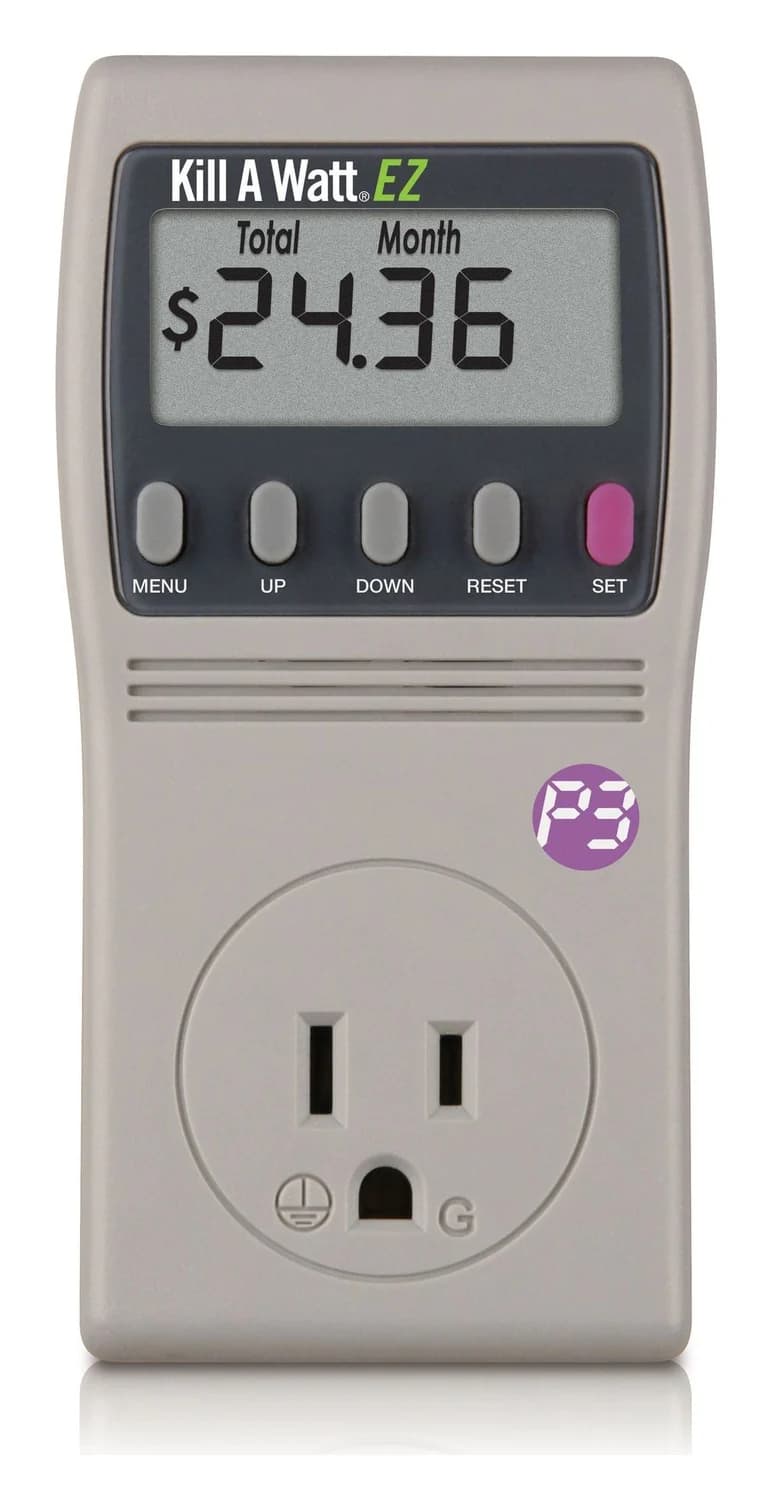
Choose the right Kill A Watt meter: P4400 vs P4460 EZ memory, cost displays, accuracy conditions, button controls and a worksheet for saving appliance readings.
Buying guide · Plug-in Watt Meters
How to Measure Power Consumption: Make a Useful Appliance Log
Measure appliance watts and kWh with a Kill A Watt, keep a repeatable multiday log, handle resets and outages, and choose a suitable meter or monitoring plug.
Best picks · Plug-in Watt Meters
Energy Monitoring Smart Plugs: History, Local Data and Load Limits
Choose an energy monitoring smart plug by history, CSV exports and local access. Compare Emporia, Kasa KP125M and Shelly Plug US Gen4, including load limits.