

Comparison
Fluke 116 vs 117: HVAC Microamps or Electrical Troubleshooting?
Choose the Fluke 116 or 117 by the work you do: compare current ranges, temperature, AutoVolt, LoZ, probe limits and the exact contents of each clamp meter kit.
By thisMETER EditorialUpdated November 3, 20268 min read1 pick
On this page · Our picks at a glance
Our picks at a glance
- 1
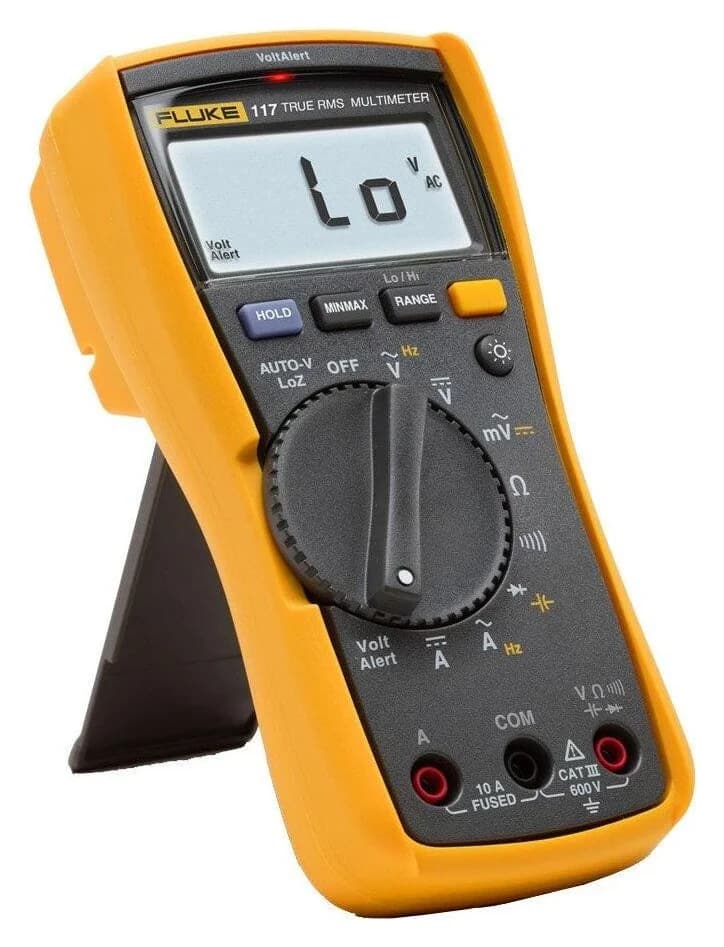
Choose for: Electrical troubleshooting with True RMS and a low-impedance mode for ghost voltage.
Limit: CAT III 600 V, not CAT IV; no mA/µA current ranges (the 6 A range resolves 1 mA).
Choose the Fluke 117 for electrical troubleshooting when you need AC/DC amp ranges and built-in VoltAlert non-contact voltage detection; choose the Fluke 116 when temperature and flame-sensor microamps are purchase requirements. The decisive current difference is the 116's 0.1 µA resolution versus the 117's 1 mA finest resolution—they cover different jobs. Both have AutoVolt and LoZ, so those features are no reason to choose one over the other, according to the 116 manual and the 117 manual's model columns.
- 0.1 µAFluke 116 current resolution for small-current work
- 1 mAFluke 117 finest current resolution on its amp range
Quick picks: match the job to the function
Compare specifications and all conditions
Flame-sensor current and contact temperature
- Our pick
- 116
- What decides it
- Microamps and a Type-K temperature function
Electrical troubleshooting with direct AC/DC amp measurements
- Our pick
- 117
- What decides it
- Amp ranges and VoltAlert
HVAC functions plus AC load current with a clamp
- Our pick
- 116/323 kit, after checking its manifest
- What decides it
- The 116 supplies temperature and microamps; the separate 323 supplies AC clamp current
Ghost-voltage rejection, capacitance or continuity
- Our pick
- Either bare meter
- What decides it
- These functions are shared; choose by your other requirements
Full comparison table
Swipe to compare. Row labels stay visible.
| Your requirement | Our pick | What decides it |
|---|---|---|
| Flame-sensor current and contact temperature | 116 | Microamps and a Type-K temperature function |
| Electrical troubleshooting with direct AC/DC amp measurements | 117 | Amp ranges and VoltAlert |
| HVAC functions plus AC load current with a clamp | 116/323 kit, after checking its manifest | The 116 supplies temperature and microamps; the separate 323 supplies AC clamp current |
| Ghost-voltage rejection, capacitance or continuity | Either bare meter | These functions are shared; choose by your other requirements |
Scroll horizontally to see every column
| Your requirement | Our pick | What decides it |
|---|---|---|
| Flame-sensor current and contact temperature | 116 | Microamps and a Type-K temperature function |
| Electrical troubleshooting with direct AC/DC amp measurements | 117 | Amp ranges and VoltAlert |
| HVAC functions plus AC load current with a clamp | 116/323 kit, after checking its manifest | The 116 supplies temperature and microamps; the separate 323 supplies AC clamp current |
| Ghost-voltage rejection, capacitance or continuity | Either bare meter | These functions are shared; choose by your other requirements |
For an apprentice, start with the required tool list from the training provider or employer. Do not buy the 117 simply because its model number is higher, or the 116 simply because the work involves heating equipment: specify the functions first. For choices across brands, use our Fluke vs Klein comparison.
Fluke 116 vs 117: the comparison table
These are manufacturer specifications, using the 116's own manual and only the 117 column in its shared manual. The family safety sheet confirms the category markings.
AC/DC voltage
- Fluke 116
- Up to 600 V
- Fluke 117
- Up to 600 V
True RMS; display
- Fluke 116
- Yes; 6,000 counts
- Fluke 117
- Yes; 6,000 counts
Direct AC/DC current
- Fluke 116
- 600.0 µA range; 0.1 µA resolution
- Fluke 117
- 6.000 A and 10.00 A ranges; 0.001 A and 0.01 A resolution
Native temperature
- Fluke 116
- Type K, −40 to 400 °C; 0.1 °C resolution
- Fluke 117
- No temperature function
AutoVolt and low-impedance voltage
- Fluke 116
- Yes; approximately 3 kΩ in AutoV/LoZ
- Fluke 117
- Yes; approximately 3 kΩ in AutoV/LoZ
Built-in non-contact voltage detection
- Fluke 116
- No VoltAlert function
- Fluke 117
- Yes, VoltAlert
Resistance; capacitance
- Fluke 116
- Up to 40 MΩ; 9,999 µF
- Fluke 117
- Up to 40 MΩ; 9,999 µF
Continuity, diode test and frequency
- Fluke 116
- Yes
- Fluke 117
- Yes
Backlight, Hold and Min/Max/Average
- Fluke 116
- Yes
- Fluke 117
- Yes
DC-voltage accuracy
- Fluke 116
- ±(0.5% of reading + 2 counts)
- Fluke 117
- ±(0.5% of reading + 2 counts)
Measurement category and voltage
- Fluke 116
- CAT III 600 V
- Fluke 117
- CAT III 600 V
Full comparison table
Swipe to compare. Row labels stay visible.
| Function or limit | Fluke 116 | Fluke 117 |
|---|---|---|
| AC/DC voltage | Up to 600 V | Up to 600 V |
| True RMS; display | Yes; 6,000 counts | Yes; 6,000 counts |
| Direct AC/DC current | 600.0 µA range; 0.1 µA resolution | 6.000 A and 10.00 A ranges; 0.001 A and 0.01 A resolution |
| Native temperature | Type K, −40 to 400 °C; 0.1 °C resolution | No temperature function |
| AutoVolt and low-impedance voltage | Yes; approximately 3 kΩ in AutoV/LoZ | Yes; approximately 3 kΩ in AutoV/LoZ |
| Built-in non-contact voltage detection | No VoltAlert function | Yes, VoltAlert |
| Resistance; capacitance | Up to 40 MΩ; 9,999 µF | Up to 40 MΩ; 9,999 µF |
| Continuity, diode test and frequency | Yes | Yes |
| Backlight, Hold and Min/Max/Average | Yes | Yes |
| DC-voltage accuracy | ±(0.5% of reading + 2 counts) | ±(0.5% of reading + 2 counts) |
| Measurement category and voltage | CAT III 600 V | CAT III 600 V |
Scroll horizontally to see every column
| Function or limit | Fluke 116 | Fluke 117 |
|---|---|---|
| AC/DC voltage | Up to 600 V | Up to 600 V |
| True RMS; display | Yes; 6,000 counts | Yes; 6,000 counts |
| Direct AC/DC current | 600.0 µA range; 0.1 µA resolution | 6.000 A and 10.00 A ranges; 0.001 A and 0.01 A resolution |
| Native temperature | Type K, −40 to 400 °C; 0.1 °C resolution | No temperature function |
| AutoVolt and low-impedance voltage | Yes; approximately 3 kΩ in AutoV/LoZ | Yes; approximately 3 kΩ in AutoV/LoZ |
| Built-in non-contact voltage detection | No VoltAlert function | Yes, VoltAlert |
| Resistance; capacitance | Up to 40 MΩ; 9,999 µF | Up to 40 MΩ; 9,999 µF |
| Continuity, diode test and frequency | Yes | Yes |
| Backlight, Hold and Min/Max/Average | Yes | Yes |
| DC-voltage accuracy | ±(0.5% of reading + 2 counts) | ±(0.5% of reading + 2 counts) |
| Measurement category and voltage | CAT III 600 V | CAT III 600 V |
Neither is the universal winner. The matching DC-voltage accuracy is another reason to choose by function rather than model number. Fluke specifies accuracy for a year after calibration at 18–28 °C, with additional conditions in the manuals; a headline percentage is not the specification for every range.
Best for HVAC temperature and flame-sensor work: Fluke 116
The Fluke 116 is our pick when the job explicitly calls for temperature and flame-sensor current. Fluke identifies microamps for flame-sensor testing on its product page; this is a buying requirement, not a furnace-service procedure.
Its 600.0 µA range has 0.1 µA steps. The manual specifies DC current accuracy of ±(1.0% + 2 counts) and AC current accuracy of ±(1.5% + 3 counts) from 45–500 Hz. AC specifications start at 1% of range, so the smallest display step does not promise specified accuracy all the way down to zero.
The limitation is equally important: the 116 has no direct amp range. Its manual describes extending current measurement with a compatible optional mV/A-output current probe. That is an additional accessory to select and interpret, not a hidden amp setting. A separate clamp meter is the other route; see clamp meter vs multimeter before assembling a kit.
The standard package includes a temperature probe, but the meter's temperature range and the probe's limit need separate checks, covered below.
See the standard Fluke 116 package at Fluke
Best for electrical troubleshooting: Fluke 117
The Fluke 117 is our choice when direct amp measurements and non-contact voltage detection matter more than native temperature and microamps.
Fluke
A compact 6,000-count True RMS multimeter for electricians, rated CAT III 600V, with built-in VoltAlert non-contact voltage detection, automatic AC/DC selection and a low-impedance mode.
Check package and model options
- 600 V max
- 10 A max
- 6,000 counts
- CAT III 600V
The 6.000 A range resolves 0.001 A, or 1 mA; the 10.00 A range resolves 0.01 A. Thus, the answer to “does the Fluke 117 read milliamps?” is qualified: it can display milliamp increments on its amp range, but it has no dedicated mA or µA range. Do not substitute it for the 116 when fine microamp readings are required.
Treat the 117 as a 10 A meter. Its manual describes above 10 A up to 20 A as 30 seconds on, 10 minutes off, with accuracy above 10 A unspecified. That overload allowance is not a continuous 20 A measurement rating.
Temperature is a documentation trap. The 117 product page contains temperature text in a comparison table and stray temperature footnotes. Its own manual's function matrix and accuracy rows provide no 117 temperature function. We follow those model-specific rows; adding the 116's thermocouple does not create a temperature mode on the 117.
AutoVolt, LoZ and VoltAlert: separate the names
AutoVolt selects AC or DC voltage automatically. LoZ is low input impedance, used to reduce false ghost-voltage readings. Both manuals describe these together in AutoV/LoZ, with approximately 3 kΩ input impedance. This is different from autoranging, which chooses the measurement range.
Low impedance is not appropriate everywhere. Fluke's safety sheet warns against Auto Volts on circuits that its low input impedance could damage. Select the function according to the manual and the circuit requirements, especially around sensitive controls.
VoltAlert belongs to the 117. It is built-in non-contact AC voltage detection, not the AutoVolt function. The 117 manual warns that voltage can still be present without an indication and says not to rely on VoltAlert with shielded wire. Its convenience does not establish that a circuit is safe to touch.
Buying guide: probes, ratings and exact packages
Temperature: do not confuse the meter range with the probe range
The 116's Type-K input covers −40 to 400 °C. Fluke's 80BK-A probe page specifies −40 to 260 °C, a lower upper limit. The 116 product page also says temperature uncertainty excludes thermocouple error; display resolution is not the accuracy of the complete meter-and-probe combination.
Check the probe's exact label. The bare 116 page names 80BK; the 116/323 kit overview says 80BK-A, while that same kit's contents list says 80BK. Preserve that distinction when ordering: the cited probe specification is for 80BK-A, and the documents do not justify promising that every supplied probe reaches the meter's full range. For a pipe or surface requirement, confirm the probe type, connector or adapter, and its own temperature limit.
Bare meter or 116/323 and 117/323 kit?
“Bare” here means the standard meter package with its listed accessories. It does not mean a clamp meter is included. Compare the full package name and part number on Fluke's 116/323 page or 117/323 page.
Fluke 116 standard
- Part number
- 2538803
- Contents to check
- Silicone leads, 80BK probe, holster and installed battery; no 323
Fluke 117 standard
- Part number
- 2538815
- Contents to check
- Silicone leads and holster; no temperature probe or 323 in the contents list
Fluke 116/323 HVAC kit
- Part number
- 4296029
- Contents to check
- Both meters; listed TL175 leads, TPAK hanger, flexible cuff pipe-clamp thermocouple, 80BK probe, 80AK-A adapter and C115 case
Fluke 117/323 electricians kit
- Part number
- 4296041
- Contents to check
- Both meters; overview lists TL175 leads, TPAK hanger and soft case; box list differs
Full comparison table
Swipe to compare. Row labels stay visible.
| Exact package | Part number | Contents to check |
|---|---|---|
| Fluke 116 standard | 2538803 | Silicone leads, 80BK probe, holster and installed battery; no 323 |
| Fluke 117 standard | 2538815 | Silicone leads and holster; no temperature probe or 323 in the contents list |
| Fluke 116/323 HVAC kit | 4296029 | Both meters; listed TL175 leads, TPAK hanger, flexible cuff pipe-clamp thermocouple, 80BK probe, 80AK-A adapter and C115 case |
| Fluke 117/323 electricians kit | 4296041 | Both meters; overview lists TL175 leads, TPAK hanger and soft case; box list differs |
Scroll horizontally to see every column
| Exact package | Part number | Contents to check |
|---|---|---|
| Fluke 116 standard | 2538803 | Silicone leads, 80BK probe, holster and installed battery; no 323 |
| Fluke 117 standard | 2538815 | Silicone leads and holster; no temperature probe or 323 in the contents list |
| Fluke 116/323 HVAC kit | 4296029 | Both meters; listed TL175 leads, TPAK hanger, flexible cuff pipe-clamp thermocouple, 80BK probe, 80AK-A adapter and C115 case |
| Fluke 117/323 electricians kit | 4296041 | Both meters; overview lists TL175 leads, TPAK hanger and soft case; box list differs |
Confirm the 117 kit manifest. Its overview names TL175 and TPAK, but its box list gives generic silicone leads and does not name the hanger. Do not assume an optional accessory is supplied merely because it appears beside a meter online. The 116 kit's probe naming discrepancy also needs confirmation against the actual package.
The 323 itself measures up to 400 A AC with its jaw and has no DC-current range. It is marked CAT III 600 V / CAT IV 300 V. Those are the clamp's ratings; buying it in a kit does not upgrade the 116 or 117 to CAT IV.
Choose the 116/323 kit if you need the 116's HVAC functions and a separate AC-current clamp, subject to the accessory checks above. The 117/323 kit serves the corresponding electrical-troubleshooting choice. If you already own a suitable clamp, buy the required standalone meter instead. For DC clamp current, neither kit's 323 fills that requirement; use our clamp meter buying guide.
Match the complete package name
Distinguish the standard meter, combo kit, CAL package and reconditioned version.
Confirm the accessory manifest
Resolve lead, hanger and temperature-probe descriptions against the exact package.
Check the measurement requirements
Match current type, probe limits and CAT markings to the work and employer requirements.
CAL and reconditioned are separate choices. Fluke lists 116 CAL and 117 CAL with a traceable calibration certificate and data. It identifies R-FLUKE-116 and R-FLUKE-117 as factory-reconditioned meters. Calibration paperwork and condition are different purchase decisions from adding a clamp or temperature accessories. For a gift, our electrician gift checklist helps avoid duplicating tools the recipient already has.
How we choose
This is a document-based comparison, without physical product testing. We read the official product pages, the dedicated 116 manual, the 117 rows in its shared manual, the family safety sheet, the probe specification and both kit manifests. Ranges and accuracy are Fluke's claims, not measurements from thisMETER.
Our recommendations prioritise required functions and a usable package. Where Fluke's pages disagree, we identify the conflict and use model-specific manual rows for measurement capability; accessory conflicts remain items to confirm before ordering. Buyer reviews are not evidence for a missing range or safety rating. The method is explained further on How we choose.
Verdict
Get the 116 for native temperature and flame-sensor microamps, adding the 116/323 kit only when its separate AC clamp and confirmed accessories meet your needs. Get the 117 for direct amp measurements and VoltAlert, or its 117/323 kit when you also need that AC clamp. Both already provide AutoVolt and LoZ; the deciding question is which missing function would force you to carry another instrument.
Frequently asked questions
What is the main difference between the Fluke 116 and 117?
Choose the 116 for its Type-K temperature function and direct microamp measurements, including flame-sensor applications. Choose the 117 for AC/DC amp measurements and built-in VoltAlert non-contact voltage detection. Both have AutoV/LoZ, True RMS and CAT III 600 V ratings, so those shared features do not decide this purchase.
Can the Fluke 117 measure temperature or test flame-sensor microamps?
The 117 has no native temperature function or microamp range in its model-specific manual column. Its finest current resolution is 1 mA, which does not replace the 116's 0.1 µA resolution. Temperature text appears in the 117 web page's comparison table and footnotes, but the manual does not support buying it for those functions.
Does the Fluke 117 read milliamps?
It resolves 1 mA on its 6.000 A range, but it has no dedicated milliamp or microamp range. That distinction matters when a task requires fine small-current readings. Fluke's manual lists 6.000 A and 10.00 A ranges, with 0.001 A and 0.01 A resolution respectively; resolution alone is not an accuracy guarantee.
Does the Fluke 116 have AutoVolt and LoZ?
Yes. The 116 manual says Auto Volts selects AC or DC automatically and sets input impedance to approximately 3 kΩ to reduce ghost-voltage readings. The 117 offers the same combination. Fluke's safety sheet warns against using this low-impedance function on circuits it could damage; it is not the default choice for every voltage measurement.
Can the Fluke 116 measure amps with a clamp?
Its direct current range stops at 600 µA. The manual permits a compatible optional current probe with an mV/A output, using the meter's voltage function. The 116/323 kit instead supplies a separate 323 clamp meter rated for 400 A AC. That clamp has no DC-current range and does not add one to the 116.
Related guides
Best picks · Multimeters
Best Multimeters for Beginners: Choose a First Meter You Can Learn On
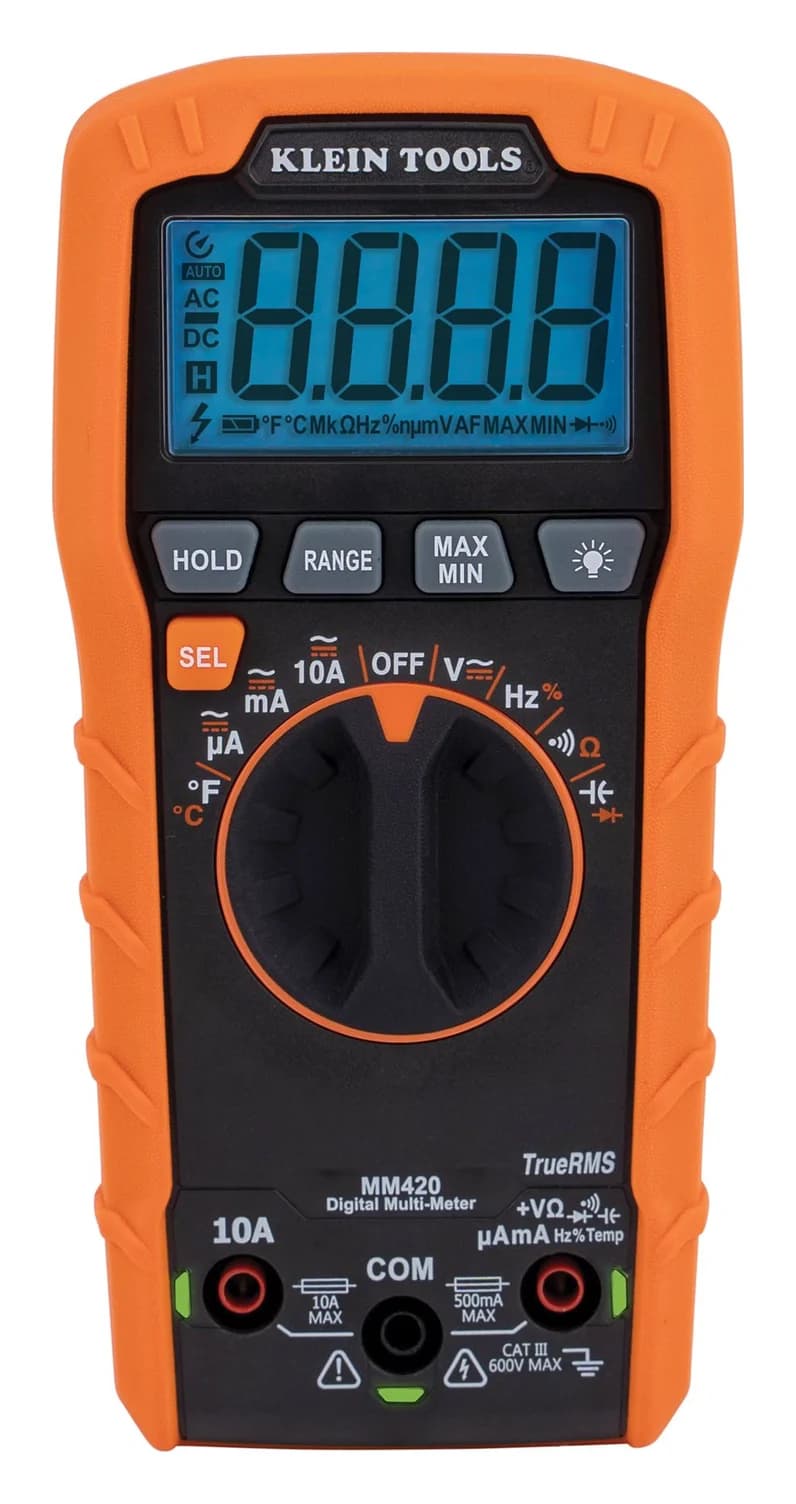
Choose a first multimeter by its controls, current ranges, jack reminders and included leads. Compare Klein MM420, MM325 and Fluke 107 for learning and gifts.
Best picks · Multimeters
Best Multimeters for HVAC: Microamps, Temperature and Complete Kits
Choose an HVAC multimeter by job: compare Fluke 116, Fieldpiece SC260 and Klein alternatives for flame sensors, clamp current, probe limits and kit contents.
Comparison · Multimeters
Fluke 101 vs 107: Current Ranges, Backlight and Regional Support
Compare the Fluke 101 and 107 by current inputs, backlight, accuracy and kit contents, with manual references and regional warranty checks before you buy.