

Comparison
Fluke 87V vs 117: Industrial Functions or Electrical Troubleshooting?
Choose the original Fluke 87V or 117 by the work: compare current ranges, drive filtering, LoZ, temperature, accuracy and exactly what comes in each US package.
By thisMETER EditorialUpdated November 3, 20268 min read1 pick
On this page · Our picks at a glance
Our picks at a glance
- 1
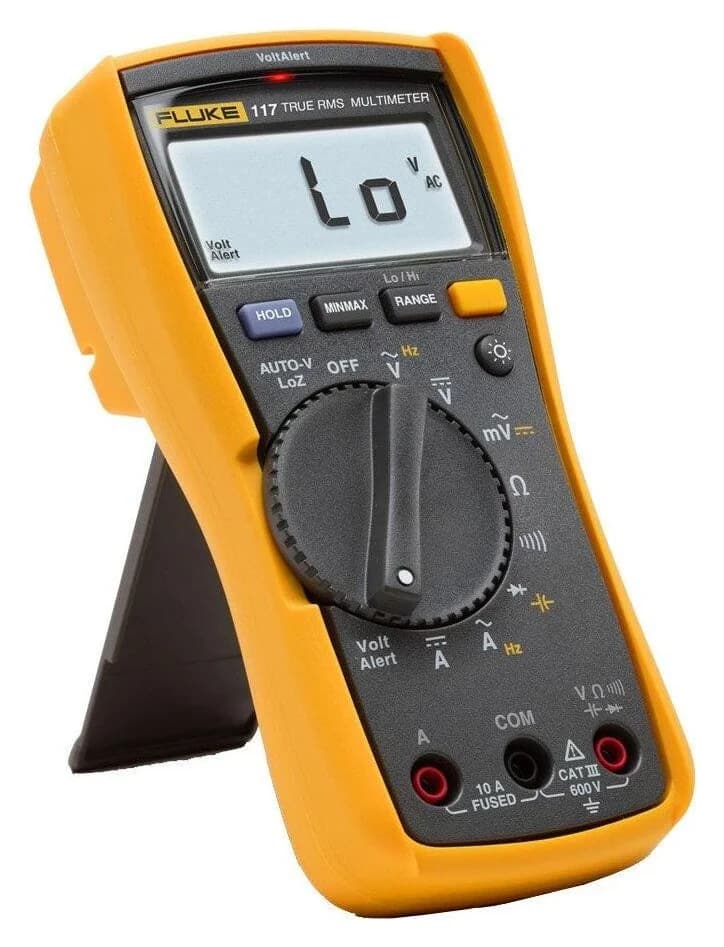
Choose for: Electrical troubleshooting with True RMS and a low-impedance mode for ghost voltage.
Limit: CAT III 600 V, not CAT IV; no mA/µA current ranges (the 6 A range resolves 1 mA).
Choose the Fluke 117 for electrical troubleshooting if you want AutoVolt/LoZ for ghost-voltage readings and built-in VoltAlert non-contact AC detection. Choose the original Fluke 87V industrial multimeter for microamp and milliamp ranges, temperature, motor-drive filtering or tighter ordinary DC-voltage accuracy. If your present meter already covers the required functions and rating, our recommendation is to keep it.
Quick picks
Compare specifications and all conditions
Industrial maintenance, low-current circuits or motor drives
- Our pick
- Original Fluke 87V
- Deciding feature
- Dedicated µA/mA ranges, low-pass filter and temperature input
Electrical troubleshooting with suspected ghost voltage
- Our pick
- Fluke 117
- Deciding feature
- AutoVolt/LoZ and VoltAlert
Your existing meter already meets the task
- Our pick
- Keep your meter
- Deciding feature
- Buy another only for a function or rating you actually need
Full comparison table
Swipe to compare. Row labels stay visible.
| Your work | Our pick | Deciding feature |
|---|---|---|
| Industrial maintenance, low-current circuits or motor drives | Original Fluke 87V | Dedicated µA/mA ranges, low-pass filter and temperature input |
| Electrical troubleshooting with suspected ghost voltage | Fluke 117 | AutoVolt/LoZ and VoltAlert |
| Your existing meter already meets the task | Keep your meter | Buy another only for a function or rating you actually need |
Scroll horizontally to see every column
| Your work | Our pick | Deciding feature |
|---|---|---|
| Industrial maintenance, low-current circuits or motor drives | Original Fluke 87V | Dedicated µA/mA ranges, low-pass filter and temperature input |
| Electrical troubleshooting with suspected ghost voltage | Fluke 117 | AutoVolt/LoZ and VoltAlert |
| Your existing meter already meets the task | Keep your meter | Buy another only for a function or rating you actually need |
Both are True RMS meters. The deciding question is which additional function you need, rather than whether either has that label. For alternatives, start with our best multimeters or the broader Fluke vs Klein comparison.
Original 87V and 117 specifications side by side
These are Fluke's published specifications, using standard display mode and ordinary voltage functions unless stated. The 80 Series V manual calls the original 87V Model 87; use that column, not the adjacent Model 83 column. For the 117, use its model entries in the shared users manual.
AC/DC voltage ceiling
- Original Fluke 87V
- 1000 V
- Fluke 117
- 600 V
DC-volts accuracy, 6 V through highest voltage range
- Original Fluke 87V
- ±(0.05% of reading + 1 count)
- Fluke 117
- ±(0.5% of reading + 2 counts)
DC millivolts, 600 mV range
- Original Fluke 87V
- ±(0.1% + 1)
- Fluke 117
- ±(0.5% + 2)
AC-volts accuracy at 50/60 Hz, volts ranges
- Original Fluke 87V
- ±(0.7% + 2)
- Fluke 117
- ±(1.0% + 3)
Lowest AC/DC current range; standard resolution
- Original Fluke 87V
- 600 µA; 0.1 µA
- Fluke 117
- 6 A; 1 mA
Dedicated milliamp ranges
- Original Fluke 87V
- 60 mA and 400 mA
- Fluke 117
- None
Normal highest current range
- Original Fluke 87V
- 10 A; duty limits apply
- Fluke 117
- 10 A; duty limits apply
Motor-drive low-pass filter
- Original Fluke 87V
- Yes
- Fluke 117
- Not listed
AutoVolt/LoZ voltage function
- Original Fluke 87V
- Not listed
- Fluke 117
- Yes
Built-in VoltAlert
- Original Fluke 87V
- Not listed
- Fluke 117
- Yes
Temperature measurement
- Original Fluke 87V
- Type-K thermocouple input
- Fluke 117
- No function listed
Display
- Original Fluke 87V
- 6,000 counts; 19,999 in HiRes mode
- Fluke 117
- 6,000 counts
Safety rating, as marked
- Original Fluke 87V
- CAT III 1000V / CAT IV 600V
- Fluke 117
- CAT III 600V
Warranty
- Original Fluke 87V
- Limited lifetime; see terms
- Fluke 117
- Three years; see terms
Full comparison table
Swipe to compare. Row labels stay visible.
| Function or specification | Original Fluke 87V | Fluke 117 |
|---|---|---|
| AC/DC voltage ceiling | 1000 V | 600 V |
| DC-volts accuracy, 6 V through highest voltage range | ±(0.05% of reading + 1 count) | ±(0.5% of reading + 2 counts) |
| DC millivolts, 600 mV range | ±(0.1% + 1) | ±(0.5% + 2) |
| AC-volts accuracy at 50/60 Hz, volts ranges | ±(0.7% + 2) | ±(1.0% + 3) |
| Lowest AC/DC current range; standard resolution | 600 µA; 0.1 µA | 6 A; 1 mA |
| Dedicated milliamp ranges | 60 mA and 400 mA | None |
| Normal highest current range | 10 A; duty limits apply | 10 A; duty limits apply |
| Motor-drive low-pass filter | Yes | Not listed |
| AutoVolt/LoZ voltage function | Not listed | Yes |
| Built-in VoltAlert | Not listed | Yes |
| Temperature measurement | Type-K thermocouple input | No function listed |
| Display | 6,000 counts; 19,999 in HiRes mode | 6,000 counts |
| Safety rating, as marked | CAT III 1000V / CAT IV 600V | CAT III 600V |
| Warranty | Limited lifetime; see terms | Three years; see terms |
Scroll horizontally to see every column
| Function or specification | Original Fluke 87V | Fluke 117 |
|---|---|---|
| AC/DC voltage ceiling | 1000 V | 600 V |
| DC-volts accuracy, 6 V through highest voltage range | ±(0.05% of reading + 1 count) | ±(0.5% of reading + 2 counts) |
| DC millivolts, 600 mV range | ±(0.1% + 1) | ±(0.5% + 2) |
| AC-volts accuracy at 50/60 Hz, volts ranges | ±(0.7% + 2) | ±(1.0% + 3) |
| Lowest AC/DC current range; standard resolution | 600 µA; 0.1 µA | 6 A; 1 mA |
| Dedicated milliamp ranges | 60 mA and 400 mA | None |
| Normal highest current range | 10 A; duty limits apply | 10 A; duty limits apply |
| Motor-drive low-pass filter | Yes | Not listed |
| AutoVolt/LoZ voltage function | Not listed | Yes |
| Built-in VoltAlert | Not listed | Yes |
| Temperature measurement | Type-K thermocouple input | No function listed |
| Display | 6,000 counts; 19,999 in HiRes mode | 6,000 counts |
| Safety rating, as marked | CAT III 1000V / CAT IV 600V | CAT III 600V |
| Warranty | Limited lifetime; see terms | Three years; see terms |
Current range ceilings do not override the manuals' time and temperature limits. In particular, neither manual specifies measurement accuracy above 10 A; do not buy either as a continuously usable higher-current meter.
Best for industrial functions: original Fluke 87V
The original 87V is our pick when the missing job involves low current, drive signals or temperature. Its manual lists current ranges starting at 600 µA with 0.1 µA resolution, followed by 6000 µA, 60 mA and 400 mA before the amp ranges. That is a meaningful capability difference from the 117's amp ranges.
For small-current work, check more than the display step. Fluke warns that a current meter introduces a voltage drop that can affect the circuit, and gives burden-voltage specifications in the manual. A finer range alone does not guarantee an undisturbed circuit.
Temperature also needs a package check. The meter input covers −200 to 1090 °C, but the included 80BK probe covers −40 to 260 °C, according to Fluke's original 87V page. The wider meter range requires a suitable probe; it is not the range of the supplied probe.
The trade-off: the original manual does not list AutoVolt/LoZ or VoltAlert. Its low-pass filter solves a different problem from those electrician-oriented features. Buy it because you need its measurement functions, rather than expecting it to replace every convenience of the 117.
Best for electrical troubleshooting: Fluke 117
The 117 is our pick when ghost-voltage discrimination and built-in non-contact detection matter more than low-current ranges. The manual explains that AutoVolt selects AC or DC and sets input impedance to approximately 3 kΩ to reduce false readings from ghost voltage. Its ordinary DC-voltage input is greater than 10 MΩ: the selected function changes how the meter loads the circuit.
Fluke
A compact 6,000-count True RMS multimeter for electricians, rated CAT III 600V, with built-in VoltAlert non-contact voltage detection, automatic AC/DC selection and a low-impedance mode.
Check package and model options
- 600 V max
- 10 A max
- 6,000 counts
- CAT III 600V
Its limitations are specific: no dedicated µA/mA ranges, no temperature function in the manual, and no motor-drive low-pass filter listed. That does not rule it out for every electronics task; it rules it out when those missing functions are required.
A misleading temperature entry: Fluke's 117 page contains temperature text in its multi-model comparison and footnotes. The 117's own manual function and accuracy tables list no temperature measurement. We therefore give it no temperature capability in this comparison.
Buying guide: match the function to the problem
Low-pass filtering, LoZ and VoltAlert have different jobs
The 87V's AC low-pass filter blocks unwanted content above 1 kHz; Fluke describes it as useful for composite waveforms from inverters and variable-frequency motor drives. The manual also gives separate filtered accuracy limits. Its ordinary AC accuracy is not a blanket promise for every drive waveform.
The 117's AutoVolt/LoZ instead changes input impedance to reduce ghost-voltage readings. VoltAlert is a separate non-contact AC-voltage presence detector. Neither feature should be treated as the 87V's drive filter, and sharing the True RMS label does not make the function sets interchangeable.
Low current, drives or temperature
The original 87V supplies the dedicated ranges, filter and temperature input.
Ghost-voltage troubleshooting
The 117 supplies AutoVolt/LoZ; VoltAlert adds non-contact AC detection.
Your present meter covers the task
Keep it if its functions and rating meet the work.
Compare accuracy on the same function and range
Both manuals specify ordinary DC volts on the 60 V range with 0.01 V resolution. For a hypothetical 12 V reading in standard mode, calculate the percentage term and then add the counts term:
Original 87V, ±(0.05% + 1)
- Percentage term
- 6 mV
- Counts term
- One 10 mV count
- Total limit
- ±16 mV
117, ±(0.5% + 2)
- Percentage term
- 60 mV
- Counts term
- Two 10 mV counts
- Total limit
- ±80 mV
Full comparison table
Swipe to compare. Row labels stay visible.
| Calculated specification limit | Percentage term | Counts term | Total limit |
|---|---|---|---|
| Original 87V, ±(0.05% + 1) | 6 mV | One 10 mV count | ±16 mV |
| 117, ±(0.5% + 2) | 60 mV | Two 10 mV counts | ±80 mV |
Scroll horizontally to see every column
| Calculated specification limit | Percentage term | Counts term | Total limit |
|---|---|---|---|
| Original 87V, ±(0.05% + 1) | 6 mV | One 10 mV count | ±16 mV |
| 117, ±(0.5% + 2) | 60 mV | Two 10 mV counts | ±80 mV |
These are calculated limits from the manuals, not observed errors. Both manuals' specifications here apply for one year after calibration at 18–28 °C, with the stated humidity conditions. This comparison establishes a tighter DC-voltage specification for the 87V on that range; it does not establish the same advantage on every function.
Two traps matter. The 117's Auto-V/LoZ has its own ±(2.0% + 3) DC specification on a 600 V range with 0.1 V resolution, so the example above does not apply in that mode. And the 87V's HiRes mode changes the counts term: its manual says to multiply the specified number of counts by 10. Extra displayed digits do not remove that uncertainty.
Check model identity and the complete standard package
Here, “standard package” means the US meter package rather than an accessory bundle. Fluke's model blocks identify the original 87V as part 2074974 and the 117 as part 2538815.
Original 87V
- Official included inventory
- Meter, TL75 test leads, AC175 alligator clips, holster, 80BK temperature probe and installed 9 V battery
117
- Official included inventory
- Meter, one pair of 4 mm silicone test leads and holster; paperwork wording differs on the page
Full comparison table
Swipe to compare. Row labels stay visible.
| Standard US package | Official included inventory |
|---|---|
| Original 87V | Meter, TL75 test leads, AC175 alligator clips, holster, 80BK temperature probe and installed 9 V battery |
| 117 | Meter, one pair of 4 mm silicone test leads and holster; paperwork wording differs on the page |
Scroll horizontally to see every column
| Standard US package | Official included inventory |
|---|---|
| Original 87V | Meter, TL75 test leads, AC175 alligator clips, holster, 80BK temperature probe and installed 9 V battery |
| 117 | Meter, one pair of 4 mm silicone test leads and holster; paperwork wording differs on the page |
The 87V page specifies TL175 leads for Europe, so do not assume a regional package has the same leads. A magnetic hanger is described as optional on that page. Treat a case or other added accessory as something to verify against the exact bundle inventory.
For the 117, the page's “What's in the box” list names a quick reference guide, while the Models block names a user manual. Confirm the printed paperwork if it matters; the linked manual is the basis for this comparison.
CAL is a paperwork variant: both product pages describe CAL versions with a traceable calibration certificate and data from Fluke. MAX is a separate model: Fluke maintains a separate 87V MAX product page. For that purchase decision, use our Fluke 87V vs 87V MAX comparison, which covers the environmental and generation differences.
- Yes: Full model name and US package match the intended purchase
- Yes: TL75 leads, AC175 clips, holster, 80BK probe and installed battery accounted for
- Partly: CAL version selected when traceable calibration paperwork is required
- No: Assuming a MAX or regional package is identical to the standard original US package
When to keep your existing meter
Already own a 117? Keep it for AutoVolt/LoZ and VoltAlert. Add an original 87V when a recurring job needs its low-current ranges, drive filter or temperature input; buying one solely to duplicate functions you already use is hard to justify.
Already own an original 87V? Keep it for those industrial functions. If the missing job is ghost-voltage troubleshooting or non-contact detection, the 117 is a complementary choice. Its different function set gives you a reason to add it without discarding the original.
For either meter, judge adequacy against the task's rating and function requirements before replacing it. For measurement basics, see how to use a multimeter.
How we choose
We compared Fluke's official US product pages, included-accessory lists and model-specific manual tables. The 87V figures use the Model 87 column of the 80 Series V manual; the 117 figures use entries assigned to the 117 in its shared manual. We distinguish ordinary voltage accuracy from LoZ and filtered specifications, and temperature-input limits from probe limits.
We have no physical test results for these meters. The tolerance example is arithmetic from published specifications, and the recommendations are our judgment about those documented functions. Read our full selection method.
Verdict
Choose the original Fluke 87V for low-current ranges, temperature, motor-drive filtering and its tighter ordinary DC-voltage specification. Choose the Fluke 117 for AutoVolt/LoZ and VoltAlert. Keep a working meter that already meets the job, and check the exact model and package before buying another.
Frequently asked questions
Which is better, the Fluke 87V or 117?
Choose the original 87V for microamp and milliamp ranges, temperature measurement, motor-drive filtering or tighter ordinary DC-voltage accuracy. Choose the 117 for electrical troubleshooting where AutoVolt/LoZ and built-in VoltAlert are useful. Our recommendation follows the required functions: keep a suitable existing meter when neither model solves a missing job.
Can the Fluke 117 measure microamps or temperature?
The 117 has no dedicated microamp or milliamp ranges: its lowest current range is 6 A, resolving 1 mA. Its manual lists no temperature measurement function. Temperature text appears in the product page's multi-model comparison and footnotes, so use the manual's model-specific function table rather than assigning that text to the 117.
Does the original Fluke 87V have LoZ or VoltAlert?
Neither AutoVolt/LoZ nor VoltAlert appears among the original 87V manual's functions. Its low-pass filter addresses unwanted high-frequency content in drive measurements. The 117's AutoVolt/LoZ changes input impedance to reduce ghost-voltage readings, while VoltAlert detects AC voltage without contact. Those functions address different problems; choose by the one your work requires.
Is the original 87V the same meter as the 87V MAX?
No. Fluke lists the original 87V Industrial Multimeter and the 87V MAX as separate products. Match the full model name, regional leads and accessory inventory before ordering. CAL identifies a package with calibration paperwork on the original 87V page. Use our separate original-versus-MAX comparison when the decision is between those two models.
Related guides
Best picks · Multimeters
Best Multimeters for Beginners: Choose a First Meter You Can Learn On
Choose a first multimeter by its controls, current ranges, jack reminders and included leads. Compare Klein MM420, MM325 and Fluke 107 for learning and gifts.
Best picks · Multimeters
Best Multimeters for HVAC: Microamps, Temperature and Complete Kits
Choose an HVAC multimeter by job: compare Fluke 116, Fieldpiece SC260 and Klein alternatives for flame sensors, clamp current, probe limits and kit contents.
Comparison · Multimeters
Fluke 101 vs 107: Current Ranges, Backlight and Regional Support
Compare the Fluke 101 and 107 by current inputs, backlight, accuracy and kit contents, with manual references and regional warranty checks before you buy.