

Comparison
Milwaukee 2216-20 vs 2217-20
Which Multimeter Should You Buy?
Compare Milwaukee's 2216-20 and 2217-20 with manual-verified current ranges, Lo-Z, temperature, included probes and the HVAC limitation that matters most.
By thisMETER EditorialUpdated November 3, 20268 min read
On this page · Quick picks: buy the missing function
Choose the Milwaukee 2217-20 if you need Lo-Z voltage troubleshooting, milliamp ranges or temperature; choose the 2216-20 when its core electrical functions cover your work. For HVAC work requiring a documented DC microamp range, choose neither on the available manual evidence: the 2217 sales page's flame-rectification claim conflicts with its exact-model manual.
Quick picks: buy the missing function
Compare specifications and all conditions
Ghost-voltage troubleshooting
- Our choice
- 2217-20
- Why
- Adds Lo-Z; the 2216 manual lists no equivalent mode
Contact temperature and finer lead-based current readings
- Our choice
- 2217-20
- Why
- K-type temperature input and milliamp ranges; thermocouple included
Voltage, resistance, continuity and capacitance without those extras
- Our choice
- 2216-20
- Why
- Covers those functions with the same CAT III 600V rating
A specified DC µA function for flame rectification
- Our choice
- Neither without clarification
- Why
- Neither manual documents a dedicated µA range
Motor current measured through jaws
- Our choice
- Choose a clamp meter
- Why
- These handhelds measure current through leads
Full comparison table
Swipe to compare. Row labels stay visible.
| Your requirement | Our choice | Why |
|---|---|---|
| Ghost-voltage troubleshooting | 2217-20 | Adds Lo-Z; the 2216 manual lists no equivalent mode |
| Contact temperature and finer lead-based current readings | 2217-20 | K-type temperature input and milliamp ranges; thermocouple included |
| Voltage, resistance, continuity and capacitance without those extras | 2216-20 | Covers those functions with the same CAT III 600V rating |
| A specified DC µA function for flame rectification | Neither without clarification | Neither manual documents a dedicated µA range |
| Motor current measured through jaws | Choose a clamp meter | These handhelds measure current through leads |
Scroll horizontally to see every column
| Your requirement | Our choice | Why |
|---|---|---|
| Ghost-voltage troubleshooting | 2217-20 | Adds Lo-Z; the 2216 manual lists no equivalent mode |
| Contact temperature and finer lead-based current readings | 2217-20 | K-type temperature input and milliamp ranges; thermocouple included |
| Voltage, resistance, continuity and capacitance without those extras | 2216-20 | Covers those functions with the same CAT III 600V rating |
| A specified DC µA function for flame rectification | Neither without clarification | Neither manual documents a dedicated µA range |
| Motor current measured through jaws | Choose a clamp meter | These handhelds measure current through leads |
The recommendations below use Milwaukee's 2216 manual and 2217 manual, with the US product pages used for box contents. For the wider shortlist, see our best multimeters guide.
Milwaukee 2216-20 vs 2217-20: the manual comparison
These are manufacturer specifications. Compare each range's resolution alongside its accuracy, minimum-input and duty limits.
AC measurement
- Milwaukee 2216-20
- True RMS
- Milwaukee 2217-20
- True RMS
Maximum voltage; marked category
- Milwaukee 2216-20
- 600 V AC/DC; CAT III 600V
- Milwaukee 2217-20
- 600 V AC/DC; CAT III 600V
DC voltage accuracy
- Milwaukee 2216-20
- ±(0.5% + 2 digits)
- Milwaukee 2217-20
- ±(0.5% + 2 digits)
DC current ranges
- Milwaukee 2216-20
- 6 A / 10 A
- Milwaukee 2217-20
- 60.00 mA / 600.0 mA / 6.000 A / 10.00 A
Smallest DC current display step
- Milwaukee 2216-20
- 0.001 A on the 6 A range
- Milwaukee 2217-20
- 0.01 mA on the 60.00 mA range
Minimum AC current specified
- Milwaukee 2216-20
- 0.040 A
- Milwaukee 2217-20
- 0.40mA
Dedicated DC µA range
- Milwaukee 2216-20
- Not documented
- Milwaukee 2217-20
- Not documented; conflicts with product-page copy
Lo-Z voltage
- Milwaukee 2216-20
- Not documented
- Milwaukee 2217-20
- 600.0 V range; 0.1 V steps; approximately 4 kΩ input
Contact temperature
- Milwaukee 2216-20
- Not documented
- Milwaukee 2217-20
- −40 to 400°C / −40 to 752°F; probe limits separate
Capacitance
- Milwaukee 2216-20
- 100 µF / 1000 µF ranges; 0.1 µF / 1 µF steps
- Milwaukee 2217-20
- 100.0 µF / 1000 µF ranges; 0.1 µF / 1 µF steps
Resistance; frequency ceilings
- Milwaukee 2216-20
- 40 MΩ; 50 kHz
- Milwaukee 2217-20
- 40 MΩ; 50 kHz
Headline display-count rating
- Milwaukee 2216-20
- Not explicitly stated in the linked documents
- Milwaukee 2217-20
- Not explicitly stated in the linked documents
Display and controls
- Milwaukee 2216-20
- Black-on-white backlit display; hold, min/max, bar graph
- Milwaukee 2217-20
- White-on-black backlit display; hold, min/max, bar graph
Ingress and drop ratings
- Milwaukee 2216-20
- IP64; 1 m
- Milwaukee 2217-20
- IP54; 1 m
Power
- Milwaukee 2216-20
- Two AA batteries
- Milwaukee 2217-20
- Two AA batteries
Full comparison table
Swipe to compare. Row labels stay visible.
| Function or specification | Milwaukee 2216-20 | Milwaukee 2217-20 |
|---|---|---|
| AC measurement | True RMS | True RMS |
| Maximum voltage; marked category | 600 V AC/DC; CAT III 600V | 600 V AC/DC; CAT III 600V |
| DC voltage accuracy | ±(0.5% + 2 digits) | ±(0.5% + 2 digits) |
| DC current ranges | 6 A / 10 A | 60.00 mA / 600.0 mA / 6.000 A / 10.00 A |
| Smallest DC current display step | 0.001 A on the 6 A range | 0.01 mA on the 60.00 mA range |
| Minimum AC current specified | 0.040 A | 0.40mA |
| Dedicated DC µA range | Not documented | Not documented; conflicts with product-page copy |
| Lo-Z voltage | Not documented | 600.0 V range; 0.1 V steps; approximately 4 kΩ input |
| Contact temperature | Not documented | −40 to 400°C / −40 to 752°F; probe limits separate |
| Capacitance | 100 µF / 1000 µF ranges; 0.1 µF / 1 µF steps | 100.0 µF / 1000 µF ranges; 0.1 µF / 1 µF steps |
| Resistance; frequency ceilings | 40 MΩ; 50 kHz | 40 MΩ; 50 kHz |
| Headline display-count rating | Not explicitly stated in the linked documents | Not explicitly stated in the linked documents |
| Display and controls | Black-on-white backlit display; hold, min/max, bar graph | White-on-black backlit display; hold, min/max, bar graph |
| Ingress and drop ratings | IP64; 1 m | IP54; 1 m |
| Power | Two AA batteries | Two AA batteries |
Scroll horizontally to see every column
| Function or specification | Milwaukee 2216-20 | Milwaukee 2217-20 |
|---|---|---|
| AC measurement | True RMS | True RMS |
| Maximum voltage; marked category | 600 V AC/DC; CAT III 600V | 600 V AC/DC; CAT III 600V |
| DC voltage accuracy | ±(0.5% + 2 digits) | ±(0.5% + 2 digits) |
| DC current ranges | 6 A / 10 A | 60.00 mA / 600.0 mA / 6.000 A / 10.00 A |
| Smallest DC current display step | 0.001 A on the 6 A range | 0.01 mA on the 60.00 mA range |
| Minimum AC current specified | 0.040 A | 0.40mA |
| Dedicated DC µA range | Not documented | Not documented; conflicts with product-page copy |
| Lo-Z voltage | Not documented | 600.0 V range; 0.1 V steps; approximately 4 kΩ input |
| Contact temperature | Not documented | −40 to 400°C / −40 to 752°F; probe limits separate |
| Capacitance | 100 µF / 1000 µF ranges; 0.1 µF / 1 µF steps | 100.0 µF / 1000 µF ranges; 0.1 µF / 1 µF steps |
| Resistance; frequency ceilings | 40 MΩ; 50 kHz | 40 MΩ; 50 kHz |
| Headline display-count rating | Not explicitly stated in the linked documents | Not explicitly stated in the linked documents |
| Display and controls | Black-on-white backlit display; hold, min/max, bar graph | White-on-black backlit display; hold, min/max, bar graph |
| Ingress and drop ratings | IP64; 1 m | IP54; 1 m |
| Power | Two AA batteries | Two AA batteries |
Sources: the two manuals above, plus Milwaukee's 2216 product page and 2217 product page for display descriptions. The manuals' range tables are more useful here than an unconfirmed headline count: compare the actual step on the function you need.
Best for Lo-Z and temperature: Milwaukee 2217-20
The 2217-20 is our first choice between these two when any of its added functions solves a real job. Its manual documents a Lo-Z voltage position, temperature and milliamp ranges. Milwaukee's base-package inventory also includes the temperature probe, so this is more than a software or display difference.
The current-range improvement is substantial on paper: the smallest documented range is 60.00 mA with 0.01 mA steps, versus the 2216's 6 A range with 0.001 A steps. Choose it for finer milliamp readings, while checking the applicable accuracy specification and your equipment's service procedure.
The limitation: those milliamp specifications do not resolve the product page's separate microamp claim. Nor does the extra function set increase the marked safety category or improve the headline DC-voltage accuracy in the table.
See the exact 2217-20 package at Milwaukee.
Best when the core functions are enough: Milwaukee 2216-20
Choose the 2216-20 when your required list is voltage, resistance, continuity, capacitance, frequency and amp-range current. Its manual specifies those functions, True RMS AC and a backlight, with hold, min/max and a bar graph. There is little reason to choose functions you will not use, or to replace a suitable existing meter simply because the other model has a higher model number.
There is also a documented enclosure difference: the current 2216 manual lists IP64, while the 2217 manual lists IP54; both list a 1 m drop rating. Those are maker ratings, and both manuals specify indoor use. Keep the instrument within its operating instructions.
The limitation: the 2216 manual provides no temperature or Lo-Z function and only amp current ranges. Buying a thermocouple does not add a temperature function to a meter whose manual does not provide one.
See the exact 2216-20 package at Milwaukee.
Is the Milwaukee 2217 a good HVAC multimeter?
It fits an HVAC shopping list that calls for capacitance, contact temperature and milliamp readings. It is a poor purchase to make on the assumption that it has a verified flame-sensor µA mode.
Milwaukee's current 2217 product page says “600µa DC for Flame Rectification” and “Measures up to 600A AC.” However, the manual linked on that same page identifies 2217-20, lists current ranges ending at 10 A, and gives milliamp ranges without a dedicated µA range. Its current-input description uses test leads. We cannot reconcile those claims from the official documents; use the manual's documented functions for this comparison and seek model-specific clarification before buying for the disputed function.
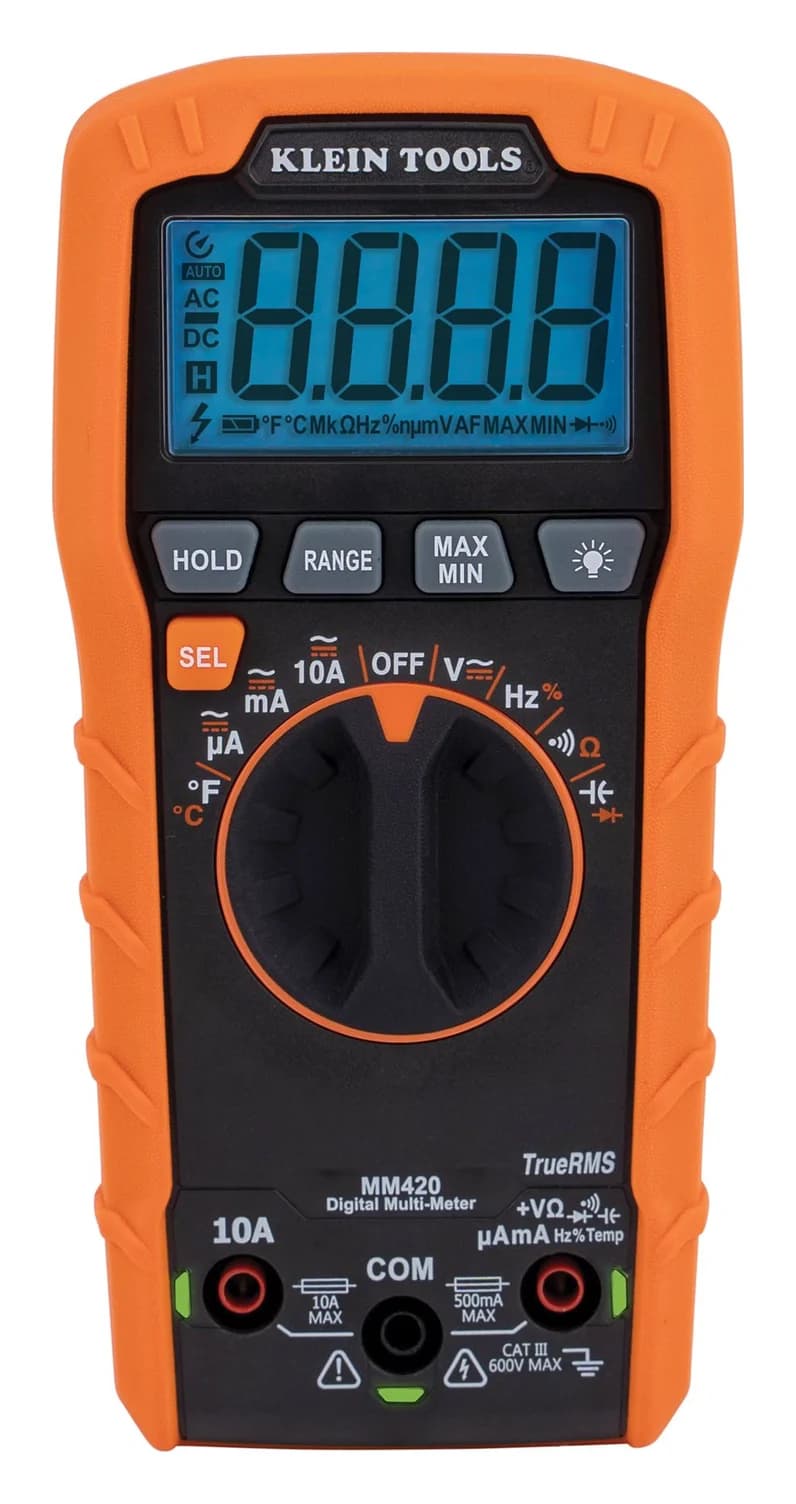
For a concrete alternative, the Klein MM420 manual explicitly specifies a 400 µA DC range with 0.1 µA resolution. Its included thermocouple is limited to temperatures below 180°C, illustrating why the probe and meter need separate checks. See the MM420 selection in our multimeter guide and its official manual. Match those specifications to the equipment maker's requirements.
Need current measurement through a jaw? Start with clamp meter vs multimeter and our clamp-meter shortlist. A lead-based current function and a jaw-current function need separate specifications.
When Lo-Z justifies choosing the 2217
Milwaukee describes Lo-Z as a way to eliminate ghost-voltage readings. The 2217 manual gives approximately 4 kΩ input impedance in Lo-Z, versus 10 MΩ for ordinary DC-voltage measurement, and automatic AC/DC voltage detection in Lo-Z. The low-impedance function is the buying reason when ghost-voltage troubleshooting is on your required feature list.
It is not a default mode for every circuit. Milwaukee warns against using Lo-Z on circuits that could be damaged by the meter's low input impedance. Its Lo-Z range has 0.1 V resolution and ±(2.0% + 3 digits) accuracy, with the AC specification applying at 45–500 Hz. Use the function and range called for by the manual and the equipment service procedure; Lo-Z adds a troubleshooting option rather than a general accuracy upgrade.
Match the box, probe and calibration package
Milwaukee documents the following US packages. The standard 2217-20 includes a dual-banana thermocouple, while the standard 2216-20 does not list one. Both base packages list an electrical test-lead set, two AA batteries and a manual.
2216-20
- Documented contents that matter to the purchase
- Meter, electrical test-lead set, two AA batteries, manual
2217-20
- Documented contents that matter to the purchase
- Meter, electrical test-lead set, dual-banana thermocouple, two AA batteries, manual
2216-20NST
- Documented contents that matter to the purchase
- Meter, test-lead set, two AA batteries, manual, NIST Certificate of Calibration with Data
2217-20NST
- Documented contents that matter to the purchase
- Meter, electrical test-lead set, dual-banana thermocouple, two AA batteries, manual, NIST Certificate of Calibration with Data
Full comparison table
Swipe to compare. Row labels stay visible.
| Exact package | Documented contents that matter to the purchase |
|---|---|
| 2216-20 | Meter, electrical test-lead set, two AA batteries, manual |
| 2217-20 | Meter, electrical test-lead set, dual-banana thermocouple, two AA batteries, manual |
| 2216-20NST | Meter, test-lead set, two AA batteries, manual, NIST Certificate of Calibration with Data |
| 2217-20NST | Meter, electrical test-lead set, dual-banana thermocouple, two AA batteries, manual, NIST Certificate of Calibration with Data |
Scroll horizontally to see every column
| Exact package | Documented contents that matter to the purchase |
|---|---|
| 2216-20 | Meter, electrical test-lead set, two AA batteries, manual |
| 2217-20 | Meter, electrical test-lead set, dual-banana thermocouple, two AA batteries, manual |
| 2216-20NST | Meter, test-lead set, two AA batteries, manual, NIST Certificate of Calibration with Data |
| 2217-20NST | Meter, electrical test-lead set, dual-banana thermocouple, two AA batteries, manual, NIST Certificate of Calibration with Data |
Sources: the standard product pages above and the official 2216-20NST and 2217-20NST inventories. Use the NST suffix to identify the calibration-document package. Its presence is not evidence of extra ranges. The 2217NST page also contains unrelated flashlight feature bullets; its box inventory and the exact meter manual are the useful references.
Probe limit remains unconfirmed. The 2217 manual specifies K-type measurement and expressly separates the meter's temperature range from the probe's specifications. Neither its standard box inventory nor that manual establishes a separate rating for the supplied dual-banana probe. Confirm its allowed temperature range and suitability for the surface or pipe you need to measure; do not transfer the meter's full range to the probe.
Replacement leads need more than a matching plug. Both manuals instruct owners to use Milwaukee test leads; the 2216 manual also requires CAT III 600V or better. Follow the exact meter and accessory instructions rather than assuming a generic banana-plug set is approved. Both meters have an accessory bay, but their base-package inventories do not list a case or mounting attachment; confirm any desired extras separately.
Match the functions
Choose the base meter from its manual; resolve the disputed microamp claim before relying on it.
Match the accessories
Confirm the supplied thermocouple's own limits and the specified replacement leads.
Match the paperwork
Select the NST package when its calibration certificate and data meet your organization's requirements.
Input limits matter as much as functions
Both manuals limit 10 A measurements to one minute, followed by at least 20 minutes of rest. Their overload-protection figures are separate from the allowed measurement ranges. A maximum-current headline does not promise continuous operation at that current.
Both meters are marked CAT III 600V. The manuals prohibit voltage measurements above 600 V and warn against voltage measurement with a lead in the current input. They also prohibit resistance, continuity and capacitance measurements on energized circuits and require capacitors to be discharged. Follow the complete meter and accessory manuals; leave panel work to a licensed electrician. Our multimeter beginner guide explains the function choices.
How we choose
We compared Milwaukee's exact-model manuals, US package inventories, range tables and accessory instructions. Recommendations come from published specifications; we have no physical test results for these meters. Missing probe limits and conflicting sales-page claims remain identified.
Verdict
Buy the 2217-20 for Lo-Z, temperature or milliamp ranges. Buy the 2216-20 when its core electrical functions cover the job. For HVAC work requiring specified DC microamp performance, choose a meter with that range explicitly documented. Resolve the function first, then the thermocouple, leads and any calibration paperwork.
Frequently asked questions
What is the difference between the Milwaukee 2216-20 and 2217-20?
The 2217-20 adds Lo-Z voltage measurement, dedicated milliamp ranges and K-type temperature measurement. Its standard box includes a dual-banana thermocouple. Both meters measure up to 600 V AC/DC and 10 A AC/DC and carry CAT III 600V ratings. Their manuals give the same DC-voltage accuracy specification, so choose the 2217 for its additional functions rather than an assumed voltage-accuracy upgrade.
Can the Milwaukee 2217-20 measure flame-sensor microamps?
We would not buy it for that purpose without written clarification from Milwaukee. The current US product page advertises 600 µA DC for flame rectification, but the linked exact-model manual documents milliamp and amp ranges without a dedicated microamp range. Its smallest current display step is 0.01 mA. That conflict prevents a dependable recommendation for a job requiring specified DC microamp performance.
Does the Milwaukee 2217-20 include a temperature probe?
Yes. Milwaukee's standard 2217-20 box inventory includes a dual-banana thermocouple, electrical test leads, two AA batteries and a manual. The meter manual specifies K-type temperature measurement from −40 to 400°C, but explicitly warns that the probe can have different specifications. The product inventory does not establish the included probe's separate temperature limit; confirm that limit for the intended job.
What does NST mean on these Milwaukee multimeters?
Milwaukee lists 2216-20NST and 2217-20NST packages with a NIST Certificate of Calibration with Data. Treat those as documented calibration-package choices: choose the underlying meter for its functions, then check whether your organization needs the certificate. The ordinary 2216-20 and 2217-20 box inventories do not list that certificate. Do not assume the NST suffix adds a new measurement function.
Related guides
Best picks · Multimeters
Best Multimeters for Beginners: Choose a First Meter You Can Learn On
Choose a first multimeter by its controls, current ranges, jack reminders and included leads. Compare Klein MM420, MM325 and Fluke 107 for learning and gifts.
Best picks · Multimeters
Best Multimeters for HVAC: Microamps, Temperature and Complete Kits
Choose an HVAC multimeter by job: compare Fluke 116, Fieldpiece SC260 and Klein alternatives for flame sensors, clamp current, probe limits and kit contents.
Comparison · Multimeters
Fluke 101 vs 107: Current Ranges, Backlight and Regional Support
Compare the Fluke 101 and 107 by current inputs, backlight, accuracy and kit contents, with manual references and regional warranty checks before you buy.