

Explainer
True RMS vs Average-Responding Multimeters
When It Matters
Choose a true RMS multimeter for distorted AC. Compare Klein MM420, Fluke 117 and 107, understand their limits, and use our worksheet to read the manual.
By thisMETER EditorialUpdated November 3, 20267 min read2 picks
On this page · Quick picks and specification comparison
Choose a True RMS multimeter for distorted or unknown AC waveforms, and keep an average-responding meter if your AC work is limited to known sine waves. Our general-purpose pick is the Klein Tools MM420; choose the Fluke 117 when its electrician features fit your work, or the Fluke 107 when pocket size matters and True RMS is unnecessary. True RMS remains subject to frequency, peak and coupling limits, as Fluke's technical guidance explains.
Quick picks and specification comparison
- MM420: our choice for general electrical checks when you want True RMS, temperature and microamp ranges together.
- 117: our electrician pick for True RMS with non-contact voltage detection, automatic AC/DC voltage selection and a low-impedance mode.
- 107: a pocket option for work where True RMS accuracy is unnecessary; Fluke explicitly confirms it is not True RMS.
These are manufacturer specifications, not our measurements. Accuracy below means ±(% of reading + least-significant digits/counts); it is specific to the function and range.
Compare specifications and all conditions
Klein MM420
- Safety rating, as marked
- CAT III 600V
- AC current frequency band
- 50–400 Hz
- AC measurement
- True RMS
All specifications
- AC volts accuracy and frequency
- ±(1.0% + 3), 50–400 Hz on 4–400 V ranges; ±(1.2% + 5) on 600 V
- Best DC volts accuracy
- ±(0.5% + 5)
Fluke 117
- Safety rating, as marked
- CAT III 600V
- AC current frequency band
- 45–500 Hz
- AC measurement
- True RMS
All specifications
- AC volts accuracy and frequency
- ±(1.0% + 3), 45–500 Hz; ±(2.0% + 3), 500 Hz–1 kHz
- Best DC volts accuracy
- ±(0.5% + 2)
Fluke 107
- Safety rating, as marked
- CAT III 600V
- AC current frequency band
- 40–200 Hz
- AC measurement
- Not True RMS
All specifications
- AC volts accuracy and frequency
- ±(1.0% + 3), 40–500 Hz
- Best DC volts accuracy
- ±(0.5% + 3)
Full comparison table
Swipe to compare. Row labels stay visible.
| Specification | Klein MM420 | Fluke 117 | Fluke 107 |
|---|---|---|---|
| AC measurement | True RMS | True RMS | Not True RMS |
| AC volts accuracy and frequency | ±(1.0% + 3), 50–400 Hz on 4–400 V ranges; ±(1.2% + 5) on 600 V | ±(1.0% + 3), 45–500 Hz; ±(2.0% + 3), 500 Hz–1 kHz | ±(1.0% + 3), 40–500 Hz |
| AC current frequency band | 50–400 Hz | 45–500 Hz | 40–200 Hz |
| Best DC volts accuracy | ±(0.5% + 5) | ±(0.5% + 2) | ±(0.5% + 3) |
| Safety rating, as marked | CAT III 600V | CAT III 600V | CAT III 600V |
Scroll horizontally to see every column
| Specification | Klein MM420 | Fluke 117 | Fluke 107 |
|---|---|---|---|
| AC measurement | True RMS | True RMS | Not True RMS |
| AC volts accuracy and frequency | ±(1.0% + 3), 50–400 Hz on 4–400 V ranges; ±(1.2% + 5) on 600 V | ±(1.0% + 3), 45–500 Hz; ±(2.0% + 3), 500 Hz–1 kHz | ±(1.0% + 3), 40–500 Hz |
| AC current frequency band | 50–400 Hz | 45–500 Hz | 40–200 Hz |
| Best DC volts accuracy | ±(0.5% + 5) | ±(0.5% + 2) | ±(0.5% + 3) |
| Safety rating, as marked | CAT III 600V | CAT III 600V | CAT III 600V |
Sources: MM420 instructions, 117 manual, 107 manual and Fluke's 107 confirmation. The 107 is our documented non-True-RMS example; Fluke's linked documents do not describe its detector circuit, so we do not attribute a particular implementation to it.
What is True RMS, and when does it matter?
RMS means root mean square: square the instantaneous values, average those squares, then take the square root. It expresses the equivalent DC heating value in a resistor. An average-responding meter averages the rectified waveform and scales that result for a sine wave; it does not simply average positive and negative voltages to zero. Fluke explains both methods.
The buying question is the shape of the signal you need to measure. Fluke identifies computers, electronic controls, LED lighting and variable-speed drives as nonlinear loads that can draw pulsed current in its nonlinear-load application note. That is a reason to choose True RMS for their current, even if the supply voltage looks sinusoidal. For known sine waves, both measurement methods can give accurate readings. Source: Fluke.
- Yes: True RMS for distorted or unknown AC waveforms, within the stated limits
- Partly: Average response for known sine waves; judge steady DC work by the DC specifications
- No: Treating a True RMS badge as proof of unlimited waveform or frequency capability
A calculated sine-versus-square example
This is a mathematical illustration, not a physical test or a prediction of a particular meter's display. Assume ideal, symmetric waveforms without DC offset, and sufficient instrument bandwidth and peak capability. Fluke uses the same sine-versus-square comparison in its 2680 series manual, Appendix C.
For a sine wave, RMS equals peak divided by √2. The average-responding conversion is approximately 1.11 × rectified average, per Fluke's explanation.
Sine with peak √2 V
- Actual RMS
- 1 V
- Ideal True RMS indication
- 1 V
- Sine-calibrated average indication
- 1 V
Square alternating equally between +1 V and −1 V
- Actual RMS
- 1 V
- Ideal True RMS indication
- 1 V
- Sine-calibrated average indication
- About 1.11 V
Full comparison table
Swipe to compare. Row labels stay visible.
| Hypothetical waveform | Actual RMS | Ideal True RMS indication | Sine-calibrated average indication |
|---|---|---|---|
| Sine with peak √2 V | 1 V | 1 V | 1 V |
| Square alternating equally between +1 V and −1 V | 1 V | 1 V | About 1.11 V |
Scroll horizontally to see every column
| Hypothetical waveform | Actual RMS | Ideal True RMS indication | Sine-calibrated average indication |
|---|---|---|---|
| Sine with peak √2 V | 1 V | 1 V | 1 V |
| Square alternating equally between +1 V and −1 V | 1 V | 1 V | About 1.11 V |
For the square wave, squaring either polarity gives the same value, so its RMS is 1 V. Its rectified average is also 1 V; multiplying by 1.11 therefore gives 1.11 V, approximately 11% high. The sine needs that scaling; the square does not. Fluke's Appendix C documents the same result. Real distorted waveforms can cause errors in either direction, so there is no universal correction percentage.
Best for general AC checks: Klein Tools MM420
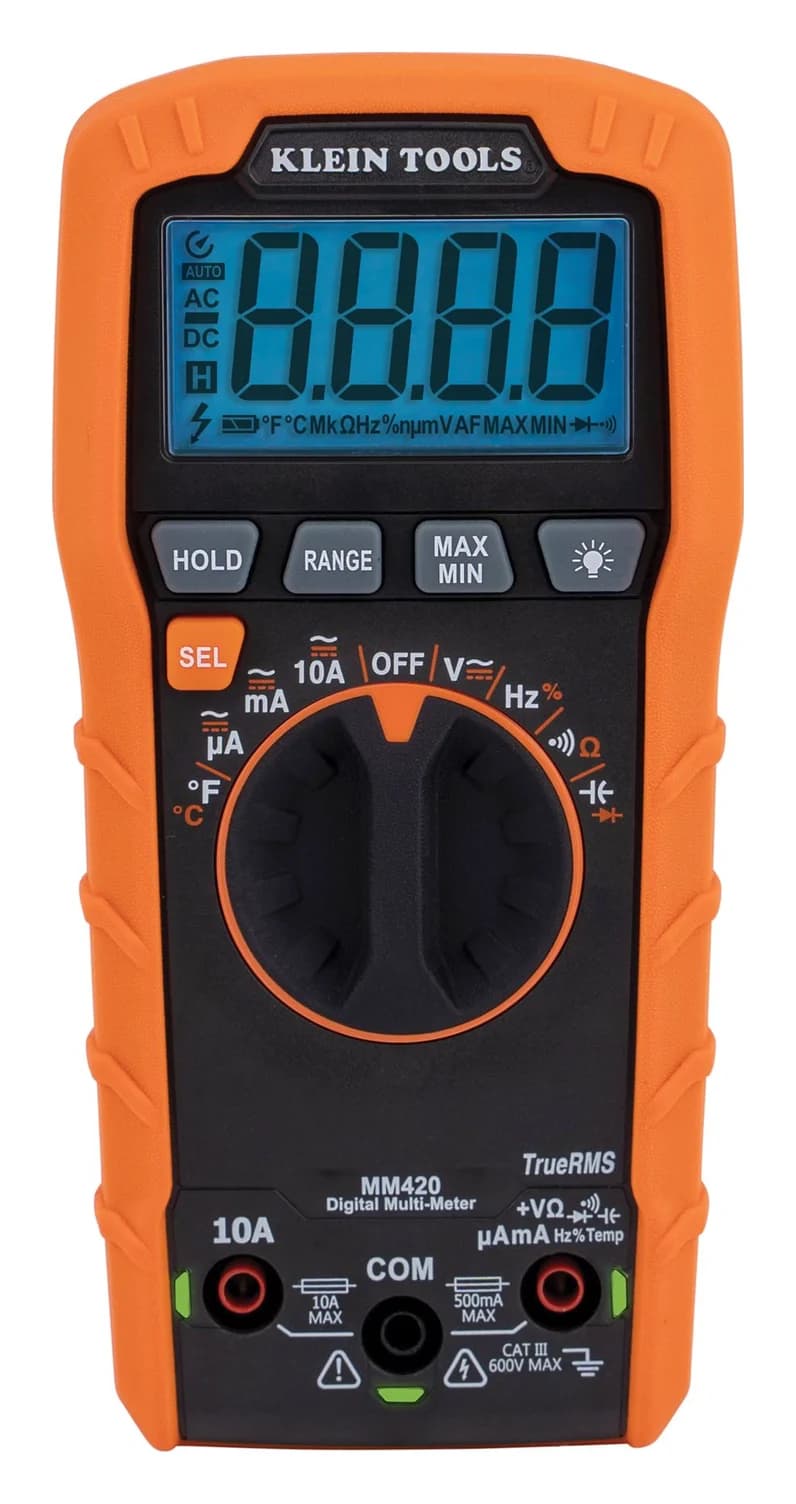
Klein Tools
A 4,000-count auto-ranging True RMS multimeter rated CAT III 600V that measures up to 600 V and 10 A, plus temperature, capacitance, frequency and duty cycle.
Check package and model options
- 600 V max
- 10 A max
- 4,000 counts
- CAT III 600V
Choose the MM420 when True RMS is one requirement among several. Klein combines it with automatic ranging, temperature measurement and microamp ranges, making this our general-purpose recommendation. Its product page also specifies Lead-Alert illumination for lead placement.
The boundary is its documented 50–400 Hz AC voltage and current band. The separate 50 kHz frequency function does not extend AC amplitude accuracy to that frequency. We found no explicit crest-factor limit or AC-coupling specification in the linked instructions. For demanding pulses or a DC-biased signal, get those conditions confirmed by Klein before choosing it.
Version trap: Klein marks the MM400 as no longer in production and identifies the MM420 as the newer model. Check the model printed on the instrument; similar names do not establish identical measurement methods. Klein's MM400 notice.
Best for electricians: Fluke 117
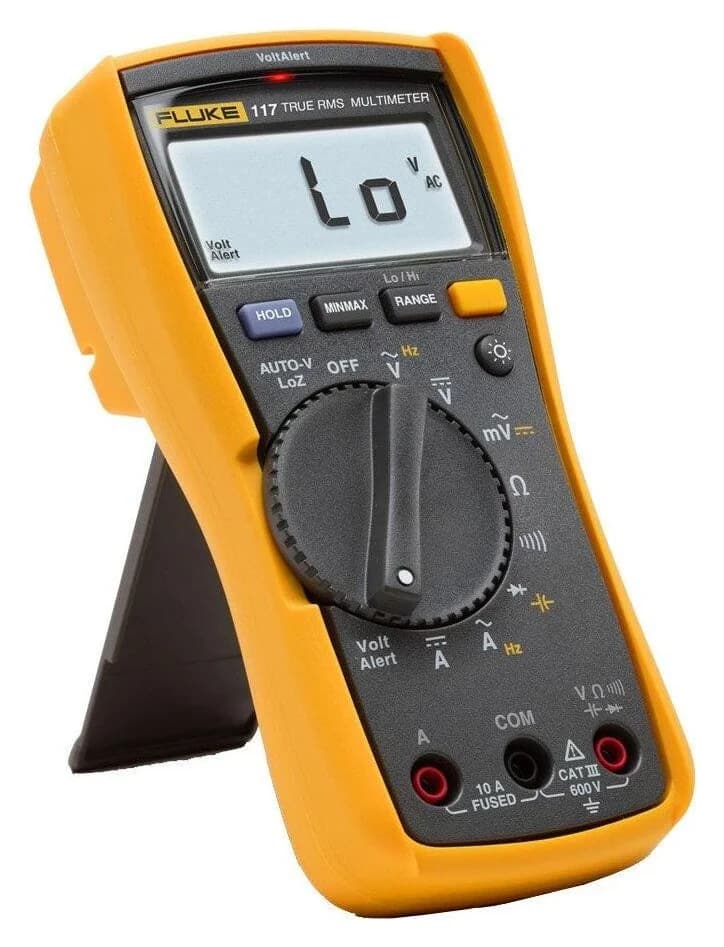
Fluke
A compact 6,000-count True RMS multimeter for electricians, rated CAT III 600V, with built-in VoltAlert non-contact voltage detection, automatic AC/DC selection and a low-impedance mode.
Check package and model options
- 600 V max
- 10 A max
- 6,000 counts
- CAT III 600V
Choose the 117 for its VoltAlert non-contact detection, AutoVolt AC/DC selection and low-impedance mode for ghost voltages. These functions are the reason to pick it over a simpler True RMS meter. Fluke's product page describes each.
Its manual provides useful boundaries: voltage crest factor ≤3 at 4,000 counts, decreasing linearly to 1.5 at full scale; AC current crest factor ≤3. Ordinary AC volts is AC-coupled, while Auto-V LoZ, AC millivolts and AC amps are DC-coupled. Thus, the coupling answer changes with the selected function. Source: 117 manual, accuracy notes.
Version choices: the 117 CAL is the paperwork choice, adding a traceable calibration certificate with data. The 115 is also True RMS, but lacks the 117's non-contact detection, AutoVolt and LoZ features. Choose by the required functions and paperwork, not the similar case. Source: Fluke's model list and comparison.
Pocket pick when True RMS is unnecessary: Fluke 107
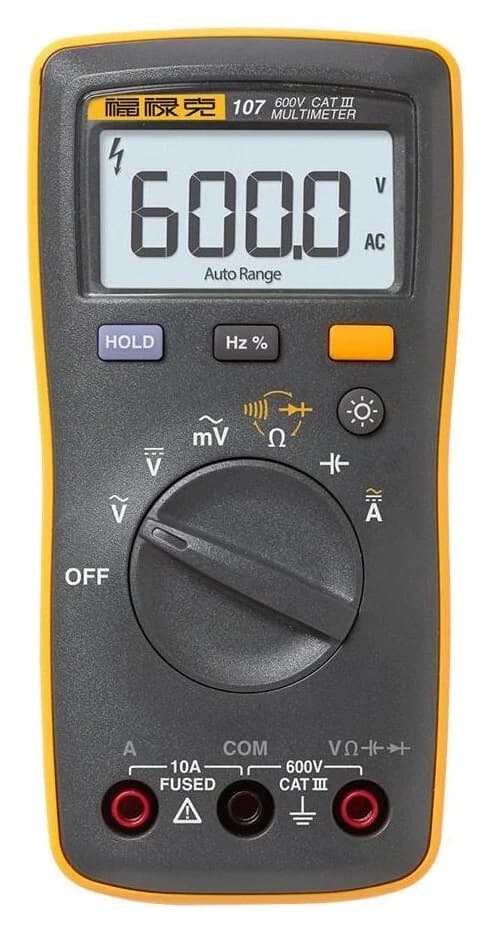
Fluke
A palm-size 6,000-count multimeter rated CAT III 600V that measures AC and DC voltage and current to 600 V and 10 A, plus resistance, capacitance, frequency and duty cycle; it is not True RMS.
Check package and model options
- 600 V max
- 10 A max
- 6,000 counts
- CAT III 600V
Choose the 107 when portability and everyday checks matter more than distorted-AC capability. Fluke describes a palm-size meter for applications where True RMS accuracy is unnecessary and lists AC/DC voltage and current, capacitance, frequency and duty cycle. Its standard package includes TL75 leads and a SmartStrap magnetic lanyard. Source: Fluke 107 page.
The 40–500 Hz AC voltage specification does not make it a substitute for True RMS on distorted signals. Keep it for suitable tasks if you already own it; consider a True RMS model when the waveform becomes uncertain. The shared 106/107 manual is not evidence that both models have every function: its table makes frequency and duty cycle 107-only. Source: 106/107 manual.
Buying guide: a manual-reading worksheet
Copy these fields before comparing another meter. A missing condition is a question for the manufacturer, not permission to assume unlimited performance.
Signal and function
____ Voltage or current; sine, distorted or unknown; exact dial position
Frequency and range
____ AC amplitude band, error terms and usable fraction of range; keep the Hz counter separate
Waveform limits
____ Crest-factor limit at the intended reading, peak limit and coupling
Independent requirements
____ DC accuracy, required functions, meter CAT marking and lead rating
Read the AC amplitude row first. The comparison above shows why: the 117's AC voltage specification extends to 1 kHz, with a larger error term in the upper band, while its AC current specification stops at 500 Hz. Klein's Hz counter reaches 50 kHz, while its AC amplitude specifications cover 50–400 Hz. Frequency measurement and voltage/current amplitude measurement are different capabilities.
Crest factor means peak divided by RMS. It describes how much peak-handling capability a waveform demands. Match the limit to the reading and range: the 117's published limit falls toward full scale. Fluke explicitly conditions True RMS performance on both crest factor and bandwidth in its harmonics application note. Sharp waveforms contain harmonics; checking their repetition frequency alone is insufficient.
Check coupling and the minimum signal. AC-coupled RMS rejects a DC component; AC+DC RMS includes it. For a stable signal, total RMS is √(AC RMS² + DC²) when the component measurements are valid, as Fluke explains. The 117 specifies AC functions other than Auto-V LoZ from 1% to 100% of range. A tiny ripple on an oversized range may therefore lack a specified accuracy.
Treat drive outputs as a separate requirement. Fluke explains that a suitable low-pass filter isolates a motor drive's low-frequency component; an unfiltered reading includes switching voltages. Establish which quantity the drive procedure requires before selecting an instrument. A generic True RMS claim does not resolve that choice. Source: Fluke.
Keep other specifications separate. True RMS does not establish steady-DC accuracy: the table lists different DC error terms. Auto-ranging selects a range; MIN/MAX/AVG averages successive readings. Neither defines the AC conversion method. CAT markings concern the measurement environment, with the meter and accessories limited by the lowest applicable rating. Sources: 117 manual, 107 safety instructions.
How we choose
This is document research, not physical product testing. We compared the makers' current product pages and matching manuals, checked function-specific accuracy notes, and labelled the waveform example as mathematics. Missing conditions remain missing. The recommendations reflect the documented functions and limits; we have no independent waveform measurements of these meters.
Verdict
Get the MM420 for general AC checks within its documented limits; choose the 117 for its electrician features and explicit waveform conditions. Keep or choose the 107 when pocket size is the priority and True RMS is unnecessary. For a wider shortlist, see best multimeters; for the brand decision, use Fluke vs Klein multimeters. If current measurement is the main job, continue to clamp meter vs multimeter.
Our picks at a glance
- 1
Choose for: Best for general AC checks
Check before buying: Rated CAT III 600V: not for service-entrance (CAT IV) work
- 2
Choose for: Electrical troubleshooting with True RMS and a low-impedance mode for ghost voltage.
Limit: CAT III 600 V, not CAT IV; no mA/µA current ranges (the 6 A range resolves 1 mA).
Frequently asked questions
What is True RMS on a multimeter?
RMS means root mean square: the effective voltage or current that produces equivalent DC heating in a resistor. True RMS measures that value for sine waves and distorted waveforms within the meter's specifications. An average-responding meter instead scales the rectified average to indicate RMS correctly on a sine wave; distortion can upset that conversion.
Do I need True RMS for DC voltage?
Choose a meter for steady DC work by its DC voltage accuracy, resolution and range. True RMS describes its AC measurement capability and does not establish better DC accuracy. If DC has AC ripple on it, decide whether you need the DC component, the AC component or total RMS, then check the selected function's coupling.
Is an auto-ranging multimeter the same as a True RMS multimeter?
No. Automatic ranging selects a measurement range; True RMS describes how the instrument determines an AC signal's effective value. A meter can provide both features, as the Klein MM420 does. Likewise, a MIN/MAX/AVG recording mode averages successive readings; its AVG label does not identify the underlying AC conversion method.
Can any True RMS multimeter measure a variable-frequency drive output?
Do not choose a meter for drive outputs from the True RMS label alone. Check its bandwidth, crest factor and the drive maker's measurement requirements. Fluke explains that an appropriate low-pass filter can isolate the motor-driving component, while an unfiltered reading includes switching components. These are different measurement objectives; the ordinary AC specifications alone do not establish suitability.
Related guides
Best picks · Multimeters
Best Multimeters for Beginners: Choose a First Meter You Can Learn On
Choose a first multimeter by its controls, current ranges, jack reminders and included leads. Compare Klein MM420, MM325 and Fluke 107 for learning and gifts.
Best picks · Multimeters
Best Multimeters for HVAC: Microamps, Temperature and Complete Kits
Choose an HVAC multimeter by job: compare Fluke 116, Fieldpiece SC260 and Klein alternatives for flame sensors, clamp current, probe limits and kit contents.
Comparison · Multimeters
Fluke 101 vs 107: Current Ranges, Backlight and Regional Support
Compare the Fluke 101 and 107 by current inputs, backlight, accuracy and kit contents, with manual references and regional warranty checks before you buy.