

Best picks
Best Multimeters for Electronics
Bench Work and Fine Resolution in 2026
Buying a multimeter for electronics bench work? Compare microamp resolution, capacitance ranges, diode test voltage and CAT safety limits with exact model picks.
By thisMETER EditorialUpdated November 5, 202611 min read5 picks
On this page · Our picks at a glance
Our picks at a glance
- 1
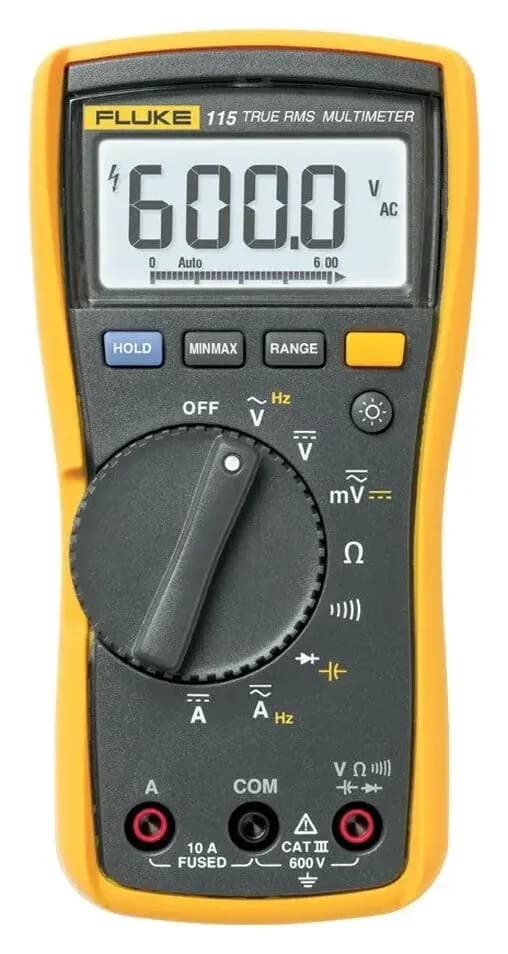
True RMS, auto-ranging, capacitance, frequency, diode test, CAT III 600V
600 V max · 6,000 counts
Choose for: True RMS, auto-ranging, capacitance, frequency, diode test, CAT III 600V
Limit: Smallest current range is 6.000 A — Fluke's Q&A says the 110-series doesn't have small currents
- 2
22000 counts, 0.01 µA step, relative/peak modes, hFE, USB
Choose for: 22000 counts, 0.01 µA step, relative/peak modes, hFE, USB
Limit: Global page says out of stock; current duty limits above 5A
- 3
Microamp ranges, ±(0.09% + 2) DC volts, 80BK probe included, lifetime warranty
Choose for: Microamp ranges, ±(0.09% + 2) DC volts, 80BK probe included, lifetime warranty
Show all 5 picks
- 4
400.0 µA range with 0.1 µA steps, fused inputs, thermocouple included
Choose for: 400.0 µA range with 0.1 µA steps, fused inputs, thermocouple included
Limit: 4000 counts; no True RMS claim on the current page
- 5
6000 counts, auto-ranging, capacitance to 100 mF, LED jack lights
1,000 V max · 10 A max
Choose for: 6000 counts, auto-ranging, capacitance to 100 mF, LED jack lights
Limit: Capacitance accuracy is ±(4.0%+3); page text and spec table disagree on maximum voltage
For electronics bench work — continuity, resistance, diode and component checks, and small DC voltages — the Fluke 115 is the meter we'd put on many benches: True RMS, auto-ranging, a 6000-count display, and the capacitance, frequency, continuity and diode functions the job needs, rated CAT III 600V. Its current measurement starts at 6.000 A, so milliamp and microamp work is not its job. If your work includes small currents, the UNI-T UT61E+ brings a 22000-count display, a 0.01 µA current step and USB logging (confirm availability, because its global page currently says out of stock); the Fluke 179 is the mid-tier Fluke with temperature and 0.01 mA maximum current resolution; the Fluke 17B+ is the budget Fluke with fused microamp inputs; and the KAIWEETS HT118A is the value pick with the widest capacitance range here. All recommendations are based on manufacturer specifications and manuals, checked November 5, 2026; we have not tested these meters.
- 0.01 µASmallest DC current display step among these picks (UT61E+, per its manual)
- ±(0.05% + 5)UT61E+ DC voltage accuracy on its 2.2000 V through 220.00 V ranges
- 20 ΩFluke 115 continuity beeper threshold, on below this, per its spec table
Quick picks: buy for the measurements you make
Compare specifications and all conditions
General troubleshooting and first real meter
- Our pick
- Fluke 115
- Why it earns the place
- True RMS, auto-ranging, capacitance, frequency, diode test, CAT III 600V
- Check before buying
- Smallest current range is 6.000 A — Fluke's Q&A says the 110-series doesn't have small currents
Fine resolution, logging, component sorting
- Our pick
- UNI-T UT61E+
- Why it earns the place
- 22000 counts, 0.01 µA step, relative/peak modes, hFE, USB
- Check before buying
- Global page says out of stock; current duty limits above 5A
Fluke build with microamps and temperature
- Our pick
- Fluke 179
- Why it earns the place
- Microamp ranges, ±(0.09% + 2) DC volts, 80BK probe included, lifetime warranty
- Check before buying
- 9 V battery, about 200 hours typical
Lowest-cost safe current inputs
- Our pick
- Fluke 17B+
- Why it earns the place
- 400.0 µA range with 0.1 µA steps, fused inputs, thermocouple included
- Check before buying
- 4000 counts; no True RMS claim on the current page
Most functions per dollar
- Our pick
- KAIWEETS HT118A
- Why it earns the place
- 6000 counts, auto-ranging, capacitance to 100 mF, LED jack lights
- Check before buying
- Capacitance accuracy is ±(4.0%+3); page text and spec table disagree on maximum voltage
Full comparison table
Swipe to compare. Row labels stay visible.
| Your bench work | Our pick | Why it earns the place | Check before buying |
|---|---|---|---|
| General troubleshooting and first real meter | Fluke 115 | True RMS, auto-ranging, capacitance, frequency, diode test, CAT III 600V | Smallest current range is 6.000 A — Fluke's Q&A says the 110-series doesn't have small currents |
| Fine resolution, logging, component sorting | UNI-T UT61E+ | 22000 counts, 0.01 µA step, relative/peak modes, hFE, USB | Global page says out of stock; current duty limits above 5A |
| Fluke build with microamps and temperature | Fluke 179 | Microamp ranges, ±(0.09% + 2) DC volts, 80BK probe included, lifetime warranty | 9 V battery, about 200 hours typical |
| Lowest-cost safe current inputs | Fluke 17B+ | 400.0 µA range with 0.1 µA steps, fused inputs, thermocouple included | 4000 counts; no True RMS claim on the current page |
| Most functions per dollar | KAIWEETS HT118A | 6000 counts, auto-ranging, capacitance to 100 mF, LED jack lights | Capacitance accuracy is ±(4.0%+3); page text and spec table disagree on maximum voltage |
Scroll horizontally to see every column
| Your bench work | Our pick | Why it earns the place | Check before buying |
|---|---|---|---|
| General troubleshooting and first real meter | Fluke 115 | True RMS, auto-ranging, capacitance, frequency, diode test, CAT III 600V | Smallest current range is 6.000 A — Fluke's Q&A says the 110-series doesn't have small currents |
| Fine resolution, logging, component sorting | UNI-T UT61E+ | 22000 counts, 0.01 µA step, relative/peak modes, hFE, USB | Global page says out of stock; current duty limits above 5A |
| Fluke build with microamps and temperature | Fluke 179 | Microamp ranges, ±(0.09% + 2) DC volts, 80BK probe included, lifetime warranty | 9 V battery, about 200 hours typical |
| Lowest-cost safe current inputs | Fluke 17B+ | 400.0 µA range with 0.1 µA steps, fused inputs, thermocouple included | 4000 counts; no True RMS claim on the current page |
| Most functions per dollar | KAIWEETS HT118A | 6000 counts, auto-ranging, capacitance to 100 mF, LED jack lights | Capacitance accuracy is ±(4.0%+3); page text and spec table disagree on maximum voltage |
Best overall: Fluke 115
Fluke's 115 page pitches the Fluke 115 Field Technicians Digital Multimeter at field service technicians: one-handed operation, a backlit 6,000-count display, and True-RMS measurement with AC and DC voltage, current, resistance, continuity, frequency and capacitance. That suits voltage and component checks, but not milliamp or microamp bench work.
- The bench functions: diode test (2.00 V range, 0.001 V resolution, 0.9% + 2 accuracy), continuity beeper on below 20 Ω and off above 250 Ω, resistance to 40 MΩ, capacitance to 9,999 µF at 1.9% + 2 from 100 µF to 1000 µF and 5% + 20 above that
- Voltage detail: 600.0 mV range at 0.1 mV resolution; DC volts specified to 0.5% + 2
- Current limits: AC/DC current to 10 A; the 20 A overload is allowed for 30 seconds maximum
- Safety: IEC 61010-2-033 CAT III 600V; 9 V battery, 400 hours typical without backlight; 3-year warranty; ships with a holster and 4 mm PVC-insulated test leads
The trade-off for electronics is the current section: the smallest range is 6.000 A, so there are no milliamp or microamp ranges for sleep-current or leakage work — Fluke's own product Q&A says the 110-series "doesn't have" small-current measurement and points buyers needing it to the 17B+, which it calls "more geared towards electronics." Its sibling, the Fluke 114, goes further: Fluke's page calls it a go/no-go troubleshooting tool, and it measures no current at all; it does add AutoVolt and a LoZ function for identifying ghost voltage. If you need microamps on a Fluke, skip to the 17B+ or 179 below.
Best resolution and logging: UNI-T UT61E+
The UT61E+ is the resolution pick. UNI-T's series page and its user manual document a 22000-count display and a 46-segment analog bar, against 6000 on the 115.
- Small currents: 220.00 µA and 2200.0 µA DC ranges, with 0.01 µA resolution on the lowest, specified to ±(0.5%+10); AC current accuracy is ±(0.8%+10) at 40 Hz–1 kHz and ±(3%+50) at 1 kHz–10 kHz
- DC voltage: 2.2000 V through 220.00 V ranges at ±(0.05%+5); the 220.00 mV range resolves 0.01 mV; input impedance about 1 GΩ on the mV range and about 10 MΩ on the others
- Component functions: resistance from 220.00 Ω to 220.00 MΩ, capacitance from 22.000 nF to 220.00 mF, diode test with about 3V open-circuit voltage and a normal forward drop between 0.12V and 2V, plus a transistor hFE socket (range 1000β, resolution 1β)
- Continuity: beeps below 50Ω conduction and stays silent at 70Ω or above
- Logging and modes: USB data transmission with maker-supplied software, relative (REL) zeroing, peak maximum/minimum capture; AC+DC and low-pass AC voltage modes
- Duty limits: when the measured current is above 5A, each measurement must be 10 seconds or less with 15 minutes of rest
- Protection: mA/µA input fused at 1A 240V, A input at 10A 240V (fast-acting, 6x25mm); CAT III 1000V / CAT IV 600V per the manual
The trade-offs are real: the global page says out of stock and unavailable, so confirm regional supply before planning around this meter. The largest capacitance range is only specified to ±(20%+5), and the manual gives no burden-voltage figure for the current ranges, so we make no low-burden claim. Our bench multimeter guide covers the step up to 5½-digit meters when 22000 counts is still not enough.
Best Fluke upgrade: Fluke 179
Fluke's 179 page calls it "the industry-standard troubleshooting tool for electrical and electronic systems," and its spec sheet is the strongest all-round set on this page.
- Accuracy and detail: DC volts ±(0.09% + 2) with 0.1 mV maximum resolution; DC current ±(1.0% + 3) with 0.01 mA maximum resolution; Fluke's comparison table lists microamps among the 179's measurement capabilities; analog bar graph and backlit display
- Ranges: voltage to 1000 V AC/DC, current to 10 A, resistance to 50 MΩ, capacitance to 10,000 µF at ±(1.2% + 2), frequency to 100 kHz at ±(0.1% + 1), temperature from -40°C to 400°C at ±(1.0% + 10)
- Safety and build: EN 61010-1 to 1000 V CAT III and to 600 V CAT IV; UL, CSA and TÜV listed; lifetime warranty; 420 g
- In the box: 80BK temperature probe, installed 9 V battery, test leads, quick reference guide
The trade-offs: a 9 V alkaline battery lasts about 200 hours typical without backlight — the shortest on this page — and the page does not state a display count. True RMS AC, temperature and Fluke's comparison-table microamps listing — with a specified maximum DC-current resolution of 0.01 mA — are why it costs more than the 115.
Best budget pick: Fluke 17B+
The 17B+ page is the cheapest way into a Fluke with the functions a bench needs: AC/DC voltage and current up to 1000 V and 10 A, resistance, capacitance and frequency checks, plus a supplied Type-K thermocouple. It is marked CAT III 600 V.
- Small currents: 400.0 µA and 4000 µA AC and DC ranges with 0.1 µA resolution, alongside 40.00 mA, 400.0 mA, 4.000 A and 10.00 A
- Accuracy: DC volts 0.5% + 3 from 4.000 V to 1000 V; DC current 1.5% + 3; frequency 0.1% + 3 from 10 Hz to 100 kHz
- Fuses: current inputs protected by 440 mA and 11A 1000 V fast fuses, Fluke-specified parts only
- Bench extras: relative zeroing for voltage-drop and temperature-change readings; diode test with typically 2.0 V open-circuit voltage and less than 0.6 mA short-circuit current; capacitance to 1000 µF
- Endurance and safety: 2 AA batteries with 500 hours minimum; IEC 61010-1 and IEC 61010-2-030 CAT III 600 V, Pollution Degree 2; 455 g
- In the box: meter, TL75 test leads, Type-K thermocouple probe, 2 AA batteries, users manual (part 4404231)
The trade-offs: 4000 counts rather than 6000 or 22000, diode accuracy is only specified to 10%, and the current page makes no True RMS claim. Buyers on a tighter budget should also see our budget multimeter guide.
Best value full-feature: KAIWEETS HT118A
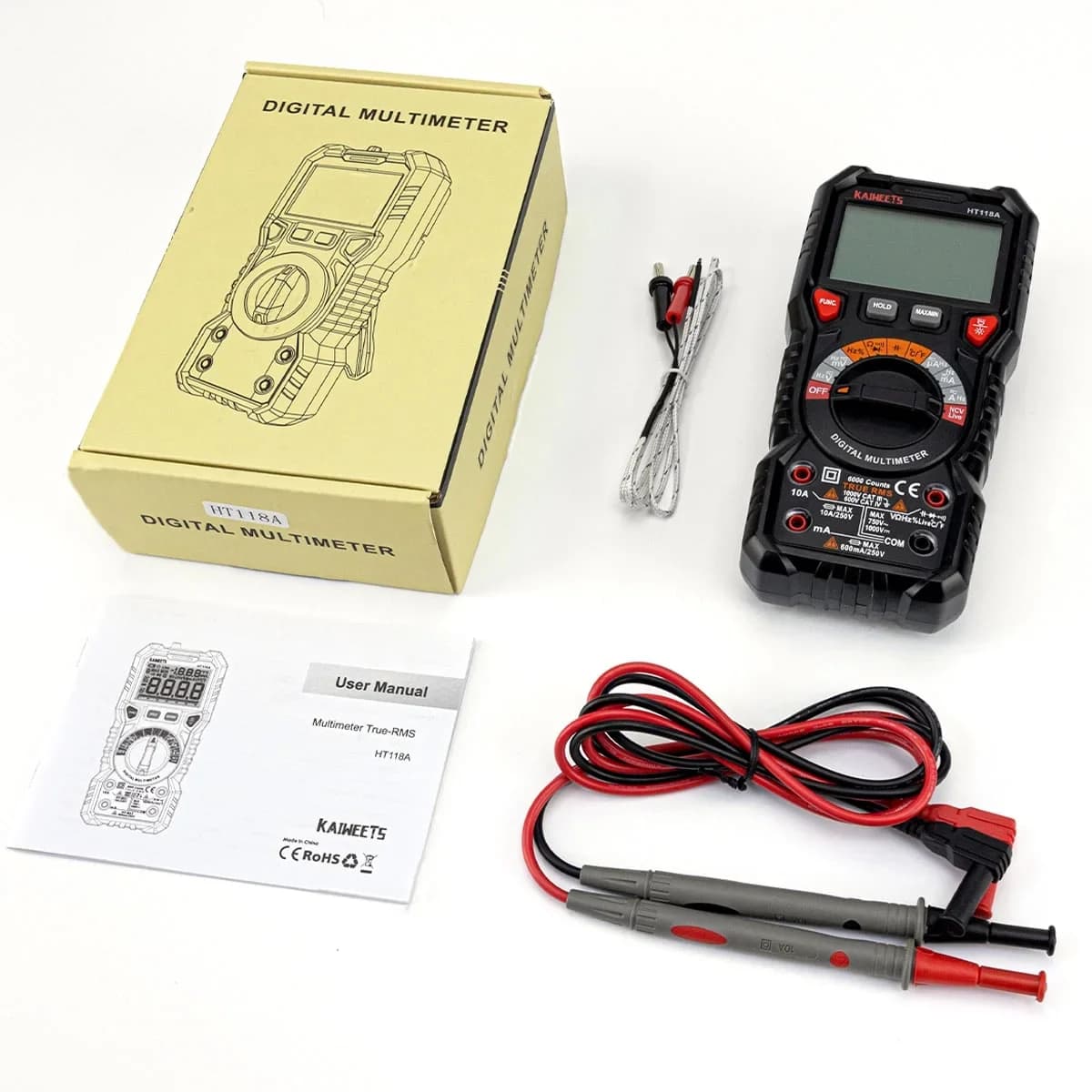
The HT118A page packs the longest function list per dollar: auto-ranging, True RMS, non-contact voltage detection, live-wire detection, LED-lit input jacks, a flashlight, Min/Max/Average, and temperature.
KAIWEETS
A 6,000-count auto-ranging True RMS multimeter with non-contact voltage and live-wire detection, LED-lit input jacks, a flashlight and temperature measurement, rated CAT III 1000V and CAT IV 600V.
- 1,000 V max
- 10 A max
- 6,000 counts
- CAT III 1000V, CAT IV 600V
- Ranges: DC voltage 600mV to 1000V and AC voltage to 750V in the spec table; DC and AC current 600uA/6000uA/60mA/600mA plus 10 A; resistance to 60 MΩ; capacitance from 10nF to 100mF; frequency to 10MHz; temperature -40°C to 1000°C
- Safety: IEC-rated CAT III 1000V / CAT IV 600V, CE and RoHS, with a double ceramic fuse and thermistor protection
- In the box: meter, test leads, thermocouple, two AAA batteries, user manual
The trade-offs we can verify: the feature text says "up to 600V" while the spec table lists ranges to 1000 V DC — KAIWEETS's own documents disagree, so confirm the maximum voltage in the supplied manual before relying on it. Capacitance accuracy is ±(4.0%+3), or ±(5.0%+3) on the 100mF range. There's no maker-stated continuity threshold or response time, so a fast beeper cannot be promised here.
Compare the small-current and component specs
Source: each maker's page or manual, linked in the sections above (the Fluke 179 page states no count)
A big maximum-current number does not give you low-current detail. These are DC range and resolution specifications from the makers' documents, not our measurements:
UNI-T UT61E+
- Smallest DC current range
- 220.00 µA
- Display step on that range
- 0.01 µA
- Capacitance to
- 220.00 mF
All specifications
- Diode test
- about 3V open-circuit, 0.12V–2V forward
Fluke 17B+
- Smallest DC current range
- 400.0 µA
- Display step on that range
- 0.1 µA
- Capacitance to
- 1000 µF
All specifications
- Diode test
- 2.0 V typical open-circuit, under 0.6 mA
KAIWEETS HT118A
- Smallest DC current range
- 600 µA
- Display step on that range
- not documented
- Capacitance to
- 100 mF
All specifications
- Diode test
- provided
Fluke 115
- Smallest DC current range
- 6.000 A
- Display step on that range
- 0.001 A
- Capacitance to
- 9,999 µF
All specifications
- Diode test
- 2.00 V range, 0.001 V resolution
Fluke 179
- Smallest DC current range
- microamp ranges listed on its comparison page
- Display step on that range
- 0.01 mA
- Capacitance to
- 10,000 µF
All specifications
- Diode test
- provided
Full comparison table
Swipe to compare. Row labels stay visible.
| Meter | Smallest DC current range | Display step on that range | Capacitance to | Diode test |
|---|---|---|---|---|
| UNI-T UT61E+ | 220.00 µA | 0.01 µA | 220.00 mF | about 3V open-circuit, 0.12V–2V forward |
| Fluke 17B+ | 400.0 µA | 0.1 µA | 1000 µF | 2.0 V typical open-circuit, under 0.6 mA |
| KAIWEETS HT118A | 600 µA | not documented | 100 mF | provided |
| Fluke 115 | 6.000 A | 0.001 A | 9,999 µF | 2.00 V range, 0.001 V resolution |
| Fluke 179 | microamp ranges listed on its comparison page | 0.01 mA | 10,000 µF | provided |
Scroll horizontally to see every column
| Meter | Smallest DC current range | Display step on that range | Capacitance to | Diode test |
|---|---|---|---|---|
| UNI-T UT61E+ | 220.00 µA | 0.01 µA | 220.00 mF | about 3V open-circuit, 0.12V–2V forward |
| Fluke 17B+ | 400.0 µA | 0.1 µA | 1000 µF | 2.0 V typical open-circuit, under 0.6 mA |
| KAIWEETS HT118A | 600 µA | not documented | 100 mF | provided |
| Fluke 115 | 6.000 A | 0.001 A | 9,999 µF | 2.00 V range, 0.001 V resolution |
| Fluke 179 | microamp ranges listed on its comparison page | 0.01 mA | 10,000 µF | provided |
Read the accuracy line next to every range: the UT61E+'s microamp ranges are ±(0.5%+10) and the 17B+'s are ±(1.5% + 3), so the finer display step is not automatically the more accurate reading. Current duty limits apply on the UT61E+ above 5A.
Read the CAT boundary before the feature count
Every meter here is safe for low-voltage bench work, and none of them should be your household-wiring meter by default. Fluke's multimeter safety guide places outlet and long branch circuits in CAT II, feeders and short branch circuits and devices fed directly from distribution panels in CAT III, and the service entrance, electricity meter and outside runs in CAT IV. Fluke's rule of thumb: choose a tool rated for the highest category you could potentially use it in.
The catch for electronics buyers: a CAT marking is about high-energy faults, not bench precision. A CAT III 1000V / CAT IV 600V marking like the UT61E+'s or HT118A's does not make the meter better at reading a diode — and a CAT III 600V marking like the 115's or 17B+'s covers outlets and branch circuits while leaving service-entrance work alone. The current-input fuses matter on the bench too: the UT61E+ protects its mA/µA input with a 1A 240V fast-acting fuse, a limit that has nothing to do with its 1000 V voltage ranges. Our electricians' multimeter guide covers mains-rated picks, and the parent roundup compares home, automotive and HVAC uses.
How we choose
We compared maker product pages, manuals and spec tables — display counts, smallest current ranges, accuracy lines, fuse ratings and marked CAT ratings — checked November 5, 2026. These are research-based recommendations; we have not physically tested any meter, and every figure here is the maker's own specification. Where a maker's documents conflict (KAIWEETS's maximum voltage, UNI-T's availability), we say so instead of picking the flattering number. Our selection method explains the process.
Buying guide: get the lead kit right too
List the smallest current you'll read
Leakage, sleep draw and sensor bias need microamp ranges; component checks need diode test and capacitance.
Match resolution to accuracy
A 0.01 µA step with ±(0.5%+10) accuracy is a display detail, not a precision promise; read both lines.
Check the current-input fuse and duty limits
Fused microamp/milliamp inputs (17B+, UT61E+) and time-limited high-current ranges protect the meter and you.
Confirm the CAT boundary
Bench work is low-energy; household mains needs a meter rated for that location and the leads to match.
Bench conveniences worth checking before ordering: a tilt stand or holster (the 115 ships with a holster; the HT118A has a stable kickstand and a back flashlight), jack lighting (the HT118A's LED lights on the jacks show the correct inputs), and relative zeroing (17B+ and UT61E+) for subtracting lead resistance. Replacement leads need the same 4 mm shrouded banana format the makers use — the 115 ships with 4 mm PVC-insulated test leads and the 17B+ with TL75 test leads. Our multimeter basics guide walks through the functions if this is your first meter, and the beginners' roundup covers gentler starter picks.
True RMS matters only where AC is distorted. On pure DC bench work it is irrelevant; Fluke's True RMS explainer notes an averaging meter can read distorted waves up to 40% low or 10% high, and recommends True RMS where AC characteristics are unknown.
Verdict
For most electronics benches the Fluke 115 is the sensible center: safe, readable, and complete for voltage, resistance, continuity, diode and capacitance work. Buy the UT61E+ when microamp resolution and logging drive the purchase (and after confirming availability), the 179 when you want Fluke accuracy with microamps and temperature in one meter, the 17B+ when the budget is tight but the inputs must still be fused, and the HT118A when function count per dollar wins. The parent best multimeters guide remains the starting point for mixed household use.
Frequently asked questions
Can I use an electronics multimeter on household mains?
Only within its marked category. Fluke's measurement-category table puts outlets and long branch circuits in CAT II, feeders and short branch circuits in CAT III, and the service entrance and electricity meter in CAT IV. Every meter on this page handles low-voltage bench work, but panel and service-entrance measurement calls for a meter rated for that location — and often for a licensed electrician rather than a hobby meter. Our electricians' multimeter guide covers those picks.
What is the best multimeter for home use with some electronics?
If most of your work is outlets, appliances and battery-powered projects, our home multimeter roundup and beginner guide are the better starting points. For bench electronics with component checks, the Fluke 17B+ adds microamp ranges and capacitance; the Fluke 115 covers the same jobs with a True RMS display and finer voltage ranges. Match the functions you actually use, not the highest headline voltage.
Do I need True RMS for electronics work?
For DC bench measurements, no. It matters when you measure AC from switch-mode supplies, dimmers or variable-speed drives: Fluke's explainer says an average-responding meter on a distorted wave can read up to 40% low or 10% high. The 115, 179, UT61E+ and HT118A are True RMS meters. The current Fluke 17B+ page makes no True RMS claim, so treat that as unconfirmed.
Why does microamp resolution matter on a bench?
Leakage currents, sensor bias, sleep-mode draw and diode behavior live in the microamp range. The UNI-T UT61E+ resolves 0.01 µA on its 220.00 µA DC range and the Fluke 17B+ resolves 0.1 µA on its 400.0 µA range; a meter whose smallest range is 6 A cannot display these values at all. Check the accuracy spec and any current-input time limits for the range you will actually use.
Is the UNI-T UT61E+ actually available?
UNI-T's global product page currently says it is out of stock and unavailable. Confirm regional availability with the seller before ordering, and match the exact plus-suffix model: UNI-T's discontinued-product list marks the older UT61E as replaced by the UT61E+.
Related guides
Buying guide · Multimeters
Professional Multimeter Buying Guide: Choose by Trade and Risk
Pick a professional multimeter by CAT category, working voltage, accuracy and calibration needs. Compare the Fluke 87V, 117, 289 and Fieldpiece SC640 by trade.
Buying guide · Multimeters
Fluke 87V Industrial Multimeter Buying: Which Version Should You Buy?
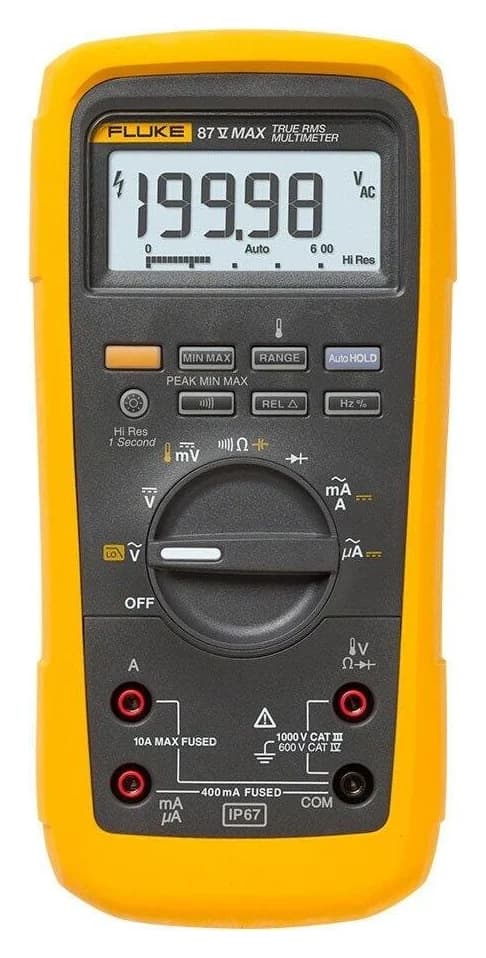
Pick the right Fluke 87V package for industrial work: standard, MAX, CAL, E2 kit or IMSK clamp kit. Compare IP ratings, CAT boundaries and box contents.
Best picks · Multimeters
Best Multimeters for Home Use and Electronics: Five Meters That Cover the Whole House
Pick a multimeter for home wiring and electronics work by safety rating, accuracy and fuse protection. Compare the KAIWEETS HT118A, Fluke 114, Brymen BM257s, Fluke 179 and Fluke 113.