

Best picks
Best Cheap Multimeters in 2026
What a Safe Budget Buys
Find a genuinely good cheap multimeter: exact models, CAT markings, fuses, True RMS and the no-buy safety floor, compared across five budget picks.
By thisMETER EditorialUpdated November 5, 202612 min read4 picks
On this page · Our picks at a glance
Our picks at a glance
- 1
One meter for the house
1,000 V max · 10 A max
Choose for: One meter for the house
Limit: The official HT118A manual specifies 1000 V DC and 750 V AC; the 1000 V headline is not the AC measurement limit
- 2
Hobby electronics
Choose for: Hobby electronics
Limit: CAT rating is not stated on the US page; check the delivered manual
- 3
Cheapest safe meter
600 V max · 10 A max
Choose for: Cheapest safe meter
Limit: Manual ranging and DC-only current; no capacitance or temperature
Show all 4 picks
- 4
AC wiring checks
Choose for: AC wiring checks
Limit: No current measurement at all; TL75 lead rating depends on its caps
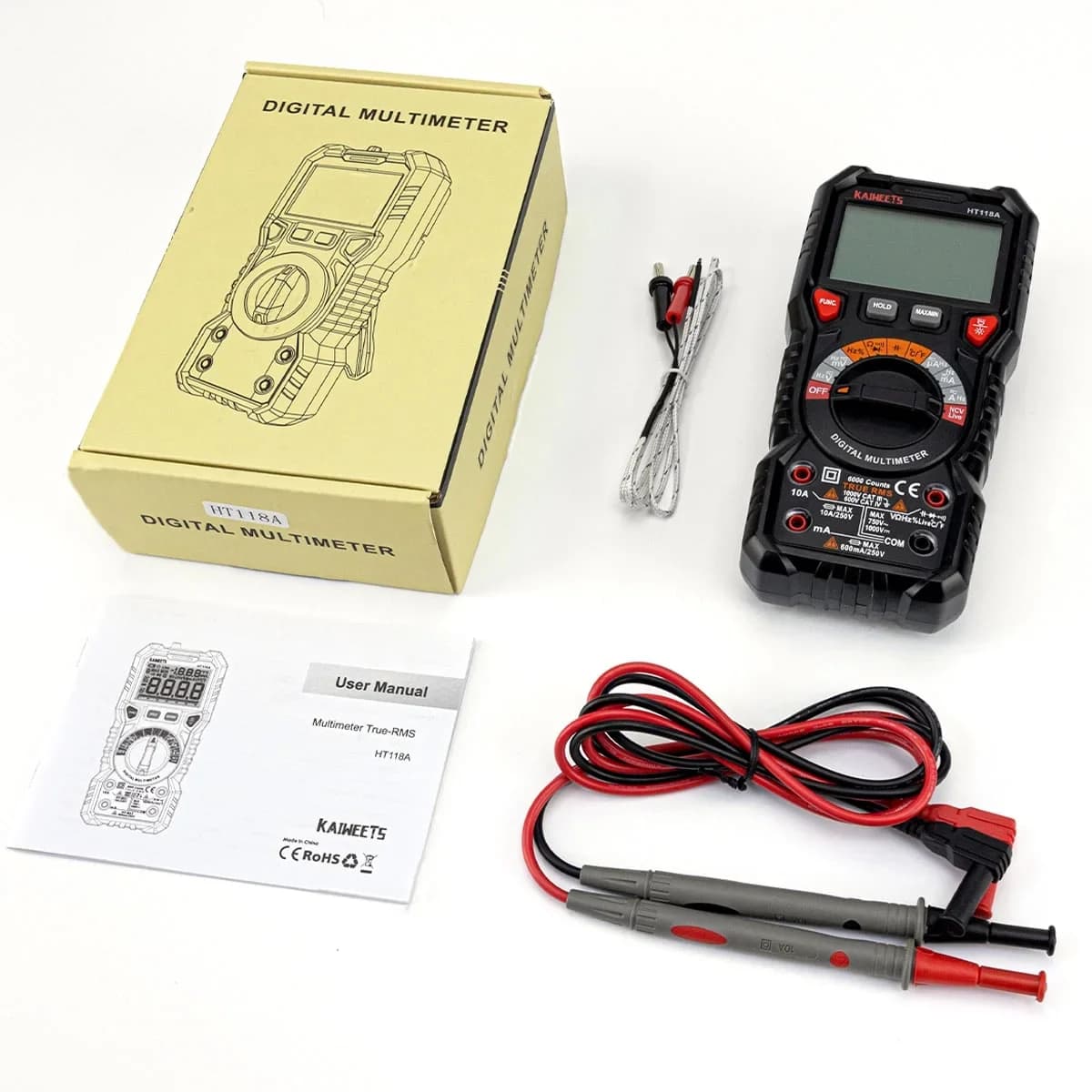
For a buyer who wants a usable multimeter now, the KAIWEETS HT118A is the best cheap multimeter: auto-ranging, True RMS, a 6,000-count display and non-contact detection, marked CAT III 1000V / CAT IV 600V with double ceramic fuses. Below it, the AstroAI DM6000AR matches the 6,000-count True RMS template and adds a thermocouple; the Klein Tools MM325 is the cheapest pick with a name-brand safety marking; and the Fluke 113 is where a small budget stops feeling cheap at all. Every specification below comes from the makers' own pages and manuals, checked November 5, 2026. We have a broader budget guide for first-time buyers; this page owns the cheap-search buying decision: the exact models, and the safety floor below which a multimeter is not a bargain at any price.
- 6000 countsDisplay resolution of both top picks, per their makers' pages
- CAT III 600VThe minimum category marking we accept on any cheap meter
- 40% lowHow far an average-responding meter can misread distorted AC, per Fluke
Quick picks: cheap, but only above the safety floor
Compare specifications and all conditions
One meter for the house
- Our pick
- KAIWEETS HT118A
- What earns its place
- True RMS, auto-ranging, NCV, CAT III 1000V / CAT IV 600V
- What to check before buying
- Spec table lists ranges to 1000 V DC while the bullets say 600 V: read the manual
Hobby electronics
- Our pick
- AstroAI DM6000AR
- What earns its place
- Capacitance, frequency, duty cycle, thermocouple included
- What to check before buying
- CAT rating is not stated on the US page; check the delivered manual
Cheapest safe meter
- Our pick
- Klein MM325
- What earns its place
- CAT III 600V, fused 10 A DC input, capped leads
- What to check before buying
- Manual ranging and DC-only current; no capacitance or temperature
AC wiring checks
- Our pick
- Fluke 113
- What earns its place
- CAT IV 600V, LoZ VCHEK rejects ghost voltages
- What to check before buying
- No current measurement at all; TL75 lead rating depends on its caps
Below the floor
- Our pick
- Refuse it
- What earns its place
- A CAT-marked meter, fused current jack and matching manual
- What to check before buying
- Any meter with no category marking, unfused current input or mismatched manual
Full comparison table
Swipe to compare. Row labels stay visible.
| Your job | Our pick | What earns its place | What to check before buying |
|---|---|---|---|
| One meter for the house | KAIWEETS HT118A | True RMS, auto-ranging, NCV, CAT III 1000V / CAT IV 600V | Spec table lists ranges to 1000 V DC while the bullets say 600 V: read the manual |
| Hobby electronics | AstroAI DM6000AR | Capacitance, frequency, duty cycle, thermocouple included | CAT rating is not stated on the US page; check the delivered manual |
| Cheapest safe meter | Klein MM325 | CAT III 600V, fused 10 A DC input, capped leads | Manual ranging and DC-only current; no capacitance or temperature |
| AC wiring checks | Fluke 113 | CAT IV 600V, LoZ VCHEK rejects ghost voltages | No current measurement at all; TL75 lead rating depends on its caps |
| Below the floor | Refuse it | A CAT-marked meter, fused current jack and matching manual | Any meter with no category marking, unfused current input or mismatched manual |
Scroll horizontally to see every column
| Your job | Our pick | What earns its place | What to check before buying |
|---|---|---|---|
| One meter for the house | KAIWEETS HT118A | True RMS, auto-ranging, NCV, CAT III 1000V / CAT IV 600V | Spec table lists ranges to 1000 V DC while the bullets say 600 V: read the manual |
| Hobby electronics | AstroAI DM6000AR | Capacitance, frequency, duty cycle, thermocouple included | CAT rating is not stated on the US page; check the delivered manual |
| Cheapest safe meter | Klein MM325 | CAT III 600V, fused 10 A DC input, capped leads | Manual ranging and DC-only current; no capacitance or temperature |
| AC wiring checks | Fluke 113 | CAT IV 600V, LoZ VCHEK rejects ghost voltages | No current measurement at all; TL75 lead rating depends on its caps |
| Below the floor | Refuse it | A CAT-marked meter, fused current jack and matching manual | Any meter with no category marking, unfused current input or mismatched manual |
What you should never economize on
Three things are not places to save, at any price point.
The category marking. Fluke's safety guide puts appliances, portable tools and outlet-fed loads in CAT II, feeders and short branch circuits in CAT III, and the service entrance in CAT IV. A meter with no CAT marking is unrated for mains work, whatever its voltage range says. The leads and any accessories need at least the same rating as the meter.
The current-input fuse. A cheap meter's 10 A-style jack must be fused, and the fuse must be replaceable with the specified type. All four picks here document fuses on their current inputs: double ceramic fuses on the HT118A and DM6000AR, an accessible fused input on the MM325, and a current jack that is simply absent on the Fluke 113.
The matching manual. Budget makers sell families of similar models. The delivered manual must name the exact model on the meter, because the page for the model you thought you bought may quote different functions or accuracy.
Best cheap multimeter overall: KAIWEETS HT118A
KAIWEETS's HT118A page marks the meter IEC CAT III 1000V / CAT IV 600V, CE and RoHS, with "Anti-Burn with double ceramic fuse and thermistor protection circuit," auto-ranging and a 6,000-count backlit display.
KAIWEETS
A 6,000-count auto-ranging True RMS multimeter with non-contact voltage and live-wire detection, LED-lit input jacks, a flashlight and temperature measurement, rated CAT III 1000V and CAT IV 600V.
- 1,000 V max
- 10 A max
- 6,000 counts
- CAT III 1000V, CAT IV 600V
- True RMS, with LED-lit input jacks for the selected function, non-contact and live-wire detection with a sound and light alarm, and a flashlight
- Measures up to 600 V AC/DC voltage, 10 A AC/DC current and 60 MΩ resistance, plus temperature, capacitance, frequency and duty cycle
- DC voltage accuracy ±(0.5% + 3); current accuracy ±(1.0% + 3) to 600 mA and ±(1.5% + 3) on 10 A
- Double ceramic fuses, thermistor protection, a silicone case, double insulation and a 3-year warranty
The trade-offs: KAIWEETS's own page is internally inconsistent — the feature bullets say "up to 600V AC/DC" while its specification table lists DC ranges to 1000 V and AC to 750 V. Treat the manual delivered with the meter as the authority. The CE and RoHS marks are not a North American independent listing.
Most functions per dollar: AstroAI DM6000AR
AstroAI's DM6000AR page is the component-tester of the cheap tier: a 6,000-count backlit display, automatic and manual ranging, True RMS per the page's own feature text, and voltage, current, resistance, continuity, diode, capacitance, frequency, duty-cycle and temperature functions.
- AC/DC voltage to 750 V AC and 1000 V DC as listed by the US page
- The US page's model comparison marks NCV detection absent for the DM6000AR, and lists a hanging magnet and kickstand instead
- "Ensure Safety: Double Ceramic Fuse" and manual and auto ranging, per the page's embedded feature text
- In the box: meter, a pair of test leads, user manual, multi-function socket and a K-type thermocouple
The trade-offs: the US page states no CAT rating, so the delivered ASIMT5000A manual is the place to confirm it — the site's earlier research could not audit per-range accuracy, current-jack limits or CAT marking from this page, and we do not guess. The page's battery metadata conflict (lithium-metal versus zinc-carbon), so check the delivered unit's battery. If non-contact voltage detection matters, buy the HT118A or a dedicated pen — our non-contact voltage tester guide covers those.
Cheapest safe name-brand pick: Klein Tools MM325
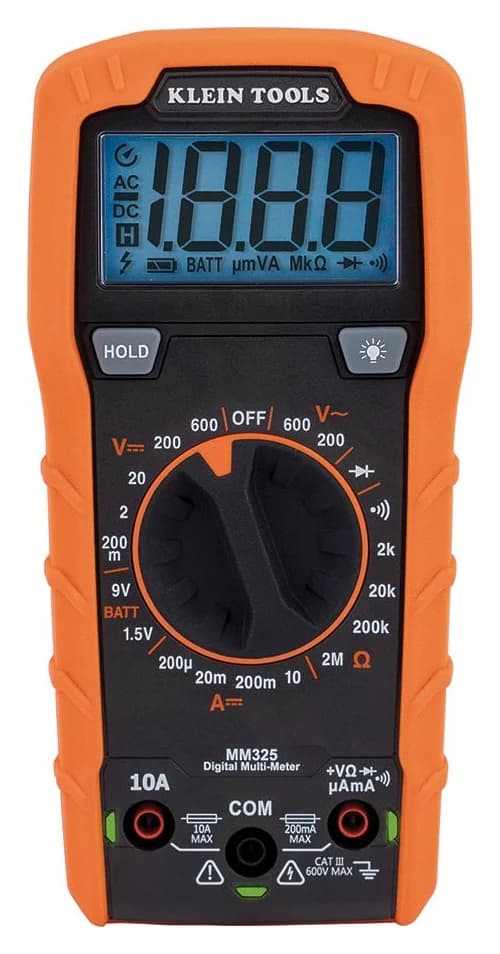
Klein's MM325 page states a CAT III 600V safety rating, a 2 m drop rating, and an easily accessible battery and fuse compartment. It is the floor of what we would put in a toolkit.
- Measures up to 600 V AC/DC voltage, 10 A DC current and 2 MΩ resistance, and tests batteries, diodes and continuity
- DC current ranges of 200.0 μA, 20.00 mA, 200.0 mA and 10.00 A, with a 200mA/600V fast-blow fuse on the low-current jack and a 10A/600V fast-blow fuse on the 10 A jack (Klein Cat. Nos. 69031 and 69032)
- Manual ranging, with a backlit display, data hold, low-battery indicator and Lead-Alert LEDs for test-lead placement
- Included: test leads with CAT III/CAT IV safety caps, instructions and two AAA batteries; the manual states conformance to UL 61010-1 and certification to CSA C22.2 No. 61010-1
- Battery-test settings load a 9 V cell at approximately 20 mA through 450 Ω and a 1.5 V cell at approximately 15 mA through 100 Ω, with ±(1.0% + 2 digits) accuracy
The trade-offs: current is DC only, ranging is manual, and there is no capacitance, frequency or temperature function. Klein makes no True RMS claim for the MM325, so for distorted AC readings it is not the pick. For buyers weighing the two options, our auto-ranging vs manual-ranging explainer works through the difference.
The Fluke entry point: Fluke 113
A cheap budget spent on a Fluke buys a different thing: a CAT IV 600V marking, a support and calibration ecosystem, and a very small feature list. Fluke's 113 page lists a backlit 6,000-count display and the VCHEK LoZ low-impedance mode: voltage or continuity from the same dial position, with the meter displaying AC or DC voltage depending on what was detected while rejecting ghost voltages from adjacent wires.
- CAT IV 600V per IEC 61010-2-033; Min/Max, auto and manual ranging
- VCHEK accuracy ±(2.0% + 3) for DC and 45 to 500 Hz, per the shared 110-series manual
- A 1-minute wait after voltage measurement to maintain accuracy of ohms, capacitance, diode test and continuity
- Included: TL75 test leads, holster, users manual and an installed 9 V battery; about 300 hours of battery life
The trade-offs: there is no current, frequency or temperature function at all — which is also why there is no current jack to overload. VCHEK's ~3 kΩ input can trip a powered GFCI when measuring phase to earth, and can load sensitive control circuits; LoZ measurements are not for every job. The TL75 leads are CAT II 1000V bare and CAT III 1000V / CAT IV 600V with their protective caps fitted.
Compare functions, ranges and accuracy
Numbers are maker-published specifications, not readings of ours.
KAIWEETS HT118A
- Current
- 10 A AC/DC
- Fused current jack
- Yes, double ceramic fuses
- Display counts
- 6,000
All specifications
- Ranging
- Auto
- True RMS
- Yes
- Voltage
- 600 V AC/DC (bullets); 1000 V DC, 750 V AC (table)
- Capacitance / frequency / duty
- Yes
- Temperature
- Yes
- CAT marking (as stated)
- CAT III 1000V, CAT IV 600V
- Headline DC accuracy
- ±(0.5% + 3)
AstroAI DM6000AR
- Current
- AC/DC current
- Fused current jack
- Yes, double ceramic fuse
- Display counts
- 6,000
All specifications
- Ranging
- Auto and manual
- True RMS
- Yes, per the page's feature text
- Voltage
- 750 V AC, 1000 V DC
- Capacitance / frequency / duty
- Yes
- Temperature
- Yes (thermocouple included)
- CAT marking (as stated)
- Not stated on the US page
- Headline DC accuracy
- See manual
Klein MM325
- Current
- 10 A DC only
- Fused current jack
- Yes
- Display counts
- 2,000
All specifications
- Ranging
- Manual
- True RMS
- Not claimed
- Voltage
- 600 V AC/DC
- Capacitance / frequency / duty
- None
- Temperature
- None
- CAT marking (as stated)
- CAT III 600V
- Headline DC accuracy
- ±2% (page)
Fluke 113
- Current
- None
- Fused current jack
- No current jack
- Display counts
- 6,000
All specifications
- Ranging
- Auto and manual
- True RMS
- Yes (LoZ voltage)
- Voltage
- 600 V
- Capacitance / frequency / duty
- Capacitance only
- Temperature
- None
- CAT marking (as stated)
- CAT IV 600V
- Headline DC accuracy
- ±(2.0% + 3) VCHEK
Full comparison table
Swipe to compare. Row labels stay visible.
| Specification | KAIWEETS HT118A | AstroAI DM6000AR | Klein MM325 | Fluke 113 |
|---|---|---|---|---|
| Display counts | 6,000 | 6,000 | 2,000 | 6,000 |
| Ranging | Auto | Auto and manual | Manual | Auto and manual |
| True RMS | Yes | Yes, per the page's feature text | Not claimed | Yes (LoZ voltage) |
| Voltage | 600 V AC/DC (bullets); 1000 V DC, 750 V AC (table) | 750 V AC, 1000 V DC | 600 V AC/DC | 600 V |
| Current | 10 A AC/DC | AC/DC current | 10 A DC only | None |
| Capacitance / frequency / duty | Yes | Yes | None | Capacitance only |
| Temperature | Yes | Yes (thermocouple included) | None | None |
| CAT marking (as stated) | CAT III 1000V, CAT IV 600V | Not stated on the US page | CAT III 600V | CAT IV 600V |
| Headline DC accuracy | ±(0.5% + 3) | See manual | ±2% (page) | ±(2.0% + 3) VCHEK |
| Fused current jack | Yes, double ceramic fuses | Yes, double ceramic fuse | Yes | No current jack |
Scroll horizontally to see every column
| Specification | KAIWEETS HT118A | AstroAI DM6000AR | Klein MM325 | Fluke 113 |
|---|---|---|---|---|
| Display counts | 6,000 | 6,000 | 2,000 | 6,000 |
| Ranging | Auto | Auto and manual | Manual | Auto and manual |
| True RMS | Yes | Yes, per the page's feature text | Not claimed | Yes (LoZ voltage) |
| Voltage | 600 V AC/DC (bullets); 1000 V DC, 750 V AC (table) | 750 V AC, 1000 V DC | 600 V AC/DC | 600 V |
| Current | 10 A AC/DC | AC/DC current | 10 A DC only | None |
| Capacitance / frequency / duty | Yes | Yes | None | Capacitance only |
| Temperature | Yes | Yes (thermocouple included) | None | None |
| CAT marking (as stated) | CAT III 1000V, CAT IV 600V | Not stated on the US page | CAT III 600V | CAT IV 600V |
| Headline DC accuracy | ±(0.5% + 3) | See manual | ±2% (page) | ±(2.0% + 3) VCHEK |
| Fused current jack | Yes, double ceramic fuses | Yes, double ceramic fuse | Yes | No current jack |
- Yes: Worth economizing: 6,000-count display, auto-ranging, extra functions
- Yes: Worth economizing: brand-name meter over no-name with identical claims
- Partly: Only after checking: AC current input, supplied lead rating, box contents
- No: Never economize: CAT category marking, fused current input, matching manual
Fuses, CAT markings and lead quality
A cheap multimeter's protection story lives in three places. The fuse behind the current jack is the part that saves the meter, and you, when the meter is connected across a live circuit on a current range. KAIWEETS specifies double ceramic fuses with a thermistor protection circuit on both the HT118A and, per its feature text, the DM6000AR; AstroAI's own FAQ even tells owners to check the battery and the two fuses behind the kickstand when the meter stops working. Klein's MM325 manual gives the exact replacements, including the interrupting rating of the low-current fuse. Buy the exact specified replacement fuse, not a hardware-store lookalike.
The CAT marking tells you where the meter may be connected. Outlets and their loads are CAT II territory in Fluke's category table; feeders, short branch circuits and panel-fed devices are CAT III; the service entrance is CAT IV and is licensed-electrician work regardless of your meter. The MM325 and 113 make the household cases comfortably. The DM6000AR's US page is silent, which is why it earns "check the delivered manual" rather than a rating in our table.
Lead quality is the quietest savings trap: leads carry the same fault energy as the meter. The MM325's supplied leads arrive with CAT III/CAT IV safety caps, and the 113's TL75 leads depend on their caps for the higher rating. A replacement set is worth buying only when its own category, voltage and current ratings match the meter. Our multimeter test leads guide compares the options.
Exact model, generation and counterfeit warnings
The cheap tier is where model families overlap hardest. Four traps, all documented on the makers' own pages:
- AstroAI's storefront sells the DM6000AR alongside models named M6K0R, CM600 and count-selector variants; a display-count selector is not a model choice. The exact model here is the DM6000AR with the ASIMT5000A manual.
- KAIWEETS's catalogue contains an HT118E with 20,000 counts as well as the HT118A here, plus KM-series meters; the KM100's page even lists "1 x KM100s Multimeter" in its package list while the delivered DC ranges match the KM100. Confirm the model printed on the dial.
- Fluke's 113 is not the 117: no current ranges, no VoltAlert, a different voltage-input design. Fluke also sells an R-FLUKE-113 reconditioned unit — a condition option, not a different meter.
- Klein's MM325 is manual-ranging and DC-current-only; the auto-ranging step-up Klein in our budget guide is the move. Klein's MM400 page states it is no longer in production, so a "new" MM400 listing deserves a second look.
Cheap meters for batteries, low-voltage DC and continuity
Most cheap-meter work is exactly the work cheap meters do best: battery checks, USB and battery-charger DC, continuity for fuses and cables. All four picks cover voltage, resistance, continuity and diode test; the MM325 even has dedicated 1.5 V and 9 V battery-test settings with documented test loads, and KAIWEETS's own storefront FAQ recommends its basic meters for household checks. For automotive battery-voltage checks, our automotive multimeters guide compares the current-capable options. At low-voltage DC, the CAT question barely arises — a battery cannot deliver a lethal transient.
What changes fast is AC. An average-responding meter reads a pure sine wave fine, but Fluke's True RMS explainer warns that an averaging meter on the distorted waveforms created by variable-speed drives and computers can read up to 40% low or 10% high. That is why True RMS is our table row for cheap AC work, and why the MM325, with no such claim, stays a battery-and-continuity meter.
When spending more prevents a wrong purchase
Being cheap stops paying when the measurement is the decision. Buy the better meter when you need:
- Certified safety listings for daily panel-adjacent work, rather than CE and RoHS marks
- Tighter accuracy on AC than a budget spec table supports, or any accuracy claim you can trace to a calibration certificate — the kind of specification our best multimeters guide compares at the next tier
- Microamp and specialty ranges for HVAC flame-safety circuits or electronics diagnostics, where the 113's VCHEK-only design and the MM325's DC-only current are non-starters
- A current clamp instead of a 10 A jack, for loads that cannot be broken into the meter's series path; our clamp meter guide covers those
The honest summary: none of the three cheap picks here claims an independently verified accuracy specification. Their specs are the makers' own. That is acceptable for household checks and unacceptable for work you would bill against.
How we choose
We compared the makers' own product pages, manuals, embedded storefront data and FAQ text, checked November 5, 2026, preferring current models with a stated category rating, a fused current input and a US support route. We did not physically test any meter, and we publish no measured readings; every number here is a manufacturer specification. Where a maker's own pages conflict, we say so instead of picking the flattering figure. Our selection method explains the process.
Black Friday and Cyber Monday price-check rules
Discount season is when a cheap multimeter becomes a wrong purchase. Hold any deal to the same checks, in this order:
Confirm the exact model
Match the model on the meter, the page and the manual; family pages overlap hardest at the cheap end.
Confirm the safety marking
A CAT marking and a fused current input are the floor; no discount lifts a meter below it.
Confirm the package
Leads with their caps, the thermocouple and the manual listed in the box, or priced in.
Confirm the warranty route
A maker with a stated warranty and support page is part of what you are buying.
Bundles are the classic trap: a case or accessory kit can rename a meter family (KAIWEETS's BB-100 case, for example, fits the HT118A and HT118E both). Klein's seasonal deals are covered separately in our Klein Tools Black Friday guide. If the "deal" fails any step above, the same money buys a safer floor-tier meter.
Verdict
The HT118A is the best cheap multimeter for a household toolkit: the right functions, a True RMS and auto-ranging design, and a CAT III 1000V / CAT IV 600V marking that clears our floor with room to spare. The DM6000AR is the functions-per-dollar pick once its manual confirms the CAT rating; the MM325 is the cheapest meter we would hand to anyone; the Fluke 113 is the smallest budget that buys the Fluke ecosystem. Below all of them sits the no-buy floor — no category marking, no fused current input, no matching manual — and no discount changes that.
Frequently asked questions
What is the best cheap multimeter?
The KAIWEETS HT118A is our overall pick: KAIWEETS marks it CAT III 1000V and CAT IV 600V with double ceramic fuses, and it is auto-ranging and True RMS with a 6,000-count display. If your budget is even tighter, Klein's MM325 keeps a CAT III 600V rating and a fused 10 A DC input at the bottom of the price ladder. Both cover battery, continuity and outlet-voltage checks, which is most of what a cheap meter is asked to do.
Are cheap multimeters safe to use?
On batteries, automotive 12 V systems and household receptacle circuits, yes, when the meter carries a CAT marking that matches the location and its fuses and leads are rated to the same level. Fluke's safety guide puts appliances and outlet-fed loads in CAT II and feeders, short branch circuits and panel-fed devices in CAT III. Any meter with no category marking at all, or leads rated below the meter, is the cheap multimeter to refuse, whatever it costs.
How do I know a cheap multimeter is counterfeit?
Buy through the maker's own store or an authorized distributor, keep the box and manual, and register the warranty if one is offered. A mismatched manual is the strongest warning sign: budget makers sell several models whose pages and booklets overlap, so the delivered manual should name the exact model on the meter. Treat a meter whose marking, manual and plug layout disagree as suspect rather than as a bargain.
Do cheap multimeters measure AC current?
Some do and some do not, so read the range list, not the price. KAIWEETS's KM100 page states it cannot test AC current, and the MM325 measures DC current only. The HT118A and DM6000AR measure AC and DC current. Even on meters that do, the 10 A-style input is for short measurements with a recovery pause, per the makers' own instructions.
When should I stop being cheap and spend more?
Spend when the measurement is the decision. Repeated calibration-dependent work, AC accuracy on distorted waveforms, microamp ranges and an independently certified safety listing are where cheap meters run out of specification, not features. If a wrong reading costs more than the price gap, buy the better meter; our best multimeters guide covers the next tier.

Related guides
Buying guide · Multimeters
Professional Multimeter Buying Guide: Choose by Trade and Risk
Pick a professional multimeter by CAT category, working voltage, accuracy and calibration needs. Compare the Fluke 87V, 117, 289 and Fieldpiece SC640 by trade.
Buying guide · Multimeters
Fluke 87V Industrial Multimeter Buying: Which Version Should You Buy?
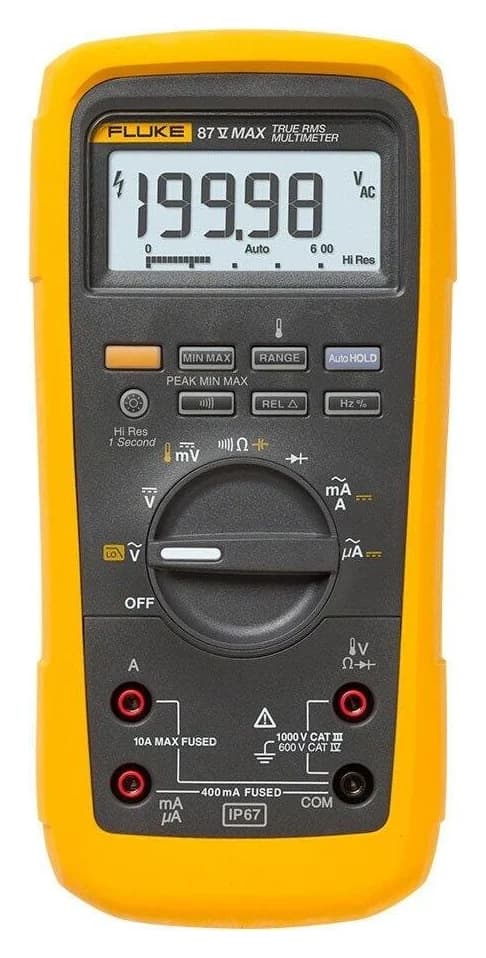
Pick the right Fluke 87V package for industrial work: standard, MAX, CAL, E2 kit or IMSK clamp kit. Compare IP ratings, CAT boundaries and box contents.
Best picks · Multimeters
Best Multimeters for Home Use and Electronics: Five Meters That Cover the Whole House
Pick a multimeter for home wiring and electronics work by safety rating, accuracy and fuse protection. Compare the KAIWEETS HT118A, Fluke 114, Brymen BM257s, Fluke 179 and Fluke 113.